
BY:
MS. LAMNUNNEM HAOKIP
SENIOR TUTOR
OBG NURSING
SSNSR, SU
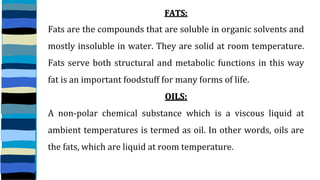
FATS:
Fats are the compounds that are soluble in organic solvents and
mostly insoluble in water. They are solid at room temperature.
Fats serve both structural and metabolic functions in this way
fat is an important foodstuff for many forms of life.
OILS:
A non-polar chemical substance which is a viscous liquid at
ambient temperatures is termed as oil. In other words, oils are
the fats, which are liquid at room temperature.
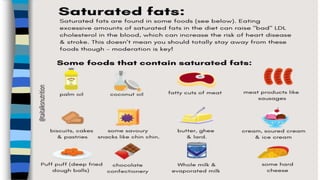
Fat
8/2/2021 4
LIPIDS-
 Fats and oils belongs to a group called lipids. They are
characterized by greasy feel, insolubility in water. They are mainly
made up of carbon, hydrogen and little oxygen. They are more
concentrated source of energy and provide 2.5 times more energy
per gram than carbohydrates and protein.
 Fats are solid at 20 degree. they are called oils if they are liquid at
that temperature.
8/2/2021 5
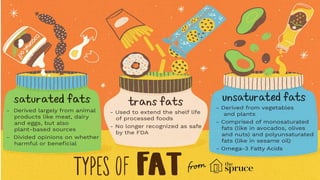
Unsaturated fatty acid- the full complement of hydrogen atoms is
not received in unsaturated fatty acids. This leads to the formation of
double bond between the atoms so they have one or more double
bonds between the carbon atoms. It is of two types:-
1- Monounsaturated- they have one double bond between the
carbon atoms. Oleic acid is an example of monosaturated fatty acid
and it is found in groundnut oil, olive oil and corn oil. They are
mostly found in vegetable oils and fruits.
2. Polyunsaturated acids- fatty acids with two or more double bonds
are called polyunsaturated fatty acids. These are mostly found in seeds.
8/2/2021 8
ESSENTIAL FATTY ACIDS
Essential fatty acids are those which cannot synthesized by humans.
They can derived from food. The most essential fatty acid is lonoleic
acid which serves as the basis for the production of other essential
fatty acids. Linoleic acid is abundantly found in vegetable oil.
• Deficiency of EFA in diet may result in growth retardation,
reproductive failure and skin disorders. So at least 3% of energy
requirement should be derived from EFA.
8/2/2021 10
 Linoleic acid
 Alpha-linolenic acid
 Omega 3 fatty acids (olive oil, fish oil, mustard oil, soyabean
and black gram)
 Omega 6 fatty acids (sunflower, cottonseed, sesame and
groundnut oil)
8/2/2021 11
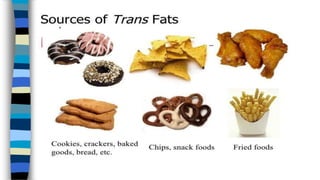
Trans Fats
Trans fat, or trans-fatty acids, are unsaturated fatty acids that come
from either natural or industrial sources. Naturally-occurring trans fat
come from ruminants (cows and sheep). Industrially-produced trans fat
are formed in an industrial process that adds hydrogen to vegetable oil
converting the liquid into a solid, resulting in “partially hydrogenated”
oil (PHO).
FUNCTIONS OF FATS
 Fats are a concentrated source of energy. All tissues except those
of central nervous system and brain can utilize fat as a source of
energy. Fats are deposited in the adipose tissue and this deposit
serves as a reserve source of energy during starvation.
Thermal insulation- subcutaneous fat acts as an insulator against
cold by retaining body heat.
 Satiety value- fats improve the palatability of the diet and give
satiety value. i.e- feeling of fullness in the stomach.
 Protein sparing action- an adequate intake of fat in the diet allows
proteins to perform their main functions of growth and maintenance.
 Protection of vital organs- fat provides a protective padding to vital
organs such as heart, kidney and intestine from mechanical shock and
keeps them in place.
 Absorption of fat soluble vitamins- fats are essential for the
absorption of fat soluble vitamins A, D, E and K. So fats serves as
vehicles for fat soluble vitamins.
 Essential fatty acids- fats contain essential fatty acids linoleic, alpha-
linolenic and arachidonic acids which are essential for maintaining
tissue in normal health
8/2/2021
PROTECTIONFROMINFECTION 21
FOOD SATISFACTION
8/2/2021 18
SOURCES OF FATS-
 Animal fats- ghee, butter,cheese, egg, yolk, meat and fish.
 Vegetable fats- groundnuts, mustard, soyabean, coconut,
almond and sunflower.
 Other- small amount of fat are found in most other food such as
cereals, pulses and vegetables.
8/2/2021 19
8/2/2021 20
8/2/2021 21
TYPES OF FAT DIETS
Low Fat Diet: A standard low fat diet contains about 30% or less of
calories from fat.
Suggested daily fat ranges from low fat diet, based on different
calorie goals
 1500 calories: about 50 g of fat/day
 2000 calories: about 67 g of fat/day
 2500 calories: about 83 g of fat/day
Ketogenic Diet
Suggested daily fat diet ranges for a low-card diet based on different
calorie goal
 1500 calories: about 82 - 125 g of fat/day
 2000 calories: about 111 - 167 g of fat/day
 2500 calories: about 139 - 208 g of fat/day
Moderate fat diet
Suggested daily fat ranges for moderate fat diet based on different
calorie goals
 1500 calories: about 58 - 67 g of fat/day
 2000 calories: about 78 - 89 g of fat/day
 2500 calories: about 97 - 111 g of fat/day
BIBLIOGRAPHY / REFERENCES
S. Dipak, K. Sreeraja Textbook of “Applied Nutrition and Dietetics”
Springfield Notion Press.com.
https://byjus.com/biology/fats/
https://www.vedantu.com/biology/fats
https://www.hsph.harvard.edu/nutritionsource/what-should-you-
eat/fats-and-cholesterol/types-of-fat/
8/2/2021 28

FATS.pptx

  • 1.
    BY: MS. LAMNUNNEM HAOKIP SENIORTUTOR OBG NURSING SSNSR, SU
  • 2.
    FATS: Fats are thecompounds that are soluble in organic solvents and mostly insoluble in water. They are solid at room temperature. Fats serve both structural and metabolic functions in this way fat is an important foodstuff for many forms of life. OILS: A non-polar chemical substance which is a viscous liquid at ambient temperatures is termed as oil. In other words, oils are the fats, which are liquid at room temperature.
  • 4.
    Fat 8/2/2021 4 LIPIDS-  Fatsand oils belongs to a group called lipids. They are characterized by greasy feel, insolubility in water. They are mainly made up of carbon, hydrogen and little oxygen. They are more concentrated source of energy and provide 2.5 times more energy per gram than carbohydrates and protein.  Fats are solid at 20 degree. they are called oils if they are liquid at that temperature.
  • 5.
  • 7.
    Unsaturated fatty acid-the full complement of hydrogen atoms is not received in unsaturated fatty acids. This leads to the formation of double bond between the atoms so they have one or more double bonds between the carbon atoms. It is of two types:- 1- Monounsaturated- they have one double bond between the carbon atoms. Oleic acid is an example of monosaturated fatty acid and it is found in groundnut oil, olive oil and corn oil. They are mostly found in vegetable oils and fruits.
  • 8.
    2. Polyunsaturated acids-fatty acids with two or more double bonds are called polyunsaturated fatty acids. These are mostly found in seeds. 8/2/2021 8
  • 10.
    ESSENTIAL FATTY ACIDS Essentialfatty acids are those which cannot synthesized by humans. They can derived from food. The most essential fatty acid is lonoleic acid which serves as the basis for the production of other essential fatty acids. Linoleic acid is abundantly found in vegetable oil. • Deficiency of EFA in diet may result in growth retardation, reproductive failure and skin disorders. So at least 3% of energy requirement should be derived from EFA. 8/2/2021 10
  • 11.
     Linoleic acid Alpha-linolenic acid  Omega 3 fatty acids (olive oil, fish oil, mustard oil, soyabean and black gram)  Omega 6 fatty acids (sunflower, cottonseed, sesame and groundnut oil) 8/2/2021 11
  • 13.
    Trans Fats Trans fat,or trans-fatty acids, are unsaturated fatty acids that come from either natural or industrial sources. Naturally-occurring trans fat come from ruminants (cows and sheep). Industrially-produced trans fat are formed in an industrial process that adds hydrogen to vegetable oil converting the liquid into a solid, resulting in “partially hydrogenated” oil (PHO).
  • 15.
    FUNCTIONS OF FATS Fats are a concentrated source of energy. All tissues except those of central nervous system and brain can utilize fat as a source of energy. Fats are deposited in the adipose tissue and this deposit serves as a reserve source of energy during starvation. Thermal insulation- subcutaneous fat acts as an insulator against cold by retaining body heat.  Satiety value- fats improve the palatability of the diet and give satiety value. i.e- feeling of fullness in the stomach.
  • 16.
     Protein sparingaction- an adequate intake of fat in the diet allows proteins to perform their main functions of growth and maintenance.  Protection of vital organs- fat provides a protective padding to vital organs such as heart, kidney and intestine from mechanical shock and keeps them in place.  Absorption of fat soluble vitamins- fats are essential for the absorption of fat soluble vitamins A, D, E and K. So fats serves as vehicles for fat soluble vitamins.  Essential fatty acids- fats contain essential fatty acids linoleic, alpha- linolenic and arachidonic acids which are essential for maintaining tissue in normal health
  • 17.
  • 18.
  • 19.
    SOURCES OF FATS- Animal fats- ghee, butter,cheese, egg, yolk, meat and fish.  Vegetable fats- groundnuts, mustard, soyabean, coconut, almond and sunflower.  Other- small amount of fat are found in most other food such as cereals, pulses and vegetables. 8/2/2021 19
  • 20.
  • 21.
  • 23.
    TYPES OF FATDIETS Low Fat Diet: A standard low fat diet contains about 30% or less of calories from fat. Suggested daily fat ranges from low fat diet, based on different calorie goals  1500 calories: about 50 g of fat/day  2000 calories: about 67 g of fat/day  2500 calories: about 83 g of fat/day
  • 24.
    Ketogenic Diet Suggested dailyfat diet ranges for a low-card diet based on different calorie goal  1500 calories: about 82 - 125 g of fat/day  2000 calories: about 111 - 167 g of fat/day  2500 calories: about 139 - 208 g of fat/day
  • 25.
    Moderate fat diet Suggesteddaily fat ranges for moderate fat diet based on different calorie goals  1500 calories: about 58 - 67 g of fat/day  2000 calories: about 78 - 89 g of fat/day  2500 calories: about 97 - 111 g of fat/day
  • 27.
    BIBLIOGRAPHY / REFERENCES S.Dipak, K. Sreeraja Textbook of “Applied Nutrition and Dietetics” Springfield Notion Press.com. https://byjus.com/biology/fats/ https://www.vedantu.com/biology/fats https://www.hsph.harvard.edu/nutritionsource/what-should-you- eat/fats-and-cholesterol/types-of-fat/
  • 28.