BY:
MS. HAOKIP
SENIOR TUTOR/LECTURER
OBG NURSING
SSNSR, SU
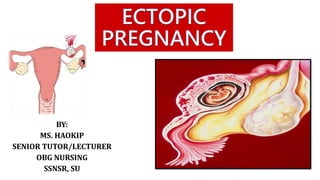
Pregnancy begins with a fertilized egg. Normally, the fertilized egg
attaches to the lining of the uterus. An ectopic pregnancy occurs
when a fertilized egg implants and grows outside the main cavity of
the uterus.
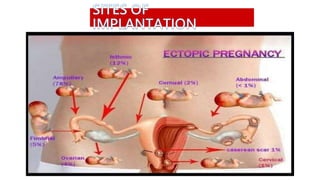
An ectopic pregnancy most often occurs in a fallopian tube, which
carries eggs from the ovaries to the uterus. This type of ectopic
pregnancy is called a tubal pregnancy. Sometimes, an ectopic
pregnancy occurs in other areas of the body, such as the ovary,
abdominal cavity or the lower part of the uterus (cervix), which
connects to the vagina.
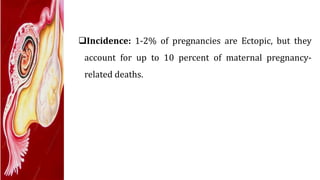
Incidence: 1-2% of pregnancies are Ectopic, but they
account for up to 10 percent of maternal pregnancy-
related deaths.
Exact cause is not known, it is believed that the following conditions
can cause ectopic pregnancy:
Hormonal factors.
Damaged fallopian tubes by either previous injury or surgery.
Genetic abnormalities.
Abnormal development of fallopian tubes or other reproductive
organs
CONTD…
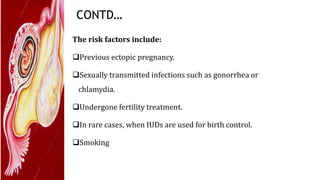
The risk factors include:
Previous ectopic pregnancy.
Sexually transmitted infections such as gonorrhea or
chlamydia.
Undergone fertility treatment.
In rare cases, when IUDs are used for birth control.
Smoking
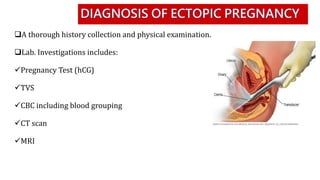
A thorough history collection and physical examination.
Lab. Investigations includes:
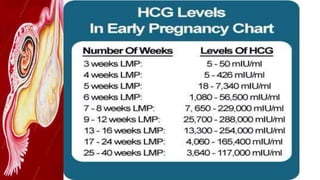
Pregnancy Test (hCG)
TVS
CBC including blood grouping
CT scan
MRI
Expectant Management
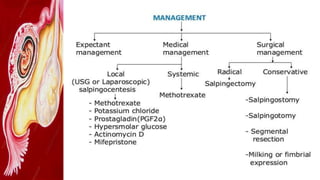
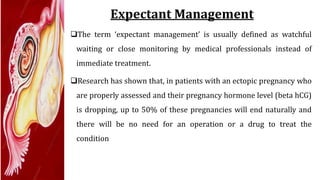
The term ‘expectant management’ is usually defined as watchful
waiting or close monitoring by medical professionals instead of
immediate treatment.
Research has shown that, in patients with an ectopic pregnancy who
are properly assessed and their pregnancy hormone level (beta hCG)
is dropping, up to 50% of these pregnancies will end naturally and
there will be no need for an operation or a drug to treat the
condition
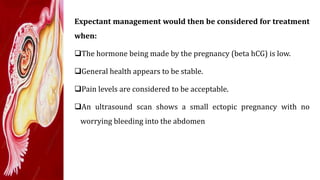
Expectant management would then be considered for treatment
when:
The hormone being made by the pregnancy (beta hCG) is low.
General health appears to be stable.
Pain levels are considered to be acceptable.
An ultrasound scan shows a small ectopic pregnancy with no
worrying bleeding into the abdomen
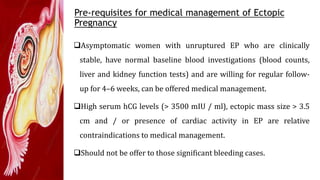
Pre-requisites for medical management of Ectopic
Pregnancy
Asymptomatic women with unruptured EP who are clinically
stable, have normal baseline blood investigations (blood counts,
liver and kidney function tests) and are willing for regular follow-
up for 4–6 weeks, can be offered medical management.
High serum hCG levels (> 3500 mIU / ml), ectopic mass size > 3.5
cm and / or presence of cardiac activity in EP are relative
contraindications to medical management.
Should not be offer to those significant bleeding cases.
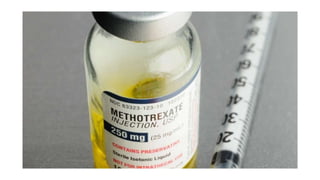
Two protocols are currently used for medical treatment of EP: “Single
Dose” MTX therapy at a dose of 50mg/m2 of body surface area and
“Multidose” regimen consisting of 1mg / kg of MTX alternating with
0.1mg / kg of Leucovorin for upto 4 doses of each agent. Both
regimens are found to be effective.
MTX can be given on outpatient basis and intramuscular injection is
the preferred route.
Multidose regimen is preferred in women with high serum hCG levels
or those with presence of cardiac activity on ultrasound.
Further doses of MTX may be repeated depending upon the response
to treatment.
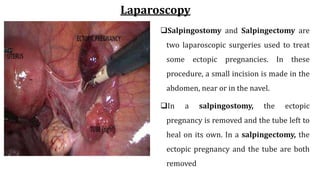
Laparoscopy
Salpingostomy and Salpingectomy are
two laparoscopic surgeries used to treat
some ectopic pregnancies. In these
procedure, a small incision is made in the
abdomen, near or in the navel.
In a salpingostomy, the ectopic
pregnancy is removed and the tube left to
heal on its own. In a salpingectomy, the
ectopic pregnancy and the tube are both
removed
NURSING MANAGEMENT
ASSESSMENT
PRE & POST OP CARE
INTERVENTIONS
EDUCATION
ANY
DOUBTS???

ECTOPIC PREGNANCY.pptx

  • 1.
  • 2.
    Pregnancy begins witha fertilized egg. Normally, the fertilized egg attaches to the lining of the uterus. An ectopic pregnancy occurs when a fertilized egg implants and grows outside the main cavity of the uterus. An ectopic pregnancy most often occurs in a fallopian tube, which carries eggs from the ovaries to the uterus. This type of ectopic pregnancy is called a tubal pregnancy. Sometimes, an ectopic pregnancy occurs in other areas of the body, such as the ovary, abdominal cavity or the lower part of the uterus (cervix), which connects to the vagina.
  • 3.
    Incidence: 1-2% ofpregnancies are Ectopic, but they account for up to 10 percent of maternal pregnancy- related deaths.
  • 5.
    Exact cause isnot known, it is believed that the following conditions can cause ectopic pregnancy: Hormonal factors. Damaged fallopian tubes by either previous injury or surgery. Genetic abnormalities. Abnormal development of fallopian tubes or other reproductive organs
  • 6.
    CONTD… The risk factorsinclude: Previous ectopic pregnancy. Sexually transmitted infections such as gonorrhea or chlamydia. Undergone fertility treatment. In rare cases, when IUDs are used for birth control. Smoking
  • 10.
    A thorough historycollection and physical examination. Lab. Investigations includes: Pregnancy Test (hCG) TVS CBC including blood grouping CT scan MRI
  • 13.
    Expectant Management The term‘expectant management’ is usually defined as watchful waiting or close monitoring by medical professionals instead of immediate treatment. Research has shown that, in patients with an ectopic pregnancy who are properly assessed and their pregnancy hormone level (beta hCG) is dropping, up to 50% of these pregnancies will end naturally and there will be no need for an operation or a drug to treat the condition
  • 14.
    Expectant management wouldthen be considered for treatment when: The hormone being made by the pregnancy (beta hCG) is low. General health appears to be stable. Pain levels are considered to be acceptable. An ultrasound scan shows a small ectopic pregnancy with no worrying bleeding into the abdomen
  • 16.
    Pre-requisites for medicalmanagement of Ectopic Pregnancy Asymptomatic women with unruptured EP who are clinically stable, have normal baseline blood investigations (blood counts, liver and kidney function tests) and are willing for regular follow- up for 4–6 weeks, can be offered medical management. High serum hCG levels (> 3500 mIU / ml), ectopic mass size > 3.5 cm and / or presence of cardiac activity in EP are relative contraindications to medical management. Should not be offer to those significant bleeding cases.
  • 17.
    Two protocols arecurrently used for medical treatment of EP: “Single Dose” MTX therapy at a dose of 50mg/m2 of body surface area and “Multidose” regimen consisting of 1mg / kg of MTX alternating with 0.1mg / kg of Leucovorin for upto 4 doses of each agent. Both regimens are found to be effective. MTX can be given on outpatient basis and intramuscular injection is the preferred route. Multidose regimen is preferred in women with high serum hCG levels or those with presence of cardiac activity on ultrasound. Further doses of MTX may be repeated depending upon the response to treatment.
  • 20.
    Laparoscopy Salpingostomy and Salpingectomyare two laparoscopic surgeries used to treat some ectopic pregnancies. In these procedure, a small incision is made in the abdomen, near or in the navel. In a salpingostomy, the ectopic pregnancy is removed and the tube left to heal on its own. In a salpingectomy, the ectopic pregnancy and the tube are both removed
  • 21.
    NURSING MANAGEMENT ASSESSMENT PRE &POST OP CARE INTERVENTIONS EDUCATION
  • 22.