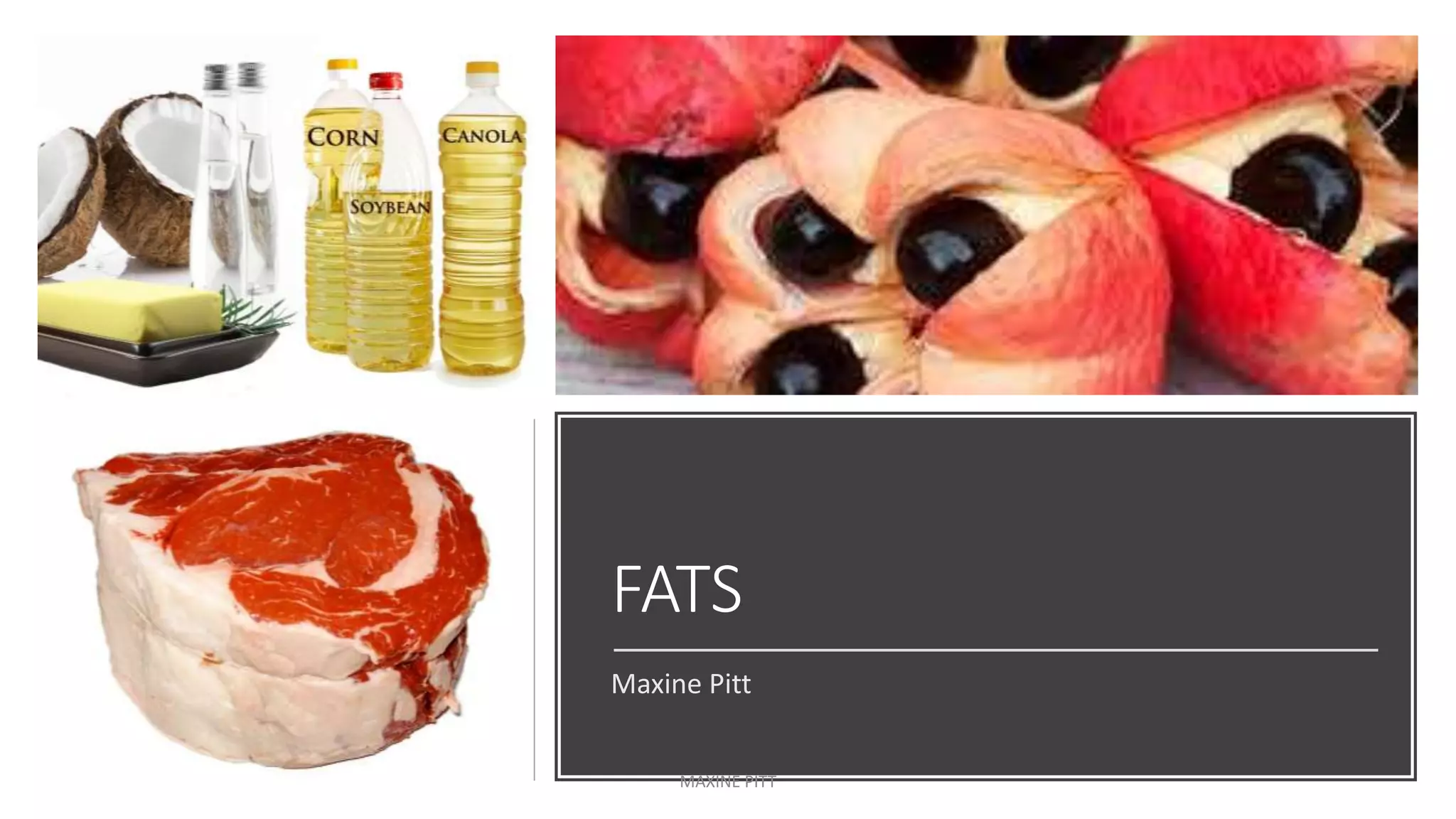
FATS
Maxine Pitt
MAXINE PITT
COMPOSITION
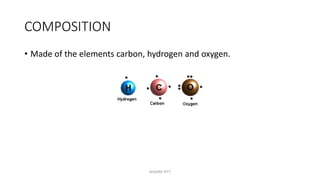
• Made of the elements carbon, hydrogen and oxygen.
MAXINE PITT
• https://www.youtube.com/watch?v=Ir5h5BmBn8M
• https://www.youtube.com/watch?v=QhUrc4BnPgg
MAXINE PITT
LIPIDS
• Lipid is the scientific term for fats and oils whether edible or inedible.
• Family of compounds that includes triglycerides, phospholipids and
sterols
MAXINE PITT
LIPIDS FAMILY
• Triglycerides (fat & oil)
Glycerol (1 per triglyceride)
Fatty acid (3 per triglyceride)
Saturated
Monounsaturated
Polyunsaturated
 Omeg-3
 Omega-6
• Phospholipid (such as lecithin)
• Sterol (such as cholesterol)
MAXINE PITT
THE LIPID FAMILY INCLUDES
• TRIGLYCERIDES: The scientific name for fat molecule of one unit of
glycerol and three fatty acids.
• Phospholipids
• Sterols
MAXINE PITT
WHAT ARE TRIGLYGERIDES?
Triglycerides are formed when one unit of glycerol combines with 3
fatty acids
MAXINE PITT
FUNCTIONS OF TRIGLYCERIDES
• Emergency energy reserve: Triglycerides account for roughly 99
percent of the lipids stored in your body and 95 percent of the lipids
found in foods. Your digestive system breaks down the triglycerides in
the foods you eat into their separate components: glycerol and fatty
acids. The body can utilize these fatty acids as an immediate energy
source or store them in the form of triglycerides for future or
emergency energy needs. These triglycerides that are stored in the
form of energy reserves reside primarily in adipose tissues has the
additional function of insulating your body and protecting internal
organs from injury. Adipose tissue also plays a role in maintaining
optimal body temperature
MAXINE PITT
WHAT ARE ESSENTIAL FATTY ACIDS?
• ESSENTIAL FATTY ACIDS: Fatty acids that cannot be made by the body.
Examples of essential amino acids include:
Linoleic acids (omega 6)
linolenic acids (omega 3)
MAXINE PITT
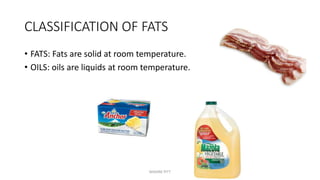
CLASSIFICATION OF FATS
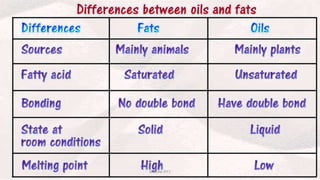
• FATS: Fats are solid at room temperature.
• OILS: oils are liquids at room temperature.
MAXINE PITT
CLASSIFICATIO OF FATS
• Saturated:
• Unsaturated
MAXINE PITT
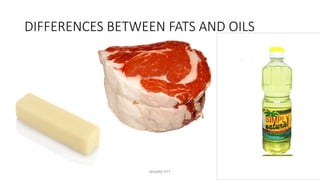
DIFFERENCES BETWEEN FATS AND OILS
MAXINE PITT
MAXINE PITT
WHAT ARE PHOSPHOLIPIDS?
• A phospholipid is a type of lipid molecule that is the main component
of the cell membrane.
MAXINE PITT
FUNCTIONS OF PHOSPHOLIPIDS
• phospholipids can act as emulsifiers, which are substances that
disperse oil droplets in water so that the oil and water do not form
separate layers. For example, egg yolks contain phospholipids, and
are used in mayonnaise to keep it from separating.
• Phospholipids play a dual role in cells as both essential structural
components of the cell membrane and as important metabolic
intermediates and regulatory molecules.
MAXINE PITT
• Phospholipids differ only slightly from triglycerides in chemical
structure. While each triglyceride molecule consists of glycerol and
three fatty acids, each phospholipid molecule substitutes a phosphate
for one of the three fatty acids. Phospholipids form the membrane
that make up the outer layer of all human cells. They play a key role in
determining what enters and exits every cell.
MAXINE PITT
STEROLS
• any of a group of naturally occurring unsaturated steroid alcohols,
typically waxy solids.
MAXINE PITT
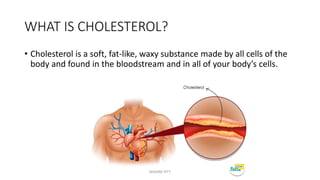
WHAT IS CHOLESTEROL?
• Cholesterol is a soft, fat-like, waxy substance made by all cells of the
body and found in the bloodstream and in all of your body’s cells.
MAXINE PITT
BENEFITS OF CHOLESTEROL
• Aiding in the production of bile, a fluid that aids in digesting fat
• Making vitamin D- dehydrocholesterol is converted into
cholecalciferol and stored in the liver. (cholecalciferol is the chemical
name for vitamin D.
• Building cells,
• Building hormones such as oestrogen and testosterone.
MAXINE PITT
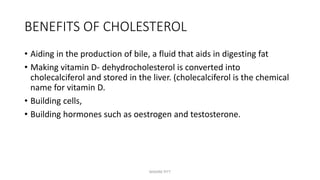
DETRIMENTS/ DRAWBACKS OF CHOLESTEROL
• The buildup is also known as cholesterol plaque. This plaque can
narrow your arteries, limit your blood flow, and raise your risk of
blood clots. If a blood clot blocks an artery in your heart or brain, it
can cause a heart attack or stroke.
MAXINE PITT
CHOLESTEROL
• The organs that make the most cholesterol are the liver and
intestines.
MAXINE PITT
CHOLESTEROL
• Cholesterol is transported in the blood by particles called
“lipoproteins,” which contain both fat and protein. Together, they
form two types of lipoproteins.
MAXINE PITT
THE GOOD CHOLESTEROL
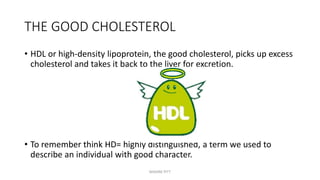
• HDL or high-density lipoprotein, the good cholesterol, picks up excess
cholesterol and takes it back to the liver for excretion.
• To remember think HD= highly distinguished, a term we used to
describe an individual with good character.
MAXINE PITT
THE BAD CHOLESTEROL
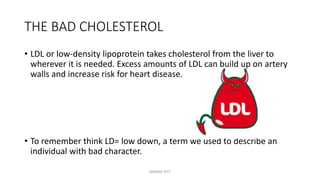
• LDL or low-density lipoprotein takes cholesterol from the liver to
wherever it is needed. Excess amounts of LDL can build up on artery
walls and increase risk for heart disease.
• To remember think LD= low down, a term we used to describe an
individual with bad character.
MAXINE PITT
FATTY ACIDS
• FATTY ACIDS are the basic chemical units or organic acids which make
up fat. All fat is one of three types of fatty acid:
 Saturated fatty acids
 Polyunsaturated fatty acids
 Monounsaturated fatty acids
MAXINE PITT
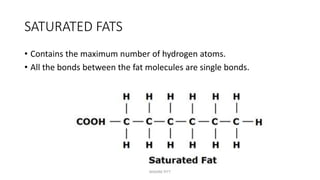
SATURATED FATS
• Contains the maximum number of hydrogen atoms.
• All the bonds between the fat molecules are single bonds.
MAXINE PITT
UNSATURATED FATS
• One or more hydrogen atoms are removed/missing from the fat
molecule.
• Fat molecules contain at least two carbon atoms that are bonded to
each other by a double bond.
MAXINE PITT
SOURCES OF FATTY ACIDS
• SATURATED - found in animal sources such as milk, cream, cheese,
butter, meat, poultry. Also in coconut and palm oil. Because it can be
made from saturated fatty acids, cholesterol levels in the blood are
related to the amount of saturated fat eaten. Appear to raise LDL or
bad cholesterol.
• POLYUNSATURATED - are better than saturated fats. They are found in
vegetable oils and fish. Seem to help lower cholesterol levels.
• MONOUNSATURATED - the best type of fat. It is found in olives,
avocados, nuts, and olive, canola and peanut oils. Most margarines
and hydrogenated vegetable oils are highly monounsaturated. These
seem to lower LDL and raise HDL levels.
MAXINE PITT
TYPES OF UNSATURATED FATS
• Monounsaturated: has one double bond between carbons and lacks
two hydrogen atoms.
• Polyunsaturated: has one or more double bonds between carbons
and lacks four or more hydrogen atoms.
MAXINE PITT
TYPES OF UNSATURATED FATS:
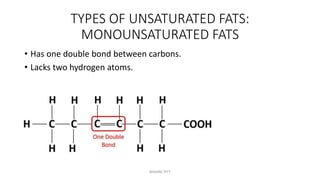
MONOUNSATURATED FATS
• Has one double bond between carbons.
• Lacks two hydrogen atoms.
MAXINE PITT
TYPES OF UNSATURATED FATS:
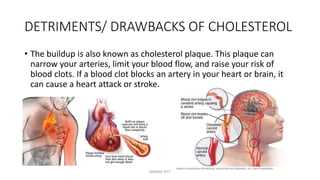
POLYUNSATURATED FATS
• Has one or more double bonds between carbons
• Lacks four or more hydrogen atoms.
MAXINE PITT
BENEFITS OF UNSATURATED FATS
• Unsaturated fats cannot stack well together and hence cannot form
plaques in the arteries.
• Also unsaturated Fats can help increasing the good (HDL) cholesterol
while decreasing the bad (LDL) cholesterol.
• Omega 3 fats, a type of poly unsaturated fat, help reduce
inflammation, prevent arthritis and cancer as well.
• Omega 6 fats, a type of poly unsaturated fat, helps hair growth, bone
health and improve metabolism.
MAXINE PITT
SOURCES OF UNSATURATED FATS
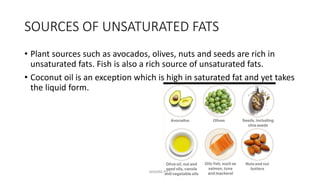
• Plant sources such as avocados, olives, nuts and seeds are rich in
unsaturated fats. Fish is also a rich source of unsaturated fats.
• Coconut oil is an exception which is high in saturated fat and yet takes
the liquid form.
MAXINE PITT
• A fat molecule is monounsaturated if it contains one double bond, and
polyunsaturated if it contains more than one double bond.
• Where double bonds are formed, hydrogen atoms are eliminated.
• Thus, a saturated fat is "saturated" with hydrogen atoms.
• The greater the degree of unsaturation in a fatty acid (i.e., the more double
bonds in the fatty acid), the more vulnerable it is to rancidity.
• Antioxidants can protect unsaturated fat from lipid rancidity.
• Foods containing unsaturated fats include avocado, nuts, and soybean,
canola, and olive oils.
• Meat products contain both saturated and unsaturated fats.
• Unsaturated fats are liquid at room temperature.
MAXINE PITT
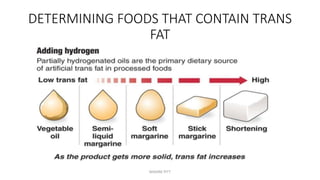
TRANS FAT
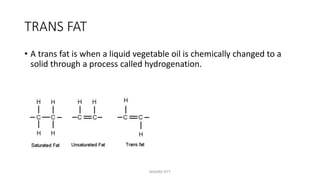
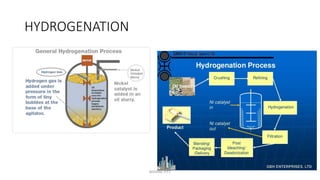
• A trans fat is when a liquid vegetable oil is chemically changed to a
solid through a process called hydrogenation.
MAXINE PITT
HYDROGENATION
https://www.youtube.com/watch?v=2iKczqO1TiE
https://study.com/academy/lesson/what-is-hydrogenation-process-
reaction.html
MAXINE PITT
HYDROGENATION
MAXINE PITT
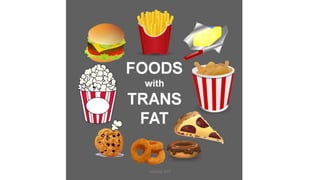
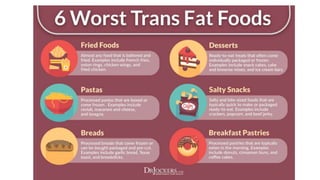
• Trans fats are used in products like margarine, baked goods, snack
foods, and fast foods to increase shelf life and add extra flavor.
• Beware! These are probably the worst fats as they can increase LDL
and seem to lower HDL. Avoid foods rich with trans fats.
MAXINE PITT
DETERMINING FOODS THAT CONTAIN TRANS
FAT
MAXINE PITT
MAXINE PITT
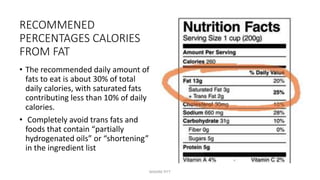
RECOMMENED
PERCENTAGES CALORIES
FROM FAT
• The recommended daily amount of
fats to eat is about 30% of total
daily calories, with saturated fats
contributing less than 10% of daily
calories.
• Completely avoid trans fats and
foods that contain “partially
hydrogenated oils” or “shortening”
in the ingredient list
MAXINE PITT
MAXINE PITT
sources
• https://whetyourwoman.com/inner-game/lose-weight-gain-muscle/
• https://www.uen.org/lessonplan/view/1265
• http://cms.gcg11.ac.in/attachments/article/88/FOOD%20AND%20NU
TRITION.pdf
• https://kristinaarquettenutrition.files.wordpress.com/2012/02/the-
three-fats.jpg
• https://dailyhealthpost.com/avoid-heart-attacks-naturally/
MAXINE PITT

Fats powerpoint pitt

  • 1.
  • 2.
    COMPOSITION • Made ofthe elements carbon, hydrogen and oxygen. MAXINE PITT
  • 3.
  • 4.
    LIPIDS • Lipid isthe scientific term for fats and oils whether edible or inedible. • Family of compounds that includes triglycerides, phospholipids and sterols MAXINE PITT
  • 5.
    LIPIDS FAMILY • Triglycerides(fat & oil) Glycerol (1 per triglyceride) Fatty acid (3 per triglyceride) Saturated Monounsaturated Polyunsaturated  Omeg-3  Omega-6 • Phospholipid (such as lecithin) • Sterol (such as cholesterol) MAXINE PITT
  • 6.
    THE LIPID FAMILYINCLUDES • TRIGLYCERIDES: The scientific name for fat molecule of one unit of glycerol and three fatty acids. • Phospholipids • Sterols MAXINE PITT
  • 7.
    WHAT ARE TRIGLYGERIDES? Triglyceridesare formed when one unit of glycerol combines with 3 fatty acids MAXINE PITT
  • 8.
    FUNCTIONS OF TRIGLYCERIDES •Emergency energy reserve: Triglycerides account for roughly 99 percent of the lipids stored in your body and 95 percent of the lipids found in foods. Your digestive system breaks down the triglycerides in the foods you eat into their separate components: glycerol and fatty acids. The body can utilize these fatty acids as an immediate energy source or store them in the form of triglycerides for future or emergency energy needs. These triglycerides that are stored in the form of energy reserves reside primarily in adipose tissues has the additional function of insulating your body and protecting internal organs from injury. Adipose tissue also plays a role in maintaining optimal body temperature MAXINE PITT
  • 9.
    WHAT ARE ESSENTIALFATTY ACIDS? • ESSENTIAL FATTY ACIDS: Fatty acids that cannot be made by the body. Examples of essential amino acids include: Linoleic acids (omega 6) linolenic acids (omega 3) MAXINE PITT
  • 10.
    CLASSIFICATION OF FATS •FATS: Fats are solid at room temperature. • OILS: oils are liquids at room temperature. MAXINE PITT
  • 11.
    CLASSIFICATIO OF FATS •Saturated: • Unsaturated MAXINE PITT
  • 12.
    DIFFERENCES BETWEEN FATSAND OILS MAXINE PITT
  • 13.
  • 14.
    WHAT ARE PHOSPHOLIPIDS? •A phospholipid is a type of lipid molecule that is the main component of the cell membrane. MAXINE PITT
  • 15.
    FUNCTIONS OF PHOSPHOLIPIDS •phospholipids can act as emulsifiers, which are substances that disperse oil droplets in water so that the oil and water do not form separate layers. For example, egg yolks contain phospholipids, and are used in mayonnaise to keep it from separating. • Phospholipids play a dual role in cells as both essential structural components of the cell membrane and as important metabolic intermediates and regulatory molecules. MAXINE PITT
  • 16.
    • Phospholipids differonly slightly from triglycerides in chemical structure. While each triglyceride molecule consists of glycerol and three fatty acids, each phospholipid molecule substitutes a phosphate for one of the three fatty acids. Phospholipids form the membrane that make up the outer layer of all human cells. They play a key role in determining what enters and exits every cell. MAXINE PITT
  • 17.
    STEROLS • any ofa group of naturally occurring unsaturated steroid alcohols, typically waxy solids. MAXINE PITT
  • 18.
    WHAT IS CHOLESTEROL? •Cholesterol is a soft, fat-like, waxy substance made by all cells of the body and found in the bloodstream and in all of your body’s cells. MAXINE PITT
  • 19.
    BENEFITS OF CHOLESTEROL •Aiding in the production of bile, a fluid that aids in digesting fat • Making vitamin D- dehydrocholesterol is converted into cholecalciferol and stored in the liver. (cholecalciferol is the chemical name for vitamin D. • Building cells, • Building hormones such as oestrogen and testosterone. MAXINE PITT
  • 20.
    DETRIMENTS/ DRAWBACKS OFCHOLESTEROL • The buildup is also known as cholesterol plaque. This plaque can narrow your arteries, limit your blood flow, and raise your risk of blood clots. If a blood clot blocks an artery in your heart or brain, it can cause a heart attack or stroke. MAXINE PITT
  • 21.
    CHOLESTEROL • The organsthat make the most cholesterol are the liver and intestines. MAXINE PITT
  • 22.
    CHOLESTEROL • Cholesterol istransported in the blood by particles called “lipoproteins,” which contain both fat and protein. Together, they form two types of lipoproteins. MAXINE PITT
  • 23.
    THE GOOD CHOLESTEROL •HDL or high-density lipoprotein, the good cholesterol, picks up excess cholesterol and takes it back to the liver for excretion. • To remember think HD= highly distinguished, a term we used to describe an individual with good character. MAXINE PITT
  • 24.
    THE BAD CHOLESTEROL •LDL or low-density lipoprotein takes cholesterol from the liver to wherever it is needed. Excess amounts of LDL can build up on artery walls and increase risk for heart disease. • To remember think LD= low down, a term we used to describe an individual with bad character. MAXINE PITT
  • 25.
    FATTY ACIDS • FATTYACIDS are the basic chemical units or organic acids which make up fat. All fat is one of three types of fatty acid:  Saturated fatty acids  Polyunsaturated fatty acids  Monounsaturated fatty acids MAXINE PITT
  • 26.
    SATURATED FATS • Containsthe maximum number of hydrogen atoms. • All the bonds between the fat molecules are single bonds. MAXINE PITT
  • 27.
    UNSATURATED FATS • Oneor more hydrogen atoms are removed/missing from the fat molecule. • Fat molecules contain at least two carbon atoms that are bonded to each other by a double bond. MAXINE PITT
  • 28.
    SOURCES OF FATTYACIDS • SATURATED - found in animal sources such as milk, cream, cheese, butter, meat, poultry. Also in coconut and palm oil. Because it can be made from saturated fatty acids, cholesterol levels in the blood are related to the amount of saturated fat eaten. Appear to raise LDL or bad cholesterol. • POLYUNSATURATED - are better than saturated fats. They are found in vegetable oils and fish. Seem to help lower cholesterol levels. • MONOUNSATURATED - the best type of fat. It is found in olives, avocados, nuts, and olive, canola and peanut oils. Most margarines and hydrogenated vegetable oils are highly monounsaturated. These seem to lower LDL and raise HDL levels. MAXINE PITT
  • 29.
    TYPES OF UNSATURATEDFATS • Monounsaturated: has one double bond between carbons and lacks two hydrogen atoms. • Polyunsaturated: has one or more double bonds between carbons and lacks four or more hydrogen atoms. MAXINE PITT
  • 30.
    TYPES OF UNSATURATEDFATS: MONOUNSATURATED FATS • Has one double bond between carbons. • Lacks two hydrogen atoms. MAXINE PITT
  • 31.
    TYPES OF UNSATURATEDFATS: POLYUNSATURATED FATS • Has one or more double bonds between carbons • Lacks four or more hydrogen atoms. MAXINE PITT
  • 32.
    BENEFITS OF UNSATURATEDFATS • Unsaturated fats cannot stack well together and hence cannot form plaques in the arteries. • Also unsaturated Fats can help increasing the good (HDL) cholesterol while decreasing the bad (LDL) cholesterol. • Omega 3 fats, a type of poly unsaturated fat, help reduce inflammation, prevent arthritis and cancer as well. • Omega 6 fats, a type of poly unsaturated fat, helps hair growth, bone health and improve metabolism. MAXINE PITT
  • 33.
    SOURCES OF UNSATURATEDFATS • Plant sources such as avocados, olives, nuts and seeds are rich in unsaturated fats. Fish is also a rich source of unsaturated fats. • Coconut oil is an exception which is high in saturated fat and yet takes the liquid form. MAXINE PITT
  • 34.
    • A fatmolecule is monounsaturated if it contains one double bond, and polyunsaturated if it contains more than one double bond. • Where double bonds are formed, hydrogen atoms are eliminated. • Thus, a saturated fat is "saturated" with hydrogen atoms. • The greater the degree of unsaturation in a fatty acid (i.e., the more double bonds in the fatty acid), the more vulnerable it is to rancidity. • Antioxidants can protect unsaturated fat from lipid rancidity. • Foods containing unsaturated fats include avocado, nuts, and soybean, canola, and olive oils. • Meat products contain both saturated and unsaturated fats. • Unsaturated fats are liquid at room temperature. MAXINE PITT
  • 35.
    TRANS FAT • Atrans fat is when a liquid vegetable oil is chemically changed to a solid through a process called hydrogenation. MAXINE PITT
  • 36.
  • 37.
  • 38.
    • Trans fatsare used in products like margarine, baked goods, snack foods, and fast foods to increase shelf life and add extra flavor. • Beware! These are probably the worst fats as they can increase LDL and seem to lower HDL. Avoid foods rich with trans fats. MAXINE PITT
  • 39.
    DETERMINING FOODS THATCONTAIN TRANS FAT MAXINE PITT
  • 40.
  • 41.
    RECOMMENED PERCENTAGES CALORIES FROM FAT •The recommended daily amount of fats to eat is about 30% of total daily calories, with saturated fats contributing less than 10% of daily calories. • Completely avoid trans fats and foods that contain “partially hydrogenated oils” or “shortening” in the ingredient list MAXINE PITT
  • 42.
  • 43.
    sources • https://whetyourwoman.com/inner-game/lose-weight-gain-muscle/ • https://www.uen.org/lessonplan/view/1265 •http://cms.gcg11.ac.in/attachments/article/88/FOOD%20AND%20NU TRITION.pdf • https://kristinaarquettenutrition.files.wordpress.com/2012/02/the- three-fats.jpg • https://dailyhealthpost.com/avoid-heart-attacks-naturally/ MAXINE PITT