


PRESENTED BY:
LAMNUNNEM HAOKIP
MSC (N) 1ST YEAR
UNDER THE SUPERVISION OF
SHILPY MA’AM
LEGAL AND ETHICAL ISSUES, CODE OF
ETHICS AND STANDARD OF MIDWIFERY
PRACTICE, STANDING ORDERS
While ethical and legal considerations are a
component of all areas and specialities of nursing,
some unique issues exist in maternal newborn
nursing. Many of these issues occur because two
parties, tightly linked are involved-the mother and the
fetus/newborn.
INTRODUCTION
ETHICS
According to Melanie & Evelyn, “ Ethics refers to the
moral code of nursing and is based on obligation to
service and respect for human life”.
CODE OF ETHICS
A written set of guidelines issued by an organization
to its workers and management to help them conduct
their actions in accordance with its primary values
and ethical standards.
DEFINITION
To identify the fundamental ethical standards and
values.
Helps to distinguish between right and wrong.
Protects the rights of an individual.
Standards for the behaviours of nurses and provide
general guidelines for nursing action.
To guide ethical decision-making and practice.
To indicate to the community the ethical values it
can expect nurses and midwives to maintain.
PURPOSE OF CODE OF ETHICS
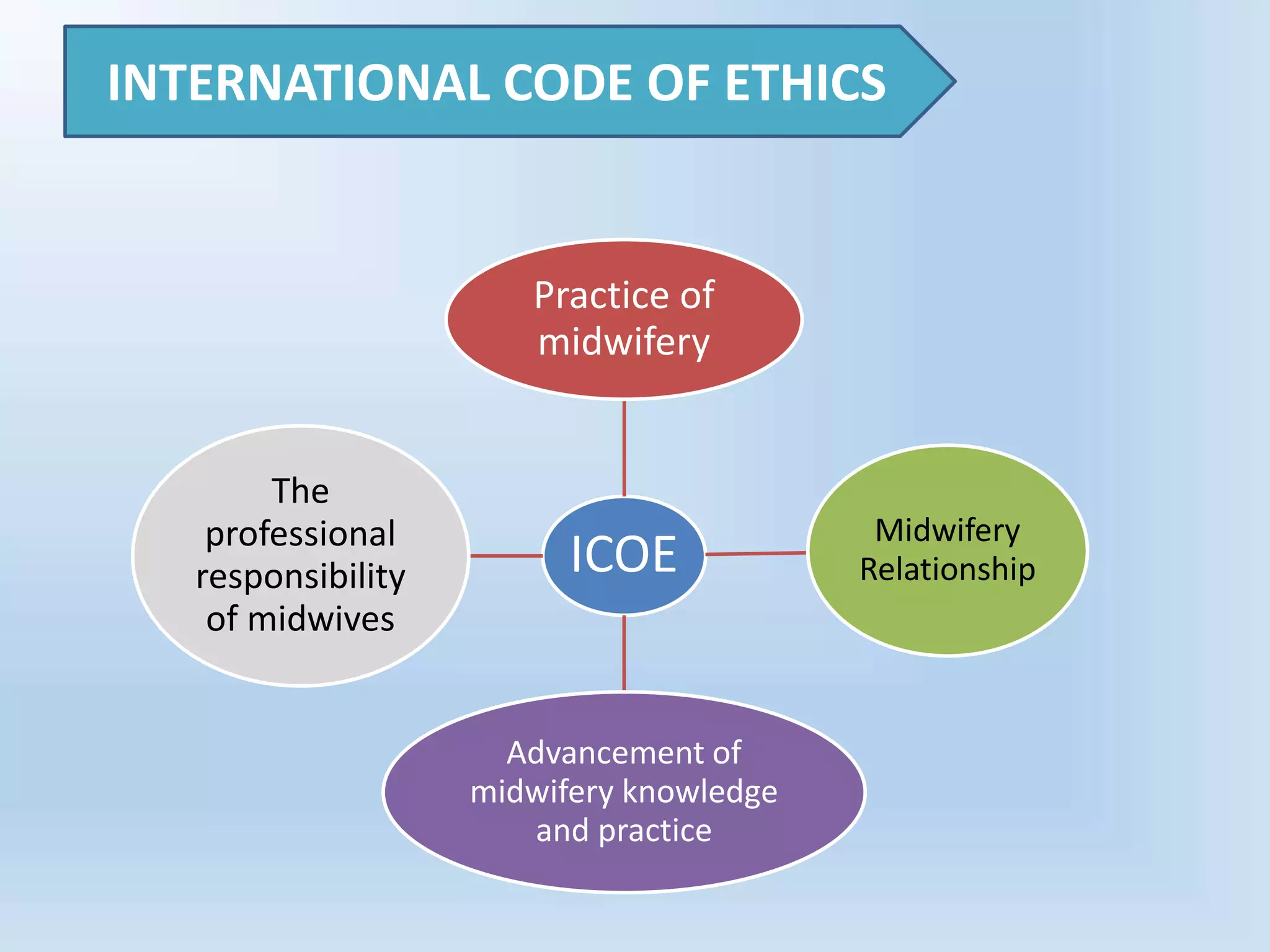
ICOE
Practice of
midwifery
Midwifery
Relationship
Advancement of
midwifery knowledge
and practice
The
professional
responsibility
of midwives
INTERNATIONAL CODE OF ETHICS
Professional Negligence: Medical negligence is the
legal error committed by medical personnel. In legal
terms, this error is a tort. A tort is a civil wrong that
injures a person.
Medication error: Nurses are to administer
medications correctly to patients. Administering
wrong medicines, wrong doses, wrong routes or
timing resulting in harm may be considered an act of
malpractice.
LEGAL AND ETHICAL ISSUES IN MIDWIFERY
PRACTICE
Failure of monitoring: A nurse is responsible to monitor
clients admitted with obstetric or gynaecologic problems.
Monitoring during intra-partum and postpartum period
requires great care.
Informed consent: Based on client’s right to self-
determination, informed consent demands that information
regarding treatment procedures be given to client’s and their
consent obtained by concerned physician and nurses witness
the patients signing in the form.
Failure in assessing: Failure in assessing and reporting
changes in a client’s condition for timely action can be
considered a malpractice.
Abortion: Nurse assist in the performance of
abortions under the act of medical termination of
pregnancy.
Nursing care of newborn: Newborns require
professional and specialized care. Failure of the
neonatal nurse to meet her obligations can result in
liability in employment or even in a civil suit.
Antepartum care
Intrapartum care
Caesarean Section
Difficult vaginal delivery
Postpartum care
Drugs in pregnancy and lactation
Ethical issues in surrogacy
MEDICOLEGAL ASPECTS OF
MIDWIFERY
Midwifery is a profession grounded in woman-centred
and evidence-based maternal health care for the
woman. Midwifery is provided through professional
relationships and respectful partnerships.
The midwife is responsible and accountable for
maintaining their capability for midwifery practice
that may include:
Providing women’s health support, care and advice
before conception, during pregnancy, labour, birth
and the postnatal period.
STANDARDS OF MIDWIFERY PRACTICE
Promoting normal physiological childbirth and
identifying complications for the woman and her
baby.
Consultation with and referral to medical care or
other appropriate assistance.
Implementing emergency measures (International
Confederation of Midwives 2017)
Standard 1: Promotes health and wellbeing through
evidence-based midwifery practice
Standard 2: Engages in professional relationships and
respectful partnerships
Standard 3: Demonstrates the capability and
accountability for midwifery practice
Standard 4: Undertakes comprehensive assessments
Standard 5: Develops plans for midwifery practice
Standard 6: Provides safety and quality in midwifery
practice
Standard 7: Evaluates outcomes to improve
midwifery practice
MIDWIFE STANDARDS OF PRACTICE
Standing orders are orders in
which the nurses may act to carry
out specific orders for a patient
who presents with symptoms or
needs addressed in the standing
orders. They must be in written
form and signed and dated by the
Licensed Independent
Practitioner.
STANDING ORDERS
To maintain the continuity of the treatment of the
patient.
To protect the life of the patient.
To create feeling of responsibility in the members
of health team.
OBJECTIVES OF STANDING ORDERS
Providing treatment during emergency.
Enhance the quality and activity of health
service.
Developing the feeling of confidence and
responsibility in nurses and health workers.
Protecting the general public from troubles.
Enhancing the faith of general public and
medical institution.
USES OF STANDING ORDER
Administration of immunization ( e.g. Influenza,
pneumococcal and other vaccines)
Nursing treatment of common health problems.
Health screening activities.
Public health services.
Telephone triage and advice services.
Orders for lab tests.
During labor.
UTILIZATION OF STANDING
ORDERS
BIBLIOGRAPHY / REFERENCE
Annamma Jacob A comprehensive textbook of
Midwifery and Gynaecological Nursing, Fourth Edition.
Jaypee Brothers Publishers. Pg 767-772.
Lily Podder fundamentals of Midwifery and Obstetrical
Nursing. Elsevier. Pg 6-9.
Littleton L, Engebretson J. Maternity Nursing Care.
India: Thompson Delmar Learning; 2007.pp.77-102.
Fry ST. The ethic of caring: can it survive in nursing?
Nursing Outlook. 1988;36(1):48
https://www.nursingmidwiferyboard.gov.au/codes-
guidelines-statements/professional-standards/midwife-
standards-for-practice.aspx
Code of ethics

Code of ethics

  • 1.
    PRESENTED BY: LAMNUNNEM HAOKIP MSC(N) 1ST YEAR UNDER THE SUPERVISION OF SHILPY MA’AM LEGAL AND ETHICAL ISSUES, CODE OF ETHICS AND STANDARD OF MIDWIFERY PRACTICE, STANDING ORDERS
  • 2.
    While ethical andlegal considerations are a component of all areas and specialities of nursing, some unique issues exist in maternal newborn nursing. Many of these issues occur because two parties, tightly linked are involved-the mother and the fetus/newborn. INTRODUCTION
  • 3.
    ETHICS According to Melanie& Evelyn, “ Ethics refers to the moral code of nursing and is based on obligation to service and respect for human life”. CODE OF ETHICS A written set of guidelines issued by an organization to its workers and management to help them conduct their actions in accordance with its primary values and ethical standards. DEFINITION
  • 4.
    To identify thefundamental ethical standards and values. Helps to distinguish between right and wrong. Protects the rights of an individual. Standards for the behaviours of nurses and provide general guidelines for nursing action. To guide ethical decision-making and practice. To indicate to the community the ethical values it can expect nurses and midwives to maintain. PURPOSE OF CODE OF ETHICS
  • 5.
    ICOE Practice of midwifery Midwifery Relationship Advancement of midwiferyknowledge and practice The professional responsibility of midwives INTERNATIONAL CODE OF ETHICS
  • 6.
    Professional Negligence: Medicalnegligence is the legal error committed by medical personnel. In legal terms, this error is a tort. A tort is a civil wrong that injures a person. Medication error: Nurses are to administer medications correctly to patients. Administering wrong medicines, wrong doses, wrong routes or timing resulting in harm may be considered an act of malpractice. LEGAL AND ETHICAL ISSUES IN MIDWIFERY PRACTICE
  • 7.
    Failure of monitoring:A nurse is responsible to monitor clients admitted with obstetric or gynaecologic problems. Monitoring during intra-partum and postpartum period requires great care. Informed consent: Based on client’s right to self- determination, informed consent demands that information regarding treatment procedures be given to client’s and their consent obtained by concerned physician and nurses witness the patients signing in the form.
  • 8.
    Failure in assessing:Failure in assessing and reporting changes in a client’s condition for timely action can be considered a malpractice. Abortion: Nurse assist in the performance of abortions under the act of medical termination of pregnancy. Nursing care of newborn: Newborns require professional and specialized care. Failure of the neonatal nurse to meet her obligations can result in liability in employment or even in a civil suit.
  • 9.
    Antepartum care Intrapartum care CaesareanSection Difficult vaginal delivery Postpartum care Drugs in pregnancy and lactation Ethical issues in surrogacy MEDICOLEGAL ASPECTS OF MIDWIFERY
  • 10.
    Midwifery is aprofession grounded in woman-centred and evidence-based maternal health care for the woman. Midwifery is provided through professional relationships and respectful partnerships. The midwife is responsible and accountable for maintaining their capability for midwifery practice that may include: Providing women’s health support, care and advice before conception, during pregnancy, labour, birth and the postnatal period. STANDARDS OF MIDWIFERY PRACTICE
  • 11.
    Promoting normal physiologicalchildbirth and identifying complications for the woman and her baby. Consultation with and referral to medical care or other appropriate assistance. Implementing emergency measures (International Confederation of Midwives 2017)
  • 12.
    Standard 1: Promoteshealth and wellbeing through evidence-based midwifery practice Standard 2: Engages in professional relationships and respectful partnerships Standard 3: Demonstrates the capability and accountability for midwifery practice Standard 4: Undertakes comprehensive assessments Standard 5: Develops plans for midwifery practice Standard 6: Provides safety and quality in midwifery practice Standard 7: Evaluates outcomes to improve midwifery practice MIDWIFE STANDARDS OF PRACTICE
  • 13.
    Standing orders areorders in which the nurses may act to carry out specific orders for a patient who presents with symptoms or needs addressed in the standing orders. They must be in written form and signed and dated by the Licensed Independent Practitioner. STANDING ORDERS
  • 14.
    To maintain thecontinuity of the treatment of the patient. To protect the life of the patient. To create feeling of responsibility in the members of health team. OBJECTIVES OF STANDING ORDERS
  • 15.
    Providing treatment duringemergency. Enhance the quality and activity of health service. Developing the feeling of confidence and responsibility in nurses and health workers. Protecting the general public from troubles. Enhancing the faith of general public and medical institution. USES OF STANDING ORDER
  • 16.
    Administration of immunization( e.g. Influenza, pneumococcal and other vaccines) Nursing treatment of common health problems. Health screening activities. Public health services. Telephone triage and advice services. Orders for lab tests. During labor. UTILIZATION OF STANDING ORDERS
  • 18.
    BIBLIOGRAPHY / REFERENCE AnnammaJacob A comprehensive textbook of Midwifery and Gynaecological Nursing, Fourth Edition. Jaypee Brothers Publishers. Pg 767-772. Lily Podder fundamentals of Midwifery and Obstetrical Nursing. Elsevier. Pg 6-9. Littleton L, Engebretson J. Maternity Nursing Care. India: Thompson Delmar Learning; 2007.pp.77-102. Fry ST. The ethic of caring: can it survive in nursing? Nursing Outlook. 1988;36(1):48 https://www.nursingmidwiferyboard.gov.au/codes- guidelines-statements/professional-standards/midwife- standards-for-practice.aspx