MACRONUTRIENTS
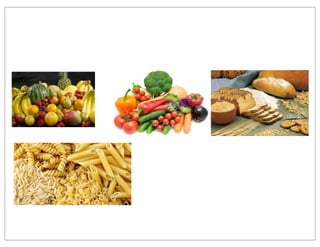
CARBOHYDRATE
CARBOHYDRATE
DEFICIENCY OF CARBOHYDRATE
1. Body weakness
2. Hypoglycemia (low blood sugar)
- Symptoms : shakiness, nervous, sweating, dizzy
3. Ketosis (body use fats as source of energy and
forms ketones)
- Excessive of ketones in the body can lead to
dehydration and imbalance of chemical in the
blood.
4.Weight loss
EXCESSIVE CONSUMPTION OF
CARBOHYDRATES
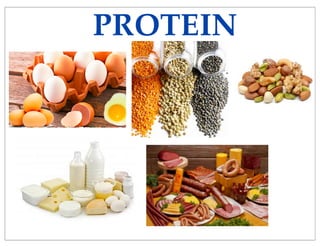
PROTEIN
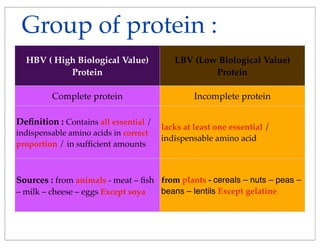
Group of protein :
HBV ( High Biological Value)
Protein
LBV (Low Biological Value)
Protein
Complete protein Incomplete protein
Definition : Contains all essential /
indispensable amino acids in correct
proportion / in sufficient amounts
lacks at least one essential /
indispensable amino acid
Sources : from animals - meat – fish
– milk – cheese – eggs Except soya
from plants - cereals – nuts – peas –
beans – lentils Except gelatine
Functions of protein :
Growth
Maintenance - renew cells
Repair damaged cells
Energy
Body secretions / enzymes / antibodies / hormones /
blood / muscles
Protein requirement
(RNI - Recommended Nutrient Intakes)
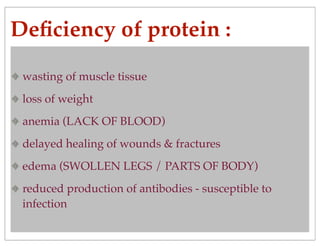
Deficiency of protein :
wasting of muscle tissue
loss of weight
anemia (LACK OF BLOOD)
delayed healing of wounds & fractures
edema (SWOLLEN LEGS / PARTS OF BODY)
reduced production of antibodies - susceptible to
infection
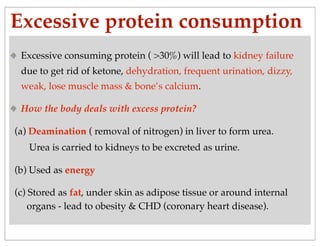
Excessive protein consumption
Excessive consuming protein ( >30%) will lead to kidney failure
due to get rid of ketone, dehydration, frequent urination, dizzy,
weak, lose muscle mass & bone’s calcium.
How the body deals with excess protein?
(a) Deamination ( removal of nitrogen) in liver to form urea.
Urea is carried to kidneys to be excreted as urine.
(b) Used as energy
(c) Stored as fat, under skin as adipose tissue or around internal
organs - lead to obesity & CHD (coronary heart disease).
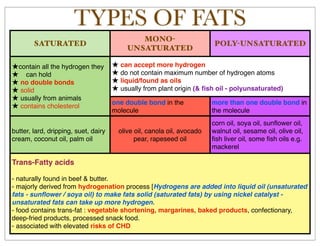
SATURATED
MONO-
UNSATURATED
POLY-UNSATURATED
★contain all the hydrogen they
★ can hold
★ no double bonds
★ solid
★ usually from animals
★ contains cholesterol
★ can accept more hydrogen
★ do not contain maximum number of hydrogen atoms
★ liquid/found as oils
★ usually from plant origin (& fish oil - polyunsaturated)
★ can accept more hydrogen
★ do not contain maximum number of hydrogen atoms
★ liquid/found as oils
★ usually from plant origin (& fish oil - polyunsaturated)
★contain all the hydrogen they
★ can hold
★ no double bonds
★ solid
★ usually from animals
★ contains cholesterol
one double bond in the
molecule
more than one double bond in
the molecule
butter, lard, dripping, suet, dairy
cream, coconut oil, palm oil
olive oil, canola oil, avocado
pear, rapeseed oil
corn oil, soya oil, sunflower oil,
walnut oil, sesame oil, olive oil,
fish liver oil, some fish oils e.g.
mackerel
Trans-Fatty acids
- naturally found in beef & butter.
- majorly derived from hydrogenation process [Hydrogens are added into liquid oil (unsaturated
fats - sunflower / soya oil) to make fats solid (saturated fats) by using nickel catalyst -
unsaturated fats can take up more hydrogen.
- food contains trans-fat : vegetable shortening, margarines, baked products, confectionary,
deep-fried products, processed snack food.
- associated with elevated risks of CHD
Trans-Fatty acids
- naturally found in beef & butter.
- majorly derived from hydrogenation process [Hydrogens are added into liquid oil (unsaturated
fats - sunflower / soya oil) to make fats solid (saturated fats) by using nickel catalyst -
unsaturated fats can take up more hydrogen.
- food contains trans-fat : vegetable shortening, margarines, baked products, confectionary,
deep-fried products, processed snack food.
- associated with elevated risks of CHD
Trans-Fatty acids
- naturally found in beef & butter.
- majorly derived from hydrogenation process [Hydrogens are added into liquid oil (unsaturated
fats - sunflower / soya oil) to make fats solid (saturated fats) by using nickel catalyst -
unsaturated fats can take up more hydrogen.
- food contains trans-fat : vegetable shortening, margarines, baked products, confectionary,
deep-fried products, processed snack food.
- associated with elevated risks of CHD
TYPES OF FATS
Saturated fats
FUNCTIONS OF FATS
1. Energy (1 gram = 9 kcal)
2. Energy reserve / storage
3. Protects vital organs
4. Insulates / preserves body heat / warmth
5. Solvent for fat soluble vitamins (ADEK)
6. Increases calorific value of food without adding bulk
7. provides texture to food
8. gives flavour to food
9. gives a feeling of fullness (satiety) after a meal
10. slows down digestion
11. formation of cell membranes
ESSENTIAL FATTY ACIDS
• Essential Fatty acids ( EFA) must be obtained from the diet
– because cannot be manufactured by the body.
• Examples :
1. Linoleic & Linolenic (plant oil) - for development of babies’
brain.
2. Omega 3 & 6 (fish oil) - reduce risk of Alzheimer’s disease,
improve memory, mood, arthritis, prevent cancer, lower
cholesterol level, prevent blood clot and reduce heart disease.
• Deficiency : dry skin / poor hair / diarrhoea
Problems with high fats intake /
saturated fats
Stroke
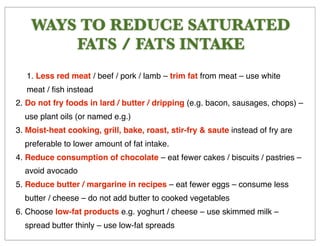
WAYS TO REDUCE SATURATED
FATS / FATS INTAKE
1. Less red meat / beef / pork / lamb – trim fat from meat – use white
meat / fish instead
2. Do not fry foods in lard / butter / dripping (e.g. bacon, sausages, chops) –
use plant oils (or named e.g.)
3. Moist-heat cooking, grill, bake, roast, stir-fry & saute instead of fry are
preferable to lower amount of fat intake.
4. Reduce consumption of chocolate – eat fewer cakes / biscuits / pastries –
avoid avocado
5. Reduce butter / margarine in recipes – eat fewer eggs – consume less
butter / cheese – do not add butter to cooked vegetables
6. Choose low-fat products e.g. yoghurt / cheese – use skimmed milk –
spread butter thinly – use low-fat spreads
Macronutrients
Macronutrients
Macronutrients

Macronutrients

  • 1.
  • 2.
  • 4.
    DEFICIENCY OF CARBOHYDRATE 1.Body weakness 2. Hypoglycemia (low blood sugar) - Symptoms : shakiness, nervous, sweating, dizzy 3. Ketosis (body use fats as source of energy and forms ketones) - Excessive of ketones in the body can lead to dehydration and imbalance of chemical in the blood. 4.Weight loss
  • 5.
  • 7.
  • 9.
    Group of protein: HBV ( High Biological Value) Protein LBV (Low Biological Value) Protein Complete protein Incomplete protein Definition : Contains all essential / indispensable amino acids in correct proportion / in sufficient amounts lacks at least one essential / indispensable amino acid Sources : from animals - meat – fish – milk – cheese – eggs Except soya from plants - cereals – nuts – peas – beans – lentils Except gelatine
  • 11.
    Functions of protein: Growth Maintenance - renew cells Repair damaged cells Energy Body secretions / enzymes / antibodies / hormones / blood / muscles
  • 12.
    Protein requirement (RNI -Recommended Nutrient Intakes)
  • 13.
    Deficiency of protein: wasting of muscle tissue loss of weight anemia (LACK OF BLOOD) delayed healing of wounds & fractures edema (SWOLLEN LEGS / PARTS OF BODY) reduced production of antibodies - susceptible to infection
  • 14.
    Excessive protein consumption Excessiveconsuming protein ( >30%) will lead to kidney failure due to get rid of ketone, dehydration, frequent urination, dizzy, weak, lose muscle mass & bone’s calcium. How the body deals with excess protein? (a) Deamination ( removal of nitrogen) in liver to form urea. Urea is carried to kidneys to be excreted as urine. (b) Used as energy (c) Stored as fat, under skin as adipose tissue or around internal organs - lead to obesity & CHD (coronary heart disease).
  • 16.
    SATURATED MONO- UNSATURATED POLY-UNSATURATED ★contain all thehydrogen they ★ can hold ★ no double bonds ★ solid ★ usually from animals ★ contains cholesterol ★ can accept more hydrogen ★ do not contain maximum number of hydrogen atoms ★ liquid/found as oils ★ usually from plant origin (& fish oil - polyunsaturated) ★ can accept more hydrogen ★ do not contain maximum number of hydrogen atoms ★ liquid/found as oils ★ usually from plant origin (& fish oil - polyunsaturated) ★contain all the hydrogen they ★ can hold ★ no double bonds ★ solid ★ usually from animals ★ contains cholesterol one double bond in the molecule more than one double bond in the molecule butter, lard, dripping, suet, dairy cream, coconut oil, palm oil olive oil, canola oil, avocado pear, rapeseed oil corn oil, soya oil, sunflower oil, walnut oil, sesame oil, olive oil, fish liver oil, some fish oils e.g. mackerel Trans-Fatty acids - naturally found in beef & butter. - majorly derived from hydrogenation process [Hydrogens are added into liquid oil (unsaturated fats - sunflower / soya oil) to make fats solid (saturated fats) by using nickel catalyst - unsaturated fats can take up more hydrogen. - food contains trans-fat : vegetable shortening, margarines, baked products, confectionary, deep-fried products, processed snack food. - associated with elevated risks of CHD Trans-Fatty acids - naturally found in beef & butter. - majorly derived from hydrogenation process [Hydrogens are added into liquid oil (unsaturated fats - sunflower / soya oil) to make fats solid (saturated fats) by using nickel catalyst - unsaturated fats can take up more hydrogen. - food contains trans-fat : vegetable shortening, margarines, baked products, confectionary, deep-fried products, processed snack food. - associated with elevated risks of CHD Trans-Fatty acids - naturally found in beef & butter. - majorly derived from hydrogenation process [Hydrogens are added into liquid oil (unsaturated fats - sunflower / soya oil) to make fats solid (saturated fats) by using nickel catalyst - unsaturated fats can take up more hydrogen. - food contains trans-fat : vegetable shortening, margarines, baked products, confectionary, deep-fried products, processed snack food. - associated with elevated risks of CHD TYPES OF FATS
  • 17.
  • 18.
    FUNCTIONS OF FATS 1.Energy (1 gram = 9 kcal) 2. Energy reserve / storage 3. Protects vital organs 4. Insulates / preserves body heat / warmth 5. Solvent for fat soluble vitamins (ADEK) 6. Increases calorific value of food without adding bulk 7. provides texture to food 8. gives flavour to food 9. gives a feeling of fullness (satiety) after a meal 10. slows down digestion 11. formation of cell membranes
  • 20.
    ESSENTIAL FATTY ACIDS •Essential Fatty acids ( EFA) must be obtained from the diet – because cannot be manufactured by the body. • Examples : 1. Linoleic & Linolenic (plant oil) - for development of babies’ brain. 2. Omega 3 & 6 (fish oil) - reduce risk of Alzheimer’s disease, improve memory, mood, arthritis, prevent cancer, lower cholesterol level, prevent blood clot and reduce heart disease. • Deficiency : dry skin / poor hair / diarrhoea
  • 21.
    Problems with highfats intake / saturated fats Stroke
  • 22.
    WAYS TO REDUCESATURATED FATS / FATS INTAKE 1. Less red meat / beef / pork / lamb – trim fat from meat – use white meat / fish instead 2. Do not fry foods in lard / butter / dripping (e.g. bacon, sausages, chops) – use plant oils (or named e.g.) 3. Moist-heat cooking, grill, bake, roast, stir-fry & saute instead of fry are preferable to lower amount of fat intake. 4. Reduce consumption of chocolate – eat fewer cakes / biscuits / pastries – avoid avocado 5. Reduce butter / margarine in recipes – eat fewer eggs – consume less butter / cheese – do not add butter to cooked vegetables 6. Choose low-fat products e.g. yoghurt / cheese – use skimmed milk – spread butter thinly – use low-fat spreads