MR211FSQ113 - FOOD CHEMISTRY
FATS
Presented by
Dr. A.Surendra Babu, Ph.D., PDF
Assistant Professor,
Dept. of Food Technology,
Hindustan University, Chennai
1
LIPIDS - COMPOSITION &
CLASSIFICATION
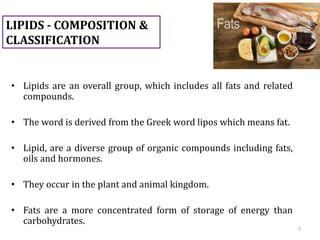
• Lipids are an overall group, which includes all fats and related
compounds.
• The word is derived from the Greek word lipos which means fat.
• Lipid, are a diverse group of organic compounds including fats,
oils and hormones.
• They occur in the plant and animal kingdom.
• Fats are a more concentrated form of storage of energy than
carbohydrates.
2
Chemical composition of lipids
• Carbon, hydrogen and oxygen, but it differs from a carbohydrate
in that it contains more carbon and hydrogen and less
oxygen.
• Fat is a complex molecule, constituting a mixture of fatty acids
and an alcohol, generally glycerol.
• When oxidized, it gives 9 kilocalories.
• 3 molecules of FA + one molecule of glycerol = triglyceride.
3
4
Classification of fats/lipids
Fats are classified into 4 categories as follows:
I. On the basis of chemical composition
II. On the basis of fatty acids
III. On the basis of requirement
IV. On the basis of sources
I. On the basis of chemical composition
Fats can be classified into 3 main groups as follows:
a) Simple lipids
• These are esters of fatty acids and glycerol.
• They are also called as neutral fats or triglycerides.
5
• These neutral fats make up 98 -99% of food and body fats
(e.g) fats and oils.
Waxes:
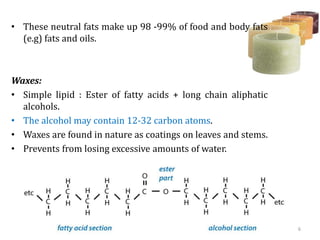
• Simple lipid : Ester of fatty acids + long chain aliphatic
alcohols.
• The alcohol may contain 12-32 carbon atoms.
• Waxes are found in nature as coatings on leaves and stems.
• Prevents from losing excessive amounts of water.
6
Compound lipids
• The compound lipids contain, in addition to fatty acids and
glycerol, some other organic compounds.
• Phospholipids: Phosphoric acid and a nitrogenous base in
addition to fatty acids and glycerol.
E.g., Lecithin and cephalin.
7
Glycolipids: Complex lipids containing carbohydrates in
combination with fatty acids and glycerol.
E.g., Cerebrosides
Lipoproteins: Proteins in combination with fatty acids.
• They are carriers of lipids in the blood and form cell membranes.
E.g., LDL, VLDL and HDL
8
Derived lipids
• Liberated during hydrolysis of simple and compound lipids
which still retain the properties of lipids.
• Includes : sterols, fatty acids and alcohol.
Sterols:
• Sterols are solid alcohols and form esters with fatty acids.
• Based on their origin sterols are classified as cholesterol (animal
origin) and phytosterol (in plants).
• Perhydrocyclopentanophenanthrene with an OH group in
3-position 9
Fatty acids:
• They are the key, refined fuel form of fat that the cell burns for
energy.
• Structural unit of fats and they may be saturated or unsaturated.
E.g., Oleic acid, linoleic acid, linolenic acid, palmitic acid and
myristic acid.
10
II. On the basis of fatty acids
a) Saturated fatty acids
• Fatty acid chains have all or predominantly single bonds.
• Saturated fatty acids, especially palmitic and stearic acids are
found in animal products such as cream, cheese, butter etc.,
• Vegetable products : high saturated fat : coconut oil and palm
kernel oil.
• Many prepared foods are high in saturated fat content, such as
pizza, dairy desserts and sausage.
11
12
13
Fats
Saturated fats Unsaturated fats
Poly unsaturated fats
Mono unsaturated fats
Omega-9 fatty acids
• Palmitoleic acid
 Vaccenic acid
 Oleic acid
Sources: Olive oil,
avocados, peanuts,
almonds
Omega-3 fatty acids
 Eicosapentanoic acid
(EPA)
 Docosahexaenoic
acid (DHA)
 α-linolenic acid
(ALA)
Sources: Flaxsed,
soybean, walnut,
rapeseed oil, shell fish
Omega-6 fatty acids
 Eicosadienoic
acid
 γ-linolenic acid
(GLA)
Sources: Corn oil,
safflower oil,
sunflower oil
14
b) Unsaturated fatty acids
• An unsaturated fat - atleast one double bond
Monounsaturated fatty acid (MUFA):
• A fatty acid chain : one double bond.
• Monounsaturated fats are good fats.
• MUFA : reduce blood cholesterol levels, CVD and breast cancer,
rheumatoid arthritis and helps in weight loss.
• Sources: (Oleic acid) are avocados, olives, olive oil, peanut butter
and peanut oil.
Polyunsaturated fatty acid (PUFA):
• A fatty acid : more than one double bond.
• They are of 2 types: omega-3 and omega-6 fatty acids.
15
Omega-3:
• n−3 fatty acids - double bond (C=C) at the third carbon atom
from methyl end.
1. α-linolenic acid (ALA)
2. Eicosapentaenoic acid (EPA)
3. Docosahexaenoic acid (DHA)
• ALA fatty acid : walnut, flaxseed, flaxseed oil, soybeans and chia
seeds.
• EPA and DHA fatty acids : fish and fish oils.
16
, f
17
18
Omega-6:
• n-6 position, that is the sixth carbon atom from methyl end.
• Omega-6 fats, also known as linoleic acid, are available only in
food.
• The human body cannot make them, so they are considered
essential fats.
On the basis of requirement
These Fatty acids are of 2 types:
a) Essential fatty acids
• Fatty acids - essential - taken - diet - cannot be synthesized in
our body are known as essential fatty acids.
• Eg. Linoleic and Linolenic acids.
19
b) Non-essential fatty acids
• Non-essential fatty acids are those which can be synthesized by
the body and which need not be supplied through the diet.
• Palmitic acid, oleic acid and butyric acid are examples of non–
essential fatty acids
On the basis of sources
• 2 types based on their source, namely visible and invisible fats.
• Some fats and oils added to food or used for frying are visible
fats. These are also known as pure fats.
• Many foods like milk, cream, egg yolk, meat, fish and even
cereals and legumes contribute substantial amount of invisible
fats (not visible in the food) to the diet.
20
FUNCTIONS OF LIPIDS
• Fats are a concentrated source of energy. One gram of fat gives 9
kilocalories of energy.
• Fats are the constituents of cell membrane structure and
regulate the membrane permeability.
• Subcutaneous fat - insulator and helps in retaining body heat.
• Essential for the digestion, absorption and utilization of fat
soluble vitamins like Vitamin A, D, E and K.
• Fats are important as cellular metabolic regulators (Steroid
hormones and prostaglandin).
21
• Fats improve the palatability of the diet and give satiety value.
(ie.) feeling of fullness in the stomach.
• Cholesterol is needed for synthesis of sex and adrenal hormones
(steroid hormones).
• Substituting a fat high in PUFA or MUFA for a fat high in
saturated fatty acids can decrease the level of blood cholesterol
levels and hence reduce risk of heart disease.
22
PROPERTIES OF FATS
Physical properties
 Pure fats and oils are colorless, odorless, and tasteless.
 Characteristic colors, odors, and flavors - imparted by foreign
substances that are lipid soluble
Ex: yellow color of butter - presence of the pigment carotene;
the taste of butter comes from two compounds—diacetyl
 Fats and oils are lighter than water, having densities of about
0.8 g/cm3.
 Oils are liquids at 20°C, they contain higher proportion of
Unsaturated fatty acids.
23
 Fats are solid at room temperature and contain saturated
long chain fatty acids
 They are poor conductors of heat and electricity and
therefore serve as excellent insulators for the body,
slowing the loss of heat through the skin.
 Soluble in organic solvents such as petroleum ether,
benzene etc.
24
CRYSTALLIZATION
• Fats differ from oils in their degree of solidification at
room temperature,
• Since in these conditions the oils are in a liquid state (not
crystallized) while the fats are in the solid (crystallized)
state.
• The fat crystals have a size between 0.1 and 0.5 μm and
can occasionally reach up to 100 μm.
• The crystals are maintained by Van der Waalls forces
forming a three-dimensional network that provides
rigidity to the product.
25
VISCOSITY
• The viscosity of a fat is due to the internal friction
between the lipids that constitute it.
• It is generally high due to the high number of molecules
molecules that make up a fat.
• By increasing the degree of unsaturation the viscosity
viscosity decreases, and when the length of the chain
increases the fatty acids components also increases the
viscosity.
26
CHEMICAL PROPERTIES
Polymerization:
• All commonly used fats when
heated under extreme conditions
of temperature and time.
• Although the polymerization
process is not completely
understood, it is believed that
polymers in fats and oils arise by
formation of either carbon-to-
carbon bonds or oxygen bridges
between molecules.
• When an appreciable amount of
polymer is present, there is a
marked increase in viscosity. 27
Rancidity:
• It is the natural process of decomposition (degradation) of
fats or oils by either hydrolysis or oxidation, or both.
• The development of rancidity is accompanied by a marked
increase in the acid value of the fat.
There are three causes for rancidity:
• Oxidative rancidity: known as autoxidation, occurs when
oxygen is absorbed from the environment.
• In the presence of oxygen and/or ultraviolet (UV) radiation,
most lipids will break down and degrade, forming several
other compounds.
28
29
• Peroxides are the initial indicators of lipid oxidation and will continue to react
and produce secondary products such as aldehydes.
Hydrolytic rancidity:
• Also called hydrolysis or enzymatic oxidation, occurs in the
absence of air, but with moisture present.
• This normally is accomplished through enzymatic peroxidation,
where enzymes found naturally in plant oils (i.e., lipoxygenase,
cyclooxygenase) and animal fats (i.e., lipase) can catalyze
reactions between water and oil.
30
• Microbial rancidity: is caused by micro-organisms such as
bacteria, molds and yeast which use enzymes to break
down chemical structures in the oil, producing unwanted
odors and flavors.
31
Hydrogenation
• In commercial practice, hydrogenation is usually carried out
with vigorous agitation with a catalyst (about 0.05 to 0.10 % of
nickel) in a steel pressure-reaction vessel.
• The ordinary ranges of temperature and pressure are from
100° to 200° C and from atmospheric pressure to 42 kilograms
per square centimeter, respectively.
• It means converting unsaturated fat in to saturated fat by the
addition of Hydrogen in presence of Nickel .
• This hydrogenation of oil is important because it converts the
liquid vegetable oil into hard mass type and this help in
stabilizing the oils and prevents it from getting rancid
32
33
Mechanism
The mechanism involved in fat hydrogenation is believed to be
the reaction between unsaturated liquid oil and atomic hydrogen
adsorbed on a metal catalyst.
• Hydrogenation converts liquid vegetable oils into solid or
semi-solid fats, such as those present in margarine.
34
• Full hydrogenation converts the vegetable oils into fully
saturated fats.
• Degree of hydrogenation of unsaturated oils controls the final
consistency of the product.
Hydrolysis
• Triglycerides can be hydrolyzed to constituent glycerol and
fatty acids by dilute acids or alkali.
• Esterases such as lipases can also catalyze the hydrolysis
reaction.
• Triglycerides are easily hydrolysed in the digestive tracts of
animals to give fatty acids and glycerol.
35
Saponification:
• When triglycerides are hydrolyzed (saponified) by alkalis,
glycerol plus the salts of fatty acids are produced.
• The sodium or potassium salts are obtained in this
reaction.
• The sodium or potassium salts of fatty acids are actually
soaps and this reaction is called saponification.
36

Fats.pptx

  • 1.
    MR211FSQ113 - FOODCHEMISTRY FATS Presented by Dr. A.Surendra Babu, Ph.D., PDF Assistant Professor, Dept. of Food Technology, Hindustan University, Chennai 1
  • 2.
    LIPIDS - COMPOSITION& CLASSIFICATION • Lipids are an overall group, which includes all fats and related compounds. • The word is derived from the Greek word lipos which means fat. • Lipid, are a diverse group of organic compounds including fats, oils and hormones. • They occur in the plant and animal kingdom. • Fats are a more concentrated form of storage of energy than carbohydrates. 2
  • 3.
    Chemical composition oflipids • Carbon, hydrogen and oxygen, but it differs from a carbohydrate in that it contains more carbon and hydrogen and less oxygen. • Fat is a complex molecule, constituting a mixture of fatty acids and an alcohol, generally glycerol. • When oxidized, it gives 9 kilocalories. • 3 molecules of FA + one molecule of glycerol = triglyceride. 3
  • 4.
  • 5.
    Classification of fats/lipids Fatsare classified into 4 categories as follows: I. On the basis of chemical composition II. On the basis of fatty acids III. On the basis of requirement IV. On the basis of sources I. On the basis of chemical composition Fats can be classified into 3 main groups as follows: a) Simple lipids • These are esters of fatty acids and glycerol. • They are also called as neutral fats or triglycerides. 5
  • 6.
    • These neutralfats make up 98 -99% of food and body fats (e.g) fats and oils. Waxes: • Simple lipid : Ester of fatty acids + long chain aliphatic alcohols. • The alcohol may contain 12-32 carbon atoms. • Waxes are found in nature as coatings on leaves and stems. • Prevents from losing excessive amounts of water. 6
  • 7.
    Compound lipids • Thecompound lipids contain, in addition to fatty acids and glycerol, some other organic compounds. • Phospholipids: Phosphoric acid and a nitrogenous base in addition to fatty acids and glycerol. E.g., Lecithin and cephalin. 7
  • 8.
    Glycolipids: Complex lipidscontaining carbohydrates in combination with fatty acids and glycerol. E.g., Cerebrosides Lipoproteins: Proteins in combination with fatty acids. • They are carriers of lipids in the blood and form cell membranes. E.g., LDL, VLDL and HDL 8
  • 9.
    Derived lipids • Liberatedduring hydrolysis of simple and compound lipids which still retain the properties of lipids. • Includes : sterols, fatty acids and alcohol. Sterols: • Sterols are solid alcohols and form esters with fatty acids. • Based on their origin sterols are classified as cholesterol (animal origin) and phytosterol (in plants). • Perhydrocyclopentanophenanthrene with an OH group in 3-position 9
  • 10.
    Fatty acids: • Theyare the key, refined fuel form of fat that the cell burns for energy. • Structural unit of fats and they may be saturated or unsaturated. E.g., Oleic acid, linoleic acid, linolenic acid, palmitic acid and myristic acid. 10
  • 11.
    II. On thebasis of fatty acids a) Saturated fatty acids • Fatty acid chains have all or predominantly single bonds. • Saturated fatty acids, especially palmitic and stearic acids are found in animal products such as cream, cheese, butter etc., • Vegetable products : high saturated fat : coconut oil and palm kernel oil. • Many prepared foods are high in saturated fat content, such as pizza, dairy desserts and sausage. 11
  • 12.
  • 13.
  • 14.
    Fats Saturated fats Unsaturatedfats Poly unsaturated fats Mono unsaturated fats Omega-9 fatty acids • Palmitoleic acid  Vaccenic acid  Oleic acid Sources: Olive oil, avocados, peanuts, almonds Omega-3 fatty acids  Eicosapentanoic acid (EPA)  Docosahexaenoic acid (DHA)  α-linolenic acid (ALA) Sources: Flaxsed, soybean, walnut, rapeseed oil, shell fish Omega-6 fatty acids  Eicosadienoic acid  γ-linolenic acid (GLA) Sources: Corn oil, safflower oil, sunflower oil 14
  • 15.
    b) Unsaturated fattyacids • An unsaturated fat - atleast one double bond Monounsaturated fatty acid (MUFA): • A fatty acid chain : one double bond. • Monounsaturated fats are good fats. • MUFA : reduce blood cholesterol levels, CVD and breast cancer, rheumatoid arthritis and helps in weight loss. • Sources: (Oleic acid) are avocados, olives, olive oil, peanut butter and peanut oil. Polyunsaturated fatty acid (PUFA): • A fatty acid : more than one double bond. • They are of 2 types: omega-3 and omega-6 fatty acids. 15
  • 16.
    Omega-3: • n−3 fattyacids - double bond (C=C) at the third carbon atom from methyl end. 1. α-linolenic acid (ALA) 2. Eicosapentaenoic acid (EPA) 3. Docosahexaenoic acid (DHA) • ALA fatty acid : walnut, flaxseed, flaxseed oil, soybeans and chia seeds. • EPA and DHA fatty acids : fish and fish oils. 16
  • 17.
  • 18.
  • 19.
    Omega-6: • n-6 position,that is the sixth carbon atom from methyl end. • Omega-6 fats, also known as linoleic acid, are available only in food. • The human body cannot make them, so they are considered essential fats. On the basis of requirement These Fatty acids are of 2 types: a) Essential fatty acids • Fatty acids - essential - taken - diet - cannot be synthesized in our body are known as essential fatty acids. • Eg. Linoleic and Linolenic acids. 19
  • 20.
    b) Non-essential fattyacids • Non-essential fatty acids are those which can be synthesized by the body and which need not be supplied through the diet. • Palmitic acid, oleic acid and butyric acid are examples of non– essential fatty acids On the basis of sources • 2 types based on their source, namely visible and invisible fats. • Some fats and oils added to food or used for frying are visible fats. These are also known as pure fats. • Many foods like milk, cream, egg yolk, meat, fish and even cereals and legumes contribute substantial amount of invisible fats (not visible in the food) to the diet. 20
  • 21.
    FUNCTIONS OF LIPIDS •Fats are a concentrated source of energy. One gram of fat gives 9 kilocalories of energy. • Fats are the constituents of cell membrane structure and regulate the membrane permeability. • Subcutaneous fat - insulator and helps in retaining body heat. • Essential for the digestion, absorption and utilization of fat soluble vitamins like Vitamin A, D, E and K. • Fats are important as cellular metabolic regulators (Steroid hormones and prostaglandin). 21
  • 22.
    • Fats improvethe palatability of the diet and give satiety value. (ie.) feeling of fullness in the stomach. • Cholesterol is needed for synthesis of sex and adrenal hormones (steroid hormones). • Substituting a fat high in PUFA or MUFA for a fat high in saturated fatty acids can decrease the level of blood cholesterol levels and hence reduce risk of heart disease. 22
  • 23.
    PROPERTIES OF FATS Physicalproperties  Pure fats and oils are colorless, odorless, and tasteless.  Characteristic colors, odors, and flavors - imparted by foreign substances that are lipid soluble Ex: yellow color of butter - presence of the pigment carotene; the taste of butter comes from two compounds—diacetyl  Fats and oils are lighter than water, having densities of about 0.8 g/cm3.  Oils are liquids at 20°C, they contain higher proportion of Unsaturated fatty acids. 23
  • 24.
     Fats aresolid at room temperature and contain saturated long chain fatty acids  They are poor conductors of heat and electricity and therefore serve as excellent insulators for the body, slowing the loss of heat through the skin.  Soluble in organic solvents such as petroleum ether, benzene etc. 24
  • 25.
    CRYSTALLIZATION • Fats differfrom oils in their degree of solidification at room temperature, • Since in these conditions the oils are in a liquid state (not crystallized) while the fats are in the solid (crystallized) state. • The fat crystals have a size between 0.1 and 0.5 μm and can occasionally reach up to 100 μm. • The crystals are maintained by Van der Waalls forces forming a three-dimensional network that provides rigidity to the product. 25
  • 26.
    VISCOSITY • The viscosityof a fat is due to the internal friction between the lipids that constitute it. • It is generally high due to the high number of molecules molecules that make up a fat. • By increasing the degree of unsaturation the viscosity viscosity decreases, and when the length of the chain increases the fatty acids components also increases the viscosity. 26
  • 27.
    CHEMICAL PROPERTIES Polymerization: • Allcommonly used fats when heated under extreme conditions of temperature and time. • Although the polymerization process is not completely understood, it is believed that polymers in fats and oils arise by formation of either carbon-to- carbon bonds or oxygen bridges between molecules. • When an appreciable amount of polymer is present, there is a marked increase in viscosity. 27
  • 28.
    Rancidity: • It isthe natural process of decomposition (degradation) of fats or oils by either hydrolysis or oxidation, or both. • The development of rancidity is accompanied by a marked increase in the acid value of the fat. There are three causes for rancidity: • Oxidative rancidity: known as autoxidation, occurs when oxygen is absorbed from the environment. • In the presence of oxygen and/or ultraviolet (UV) radiation, most lipids will break down and degrade, forming several other compounds. 28
  • 29.
    29 • Peroxides arethe initial indicators of lipid oxidation and will continue to react and produce secondary products such as aldehydes.
  • 30.
    Hydrolytic rancidity: • Alsocalled hydrolysis or enzymatic oxidation, occurs in the absence of air, but with moisture present. • This normally is accomplished through enzymatic peroxidation, where enzymes found naturally in plant oils (i.e., lipoxygenase, cyclooxygenase) and animal fats (i.e., lipase) can catalyze reactions between water and oil. 30
  • 31.
    • Microbial rancidity:is caused by micro-organisms such as bacteria, molds and yeast which use enzymes to break down chemical structures in the oil, producing unwanted odors and flavors. 31
  • 32.
    Hydrogenation • In commercialpractice, hydrogenation is usually carried out with vigorous agitation with a catalyst (about 0.05 to 0.10 % of nickel) in a steel pressure-reaction vessel. • The ordinary ranges of temperature and pressure are from 100° to 200° C and from atmospheric pressure to 42 kilograms per square centimeter, respectively. • It means converting unsaturated fat in to saturated fat by the addition of Hydrogen in presence of Nickel . • This hydrogenation of oil is important because it converts the liquid vegetable oil into hard mass type and this help in stabilizing the oils and prevents it from getting rancid 32
  • 33.
    33 Mechanism The mechanism involvedin fat hydrogenation is believed to be the reaction between unsaturated liquid oil and atomic hydrogen adsorbed on a metal catalyst. • Hydrogenation converts liquid vegetable oils into solid or semi-solid fats, such as those present in margarine.
  • 34.
    34 • Full hydrogenationconverts the vegetable oils into fully saturated fats. • Degree of hydrogenation of unsaturated oils controls the final consistency of the product.
  • 35.
    Hydrolysis • Triglycerides canbe hydrolyzed to constituent glycerol and fatty acids by dilute acids or alkali. • Esterases such as lipases can also catalyze the hydrolysis reaction. • Triglycerides are easily hydrolysed in the digestive tracts of animals to give fatty acids and glycerol. 35
  • 36.
    Saponification: • When triglyceridesare hydrolyzed (saponified) by alkalis, glycerol plus the salts of fatty acids are produced. • The sodium or potassium salts are obtained in this reaction. • The sodium or potassium salts of fatty acids are actually soaps and this reaction is called saponification. 36