•Fats belong to a group of substances called
lipids, which do not dissolve in water.

•Fats are organic compounds that are made up
of carbon, hydrogen, and oxygen. They are
sources of energy in foods.
ANIMAL ORIGIN

    -meat and meat products, eggs and dairy
products like butter, cheese, milk and cream.
PLANT ORIGIN

     -fats can be found in plant seeds, fruits
and nuts.
Visible fats

     -Are obvious fats that are plain to see.
Invisible fats

     Counts for about 70% intake of fat.
Saturated fat
  •This type of fat is typically found in large
  amounts in foods from animals. Many
  baked goods such as cakes, biscuits and
  pastries are also high in saturated fat.
  Excessive intake of saturated fat can
  increase blood cholesterol levels.
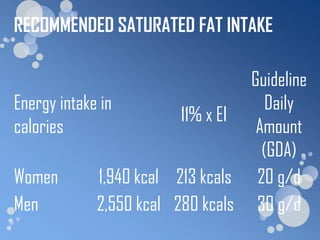
RECOMMENDED SATURATED FAT INTAKE

                                  Guideline
Energy intake in                     Daily
                         11% x EI
calories                           Amount
                                    (GDA)
Women        1,940 kcal 213 kcals 20 g/d
Men          2,550 kcal 280 kcals 30 g/d
Unsaturated fats

                   3 types:

            Monounsaturated
            Polyunsaturated
            Trans-fatty Acids
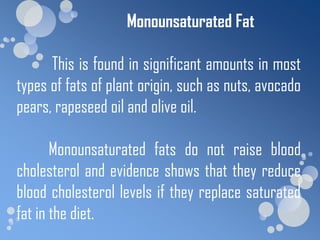
Monounsaturated Fat

      This is found in significant amounts in most
types of fats of plant origin, such as nuts, avocado
pears, rapeseed oil and olive oil.

       Monounsaturated fats do not raise blood
cholesterol and evidence shows that they reduce
blood cholesterol levels if they replace saturated
fat in the diet.
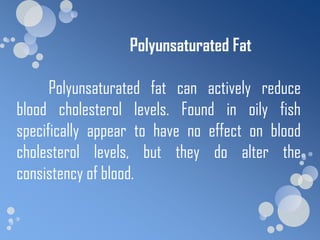
Polyunsaturated Fat

      Polyunsaturated fat can actively reduce
blood cholesterol levels. Found in oily fish
specifically appear to have no effect on blood
cholesterol levels, but they do alter the
consistency of blood.
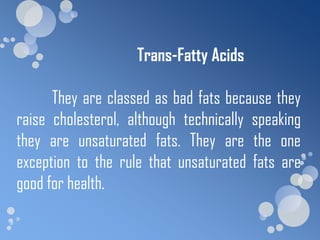
Trans-Fatty Acids

      They are classed as bad fats because they
raise cholesterol, although technically speaking
they are unsaturated fats. They are the one
exception to the rule that unsaturated fats are
good for health.
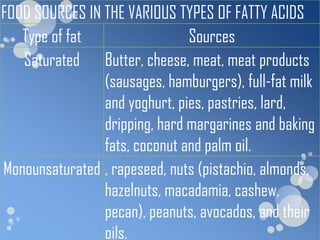
FOOD SOURCES IN THE VARIOUS TYPES OF FATTY ACIDS
   Type of fat                 Sources
   Saturated Butter, cheese, meat, meat products
                (sausages, hamburgers), full-fat milk
                and yoghurt, pies, pastries, lard,
                dripping, hard margarines and baking
                fats, coconut and palm oil.
Monounsaturated , rapeseed, nuts (pistachio, almonds,
                hazelnuts, macadamia, cashew,
                pecan), peanuts, avocados, and their
                oils.
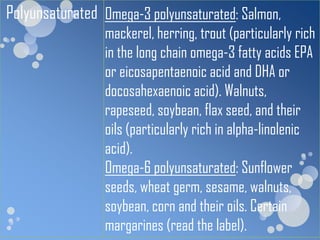
Polyunsaturated Omega-3 polyunsaturated: Salmon,
                 mackerel, herring, trout (particularly rich
                 in the long chain omega-3 fatty acids EPA
                 or eicosapentaenoic acid and DHA or
                 docosahexaenoic acid). Walnuts,
                 rapeseed, soybean, flax seed, and their
                 oils (particularly rich in alpha-linolenic
                 acid).
                 Omega-6 polyunsaturated: Sunflower
                 seeds, wheat germ, sesame, walnuts,
                 soybean, corn and their oils. Certain
                 margarines (read the label).
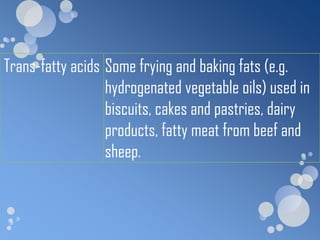
Trans-fatty acids Some frying and baking fats (e.g.
                  hydrogenated vegetable oils) used in
                  biscuits, cakes and pastries, dairy
                  products, fatty meat from beef and
                  sheep.
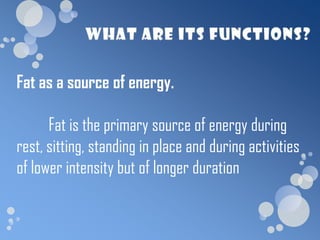
Fat as a source of energy.

      Fat is the primary source of energy during
rest, sitting, standing in place and during activities
of lower intensity but of longer duration
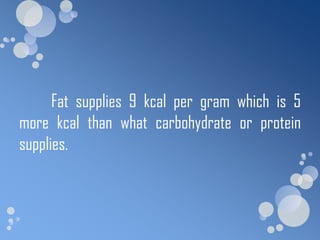
Fat supplies 9 kcal per gram which is 5
more kcal than what carbohydrate or protein
supplies.
Fat as a cell structure.

     Myelin sheat is a special fat coating that
protects nerve fibers and helps relay the nerve
impulses.
Fat as a source of essential fatty acids.

      Linoleic (Omega-6) and Alpha-linoleic
(Omega-3) fatty acids are not made by the body on
it’s own so it needs to be obtained from foods.
These fatty acids come from polyunsaturated fats.
Eicosapentaenoic acid (EPA) and
docosahexaenoic acid (DHA) are Omega-3 fatty
acids that are needed for the brain development of
babies and young children.
Fat as a regulator of body functions.

     Omega-3 and omega-6 fatty acids are used
to make hormone-like compounds called
eicosanoids, these help regulate bodily functions
such as blood clotting, immune function and blood
pressure control.
EPA and DHA are precursors of natural anti-
inflammatory substances called prostaglandins
and leukotrienes.

      Cholesterol helps in making vitamin D
(calcium regulator), bile acids (emulsifiers), and
hormones such as cortisol, estrogen, and
testosterone.
Fat as a contributor to feeling of
     fullness, taste and smell.

     Fats bring important ‘mouth feel’ and flavor to
many foods. Fats have also satiety value which is
due partly by the slower rate of digestion of fats in
comparison to carbohydrate and protein.
Fat as an energy reserve and emergency fuel.

     Fat is the primary form in which energy is
stored in cells, collectively called adipose tissue.

        One pound of stored fat is equivalent to 3500
kcal.

        *18%-24% for women * 15%-18% for men
Fat as a protein sparer.

     Fat spares protein from being burned for
energy. In this way, protein can do its many
important tasks in the body.
Fat as an insulator and protector.

      Subcutaneous fat (fat layer under the skin)
insulates the body against extreme temperatures
and provides a protective pad for critical organs
against shock.

Fats also helps absorb and transport vitamins A,
D, E, and K.
•Fat requires the presence of enzymes (lipase)
and mixing compounds (bile) from the gallbladder
for digestion.

MOUTH
     -actions by a lingual lipase released by
Ebner’s glands at the back of the tongue.
STOMACH
     -little digestion takes place; muscle action of
stomach continues to mix fat with stomach
contents.

     -Gastric lipase (or tributyrinase) acts on
emulsified butterfat.
INTESTINE
     Bile –secreted by the gal bladder to
           through the hormone cholecystokinin.
          -emulsifies fat for preparation for fat
           digestion by specific enzymes:
           pancreatic lipase (steapsin), this
           breaks off one fatty acid at a time from
           the glycerol base fats.
INTESTINE
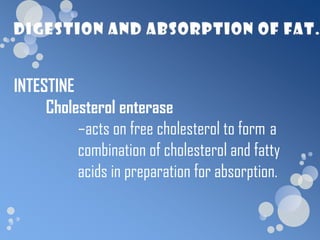
     Cholesterol enterase
          –acts on free cholesterol to form a
          combination of cholesterol and fatty
          acids in preparation for absorption.
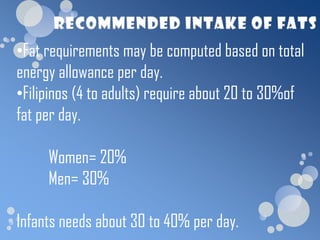
•Fat requirements may be computed based on total
energy allowance per day.
•Filipinos (4 to adults) require about 20 to 30%of
fat per day.

     Women= 20%
     Men= 30%

Infants needs about 30 to 40% per day.
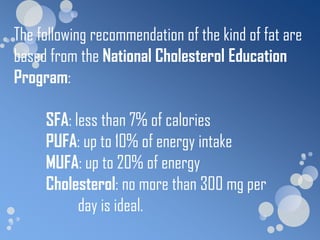
The following recommendation of the kind of fat are
based from the National Cholesterol Education
Program:

     SFA: less than 7% of calories
     PUFA: up to 10% of energy intake
     MUFA: up to 20% of energy
     Cholesterol: no more than 300 mg per
           day is ideal.
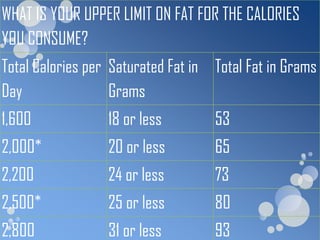
WHAT IS YOUR UPPER LIMIT ON FAT FOR THE CALORIES
YOU CONSUME?
Total Calories per Saturated Fat in Total Fat in Grams
Day                Grams
1,600             18 or less        53
2,000*            20 or less        65
2,200             24 or less        73
2,500*            25 or less        80
2,800             31 or less        93
CANCER

      Cancer is a condition where the cells of the
body start to grow in a rapid, uncontrollable
way. Monounsatured fats and omega 3 essential
fatty acids (EFAs) have been linked with the
prevention of breast cancer, colon
cancer and prostate cancer. Being deficient in
these types of fat removes this protection and
increases your cancer risk.
FAT-SOLUBLE VITAMIN DEFICIENCY

      Reducing your dietary fat intake significantly
can cause you to become deficient in these
essential vitamins which can lead to a number of
unpleasant symptoms including anemia (a low red
blood cell count), vision problems, weak bones and
skin problems.
UNDERNUTRITION

       Insufficient fat in the diet results in weight
loss and thinness. Nutrition survey conducted by
the Food and Nutrition Institute suggests that many
Filipinos do not meet their energy needs from fat.
TOXICITY
HIGH BLOOD PRESSURE

     High blood pressure is a condition which can
damage your blood vessels and vital organs. It also
increases your risk of a heart attack or a
stroke. Regular consumption of omega 3 EFAs can
lower blood pressure whilst not getting enough can
have the opposite effect and lead to high blood
pressure.
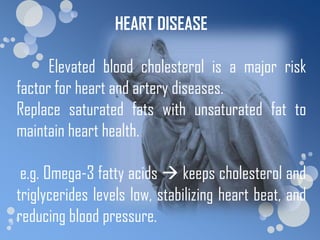
HEART DISEASE

      Elevated blood cholesterol is a major risk
factor for heart and artery diseases.
Replace saturated fats with unsaturated fat to
maintain heart health.

 e.g. Omega-3 fatty acids  keeps cholesterol and
triglycerides levels low, stabilizing heart beat, and
reducing blood pressure.
OBESITY

      People who eat high-fat diets regularly may
exceed their energy needs and gain weight.
Overweight and obesity are defined as abnormal or
excessive fat accumulation that presents a risk to
health.

A crude population measure of obesity is the body
mass index (BMI), a person’s
weight (in kilograms) divided by the square of his
or her height (in metres). A person with a BMI of
30 or more is generally considered obese. A
person with a BMI equal to or more than 25 is
considered overweight.

Fats

  • 2.
    •Fats belong toa group of substances called lipids, which do not dissolve in water. •Fats are organic compounds that are made up of carbon, hydrogen, and oxygen. They are sources of energy in foods.
  • 3.
    ANIMAL ORIGIN -meat and meat products, eggs and dairy products like butter, cheese, milk and cream.
  • 4.
    PLANT ORIGIN -fats can be found in plant seeds, fruits and nuts.
  • 5.
    Visible fats -Are obvious fats that are plain to see.
  • 6.
    Invisible fats Counts for about 70% intake of fat.
  • 7.
    Saturated fat •This type of fat is typically found in large amounts in foods from animals. Many baked goods such as cakes, biscuits and pastries are also high in saturated fat. Excessive intake of saturated fat can increase blood cholesterol levels.
  • 8.
    RECOMMENDED SATURATED FATINTAKE Guideline Energy intake in Daily 11% x EI calories Amount (GDA) Women 1,940 kcal 213 kcals 20 g/d Men 2,550 kcal 280 kcals 30 g/d
  • 9.
    Unsaturated fats 3 types: Monounsaturated Polyunsaturated Trans-fatty Acids
  • 10.
    Monounsaturated Fat This is found in significant amounts in most types of fats of plant origin, such as nuts, avocado pears, rapeseed oil and olive oil. Monounsaturated fats do not raise blood cholesterol and evidence shows that they reduce blood cholesterol levels if they replace saturated fat in the diet.
  • 11.
    Polyunsaturated Fat Polyunsaturated fat can actively reduce blood cholesterol levels. Found in oily fish specifically appear to have no effect on blood cholesterol levels, but they do alter the consistency of blood.
  • 12.
    Trans-Fatty Acids They are classed as bad fats because they raise cholesterol, although technically speaking they are unsaturated fats. They are the one exception to the rule that unsaturated fats are good for health.
  • 13.
    FOOD SOURCES INTHE VARIOUS TYPES OF FATTY ACIDS Type of fat Sources Saturated Butter, cheese, meat, meat products (sausages, hamburgers), full-fat milk and yoghurt, pies, pastries, lard, dripping, hard margarines and baking fats, coconut and palm oil. Monounsaturated , rapeseed, nuts (pistachio, almonds, hazelnuts, macadamia, cashew, pecan), peanuts, avocados, and their oils.
  • 14.
    Polyunsaturated Omega-3 polyunsaturated:Salmon, mackerel, herring, trout (particularly rich in the long chain omega-3 fatty acids EPA or eicosapentaenoic acid and DHA or docosahexaenoic acid). Walnuts, rapeseed, soybean, flax seed, and their oils (particularly rich in alpha-linolenic acid). Omega-6 polyunsaturated: Sunflower seeds, wheat germ, sesame, walnuts, soybean, corn and their oils. Certain margarines (read the label).
  • 15.
    Trans-fatty acids Somefrying and baking fats (e.g. hydrogenated vegetable oils) used in biscuits, cakes and pastries, dairy products, fatty meat from beef and sheep.
  • 16.
    Fat as asource of energy. Fat is the primary source of energy during rest, sitting, standing in place and during activities of lower intensity but of longer duration
  • 17.
    Fat supplies 9kcal per gram which is 5 more kcal than what carbohydrate or protein supplies.
  • 18.
    Fat as acell structure. Myelin sheat is a special fat coating that protects nerve fibers and helps relay the nerve impulses.
  • 19.
    Fat as asource of essential fatty acids. Linoleic (Omega-6) and Alpha-linoleic (Omega-3) fatty acids are not made by the body on it’s own so it needs to be obtained from foods. These fatty acids come from polyunsaturated fats.
  • 20.
    Eicosapentaenoic acid (EPA)and docosahexaenoic acid (DHA) are Omega-3 fatty acids that are needed for the brain development of babies and young children.
  • 21.
    Fat as aregulator of body functions. Omega-3 and omega-6 fatty acids are used to make hormone-like compounds called eicosanoids, these help regulate bodily functions such as blood clotting, immune function and blood pressure control.
  • 22.
    EPA and DHAare precursors of natural anti- inflammatory substances called prostaglandins and leukotrienes. Cholesterol helps in making vitamin D (calcium regulator), bile acids (emulsifiers), and hormones such as cortisol, estrogen, and testosterone.
  • 23.
    Fat as acontributor to feeling of fullness, taste and smell. Fats bring important ‘mouth feel’ and flavor to many foods. Fats have also satiety value which is due partly by the slower rate of digestion of fats in comparison to carbohydrate and protein.
  • 24.
    Fat as anenergy reserve and emergency fuel. Fat is the primary form in which energy is stored in cells, collectively called adipose tissue. One pound of stored fat is equivalent to 3500 kcal. *18%-24% for women * 15%-18% for men
  • 25.
    Fat as aprotein sparer. Fat spares protein from being burned for energy. In this way, protein can do its many important tasks in the body.
  • 26.
    Fat as aninsulator and protector. Subcutaneous fat (fat layer under the skin) insulates the body against extreme temperatures and provides a protective pad for critical organs against shock. Fats also helps absorb and transport vitamins A, D, E, and K.
  • 27.
    •Fat requires thepresence of enzymes (lipase) and mixing compounds (bile) from the gallbladder for digestion. MOUTH -actions by a lingual lipase released by Ebner’s glands at the back of the tongue.
  • 28.
    STOMACH -little digestion takes place; muscle action of stomach continues to mix fat with stomach contents. -Gastric lipase (or tributyrinase) acts on emulsified butterfat.
  • 29.
    INTESTINE Bile –secreted by the gal bladder to through the hormone cholecystokinin. -emulsifies fat for preparation for fat digestion by specific enzymes: pancreatic lipase (steapsin), this breaks off one fatty acid at a time from the glycerol base fats.
  • 30.
    INTESTINE Cholesterol enterase –acts on free cholesterol to form a combination of cholesterol and fatty acids in preparation for absorption.
  • 31.
    •Fat requirements maybe computed based on total energy allowance per day. •Filipinos (4 to adults) require about 20 to 30%of fat per day. Women= 20% Men= 30% Infants needs about 30 to 40% per day.
  • 32.
    The following recommendationof the kind of fat are based from the National Cholesterol Education Program: SFA: less than 7% of calories PUFA: up to 10% of energy intake MUFA: up to 20% of energy Cholesterol: no more than 300 mg per day is ideal.
  • 33.
    WHAT IS YOURUPPER LIMIT ON FAT FOR THE CALORIES YOU CONSUME? Total Calories per Saturated Fat in Total Fat in Grams Day Grams 1,600 18 or less 53 2,000* 20 or less 65 2,200 24 or less 73 2,500* 25 or less 80 2,800 31 or less 93
  • 35.
    CANCER Cancer is a condition where the cells of the body start to grow in a rapid, uncontrollable way. Monounsatured fats and omega 3 essential fatty acids (EFAs) have been linked with the prevention of breast cancer, colon cancer and prostate cancer. Being deficient in these types of fat removes this protection and increases your cancer risk.
  • 36.
    FAT-SOLUBLE VITAMIN DEFICIENCY Reducing your dietary fat intake significantly can cause you to become deficient in these essential vitamins which can lead to a number of unpleasant symptoms including anemia (a low red blood cell count), vision problems, weak bones and skin problems.
  • 37.
    UNDERNUTRITION Insufficient fat in the diet results in weight loss and thinness. Nutrition survey conducted by the Food and Nutrition Institute suggests that many Filipinos do not meet their energy needs from fat.
  • 38.
  • 39.
    HIGH BLOOD PRESSURE High blood pressure is a condition which can damage your blood vessels and vital organs. It also increases your risk of a heart attack or a stroke. Regular consumption of omega 3 EFAs can lower blood pressure whilst not getting enough can have the opposite effect and lead to high blood pressure.
  • 40.
    HEART DISEASE Elevated blood cholesterol is a major risk factor for heart and artery diseases. Replace saturated fats with unsaturated fat to maintain heart health. e.g. Omega-3 fatty acids  keeps cholesterol and triglycerides levels low, stabilizing heart beat, and reducing blood pressure.
  • 41.
    OBESITY People who eat high-fat diets regularly may exceed their energy needs and gain weight. Overweight and obesity are defined as abnormal or excessive fat accumulation that presents a risk to health. A crude population measure of obesity is the body mass index (BMI), a person’s
  • 42.
    weight (in kilograms)divided by the square of his or her height (in metres). A person with a BMI of 30 or more is generally considered obese. A person with a BMI equal to or more than 25 is considered overweight.