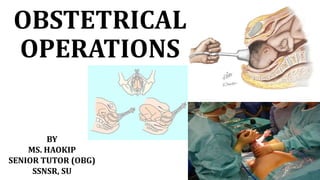
OBSTETRICAL
OPERATIONS
BY
MS. HAOKIP
SENIOR TUTOR (OBG)
SSNSR, SU
OBSTETRICAL
OPERATIONS
FORCEP
DELIVERY
C-SECTION
VACUUM
DELIVERY
TYPES OF FORCEPS
Outlet forceps delivery, where the forceps are applied when the fetal head
has reached the perineal floor and its scalp is visible between contractions.
Low forceps delivery, when the baby's head is at +2 station or lower. There is
no restriction on rotation for this type of delivery.
Midforceps delivery, when the baby's head is above +2 station. There must
be head engagement before it can be carried out.
INDICATIONS OF FORCEPS APPLICATION
MATERNAL FETAL MATERNAL AND FETAL
 Impairment of ability
to push.
 Heart disease
 Pulmonary
compromise
 Intrapartum infection
 Umbilical cord
prolapse
 Premature separation
of placenta
 Non – reassuring fetal
heart pattern
 Prolonged second stage of
labour( more than 3 hours
and more than three hours
without regional anesthesia
in nulliparous women)
 In parous women more than
2 hours with and more than
one hour without regional
anesthesia.
CONTRAINDICATIONS FOR FORCEP
APPLICATION
Any contraindication to vaginal delivery.
Cervix not fully dilated and fully effaced.
CPD/ CP
Inability to determine the presentation and position of the fetal head
Unsuccessful trial of vacuum extraction
PRE-REQUISITES FOR FORCEPS APPLICATION
F: Favourable head position and station
O: Open os
R: Ruptured Membranes
C: Contraction present and consent
E: Engaged head, Empty Bladder
P: Pelvimetry
S: Stirrups / Lithotomy Position
PROCEDURE
INTRODUCTION OF THE BLADES
The patient is anesthetized and the
perineum is carefully prepared.
The two fingers are introduced into the
vaginal canal followed by the blade of each
side. The blade should be jellified.
Once both the blades are localized, the
operator locked the forceps for further
procedure.
LOCKING OF THE FORCEP
With proper application, the forceps locks easily or with minor
manipulation.
Make sure that there is no injuries to the cervix and surrounding
tissues.
TRACTION
Traction should be applied using
traction handle only and not by holding
the shaft of the blade.
The force exerted should be from the
wrist. The traction should be done
during a contraction so that minimal
force needs to be exerted.
The direction of traction should be in
the direction of the birth canal.
COMPLICATIONS
MATERNAL FETAL
 Extension of episiotomy
 Vaginal lacerations
 Cervical tear
 Injury to the lower uterine segment
 Traumatic haemorrhage
 Bladder injury
 Rectal injury
 Puerperal sepsis
 Intracranial haemorrhage
 Skull fractures
 Cephalohematoma
 Facial nerve palsy
VACUUM EXTRACTOR
VACUUM/VENTOUSE EXTRACTOR
• The vacuum extractor like the obstetric forceps, is a method of getting hold of
the fetal head while it is still in the birth canal.
WORKING
The obstetric forceps applied around the head gives force theoretically to the
base of the skull, while in ventouse, the extractor grips the scalp and it is
almost true to say that the baby is pulled out by its hair.
CONTRAINDICATIONS OF VENTOUSE
• Ant presentation other than vertex
• Preterm fetus
• Suspected fetal coagulation disorder
• Suspected fetal macrosomia
• Unengaged fetal head
• Obvious CPD
• Patient’s refusal
• Haemophilia
PROCEDURE FOR VENTOUSE APPLICATION
STEP 1:
The cup is placed against the fetal head nearer to the occiput with the
‘knob’ of the cup pointing towards the occiput.
A vacuum of 0.2 kg/cm2 is induced by the pump slowly, taking at least
2 minutes.
The pressure is gradually increased at the rate of 0.1 kg/cm2/min
until effective vacuum of 0.8 kg/cm2 is achieved in about 10 minutes.
STEP 2: Traction
Traction must be at the right angle to the cup
Should be synchronous with the uterine contractions
Traction is released in between contraction
Traction should be made using one hand along with the axis of the birth
canal. The fingers on the other hand are to be placed against the cup to
note the correct angle of traction, rotation and advancement of the
head.
contd
Operative vaginal delivery should be abandoned when there is no
descent of the head. The traction should not exceed 30 minutes on no
account.
As soon as delivered, the vacuum is reduced by opening the screw-
release valve and the cup is then detached.
Complications
MATERNAL NEONATE
Trauma
Superficial scalp abrasion
Sloughing of the scalp
Cephalohematoma
Subaponeurotic haemorrhage
Intracranial haemorrhage
Retinal haemorrhage
Jaundice
CAESAREAN SECTION
DEFINITION
• It is an operative procedure whereby the foetuses after the end of
the 28th weeks are delivered through an incision on the abdominal
and uterine walls.
INDICATIONS
ABSOLUTE INDICATIONS RELATIVE INDICATIONS
Vaginal delivery is not possible:
• Central placenta previa
• CP or CPD
• Pelvic mass
• Advanced carcinoma cervix
• Vaginal obstruction
Vaginal delivery may be possible but risks to
the mother and/or to the baby are high:
• CPD/previous CS
• Non reassuring FHS
• Dystocia, Malpresentation
• BOH, Hypertensive disorder
Common Indications
Primigravida
• Failed induction, Previous LSCS, CPD, Dystocia,
Malpresentation
Multigravida
• Previous LSCS
• APH
• Malpresentation
Preoperative preparation
• Abdomen is scrubbed, hair clipped
• Ranitidine 150 mg is given orally the night before and is repeated 1
hour before surgery to raise the gastric pH
• Stomach to be emptied
• FHS to be checked regularly
• Cross match blood when average blood loss is anticipated
Intraoperative care
• Help and support in positioning during spinal/epidural anesthesia
• FHS monitored and document in clinical record
• Support mother with surgery
• Support with neonatal resuscitation
• Facilitate skin to skin contact
• New-born assessment
Postoperative care: First 24 Hours – 0 day
• First 6-8 hours is important, check vitals, bleeding etc.
• Fluid: sodium chloride or RL continued until 2 – 2.5L is infused.
• Oxytocic: 5 units IV is given and may be repeated
• Prophylactic antibiotic 2 – 3 days
• Ambulation to be attempted
• Breastfeeding
Day – 1
• Oral feeding in the form of lain or electrolyte water or raw tea is given.
• Active bowel sounds are observed by the end of the day
Day – 2
• Light solid diet of mother’s choice is given
• Bowel care is done
Day 5-6
• The abdominal skin stitches are removed
Complications
Intraoperative
• Extension of the uterine incision in one or both sides
• Uterine lacerations at the lower uterine incision
• Ureteral injury rare
• GI tract injury
Postoperative
Maternal: Immediate
• PPH
• Shock
• Anesthesia hazards
• Infections
• Intestinal obstruction
• DVT and wound complications
Remote
• Gynaecological: Menstrual excess or irregularities, chronic pelvic pain
• General surgical: Incisional hernia, IO because of adhesion and bands
• Future pregnancy: Risk of scar rupture
Fetal:
• Iatrogenic prematurity and development of RDS.
EPISIOTOMY
• An episiotomy is a surgical procedure where a small incision is made in
the area between vagina and anus (perineum) during childbirth.
INDICATIONS
• Delay due to rigid perineum, disproportion between fetus and vaginal
orifice.
• Fetal distress due to prolapsed cord in second stage.
• To facilitate vaginal or intra uterine manipulation Eg. Forceps, breach
delivery
• Preterm baby in order to avoid intracranial damage
• Previous 3rd degree repaired on the perineum.
ADVANTAGES
• Fetal acidosis and hypoxia are reduced
• Over stretching of the pelvic floor is
lessened
• Bruising of the urethra is avoided.
• In sever pre – eclampsia or cardiac disease
to reduce the effort bearing down.
• A previous third degree tear which may
occur again because of the scar tissue
which does not stretch well is prevented
DISADVANTAGES
• Bartholin's duct may be served
• The levatorani muscle is weakened
• Bleeding is more profuse
• Suturing is more difficult
• The woman experiences subsequent
discomfort
Local analgesia for Episiotomy
• Lignocaine /lidocaine/ 0.5 percent of 10ml is safe and efficient. It takes
effect rapidly with in 1 & 2 minutes.
Timing of Episiotomy
The head should be well down on the perineum, low enough to keep it
stretched and thinned.
In breech presentation the posterior buttock would be distending the
perineum.
It must be made neither too soon nor too late
PROCEDURE/STEPS OF EPISIOTOMY
• Two fingers are placed in the vagina between the presenting part and the
posterior vaginal wall.
• The incision is made by the episiotomy scissors, one blade of which is placed
inside in between the fingers and the posterior vaginal wall and other on the
skin.
• The incision should be made at the height of uterine contraction. · Deliberate
cut is made starting from the Centre of the fourchette extending laterally
either to the right or to the left (medio lateral)
Procedures of suturing episiotomy
• Timing of repair – Repair is done soon after expulsion of placenta.
Early repair prevents sepsis and excessive bleeding per vagina.
• Preparation – The patient is placed in lithotomy position. A good
light source from behind is needed. The perineum and wound area is
cleansed with antiseptic solution. Repair should be done under strict
aseptic precautions. A vaginal pack may be inserted and is placed high
up. The pack must be removed after the repair is completed.
• Interrupted chromic catgut sutures are placed by the curved round needle on
the vaginal wall starting from the apex of the wound upto the margins of the
hymen.
• Interrupted chromic catgut stitches are placed by the round body needle to
oppose the perineal muscles. The margins of the wound from the hymen upto
the fourchette are opposed by a few interrupted catgut sutures like that in the
first step.
• Interrupted chromic catgut sutures are placed to oppose the skin, perineal fascia
by the cutting curved needle. After the procedure perineum is cleaned. Sterile
pad is applied and patient is made comfortable in bed.
After care of Episiotomy
• Hot bath, clean wound care.
• If pus or fouls smelling discharge develop report to health personnel.
• Advise not to strain and avoid constipation

OBS Operation.pptx

  • 1.
  • 2.
  • 8.
    TYPES OF FORCEPS Outletforceps delivery, where the forceps are applied when the fetal head has reached the perineal floor and its scalp is visible between contractions. Low forceps delivery, when the baby's head is at +2 station or lower. There is no restriction on rotation for this type of delivery. Midforceps delivery, when the baby's head is above +2 station. There must be head engagement before it can be carried out.
  • 10.
    INDICATIONS OF FORCEPSAPPLICATION MATERNAL FETAL MATERNAL AND FETAL  Impairment of ability to push.  Heart disease  Pulmonary compromise  Intrapartum infection  Umbilical cord prolapse  Premature separation of placenta  Non – reassuring fetal heart pattern  Prolonged second stage of labour( more than 3 hours and more than three hours without regional anesthesia in nulliparous women)  In parous women more than 2 hours with and more than one hour without regional anesthesia.
  • 11.
    CONTRAINDICATIONS FOR FORCEP APPLICATION Anycontraindication to vaginal delivery. Cervix not fully dilated and fully effaced. CPD/ CP Inability to determine the presentation and position of the fetal head Unsuccessful trial of vacuum extraction
  • 12.
    PRE-REQUISITES FOR FORCEPSAPPLICATION F: Favourable head position and station O: Open os R: Ruptured Membranes C: Contraction present and consent E: Engaged head, Empty Bladder P: Pelvimetry S: Stirrups / Lithotomy Position
  • 13.
    PROCEDURE INTRODUCTION OF THEBLADES The patient is anesthetized and the perineum is carefully prepared. The two fingers are introduced into the vaginal canal followed by the blade of each side. The blade should be jellified. Once both the blades are localized, the operator locked the forceps for further procedure.
  • 15.
    LOCKING OF THEFORCEP With proper application, the forceps locks easily or with minor manipulation. Make sure that there is no injuries to the cervix and surrounding tissues.
  • 16.
    TRACTION Traction should beapplied using traction handle only and not by holding the shaft of the blade. The force exerted should be from the wrist. The traction should be done during a contraction so that minimal force needs to be exerted. The direction of traction should be in the direction of the birth canal.
  • 17.
    COMPLICATIONS MATERNAL FETAL  Extensionof episiotomy  Vaginal lacerations  Cervical tear  Injury to the lower uterine segment  Traumatic haemorrhage  Bladder injury  Rectal injury  Puerperal sepsis  Intracranial haemorrhage  Skull fractures  Cephalohematoma  Facial nerve palsy
  • 18.
  • 19.
    VACUUM/VENTOUSE EXTRACTOR • Thevacuum extractor like the obstetric forceps, is a method of getting hold of the fetal head while it is still in the birth canal. WORKING The obstetric forceps applied around the head gives force theoretically to the base of the skull, while in ventouse, the extractor grips the scalp and it is almost true to say that the baby is pulled out by its hair.
  • 21.
    CONTRAINDICATIONS OF VENTOUSE •Ant presentation other than vertex • Preterm fetus • Suspected fetal coagulation disorder • Suspected fetal macrosomia • Unengaged fetal head • Obvious CPD • Patient’s refusal • Haemophilia
  • 22.
    PROCEDURE FOR VENTOUSEAPPLICATION STEP 1: The cup is placed against the fetal head nearer to the occiput with the ‘knob’ of the cup pointing towards the occiput. A vacuum of 0.2 kg/cm2 is induced by the pump slowly, taking at least 2 minutes. The pressure is gradually increased at the rate of 0.1 kg/cm2/min until effective vacuum of 0.8 kg/cm2 is achieved in about 10 minutes.
  • 23.
    STEP 2: Traction Tractionmust be at the right angle to the cup Should be synchronous with the uterine contractions Traction is released in between contraction Traction should be made using one hand along with the axis of the birth canal. The fingers on the other hand are to be placed against the cup to note the correct angle of traction, rotation and advancement of the head.
  • 24.
    contd Operative vaginal deliveryshould be abandoned when there is no descent of the head. The traction should not exceed 30 minutes on no account. As soon as delivered, the vacuum is reduced by opening the screw- release valve and the cup is then detached.
  • 25.
    Complications MATERNAL NEONATE Trauma Superficial scalpabrasion Sloughing of the scalp Cephalohematoma Subaponeurotic haemorrhage Intracranial haemorrhage Retinal haemorrhage Jaundice
  • 26.
  • 27.
    DEFINITION • It isan operative procedure whereby the foetuses after the end of the 28th weeks are delivered through an incision on the abdominal and uterine walls.
  • 28.
    INDICATIONS ABSOLUTE INDICATIONS RELATIVEINDICATIONS Vaginal delivery is not possible: • Central placenta previa • CP or CPD • Pelvic mass • Advanced carcinoma cervix • Vaginal obstruction Vaginal delivery may be possible but risks to the mother and/or to the baby are high: • CPD/previous CS • Non reassuring FHS • Dystocia, Malpresentation • BOH, Hypertensive disorder Common Indications Primigravida • Failed induction, Previous LSCS, CPD, Dystocia, Malpresentation Multigravida • Previous LSCS • APH • Malpresentation
  • 29.
    Preoperative preparation • Abdomenis scrubbed, hair clipped • Ranitidine 150 mg is given orally the night before and is repeated 1 hour before surgery to raise the gastric pH • Stomach to be emptied • FHS to be checked regularly • Cross match blood when average blood loss is anticipated
  • 30.
    Intraoperative care • Helpand support in positioning during spinal/epidural anesthesia • FHS monitored and document in clinical record • Support mother with surgery • Support with neonatal resuscitation • Facilitate skin to skin contact • New-born assessment
  • 31.
    Postoperative care: First24 Hours – 0 day • First 6-8 hours is important, check vitals, bleeding etc. • Fluid: sodium chloride or RL continued until 2 – 2.5L is infused. • Oxytocic: 5 units IV is given and may be repeated • Prophylactic antibiotic 2 – 3 days • Ambulation to be attempted • Breastfeeding
  • 32.
    Day – 1 •Oral feeding in the form of lain or electrolyte water or raw tea is given. • Active bowel sounds are observed by the end of the day Day – 2 • Light solid diet of mother’s choice is given • Bowel care is done Day 5-6 • The abdominal skin stitches are removed
  • 33.
    Complications Intraoperative • Extension ofthe uterine incision in one or both sides • Uterine lacerations at the lower uterine incision • Ureteral injury rare • GI tract injury
  • 34.
    Postoperative Maternal: Immediate • PPH •Shock • Anesthesia hazards • Infections • Intestinal obstruction • DVT and wound complications
  • 35.
    Remote • Gynaecological: Menstrualexcess or irregularities, chronic pelvic pain • General surgical: Incisional hernia, IO because of adhesion and bands • Future pregnancy: Risk of scar rupture Fetal: • Iatrogenic prematurity and development of RDS.
  • 39.
    EPISIOTOMY • An episiotomyis a surgical procedure where a small incision is made in the area between vagina and anus (perineum) during childbirth.
  • 40.
    INDICATIONS • Delay dueto rigid perineum, disproportion between fetus and vaginal orifice. • Fetal distress due to prolapsed cord in second stage. • To facilitate vaginal or intra uterine manipulation Eg. Forceps, breach delivery • Preterm baby in order to avoid intracranial damage • Previous 3rd degree repaired on the perineum.
  • 42.
    ADVANTAGES • Fetal acidosisand hypoxia are reduced • Over stretching of the pelvic floor is lessened • Bruising of the urethra is avoided. • In sever pre – eclampsia or cardiac disease to reduce the effort bearing down. • A previous third degree tear which may occur again because of the scar tissue which does not stretch well is prevented DISADVANTAGES • Bartholin's duct may be served • The levatorani muscle is weakened • Bleeding is more profuse • Suturing is more difficult • The woman experiences subsequent discomfort
  • 43.
    Local analgesia forEpisiotomy • Lignocaine /lidocaine/ 0.5 percent of 10ml is safe and efficient. It takes effect rapidly with in 1 & 2 minutes.
  • 44.
    Timing of Episiotomy Thehead should be well down on the perineum, low enough to keep it stretched and thinned. In breech presentation the posterior buttock would be distending the perineum. It must be made neither too soon nor too late
  • 45.
    PROCEDURE/STEPS OF EPISIOTOMY •Two fingers are placed in the vagina between the presenting part and the posterior vaginal wall. • The incision is made by the episiotomy scissors, one blade of which is placed inside in between the fingers and the posterior vaginal wall and other on the skin. • The incision should be made at the height of uterine contraction. · Deliberate cut is made starting from the Centre of the fourchette extending laterally either to the right or to the left (medio lateral)
  • 47.
    Procedures of suturingepisiotomy • Timing of repair – Repair is done soon after expulsion of placenta. Early repair prevents sepsis and excessive bleeding per vagina. • Preparation – The patient is placed in lithotomy position. A good light source from behind is needed. The perineum and wound area is cleansed with antiseptic solution. Repair should be done under strict aseptic precautions. A vaginal pack may be inserted and is placed high up. The pack must be removed after the repair is completed.
  • 48.
    • Interrupted chromiccatgut sutures are placed by the curved round needle on the vaginal wall starting from the apex of the wound upto the margins of the hymen. • Interrupted chromic catgut stitches are placed by the round body needle to oppose the perineal muscles. The margins of the wound from the hymen upto the fourchette are opposed by a few interrupted catgut sutures like that in the first step. • Interrupted chromic catgut sutures are placed to oppose the skin, perineal fascia by the cutting curved needle. After the procedure perineum is cleaned. Sterile pad is applied and patient is made comfortable in bed.
  • 51.
    After care ofEpisiotomy • Hot bath, clean wound care. • If pus or fouls smelling discharge develop report to health personnel. • Advise not to strain and avoid constipation