
PRESENTED BY
LAMNUNNEM HAOKIP
MSC (N) 1ST YEAR
UNDER THE SUPERVISION OF
DEBIKA MA’AM
DEFINITION
• Infertility is "a disease of the reproductive system
defined by the failure to achieve a clinical pregnancy
after 12 months or more of regular
unprotected sexual intercourse (and there is no other
reason, such as breastfeeding or
postpartum amenorrhea).
TYPES
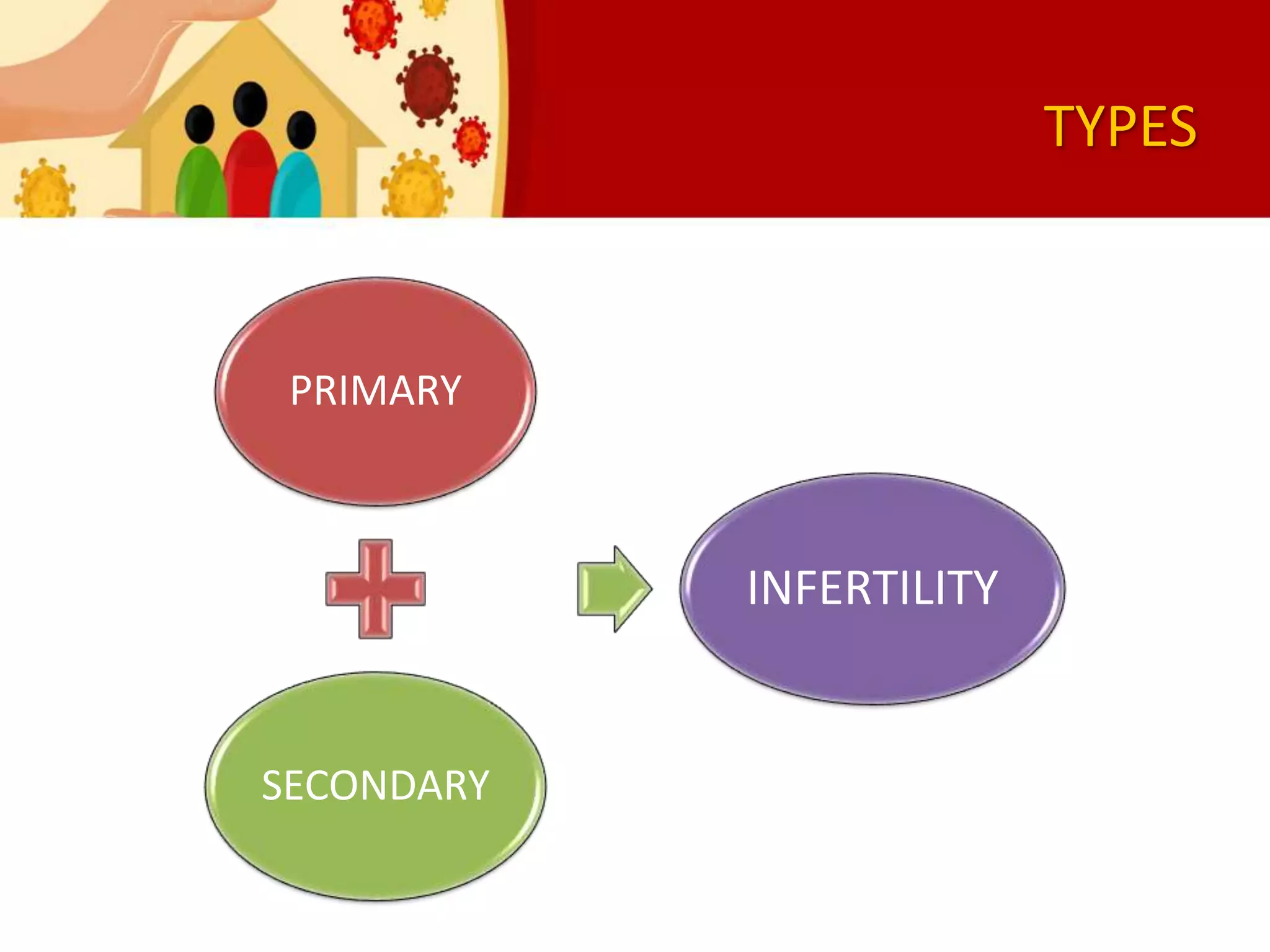
PRIMARY
SECONDARY
INFERTILITY
• PRIMARY INFERTILITY: It denotes those couples who
have never conceived even once.
• SECONDARY INFERTILITY: It indicates previous
pregnancy but failure to conceive subsequently.
RISK FACTORS FOR INFERTILITY
• Age: A women over 35 years of age and men over 40
years of age.
• Diabetic person.
• Eating disorders, including anorexia nervosa and
bulimia.
• Excessive alcohol use.
• Exposure to environmental toxins such as leads and
pesticides.
• Over exercising.
• Radiation therapy or other cancer treatments.
CAUSES OF INFERTILITY
FLIP CARDS
WOMEN:
Ovulation disorders
• Premature ovarian failure (before the age of 40).
• Polycystic ovarian syndrome.
• Hyper-prolactinemia.
• Poor egg quality.
Uterus and fallopian tube
• Any surgery .
• Sub-mucosal fibroids.
• Endometriosis.
• Previous sterilization treatment.
• Salpingitis
Vaginal factors
• Atresia (Partial or complete).
• Septum of vagina.
• Narrow introitus.
Medications
• NSAID’s (aspirin and ibuprofen).
• Chemotherapy.
• Radiotherapy.
• Illegal drugs.
MEN
Defective spermatogenesis
• Congenital: Undescended testes where the vas
deferen is absent.
• Hypospadias: Failure to deposit sperm high in vagina.
• Thermal factor: Rise in body temperature due to
varicocele, big hydrocele, tight undergarments.
• Infection: Mumps orchitis after puberty.
• Loss of sperm motility( asthenozoospermia and
abnormal sperm morphology).
• Iatrogenic: Radiation, cytotoxic drugs, nitrofurantoin
etc.
Obstruction of efferent ducts
• Obstructed by gonococcal or tubercular infections.
Surgical trauma during vasectomy.
Failure to deposit sperm high in vagina
• Erectile dysfunction
• Ejaculatory defects.
DIAGNOSTIC
PROCEDURES OF
INFERTILITY
CHART
MALE
• History and physical examination: Age, duration of
marriage, contraception used, any sexual
dysfunction.
• Semen Analysis: Helps to show the level of sperm
production and whether sperm are functioning well.
• Transrectal Ultrasound: A probe is placed in the
rectum it beams a sound waves to the nearby
ejaculatory ducts. It is use to see the structures of
ejaculatory ducts or seminal vesicles are poorly
formed or blocked.
• Testicular Biopsy: If a semen shows very low number
of sperm or no sperm, testicular biopsy is needed.
• Hormonal profile: This is to check how well the
testicles make sperm and also can rule out major
health problems.
WOMEN
• History and physical examination: Age, duration of
marriage, previous surgical and medical history
(Obstetrics), any contraceptives practice, any sexual
problems.
• Hysterosalpingogram(HSG): This is an x-ray procedure
to see if the fallopian tubes are open or not and to see
the uterine cavity.
• Laparoscopy and Chromopertubation: For detection of
tubal patency, block, motility, any changes in the
endometrium, PCOS.
• Transvaginal Ultrasonography: An ultrasound probe
is placed in the vagina to check the uterus and
ovaries for any abnormalities such as fibroids and
ovarian cysts.
• Ovarian reserve testing: To find out whether the
women can produce an egg of good quality and how
well is the ovaries are responding to hormonal
signals from the brain.
INFERTILITY COUNSELING
• Infertility counselling deals with the psycho-social
impact of infertility in terms of- intervention,
treatment and after-effects of both successful and
unsuccessful treatments. It also involves therapeutic
work to help patient cope with the consequences of
infertility and treatment.
OBJECTIVES AND NEED OF INFERTILITY COUNSELLING
• Informed consent.
• To offer coping strategies to couples.
• To facilitate decision making.
• To offer preparation for procedures.
• To help client in achieving a better quality of life.
• To provide genetic counselling.
COUNSELING SERVICES:
• IVF-group discussion by staff.
• Third party reproduction for both donors and
recipients.
• Therapeutic counselling.
• Assessment and follow up
NURSES RESPONSIBILITIES
• Make the patient or couple comfortable with the
counseling.
• Obtain history of both the couples
• Explain the plan of care and treatment
• Maintain confidentiality
• Ensure follow up care
BIBLIOGRAPHY/REFERENCE
• Annamma Jacob, A comprehensive textbook Midwifery and
Gynaecological Nursing, 4th Edition. Jaypee Brothers. pg no.
857-866.
• DC Dutta’s, Hiralal Konar, Textbook of Gynecology, 7th Edition.
Jaypee Brothers. pg 186-209.
• Lily Podder, Fundamentals of Midwifery and Obstetrical
Nursing. ELSEVIER. pg 295-310.
• https://www.urologyhealth.org/urology-a-z/m/male-
infertility
• https://www.mayoclinic.org/diseases-conditions/female-
infertility/diagnosis-treatment/drc-
20354313#:~:text=Fertility%20tests%20may%20include%3A,
document%20that%20you're%20ovulating

Diagnostic procedures.pptx

  • 1.
    PRESENTED BY LAMNUNNEM HAOKIP MSC(N) 1ST YEAR UNDER THE SUPERVISION OF DEBIKA MA’AM
  • 3.
    DEFINITION • Infertility is"a disease of the reproductive system defined by the failure to achieve a clinical pregnancy after 12 months or more of regular unprotected sexual intercourse (and there is no other reason, such as breastfeeding or postpartum amenorrhea).
  • 4.
  • 5.
    • PRIMARY INFERTILITY:It denotes those couples who have never conceived even once. • SECONDARY INFERTILITY: It indicates previous pregnancy but failure to conceive subsequently.
  • 6.
    RISK FACTORS FORINFERTILITY • Age: A women over 35 years of age and men over 40 years of age. • Diabetic person. • Eating disorders, including anorexia nervosa and bulimia. • Excessive alcohol use. • Exposure to environmental toxins such as leads and pesticides. • Over exercising. • Radiation therapy or other cancer treatments.
  • 7.
  • 8.
    WOMEN: Ovulation disorders • Prematureovarian failure (before the age of 40). • Polycystic ovarian syndrome. • Hyper-prolactinemia. • Poor egg quality.
  • 9.
    Uterus and fallopiantube • Any surgery . • Sub-mucosal fibroids. • Endometriosis. • Previous sterilization treatment. • Salpingitis
  • 10.
    Vaginal factors • Atresia(Partial or complete). • Septum of vagina. • Narrow introitus. Medications • NSAID’s (aspirin and ibuprofen). • Chemotherapy. • Radiotherapy. • Illegal drugs.
  • 11.
    MEN Defective spermatogenesis • Congenital:Undescended testes where the vas deferen is absent. • Hypospadias: Failure to deposit sperm high in vagina. • Thermal factor: Rise in body temperature due to varicocele, big hydrocele, tight undergarments.
  • 12.
    • Infection: Mumpsorchitis after puberty. • Loss of sperm motility( asthenozoospermia and abnormal sperm morphology). • Iatrogenic: Radiation, cytotoxic drugs, nitrofurantoin etc.
  • 13.
    Obstruction of efferentducts • Obstructed by gonococcal or tubercular infections. Surgical trauma during vasectomy. Failure to deposit sperm high in vagina • Erectile dysfunction • Ejaculatory defects.
  • 14.
  • 15.
    MALE • History andphysical examination: Age, duration of marriage, contraception used, any sexual dysfunction. • Semen Analysis: Helps to show the level of sperm production and whether sperm are functioning well. • Transrectal Ultrasound: A probe is placed in the rectum it beams a sound waves to the nearby ejaculatory ducts. It is use to see the structures of ejaculatory ducts or seminal vesicles are poorly formed or blocked.
  • 16.
    • Testicular Biopsy:If a semen shows very low number of sperm or no sperm, testicular biopsy is needed. • Hormonal profile: This is to check how well the testicles make sperm and also can rule out major health problems.
  • 17.
    WOMEN • History andphysical examination: Age, duration of marriage, previous surgical and medical history (Obstetrics), any contraceptives practice, any sexual problems. • Hysterosalpingogram(HSG): This is an x-ray procedure to see if the fallopian tubes are open or not and to see the uterine cavity. • Laparoscopy and Chromopertubation: For detection of tubal patency, block, motility, any changes in the endometrium, PCOS.
  • 18.
    • Transvaginal Ultrasonography:An ultrasound probe is placed in the vagina to check the uterus and ovaries for any abnormalities such as fibroids and ovarian cysts. • Ovarian reserve testing: To find out whether the women can produce an egg of good quality and how well is the ovaries are responding to hormonal signals from the brain.
  • 19.
    INFERTILITY COUNSELING • Infertilitycounselling deals with the psycho-social impact of infertility in terms of- intervention, treatment and after-effects of both successful and unsuccessful treatments. It also involves therapeutic work to help patient cope with the consequences of infertility and treatment.
  • 20.
    OBJECTIVES AND NEEDOF INFERTILITY COUNSELLING • Informed consent. • To offer coping strategies to couples. • To facilitate decision making. • To offer preparation for procedures. • To help client in achieving a better quality of life. • To provide genetic counselling.
  • 21.
    COUNSELING SERVICES: • IVF-groupdiscussion by staff. • Third party reproduction for both donors and recipients. • Therapeutic counselling. • Assessment and follow up
  • 22.
    NURSES RESPONSIBILITIES • Makethe patient or couple comfortable with the counseling. • Obtain history of both the couples • Explain the plan of care and treatment • Maintain confidentiality • Ensure follow up care
  • 24.
    BIBLIOGRAPHY/REFERENCE • Annamma Jacob,A comprehensive textbook Midwifery and Gynaecological Nursing, 4th Edition. Jaypee Brothers. pg no. 857-866. • DC Dutta’s, Hiralal Konar, Textbook of Gynecology, 7th Edition. Jaypee Brothers. pg 186-209. • Lily Podder, Fundamentals of Midwifery and Obstetrical Nursing. ELSEVIER. pg 295-310. • https://www.urologyhealth.org/urology-a-z/m/male- infertility • https://www.mayoclinic.org/diseases-conditions/female- infertility/diagnosis-treatment/drc- 20354313#:~:text=Fertility%20tests%20may%20include%3A, document%20that%20you're%20ovulating