NCM 105
NUTRITION
AND DIET THERAPY
By: Ray-Hannah G. Makakena, RND
Instructor
Nutrition and Dietetics Department
First Semester, School Year 2020-2021
COURSE DESCRIPTION
• This course deals with the study of food in relation to
health and illness. It covers nutrients and other
substances and their action, interaction, and balance in
relation to health and diseases and the process by which
the human body ingests, digests, absorbs, transports,
utilizes, and excrete food substances. It also focuses on
the therapeutic and food service aspects of delivery of
nutritional services in hospitals and other healthcare
institutions. The learners are expected to develop the
competencies in appropriate meal planning and
education of a given client.
COURSE OUTLINE
• Classifications
• Functions
• Food Sources
• Digestion, Absorption, and Utilization
• Individual Requirements and PDRI
• Effects of Excessive and Deficient Intakes
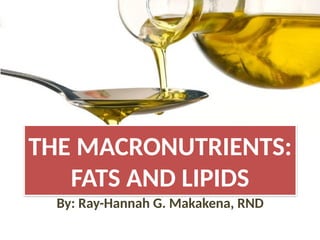
THE MACRONUTRIENTS:
FATS AND LIPIDS
By: Ray-Hannah G. Makakena, RND
INTENDED LEARNING OUTCOME
By the end of the learning experience, the students must be able to:
1. Describe and explain the characteristics and classifications of
fats
2. Distinguish the different functions of fat in the body
3. Suggest food items that are sources of good fats
4. Discuss the processes involved in digestions, absorption, and
utilization of fats
5. Estimate the individual requirements/PDRI of fats for each age
group
6. Predict the consequences of excessive and inadequate intakes of
fats
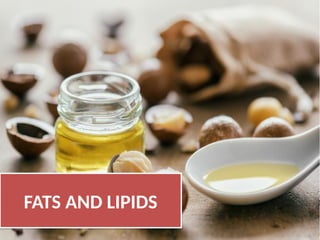
FATS AND LIPIDS
Fats and Lipids
• Fats and lipids in the right kind and amount,
are necessary as component of tissues and to
regulate certain body processes.
• True fats belong to a larger group of organic
compounds chemically called Lipids.
• Fats stay solid at room temperature and oils
stay liquid.
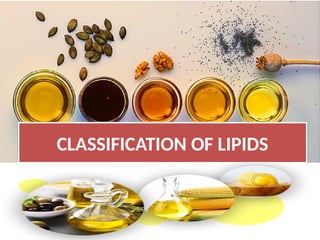
CLASSIFICATION OF LIPIDS
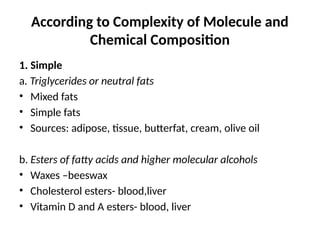
According to Complexity of Molecule and
Chemical Composition
1. Simple
a. Triglycerides or neutral fats
• Mixed fats
• Simple fats
• Sources: adipose, tissue, butterfat, cream, olive oil
b. Esters of fatty acids and higher molecular alcohols
• Waxes –beeswax
• Cholesterol esters- blood,liver
• Vitamin D and A esters- blood, liver
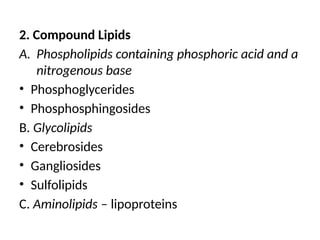
2. Compound Lipids
A. Phospholipids containing phosphoric acid and a
nitrogenous base
• Phosphoglycerides
• Phosphosphingosides
B. Glycolipids
• Cerebrosides
• Gangliosides
• Sulfolipids
C. Aminolipids – lipoproteins
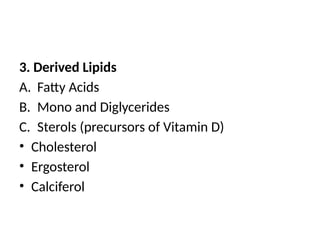
3. Derived Lipids
A. Fatty Acids
B. Mono and Diglycerides
C. Sterols (precursors of Vitamin D)
• Cholesterol
• Ergosterol
• Calciferol
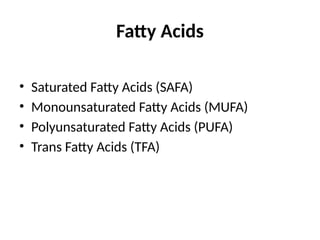
Fatty Acids
• Saturated Fatty Acids (SAFA)
• Monounsaturated Fatty Acids (MUFA)
• Polyunsaturated Fatty Acids (PUFA)
• Trans Fatty Acids (TFA)
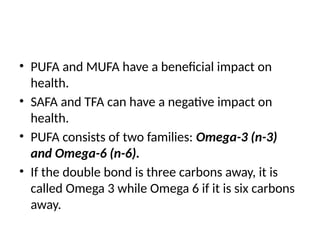
• PUFA and MUFA have a beneficial impact on
health.
• SAFA and TFA can have a negative impact on
health.
• PUFA consists of two families: Omega-3 (n-3)
and Omega-6 (n-6).
• If the double bond is three carbons away, it is
called Omega 3 while Omega 6 if it is six carbons
away.
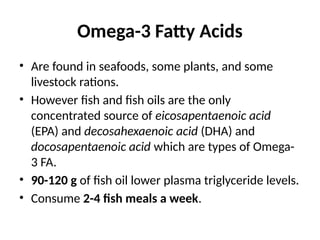
Omega-3 Fatty Acids
• Are found in seafoods, some plants, and some
livestock rations.
• However fish and fish oils are the only
concentrated source of eicosapentaenoic acid
(EPA) and decosahexaenoic acid (DHA) and
docosapentaenoic acid which are types of Omega-
3 FA.
• 90-120 g of fish oil lower plasma triglyceride levels.
• Consume 2-4 fish meals a week.
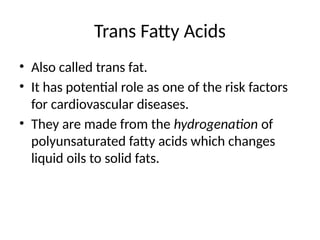
Trans Fatty Acids
• Also called trans fat.
• It has potential role as one of the risk factors
for cardiovascular diseases.
• They are made from the hydrogenation of
polyunsaturated fatty acids which changes
liquid oils to solid fats.
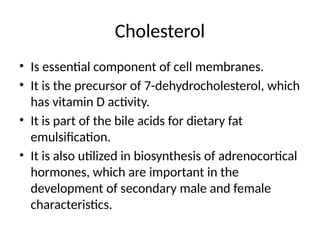
Cholesterol
• Is essential component of cell membranes.
• It is the precursor of 7-dehydrocholesterol, which
has vitamin D activity.
• It is part of the bile acids for dietary fat
emulsification.
• It is also utilized in biosynthesis of adrenocortical
hormones, which are important in the
development of secondary male and female
characteristics.
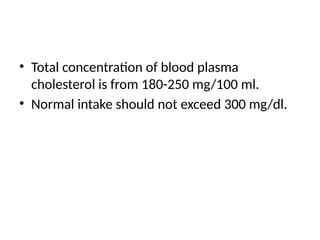
• Total concentration of blood plasma
cholesterol is from 180-250 mg/100 ml.
• Normal intake should not exceed 300 mg/dl.
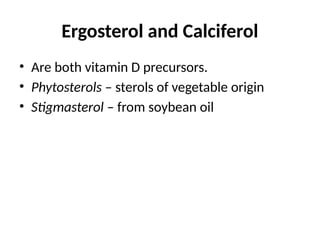
Ergosterol and Calciferol
• Are both vitamin D precursors.
• Phytosterols – sterols of vegetable origin
• Stigmasterol – from soybean oil
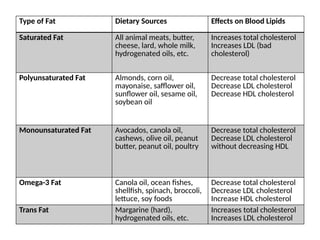
Type of Fat Dietary Sources Effects on Blood Lipids
Saturated Fat All animal meats, butter,
cheese, lard, whole milk,
hydrogenated oils, etc.
Increases total cholesterol
Increases LDL (bad
cholesterol)
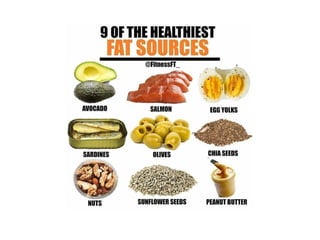
Polyunsaturated Fat Almonds, corn oil,
mayonaise, safflower oil,
sunflower oil, sesame oil,
soybean oil
Decrease total cholesterol
Decrease LDL cholesterol
Decrease HDL cholesterol
Monounsaturated Fat Avocados, canola oil,
cashews, olive oil, peanut
butter, peanut oil, poultry
Decrease total cholesterol
Decrease LDL cholesterol
without decreasing HDL
Omega-3 Fat Canola oil, ocean fishes,
shellfish, spinach, broccoli,
lettuce, soy foods
Decrease total cholesterol
Decrease LDL cholesterol
Increase HDL cholesterol
Trans Fat Margarine (hard),
hydrogenated oils, etc.
Increases total cholesterol
Increases LDL cholesterol
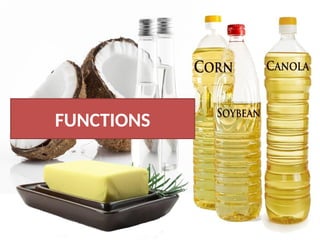
FUNCTIONS
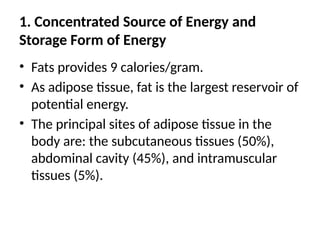
1. Concentrated Source of Energy and
Storage Form of Energy
• Fats provides 9 calories/gram.
• As adipose tissue, fat is the largest reservoir of
potential energy.
• The principal sites of adipose tissue in the
body are: the subcutaneous tissues (50%),
abdominal cavity (45%), and intramuscular
tissues (5%).
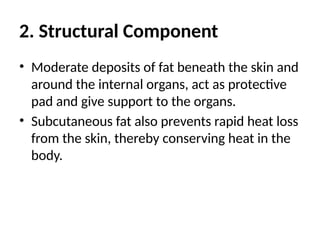
2. Structural Component
• Moderate deposits of fat beneath the skin and
around the internal organs, act as protective
pad and give support to the organs.
• Subcutaneous fat also prevents rapid heat loss
from the skin, thereby conserving heat in the
body.
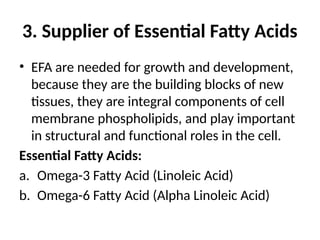
3. Supplier of Essential Fatty Acids
• EFA are needed for growth and development,
because they are the building blocks of new
tissues, they are integral components of cell
membrane phospholipids, and play important
in structural and functional roles in the cell.
Essential Fatty Acids:
a. Omega-3 Fatty Acid (Linoleic Acid)
b. Omega-6 Fatty Acid (Alpha Linoleic Acid)
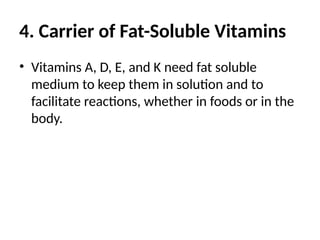
4. Carrier of Fat-Soluble Vitamins
• Vitamins A, D, E, and K need fat soluble
medium to keep them in solution and to
facilitate reactions, whether in foods or in the
body.
5. Sparer of Protein, Thiamin, and Niacin
• Thiamin and niacin are not appreciably
needed in fat metabolism as compared to CHO
metabolism.
6. Other Special Functions
• Fat has a high satiety value.
• It is also contributes to flavor and palatability.
• It helps retain moistness in food products.
• Certain lipids are emulsifying agents which help in the
transport of fatty substances that cannot easily pass
through the cell membrane.
• Fatty acids are precursors of a group substance called
prostaglandins, which participates in the regulation of
blood pressure, heart rate, and lipolysis.
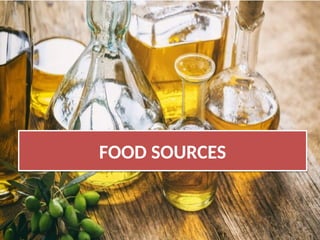
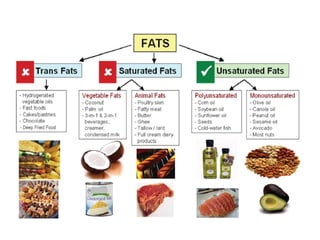
FOOD SOURCES
DIGESTION, ABSORPTION, AND UTILIZATION
Digestion, Absorption, and Utilization
• In the stomach, emulsified fat is digested to
free fatty acids and glycerol by the action of
gastric lipase.
• Non-emulsified fat is acted upon by the bile
salts in the small intestines and the resulting
emulsified fat is hydrolyzed by the pancreatic
lipase to fatty acids and glycerol.
• Almost all fats are absorbed into the lymphatic
system from the intestinal mucus as
chylomicrons.
• The glycerol portion and short-chained free
fatty acids are absorbed directly into the
portal circulation via the liver.
• The major site of lipid metabolism is in the
liver.
• Oxidation of fatty acids to release energy is
accomplished by the beta-oxidation process.
• The active acetate enters the Krebs Cycle,
which is the common pathway for energy
release.
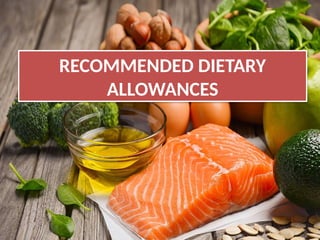
RECOMMENDED DIETARY
ALLOWANCES
RDA
• At least 20% of total caloric allowance be
supplied by the dietary fat.
• The RDA for Essential Fatty Acids is 2%.
• An adequate Omega-3 FA intake for adults is
3-6 grams/day.
• The consensus of opinion by professional organizations
such as dietetic associations, heart associations, and
cancer institutes, as implemented by nutritionists and
dietitians, is to provide 30% of total calories from fat
sources. The recommended distribution are:
• 6-10% from PUFA
• 10-15% from MUFA
• 10% or less from SUFA
• 1% or less from TFA
Example:
Total Caloric need= 1,890 Kcal
1,890 .25 (25%) = 472.5 kcal
472.5 kcal 9 kcal/gram (1 g of fat=9 kcal)
Fat Requirement=52.5 g/day
CHO Requirement (60%) = 283.5 g/day
CHON Requirement (15%) = 71 g/day
Fat Requirement (25%) = 52.5 g/day
EFFECTS OF EXCESSIVE AND
DEFICIENT INTAKES
• Deficiency will reduce the caloric supply in the
body and cause protein catabolism. Depot fats
will be withdrawn and body weight reduced.
• Deficiency of EFA causes retarded growth and
eczematous skin in infants.
• Excessive intake above the normal level leads
to obesity.
SUMMARY
• Fats is classified according to Complexity of
Molecule and Chemical Composition.
• The main function of fats is concentrated
source of energy and storage form of energy.
• Deficiency will reduce the caloric supply in the
body and cause protein catabolism. Excessive
intake above the normal level leads to obesity.
REFERENCES
• Basic Nutrition for Filipinos 6th
Edition by
Adela Jamorabo-Ruiz and Virginia Serraon
Claudio

Chapter-4-Fats.pptx please read that to understand

  • 1.
    NCM 105 NUTRITION AND DIETTHERAPY By: Ray-Hannah G. Makakena, RND Instructor Nutrition and Dietetics Department First Semester, School Year 2020-2021
  • 2.
    COURSE DESCRIPTION • Thiscourse deals with the study of food in relation to health and illness. It covers nutrients and other substances and their action, interaction, and balance in relation to health and diseases and the process by which the human body ingests, digests, absorbs, transports, utilizes, and excrete food substances. It also focuses on the therapeutic and food service aspects of delivery of nutritional services in hospitals and other healthcare institutions. The learners are expected to develop the competencies in appropriate meal planning and education of a given client.
  • 3.
    COURSE OUTLINE • Classifications •Functions • Food Sources • Digestion, Absorption, and Utilization • Individual Requirements and PDRI • Effects of Excessive and Deficient Intakes
  • 4.
    THE MACRONUTRIENTS: FATS ANDLIPIDS By: Ray-Hannah G. Makakena, RND
  • 5.
    INTENDED LEARNING OUTCOME Bythe end of the learning experience, the students must be able to: 1. Describe and explain the characteristics and classifications of fats 2. Distinguish the different functions of fat in the body 3. Suggest food items that are sources of good fats 4. Discuss the processes involved in digestions, absorption, and utilization of fats 5. Estimate the individual requirements/PDRI of fats for each age group 6. Predict the consequences of excessive and inadequate intakes of fats
  • 6.
  • 7.
    Fats and Lipids •Fats and lipids in the right kind and amount, are necessary as component of tissues and to regulate certain body processes. • True fats belong to a larger group of organic compounds chemically called Lipids. • Fats stay solid at room temperature and oils stay liquid.
  • 8.
  • 9.
    According to Complexityof Molecule and Chemical Composition 1. Simple a. Triglycerides or neutral fats • Mixed fats • Simple fats • Sources: adipose, tissue, butterfat, cream, olive oil b. Esters of fatty acids and higher molecular alcohols • Waxes –beeswax • Cholesterol esters- blood,liver • Vitamin D and A esters- blood, liver
  • 10.
    2. Compound Lipids A.Phospholipids containing phosphoric acid and a nitrogenous base • Phosphoglycerides • Phosphosphingosides B. Glycolipids • Cerebrosides • Gangliosides • Sulfolipids C. Aminolipids – lipoproteins
  • 11.
    3. Derived Lipids A.Fatty Acids B. Mono and Diglycerides C. Sterols (precursors of Vitamin D) • Cholesterol • Ergosterol • Calciferol
  • 12.
    Fatty Acids • SaturatedFatty Acids (SAFA) • Monounsaturated Fatty Acids (MUFA) • Polyunsaturated Fatty Acids (PUFA) • Trans Fatty Acids (TFA)
  • 13.
    • PUFA andMUFA have a beneficial impact on health. • SAFA and TFA can have a negative impact on health. • PUFA consists of two families: Omega-3 (n-3) and Omega-6 (n-6). • If the double bond is three carbons away, it is called Omega 3 while Omega 6 if it is six carbons away.
  • 14.
    Omega-3 Fatty Acids •Are found in seafoods, some plants, and some livestock rations. • However fish and fish oils are the only concentrated source of eicosapentaenoic acid (EPA) and decosahexaenoic acid (DHA) and docosapentaenoic acid which are types of Omega- 3 FA. • 90-120 g of fish oil lower plasma triglyceride levels. • Consume 2-4 fish meals a week.
  • 15.
    Trans Fatty Acids •Also called trans fat. • It has potential role as one of the risk factors for cardiovascular diseases. • They are made from the hydrogenation of polyunsaturated fatty acids which changes liquid oils to solid fats.
  • 16.
    Cholesterol • Is essentialcomponent of cell membranes. • It is the precursor of 7-dehydrocholesterol, which has vitamin D activity. • It is part of the bile acids for dietary fat emulsification. • It is also utilized in biosynthesis of adrenocortical hormones, which are important in the development of secondary male and female characteristics.
  • 17.
    • Total concentrationof blood plasma cholesterol is from 180-250 mg/100 ml. • Normal intake should not exceed 300 mg/dl.
  • 18.
    Ergosterol and Calciferol •Are both vitamin D precursors. • Phytosterols – sterols of vegetable origin • Stigmasterol – from soybean oil
  • 19.
    Type of FatDietary Sources Effects on Blood Lipids Saturated Fat All animal meats, butter, cheese, lard, whole milk, hydrogenated oils, etc. Increases total cholesterol Increases LDL (bad cholesterol) Polyunsaturated Fat Almonds, corn oil, mayonaise, safflower oil, sunflower oil, sesame oil, soybean oil Decrease total cholesterol Decrease LDL cholesterol Decrease HDL cholesterol Monounsaturated Fat Avocados, canola oil, cashews, olive oil, peanut butter, peanut oil, poultry Decrease total cholesterol Decrease LDL cholesterol without decreasing HDL Omega-3 Fat Canola oil, ocean fishes, shellfish, spinach, broccoli, lettuce, soy foods Decrease total cholesterol Decrease LDL cholesterol Increase HDL cholesterol Trans Fat Margarine (hard), hydrogenated oils, etc. Increases total cholesterol Increases LDL cholesterol
  • 20.
  • 21.
    1. Concentrated Sourceof Energy and Storage Form of Energy • Fats provides 9 calories/gram. • As adipose tissue, fat is the largest reservoir of potential energy. • The principal sites of adipose tissue in the body are: the subcutaneous tissues (50%), abdominal cavity (45%), and intramuscular tissues (5%).
  • 22.
    2. Structural Component •Moderate deposits of fat beneath the skin and around the internal organs, act as protective pad and give support to the organs. • Subcutaneous fat also prevents rapid heat loss from the skin, thereby conserving heat in the body.
  • 23.
    3. Supplier ofEssential Fatty Acids • EFA are needed for growth and development, because they are the building blocks of new tissues, they are integral components of cell membrane phospholipids, and play important in structural and functional roles in the cell. Essential Fatty Acids: a. Omega-3 Fatty Acid (Linoleic Acid) b. Omega-6 Fatty Acid (Alpha Linoleic Acid)
  • 24.
    4. Carrier ofFat-Soluble Vitamins • Vitamins A, D, E, and K need fat soluble medium to keep them in solution and to facilitate reactions, whether in foods or in the body.
  • 25.
    5. Sparer ofProtein, Thiamin, and Niacin • Thiamin and niacin are not appreciably needed in fat metabolism as compared to CHO metabolism.
  • 26.
    6. Other SpecialFunctions • Fat has a high satiety value. • It is also contributes to flavor and palatability. • It helps retain moistness in food products. • Certain lipids are emulsifying agents which help in the transport of fatty substances that cannot easily pass through the cell membrane. • Fatty acids are precursors of a group substance called prostaglandins, which participates in the regulation of blood pressure, heart rate, and lipolysis.
  • 27.
  • 30.
  • 31.
    Digestion, Absorption, andUtilization • In the stomach, emulsified fat is digested to free fatty acids and glycerol by the action of gastric lipase. • Non-emulsified fat is acted upon by the bile salts in the small intestines and the resulting emulsified fat is hydrolyzed by the pancreatic lipase to fatty acids and glycerol.
  • 32.
    • Almost allfats are absorbed into the lymphatic system from the intestinal mucus as chylomicrons. • The glycerol portion and short-chained free fatty acids are absorbed directly into the portal circulation via the liver. • The major site of lipid metabolism is in the liver.
  • 33.
    • Oxidation offatty acids to release energy is accomplished by the beta-oxidation process. • The active acetate enters the Krebs Cycle, which is the common pathway for energy release.
  • 34.
  • 35.
    RDA • At least20% of total caloric allowance be supplied by the dietary fat. • The RDA for Essential Fatty Acids is 2%. • An adequate Omega-3 FA intake for adults is 3-6 grams/day.
  • 36.
    • The consensusof opinion by professional organizations such as dietetic associations, heart associations, and cancer institutes, as implemented by nutritionists and dietitians, is to provide 30% of total calories from fat sources. The recommended distribution are: • 6-10% from PUFA • 10-15% from MUFA • 10% or less from SUFA • 1% or less from TFA
  • 37.
    Example: Total Caloric need=1,890 Kcal 1,890 .25 (25%) = 472.5 kcal 472.5 kcal 9 kcal/gram (1 g of fat=9 kcal) Fat Requirement=52.5 g/day CHO Requirement (60%) = 283.5 g/day CHON Requirement (15%) = 71 g/day Fat Requirement (25%) = 52.5 g/day
  • 38.
    EFFECTS OF EXCESSIVEAND DEFICIENT INTAKES
  • 39.
    • Deficiency willreduce the caloric supply in the body and cause protein catabolism. Depot fats will be withdrawn and body weight reduced. • Deficiency of EFA causes retarded growth and eczematous skin in infants. • Excessive intake above the normal level leads to obesity.
  • 40.
    SUMMARY • Fats isclassified according to Complexity of Molecule and Chemical Composition. • The main function of fats is concentrated source of energy and storage form of energy. • Deficiency will reduce the caloric supply in the body and cause protein catabolism. Excessive intake above the normal level leads to obesity.
  • 41.
    REFERENCES • Basic Nutritionfor Filipinos 6th Edition by Adela Jamorabo-Ruiz and Virginia Serraon Claudio