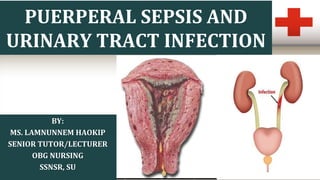


PUERPERAL SEPSIS AND
URINARY TRACT INFECTION
BY:
MS. LAMNUNNEM HAOKIP
SENIOR TUTOR/LECTURER
OBG NURSING
SSNSR, SU
PUERPERIUM
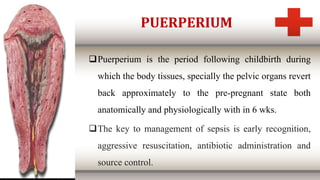
Puerperium is the period following childbirth during
which the body tissues, specially the pelvic organs revert
back approximately to the pre-pregnant state both
anatomically and physiologically with in 6 wks.
The key to management of sepsis is early recognition,
aggressive resuscitation, antibiotic administration and
source control.
INCIDENCES
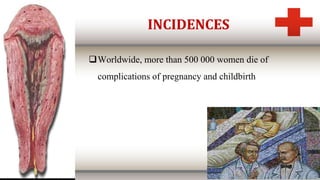
Worldwide, more than 500 000 women die of
complications of pregnancy and childbirth
PUERPERAL SEPSIS
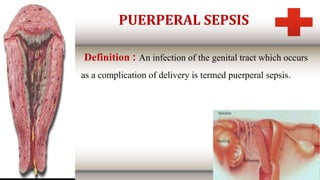
Definition : An infection of the genital tract which occurs
as a complication of delivery is termed puerperal sepsis.
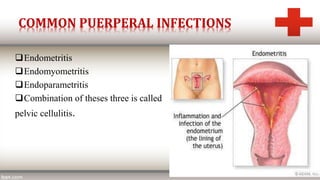
COMMON PUERPERAL INFECTIONS
Endometritis
Endomyometritis
Endoparametritis
Combination of theses three is called
pelvic cellulitis.
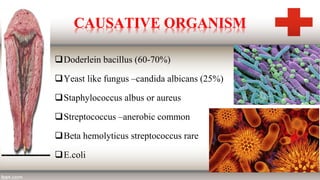
CAUSATIVE ORGANISM
Doderlein bacillus (60-70%)
Yeast like fungus –candida albicans (25%)
Staphylococcus albus or aureus
Streptococcus –anerobic common
Beta hemolyticus streptococcus rare
E.coli
PREDISPOSING FACTORS
Antepartum factors :
• Malnutrition and anaemia
• Preterm labor
• Premature rupture of the membrane
• Chronic deliberating illness
• Prolonged rupture of the membrane
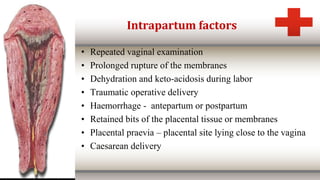
• Repeated vaginal examination
• Prolonged rupture of the membranes
• Dehydration and keto-acidosis during labor
• Traumatic operative delivery
• Haemorrhage - antepartum or postpartum
• Retained bits of the placental tissue or membranes
• Placental praevia – placental site lying close to the vagina
• Caesarean delivery
Intrapartum factors
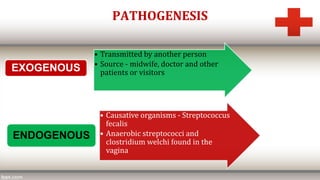
PATHOGENESIS
• Transmitted by another person
• Source - midwife, doctor and other
patients or visitors
EXOGENOUS
• Causative organisms - Streptococcus
fecalis
• Anaerobic streptococci and
clostridium welchi found in the
vagina
ENDOGENOUS
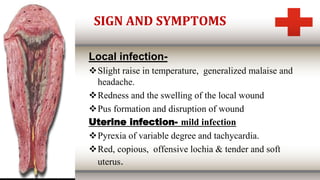
SIGN AND SYMPTOMS
Local infection-
Slight raise in temperature, generalized malaise and
headache.
Redness and the swelling of the local wound
Pus formation and disruption of wound
Uterine infection- mild infection
Pyrexia of variable degree and tachycardia.
Red, copious, offensive lochia & tender and soft
uterus.
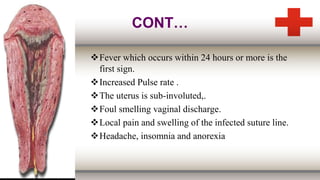
CONT…
Fever which occurs within 24 hours or more is the
first sign.
Increased Pulse rate .
The uterus is sub-involuted,.
Foul smelling vaginal discharge.
Local pain and swelling of the infected suture line.
Headache, insomnia and anorexia
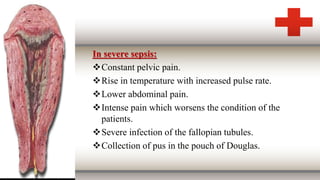
In severe sepsis:
Constant pelvic pain.
Rise in temperature with increased pulse rate.
Lower abdominal pain.
Intense pain which worsens the condition of the
patients.
Severe infection of the fallopian tubules.
Collection of pus in the pouch of Douglas.
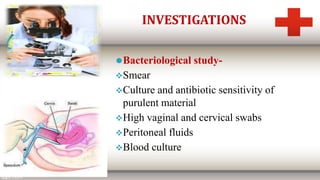
⚫Bacteriological study-
Smear
Culture and antibiotic sensitivity of
purulent material
High vaginal and cervical swabs
Peritoneal fluids
Blood culture
INVESTIGATIONS
 Urine :-
 Routine and microscopic examination
 Culture if infection is suspected
 CBC Profile
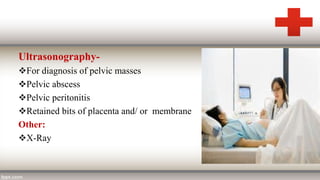
Ultrasonography-
For diagnosis of pelvic masses
Pelvic abscess
Pelvic peritonitis
Retained bits of placenta and/ or membrane
Other:
X-Ray
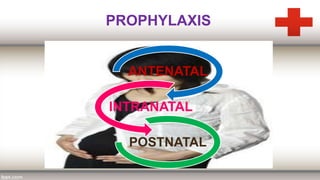
PROPHYLAXIS
ANTENATAL
INTRANATAL
POSTNATAL
ANTENATAL
Improvement of general condition
Treatment of septic cocci
Abstinence from sexual intercourse in the last two
months
Care about personal hygiene – bathing in dirty water to
be avoided
Avoiding contact with people having infection, such as
cold, boils.
Avoiding unnecessary vaginal examinations and douches
in the later months.
INTRAPARTUM
Staff attending on labor client should be free of
infections.
Full surgical asepsis to be taken while conducting
delivery
Prophylactic antibiotic must be administered in cases
of caesarean section to reduced the incidence of
wound infection, endometritis UTI.
Ceftriaxone 1g IV immediately after cord clamping
and a second dose after 8 hours is recommended.
POSTPARTUM
Take aseptic precautions while dressing the perineal
wound
Restriction of the visitor in the postpartum ward
Mothers to be instructed to use sterile sanitary pads
and to change them frequently
Vulva and perineum to be cleaned with mild
antiseptic solution following urination and defecation
Infected mothers and babies are to be isolated
TREATMENT
1. ISOLATION OF PATIENT: specially when
haemolytic streptococcus is obtained on culture.
2. MAINTAIN INTAKE & OUTPUT
3. INDWELLING CATHETER: to relieve any urine
retention due to pelvic abscess.
4. ANTIBIOTIC: intravenous administration of
cefotaxim 1g, 8hrly & metronidazole 0.5g, every 8
hrly. The treatment is continued for at least 7-10
days.
SURGICAL INTERVENTION
PERINEAL WOUND:
• The stitches of the perineal wound may have to be
removed to facilitate drainage of pus and relieve pain
After the infection is controlled, secondary sutures
may be given later.
RETAINED UTERINE PRODUCTS
PELVIC ABSCESS :should be drained by
colpotomy under ultrasound guidance.
HYSTRECTOMY
URINARY TRACT
INFECTION
DEFINITION
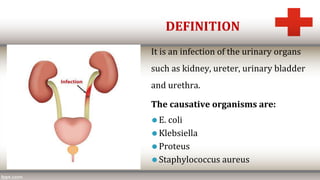
It is an infection of the urinary organs
such as kidney, ureter, urinary bladder
and urethra.
The causative organisms are:
⚫ E. coli
⚫ Klebsiella
⚫ Proteus
⚫ Staphylococcus aureus
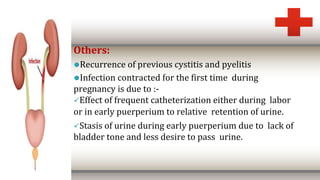
Others:
⚫Recurrence of previous cystitis and pyelitis
⚫Infection contracted for the first time during
pregnancy is due to :-
Effect of frequent catheterization either during labor
or in early puerperium to relative retention of urine.
Stasis of urine during early puerperium due to lack of
bladder tone and less desire to pass urine.
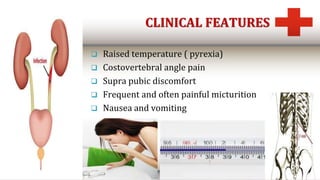
CLINICAL FEATURES
 Raised temperature ( pyrexia)
 Costovertebral angle pain
 Supra pubic discomfort
 Frequent and often painful micturition
 Nausea and vomiting
DIAGNOSIS
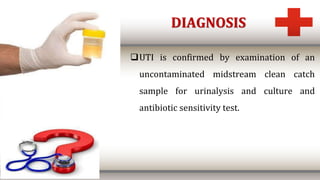
UTI is confirmed by examination of an
uncontaminated midstream clean catch
sample for urinalysis and culture and
antibiotic sensitivity test.
MANAGEMENT
Adequate intake of fluids
Adequate drainage of urine
Keeping the perineal area clean and hygienic
Frequent changing of inner wears
Used of clean warm water
Proper Antimicrobial therapy: Ceftriaxone 250 mg 6 hours apart or
500 mg 8 hours apart IV.
BIBLIOGRAPHY/REFERENCES
• Annamma Jabob. A comprehensive textbook of Midwifery and Gynaecological
Nursing, Fourth edition.
• Lily Podder. Fundamentals of Midwifery and Obstetrical Nursing. ELSEVIER.
• DC Dutta’s textbook of Obstetrics. Hiralal Konar 8th Edition.Jaypee The Health
Sciences Publisher.
• https://www.nhp.gov.in/disease/gynaecology-and-obstetrics/puerperal-sepsis
• https://pubmed.ncbi.nlm.nih.gov/23993724/
PUERPERAL SEPSIS & UTI.ppt

PUERPERAL SEPSIS & UTI.ppt

  • 1.
    PUERPERAL SEPSIS AND URINARYTRACT INFECTION BY: MS. LAMNUNNEM HAOKIP SENIOR TUTOR/LECTURER OBG NURSING SSNSR, SU
  • 2.
    PUERPERIUM Puerperium is theperiod following childbirth during which the body tissues, specially the pelvic organs revert back approximately to the pre-pregnant state both anatomically and physiologically with in 6 wks. The key to management of sepsis is early recognition, aggressive resuscitation, antibiotic administration and source control.
  • 3.
    INCIDENCES Worldwide, more than500 000 women die of complications of pregnancy and childbirth
  • 4.
    PUERPERAL SEPSIS Definition :An infection of the genital tract which occurs as a complication of delivery is termed puerperal sepsis.
  • 5.
  • 6.
    CAUSATIVE ORGANISM Doderlein bacillus(60-70%) Yeast like fungus –candida albicans (25%) Staphylococcus albus or aureus Streptococcus –anerobic common Beta hemolyticus streptococcus rare E.coli
  • 7.
    PREDISPOSING FACTORS Antepartum factors: • Malnutrition and anaemia • Preterm labor • Premature rupture of the membrane • Chronic deliberating illness • Prolonged rupture of the membrane
  • 8.
    • Repeated vaginalexamination • Prolonged rupture of the membranes • Dehydration and keto-acidosis during labor • Traumatic operative delivery • Haemorrhage - antepartum or postpartum • Retained bits of the placental tissue or membranes • Placental praevia – placental site lying close to the vagina • Caesarean delivery Intrapartum factors
  • 9.
    PATHOGENESIS • Transmitted byanother person • Source - midwife, doctor and other patients or visitors EXOGENOUS • Causative organisms - Streptococcus fecalis • Anaerobic streptococci and clostridium welchi found in the vagina ENDOGENOUS
  • 10.
    SIGN AND SYMPTOMS Localinfection- Slight raise in temperature, generalized malaise and headache. Redness and the swelling of the local wound Pus formation and disruption of wound Uterine infection- mild infection Pyrexia of variable degree and tachycardia. Red, copious, offensive lochia & tender and soft uterus.
  • 11.
    CONT… Fever which occurswithin 24 hours or more is the first sign. Increased Pulse rate . The uterus is sub-involuted,. Foul smelling vaginal discharge. Local pain and swelling of the infected suture line. Headache, insomnia and anorexia
  • 12.
    In severe sepsis: Constantpelvic pain. Rise in temperature with increased pulse rate. Lower abdominal pain. Intense pain which worsens the condition of the patients. Severe infection of the fallopian tubules. Collection of pus in the pouch of Douglas.
  • 13.
    ⚫Bacteriological study- Smear Culture andantibiotic sensitivity of purulent material High vaginal and cervical swabs Peritoneal fluids Blood culture INVESTIGATIONS
  • 14.
     Urine :- Routine and microscopic examination  Culture if infection is suspected  CBC Profile
  • 15.
    Ultrasonography- For diagnosis ofpelvic masses Pelvic abscess Pelvic peritonitis Retained bits of placenta and/ or membrane Other: X-Ray
  • 16.
  • 17.
    ANTENATAL Improvement of generalcondition Treatment of septic cocci Abstinence from sexual intercourse in the last two months Care about personal hygiene – bathing in dirty water to be avoided Avoiding contact with people having infection, such as cold, boils. Avoiding unnecessary vaginal examinations and douches in the later months.
  • 18.
    INTRAPARTUM Staff attending onlabor client should be free of infections. Full surgical asepsis to be taken while conducting delivery Prophylactic antibiotic must be administered in cases of caesarean section to reduced the incidence of wound infection, endometritis UTI. Ceftriaxone 1g IV immediately after cord clamping and a second dose after 8 hours is recommended.
  • 19.
    POSTPARTUM Take aseptic precautionswhile dressing the perineal wound Restriction of the visitor in the postpartum ward Mothers to be instructed to use sterile sanitary pads and to change them frequently Vulva and perineum to be cleaned with mild antiseptic solution following urination and defecation Infected mothers and babies are to be isolated
  • 20.
    TREATMENT 1. ISOLATION OFPATIENT: specially when haemolytic streptococcus is obtained on culture. 2. MAINTAIN INTAKE & OUTPUT 3. INDWELLING CATHETER: to relieve any urine retention due to pelvic abscess. 4. ANTIBIOTIC: intravenous administration of cefotaxim 1g, 8hrly & metronidazole 0.5g, every 8 hrly. The treatment is continued for at least 7-10 days.
  • 21.
    SURGICAL INTERVENTION PERINEAL WOUND: •The stitches of the perineal wound may have to be removed to facilitate drainage of pus and relieve pain After the infection is controlled, secondary sutures may be given later. RETAINED UTERINE PRODUCTS PELVIC ABSCESS :should be drained by colpotomy under ultrasound guidance. HYSTRECTOMY
  • 22.
  • 23.
    DEFINITION It is aninfection of the urinary organs such as kidney, ureter, urinary bladder and urethra. The causative organisms are: ⚫ E. coli ⚫ Klebsiella ⚫ Proteus ⚫ Staphylococcus aureus
  • 24.
    Others: ⚫Recurrence of previouscystitis and pyelitis ⚫Infection contracted for the first time during pregnancy is due to :- Effect of frequent catheterization either during labor or in early puerperium to relative retention of urine. Stasis of urine during early puerperium due to lack of bladder tone and less desire to pass urine.
  • 25.
    CLINICAL FEATURES  Raisedtemperature ( pyrexia)  Costovertebral angle pain  Supra pubic discomfort  Frequent and often painful micturition  Nausea and vomiting
  • 26.
    DIAGNOSIS UTI is confirmedby examination of an uncontaminated midstream clean catch sample for urinalysis and culture and antibiotic sensitivity test.
  • 27.
    MANAGEMENT Adequate intake offluids Adequate drainage of urine Keeping the perineal area clean and hygienic Frequent changing of inner wears Used of clean warm water Proper Antimicrobial therapy: Ceftriaxone 250 mg 6 hours apart or 500 mg 8 hours apart IV.
  • 28.
    BIBLIOGRAPHY/REFERENCES • Annamma Jabob.A comprehensive textbook of Midwifery and Gynaecological Nursing, Fourth edition. • Lily Podder. Fundamentals of Midwifery and Obstetrical Nursing. ELSEVIER. • DC Dutta’s textbook of Obstetrics. Hiralal Konar 8th Edition.Jaypee The Health Sciences Publisher. • https://www.nhp.gov.in/disease/gynaecology-and-obstetrics/puerperal-sepsis • https://pubmed.ncbi.nlm.nih.gov/23993724/