Objectives
- Identify factors that contribute to heart
disease.
- Explain why cholesterol and saturated fats
are limited in some cardiovascular
conditions.
- Identify foods to avoid or limit in a
cholesterol-controlled diet.
- Explain why sodium is limited in some
cardiovascular conditions.
- Identify foods that are limited or
prohibited in sodium-controlled diets.
- Identify alternatives to sodium in diets for
patients with heart disease
Cardiovascular Disease
- Affects heart and blood vessels
- Leading cause of death and permanent
disability in the United States
- More deaths are caused by heart disease
than by cancer, accidents and AIDS
combined
Risk Factors of heart disease:
Eg:
- Smoking - Hypertension
- Diabetes - Insulin resistance
- Infection - Periodontal disease
- Obesity - age
- Male sex - Sedentary lifestyle
- ect….
Cardiovascular Disease
Cardiovascular disease can be acute or
chronic.
Acute: means sudden such as myocardial
infarction (MI) also known as heart attack
Chronic: develops over time such as
congested heart failure (CHF),
Arteriosclerosis and Atherosclerosis
Myocardial Infarction
- Caused by blockage of a coronary artery
supplying blood to the heart
- Heart tissue beyond the blockage dies.
Causes
- Atherosclerosis
- Hypertension
- Abnormal blood clotting
- Infection such as that caused by rheumatic
fever (damages heart valves)
Arteriosclerosis: arteries harden, making
the passage of blood difficult and
sometimes impossible
Atherosclerosis: thickening and weakening
of artery walls by cholesterol and fatty
deposits called plaque
Myocardial Infarction
Dietary managements MI
- After the heart attack, the client is in
shock.
- Client should be NPO (nothing by
mouth).
- IV fluids may be given.
- After several hours, client may begin to
eat.
- Liquid diet usually recommended for the
first 24 hours.
- Then, a low-cholesterol, low-sodium diet
- Foods should not be extremely hot or
cold.
- Food that is easy to chew and digest is
prescribed.
- Sodium limited to prevent fluid overload.
- Restriction on caffeine the first few days
after an MI
Congestive Heart Failure
- Due to decompensation or severe injury to
the heart muscle
- Decreased circulation causes decreased
oxygenation of the body.
- Shortness of breath, chest pain on
exertion, and edema are common.
- Decreased nutrients to body tissues
- Edema may mask the problems of
malnutrition and underweight.
- The heart beats faster and enlarges.
Diet for Congestive Heart Failure
- Fluid restriction may be ordered.
- Soft Foods
- Small, frequent meals
- Diuretics and a sodium-restricted diet are
typically prescribed.
- Diuretics can cause excessive loss of
potassium and blood levels should be
monitored.
- Hypokalemia can upset the heartbeat.
- Fruits, especially oranges, bananas, and
prunes, are excellent sources of
potassium, but supplements may be given.
High Potassium Foods
- Fruits
Apricots, oranges, bananas, avocados,
cantaloupe, dates, figs, raisins, grapefruit,
kiwifruit, peaches, pineapple, prunes,
strawberries
( ‫والجريب‬ ‫والزبيب‬ ‫والتين‬ ‫والتمر‬ ‫والشمام‬ ‫واألفوكادو‬ ‫والموز‬ ‫والبرتقال‬ ‫المشمش‬
‫والفراولة‬ ،‫والخوخ‬ ،‫واألناناس‬ ‫والخوخ‬ ‫الكيوي‬ ‫وفاكهة‬ ‫)فروت‬
- Vegetables
Broccoli, cabbage, green beans, pumpkin,
squash, tomatoes, spinach, potatoes,
sweet potatoes
( ‫البط‬ ،‫البطاطا‬ ،‫والسبانخ‬ ،‫والطماطم‬ ‫والقرع‬ ‫واليقطين‬ ‫الخضراء‬ ‫والفاصوليا‬ ،‫والملفوف‬ ،‫القرنبيط‬‫اطا‬
‫)الحلوة‬
Diet for Heart Disease
Foods to include:
- Oils (canola, olive, peanu ‫الفول‬ ،‫الزيتون‬ ‫وزيت‬ ‫الكانوال‬‫السوداني‬ )
- Fish
- Lean beef, lamb, veal
- Egg whites
- Whole grain breads and cereals
Foods to Avoid:
- Coconut oil, palm oil (‫النخيل‬ ‫زيت‬ ،‫الهند‬ ‫جوز‬ ‫)زيت‬
- Fatty meats, sausage and duck
- Butter
- Fried foods (‫المقلية‬ ‫)األطعمة‬
- Cream sauces (‫الصلصات‬ ‫كريم‬ )
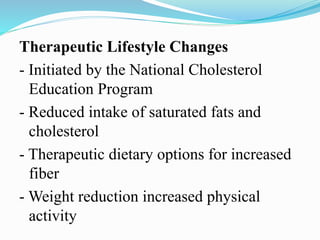
Therapeutic Lifestyle Changes
- Initiated by the National Cholesterol
Education Program
- Reduced intake of saturated fats and
cholesterol
- Therapeutic dietary options for increased
fiber
- Weight reduction increased physical
activity
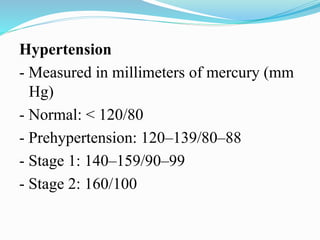
Hypertension
- Measured in millimeters of mercury (mm
Hg)
- Normal: < 120/80
- Prehypertension: 120–139/80–88
- Stage 1: 140–159/90–99
- Stage 2: 160/100
- Contributes to heart attack, stroke, heart
failure, and kidney failure
- “Silent disease” because sufferers can be
asymptomatic
- Heredity, age, obesity and African-
American race are predisposing factors.
- Smoking and stress also contribute to
hypertension.
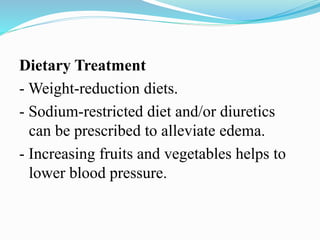
Dietary Treatment
- Weight-reduction diets.
- Sodium-restricted diet and/or diuretics
can be prescribed to alleviate edema.
- Increasing fruits and vegetables helps to
lower blood pressure.
Foods Permitted for hypertensive
- Fresh fruits and vegetables
- Pasta, rice
- Fresh meats and fish
- Oil, vinegar (‫)خل‬
- Unsalted margarine
- Popcorn - Spices - Coffee, tea
Foods to Avoid
- Tomato or vegetable juice
- Canned vegetables
- Dried, smoked or canned fish or meats
- Potato chips, salted nuts, pretzels
- Fast foods
Dietary Approaches to Stop
Hypertension
- High potassium foods
- Low fat dairy products
- Use low cholesterol and low saturated fat
products
- Use fresh, frozen, or no-salt-added
products
- Increase dietary fiber
Considerations for the Health Care
Professional
- Most cardiac clients will be told to reduce
fat, sodium, and sometimes, the amount
of calories in their diets.
- Help the cardiac client want to learn how
to help himself or herself via nutrition.
Conclusion
- Cardiovascular disease is the leading
cause of death in the United States.
- May be acute, as in myocardial infarction,
or chronic, as in hypertension and
atherosclerosis.
- Hypertension may be a symptom of
another disease.
- Cholesterol is associated with
atherosclerosis and a low-cholesterol diet
or a fat-restricted diet might be
prescribed.
- The health care professional can
encourage the client to maintain a healthy
weight, exercise, limit salt and fat intake,
and avoid smoking to reduce the risk of
heart disease.
Thank

Diet and cardiovascular disease

  • 2.
    Objectives - Identify factorsthat contribute to heart disease. - Explain why cholesterol and saturated fats are limited in some cardiovascular conditions. - Identify foods to avoid or limit in a cholesterol-controlled diet.
  • 3.
    - Explain whysodium is limited in some cardiovascular conditions. - Identify foods that are limited or prohibited in sodium-controlled diets. - Identify alternatives to sodium in diets for patients with heart disease
  • 4.
    Cardiovascular Disease - Affectsheart and blood vessels - Leading cause of death and permanent disability in the United States - More deaths are caused by heart disease than by cancer, accidents and AIDS combined
  • 5.
    Risk Factors ofheart disease: Eg: - Smoking - Hypertension - Diabetes - Insulin resistance - Infection - Periodontal disease - Obesity - age - Male sex - Sedentary lifestyle - ect….
  • 6.
    Cardiovascular Disease Cardiovascular diseasecan be acute or chronic. Acute: means sudden such as myocardial infarction (MI) also known as heart attack Chronic: develops over time such as congested heart failure (CHF), Arteriosclerosis and Atherosclerosis
  • 7.
    Myocardial Infarction - Causedby blockage of a coronary artery supplying blood to the heart - Heart tissue beyond the blockage dies.
  • 8.
    Causes - Atherosclerosis - Hypertension -Abnormal blood clotting - Infection such as that caused by rheumatic fever (damages heart valves)
  • 9.
    Arteriosclerosis: arteries harden,making the passage of blood difficult and sometimes impossible Atherosclerosis: thickening and weakening of artery walls by cholesterol and fatty deposits called plaque
  • 10.
  • 11.
    Dietary managements MI -After the heart attack, the client is in shock. - Client should be NPO (nothing by mouth). - IV fluids may be given.
  • 12.
    - After severalhours, client may begin to eat. - Liquid diet usually recommended for the first 24 hours. - Then, a low-cholesterol, low-sodium diet - Foods should not be extremely hot or cold.
  • 13.
    - Food thatis easy to chew and digest is prescribed. - Sodium limited to prevent fluid overload. - Restriction on caffeine the first few days after an MI
  • 14.
    Congestive Heart Failure -Due to decompensation or severe injury to the heart muscle - Decreased circulation causes decreased oxygenation of the body. - Shortness of breath, chest pain on exertion, and edema are common.
  • 15.
    - Decreased nutrientsto body tissues - Edema may mask the problems of malnutrition and underweight. - The heart beats faster and enlarges.
  • 16.
    Diet for CongestiveHeart Failure - Fluid restriction may be ordered. - Soft Foods - Small, frequent meals - Diuretics and a sodium-restricted diet are typically prescribed.
  • 17.
    - Diuretics cancause excessive loss of potassium and blood levels should be monitored. - Hypokalemia can upset the heartbeat. - Fruits, especially oranges, bananas, and prunes, are excellent sources of potassium, but supplements may be given.
  • 18.
    High Potassium Foods -Fruits Apricots, oranges, bananas, avocados, cantaloupe, dates, figs, raisins, grapefruit, kiwifruit, peaches, pineapple, prunes, strawberries ( ‫والجريب‬ ‫والزبيب‬ ‫والتين‬ ‫والتمر‬ ‫والشمام‬ ‫واألفوكادو‬ ‫والموز‬ ‫والبرتقال‬ ‫المشمش‬ ‫والفراولة‬ ،‫والخوخ‬ ،‫واألناناس‬ ‫والخوخ‬ ‫الكيوي‬ ‫وفاكهة‬ ‫)فروت‬
  • 19.
    - Vegetables Broccoli, cabbage,green beans, pumpkin, squash, tomatoes, spinach, potatoes, sweet potatoes ( ‫البط‬ ،‫البطاطا‬ ،‫والسبانخ‬ ،‫والطماطم‬ ‫والقرع‬ ‫واليقطين‬ ‫الخضراء‬ ‫والفاصوليا‬ ،‫والملفوف‬ ،‫القرنبيط‬‫اطا‬ ‫)الحلوة‬
  • 20.
    Diet for HeartDisease Foods to include: - Oils (canola, olive, peanu ‫الفول‬ ،‫الزيتون‬ ‫وزيت‬ ‫الكانوال‬‫السوداني‬ ) - Fish - Lean beef, lamb, veal - Egg whites - Whole grain breads and cereals
  • 21.
    Foods to Avoid: -Coconut oil, palm oil (‫النخيل‬ ‫زيت‬ ،‫الهند‬ ‫جوز‬ ‫)زيت‬ - Fatty meats, sausage and duck - Butter - Fried foods (‫المقلية‬ ‫)األطعمة‬ - Cream sauces (‫الصلصات‬ ‫كريم‬ )
  • 22.
    Therapeutic Lifestyle Changes -Initiated by the National Cholesterol Education Program - Reduced intake of saturated fats and cholesterol - Therapeutic dietary options for increased fiber - Weight reduction increased physical activity
  • 23.
    Hypertension - Measured inmillimeters of mercury (mm Hg) - Normal: < 120/80 - Prehypertension: 120–139/80–88 - Stage 1: 140–159/90–99 - Stage 2: 160/100
  • 24.
    - Contributes toheart attack, stroke, heart failure, and kidney failure - “Silent disease” because sufferers can be asymptomatic - Heredity, age, obesity and African- American race are predisposing factors. - Smoking and stress also contribute to hypertension.
  • 25.
    Dietary Treatment - Weight-reductiondiets. - Sodium-restricted diet and/or diuretics can be prescribed to alleviate edema. - Increasing fruits and vegetables helps to lower blood pressure.
  • 26.
    Foods Permitted forhypertensive - Fresh fruits and vegetables - Pasta, rice - Fresh meats and fish - Oil, vinegar (‫)خل‬ - Unsalted margarine - Popcorn - Spices - Coffee, tea
  • 27.
    Foods to Avoid -Tomato or vegetable juice - Canned vegetables - Dried, smoked or canned fish or meats - Potato chips, salted nuts, pretzels - Fast foods
  • 28.
    Dietary Approaches toStop Hypertension - High potassium foods - Low fat dairy products - Use low cholesterol and low saturated fat products - Use fresh, frozen, or no-salt-added products - Increase dietary fiber
  • 29.
    Considerations for theHealth Care Professional - Most cardiac clients will be told to reduce fat, sodium, and sometimes, the amount of calories in their diets. - Help the cardiac client want to learn how to help himself or herself via nutrition.
  • 30.
    Conclusion - Cardiovascular diseaseis the leading cause of death in the United States. - May be acute, as in myocardial infarction, or chronic, as in hypertension and atherosclerosis. - Hypertension may be a symptom of another disease.
  • 31.
    - Cholesterol isassociated with atherosclerosis and a low-cholesterol diet or a fat-restricted diet might be prescribed. - The health care professional can encourage the client to maintain a healthy weight, exercise, limit salt and fat intake, and avoid smoking to reduce the risk of heart disease.
  • 32.