© 2016 Cengage Learning. All Rights Reserved.
The Lipids:
Triglycerides,
Phospholipids,
and Sterols
Chapter 5
© 2016 Cengage Learning. All Rights Reserved.
Introduction
• Poor health
• Too much fat
• Too little fat
• Too much of some kinds of fat
• Family of lipids
• Triglycerides
• Phospholipids
• Sterols
© 2016 Cengage Learning. All Rights Reserved.
Chemist’s View of Fatty Acids
and Triglycerides
• Energy provided per gram greater than
carbohydrates
• More carbons and hydrogens
• Preview of lipids
• Triglycerides: glycerol and three fatty acids
• Fatty acids: even number of carbons
• Saturated or unsaturated
• Omega-3 and omega-6 fatty acids
• 18-carbon polyunsaturated fatty acids
© 2016 Cengage Learning. All Rights Reserved.
Fatty Acids
• Methyl group at one end
• Acid group at other end
• Usually even number of carbons
• 18-carbon fatty acids abundant in food
• Saturations
• Saturated – full of hydrogens
• Unsaturated – missing hydrogens
© 2016 Cengage Learning. All Rights Reserved.
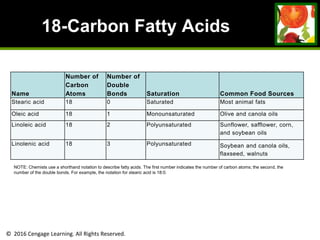
18-Carbon Fatty Acids
NOTE: Chemists use a shorthand notation to describe fatty acids. The first number indicates the number of carbon atoms; the second, the
number of the double bonds. For example, the notation for stearic acid is 18:0.
Name
Number of
Carbon
Atoms
Number of
Double
Bonds Saturation Common Food Sources
Stearic acid 18 0 Saturated Most animal fats
Oleic acid 18 1 Monounsaturated Olive and canola oils
Linoleic acid 18 2 Polyunsaturated Sunflower, safflower, corn,
and soybean oils
Linolenic acid 18 3 Polyunsaturated Soybean and canola oils,
flaxseed, walnuts
© 2016 Cengage Learning. All Rights Reserved.
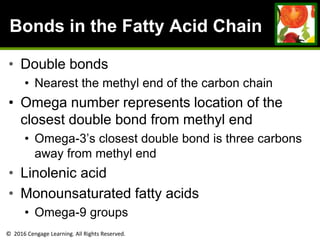
Bonds in the Fatty Acid Chain
• Double bonds
• Nearest the methyl end of the carbon chain
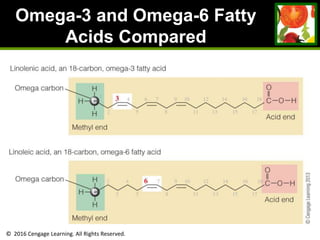
• Omega number represents location of the
closest double bond from methyl end
• Omega-3’s closest double bond is three carbons
away from methyl end
• Linolenic acid
• Monounsaturated fatty acids
• Omega-9 groups
© 2016 Cengage Learning. All Rights Reserved.
Omega-3 and Omega-6 Fatty
Acids Compared
© 2016 Cengage Learning. All Rights Reserved.
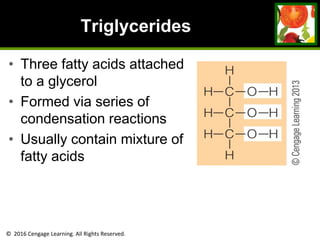
Triglycerides
• Three fatty acids attached
to a glycerol
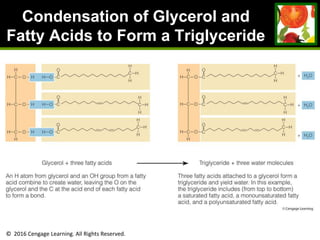
• Formed via series of
condensation reactions
• Usually contain mixture of
fatty acids
© 2016 Cengage Learning. All Rights Reserved.
Condensation of Glycerol and
Fatty Acids to Form a Triglyceride
© 2016 Cengage Learning. All Rights Reserved.
Characteristics of Solid Fats
and Oils
• Firmness
• Polyunsaturated fats tend to be liquid at room
temperature
• Saturated fats tend to be solid
• Length of carbon chain influences degree of
firmness
• Stability
• Fats spoil when exposed to oxygen
• Polyunsaturated fats spoil most readily
© 2016 Cengage Learning. All Rights Reserved.
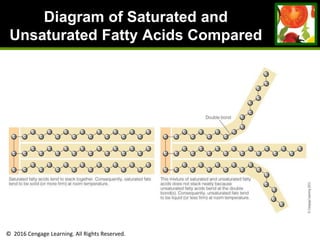
Diagram of Saturated and
Unsaturated Fatty Acids Compared
© 2016 Cengage Learning. All Rights Reserved.
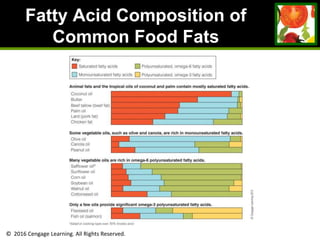
Fatty Acid Composition of
Common Food Fats
© 2016 Cengage Learning. All Rights Reserved.
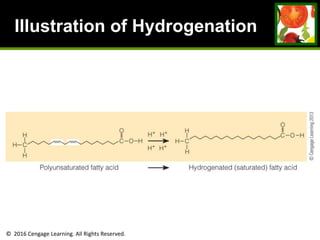
Hydrogenation
• Protects against oxidation
• Makes liquid oils more solid
• Partial hydrogenation most common
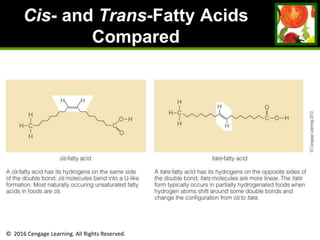
• Trans-fatty acids
• Configurations – cis and trans
• Relatively few natural sources of trans fats
• Similarity to other types of fat
© 2016 Cengage Learning. All Rights Reserved.
Illustration of Hydrogenation
© 2016 Cengage Learning. All Rights Reserved.
Cis- and Trans-Fatty Acids
Compared
© 2016 Cengage Learning. All Rights Reserved.
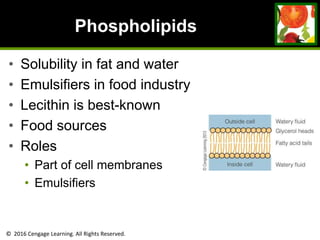
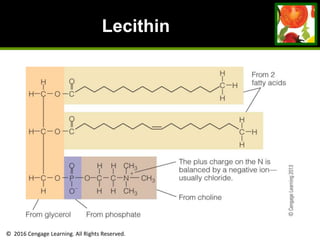
Phospholipids
• Solubility in fat and water
• Emulsifiers in food industry
• Lecithin is best-known
• Food sources
• Roles
• Part of cell membranes
• Emulsifiers
© 2016 Cengage Learning. All Rights Reserved.
Lecithin
© 2016 Cengage Learning. All Rights Reserved.
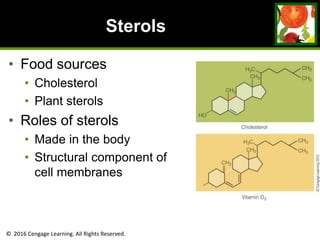
Sterols
• Food sources
• Cholesterol
• Plant sterols
• Roles of sterols
• Made in the body
• Structural component of
cell membranes
© 2016 Cengage Learning. All Rights Reserved.
Lipid Digestion
• Fats are hydrophobic
• Digestive enzymes are hydrophilic
• Goal of fat digestion
• Dismantle triglycerides
• Monoglycerides, fatty acids, and glycerol
© 2016 Cengage Learning. All Rights Reserved.
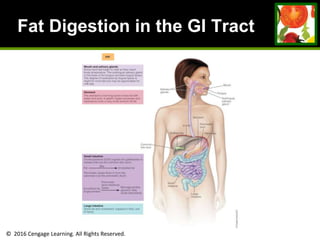
Fat Digestion in the GI Tract
© 2016 Cengage Learning. All Rights Reserved.
The Beginning of Fat Digestion
• Mouth
• Lingual lipase plays role in fat digestion in infants
• Stomach
• Strong muscle contractions
• Gastric lipase
© 2016 Cengage Learning. All Rights Reserved.
Lipid Digestion in the
Small Intestine
• Cholecystokinin (CCK)
• Gall bladder releases bile
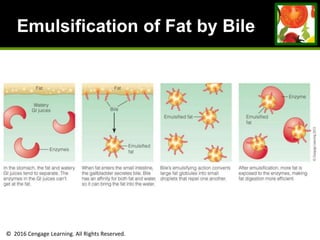
• Bile acts as emulsifier
• Pancreatic lipase
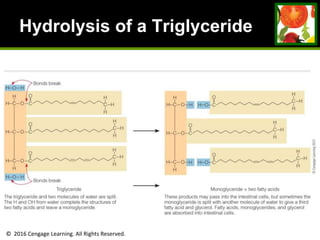
• Hydrolysis
• Triglycerides and phospholipids
• Bile routes
• Effect on blood cholesterol levels
© 2016 Cengage Learning. All Rights Reserved.
Emulsification of Fat by Bile
Stepped Art-
Emulsification of fat by bile
Fat
Watery GI
juices
Fat
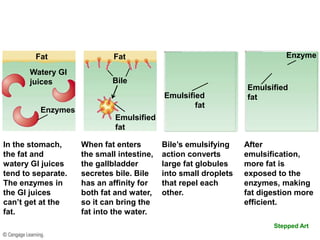
In the stomach,
the fat and
watery GI juices
tend to separate.
The enzymes in
the GI juices
can’t get at the
fat.
When fat enters
the small intestine,
the gallbladder
secretes bile. Bile
has an affinity for
both fat and water,
so it can bring the
fat into the water.
Bile’s emulsifying
action converts
large fat globules
into small droplets
that repel each
other.
After
emulsification,
more fat is
exposed to the
enzymes, making
fat digestion more
efficient.
Enzyme
Bile
Enzymes
Emulsified
fatEmulsified
fat
Emulsified
fat
© 2016 Cengage Learning. All Rights Reserved.
Hydrolysis of a Triglyceride
© 2016 Cengage Learning. All Rights Reserved.
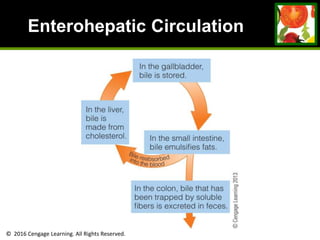
Enterohepatic Circulation
Stepped Art-
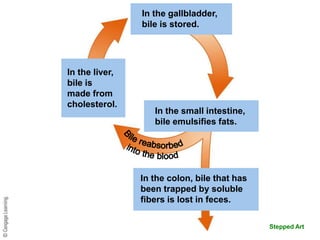
Enterohepatic Circulation
In the gallbladder,
bile is stored.
In the liver,
bile is
made from
cholesterol.
In the colon, bile that has
been trapped by soluble
fibers is lost in feces.
In the small intestine,
bile emulsifies fats.
© 2016 Cengage Learning. All Rights Reserved.
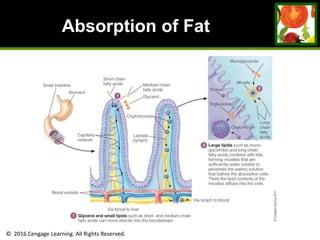
Lipid Absorption
• Directly into bloodstream
• Glycerol and short- and medium-chain fatty acids
• Lymphatic system
• Micelles diffuse into intestinal cells
• Reassembled into triglycerides
• Packed with proteins into transport vehicles called
chylomicrons
• Bypass liver at first
© 2016 Cengage Learning. All Rights Reserved.
Absorption of Fat
© 2016 Cengage Learning. All Rights Reserved.
Lipid Transport
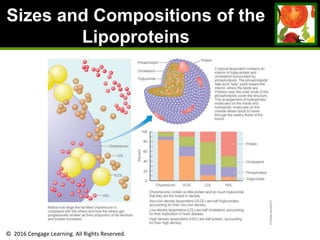
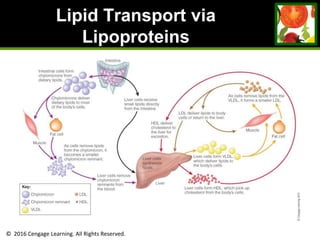
• Four main types of lipoproteins
• Chylomicrons
• Largest and least dense
• Transport diet-derived lipids
• Liver removes remnants from blood
• Very-low-density lipoproteins (VLDL)
• Made in the liver
• Proportion of lipids shifts
© 2016 Cengage Learning. All Rights Reserved.
Lipoprotein Types
• Low-density lipoproteins (LDL)
• Cell needs
• Liver regulation
• High-density lipoproteins (HDL)
• Remove cholesterol from cells
• Carry cholesterol to liver for recycling
• Anti-inflammatory properties
• Health implications
© 2016 Cengage Learning. All Rights Reserved.
Sizes and Compositions of the
Lipoproteins
© 2016 Cengage Learning. All Rights Reserved.
Lipid Transport via
Lipoproteins
© 2016 Cengage Learning. All Rights Reserved.
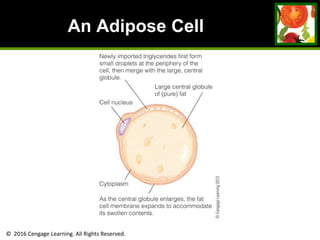
Roles of Triglycerides
• Provide the cells with energy
• Virtually unlimited ability to store fat energy
• Adipose tissue stores body fat
• Secretes hormones (adipokines)
• Other uses of fat in the body
• Skin insulation
• Shock absorption
• Cell membrane material
• Cell signaling pathways
© 2016 Cengage Learning. All Rights Reserved.
An Adipose Cell
© 2016 Cengage Learning. All Rights Reserved.
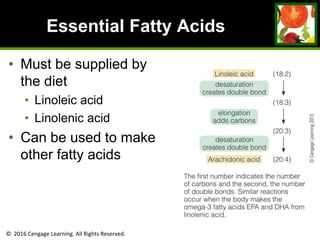
Essential Fatty Acids
• Must be supplied by
the diet
• Linoleic acid
• Linolenic acid
• Can be used to make
other fatty acids
© 2016 Cengage Learning. All Rights Reserved.
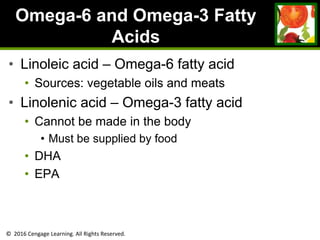
Omega-6 and Omega-3 Fatty
Acids
• Linoleic acid – Omega-6 fatty acid
• Sources: vegetable oils and meats
• Linolenic acid – Omega-3 fatty acid
• Cannot be made in the body
• Must be supplied by food
• DHA
• EPA
© 2016 Cengage Learning. All Rights Reserved.
Eicosanoids
• Eicosanoids
• “Hormonelike”
• Health benefits
• Omega-6 to Omega-3 ratio
• Fatty acid deficiencies
• Rare in the United States and Canada
• Symptoms
© 2016 Cengage Learning. All Rights Reserved.
A Preview of Lipid Metabolism
• Adipose cells store fat after meals
• Lipoprotein lipase
• Hydrolyzes triglycerides
• Triglycerides reassembled inside adipose cells
• Using fat for energy
• Fat supplies 60 percent of energy needs during
rest
• Energy deprivation
• Fasting: fat and lean protein tissue used for energy
© 2016 Cengage Learning. All Rights Reserved.
Health Effects of Saturated Fats,
Trans Fats, and Cholesterol
• Current American diet
• Excessive amounts of solid fats
• Blood lipid profile
• Heart disease
• Elevated LDL cholesterol a risk factor
• Saturated fats increase LDL cholesterol, promote
blood clotting
• Dietary choices
• Trans fats – increase LDL cholesterol
• Dietary cholesterol
© 2016 Cengage Learning. All Rights Reserved.
Fat Links to Cancer and Obesity
• Cancer
• Dietary fat and cancer risk
• Differs for various types of cancer
• Promotion rather than initiation of cancer
• Obesity
• Cutting fat from diet reduces kcalories
• Dietary recommendations
© 2016 Cengage Learning. All Rights Reserved.
Recommended Intakes of Saturated
Fat, Trans Fat, and Cholesterol
• DRI and Dietary Guidelines
• 20 to 35 percent of daily energy from fat
• Less than 10 percent of daily intake from
saturated fat
• As little trans fat as possible
• Less than 300 mg cholesterol
• Avoid getting too little fat
• Recommendation: one teaspoon of fat with every
meal
© 2016 Cengage Learning. All Rights Reserved.
Health Effects of Monounsaturated
and Polyunsaturated Fats
• Heart disease
• Replace saturated fats with
unsaturated fats
• Regular consumption of
omega-3 fatty acids
• Suppresses inflammation
• Cancer
• Omega-3 fatty acids from
food
• Supplements
© 2016 Cengage Learning. All Rights Reserved.
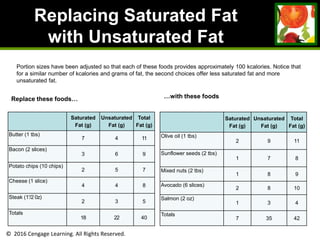
Replacing Saturated Fat
with Unsaturated Fat
Portion sizes have been adjusted so that each of these foods provides approximately 100 kcalories. Notice that
for a similar number of kcalories and grams of fat, the second choices offer less saturated fat and more
unsaturated fat.
Replace these foods…
Saturated
Fat (g)
Unsaturated
Fat (g)
Total
Fat (g)
Butter (1 tbs)
7 4 11
Bacon (2 slices)
3 6 9
Potato chips (10 chips)
2 5 7
Cheese (1 slice)
4 4 8
Steak (1'/2 0z)
2 3 5
Totals
18 22 40
…with these foods
Saturated
Fat (g)
Unsaturated
Fat (g)
Total
Fat (g)
Olive oil (1 tbs)
2 9 11
Sunflower seeds (2 tbs)
1 7 8
Mixed nuts (2 tbs)
1 8 9
Avocado (6 slices)
2 8 10
Salmon (2 oz)
1 3 4
Totals
7 35 42
© 2016 Cengage Learning. All Rights Reserved.
Recommended Intakes of Mono-
and Polyunsaturated Fats
• 20 to 35 percent of kcalories from fat
• Includes essential fatty acids
• AI have been established
• DRI
• Linoleic acid: 5-10% of daily energy
• Linolenic acid: 0.6-1.2% of daily energy
© 2016 Cengage Learning. All Rights Reserved.
Selecting Groceries
• Fat-soluble vitamins
• A, D, E, and K
• Flavor, texture, and palatability
• Protein foods
• Selections
• Milk and milk products
• Selections
© 2016 Cengage Learning. All Rights Reserved.
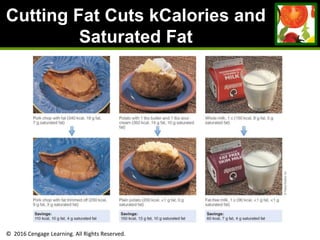
Cutting Fat Cuts kCalories and
Saturated Fat
© 2016 Cengage Learning. All Rights Reserved.
Grocery Choices
• Vegetables, fruits, and grains
• Lowers consumption of various fats in the diet
• Provides phytochemicals
• Solid fats and oils
• Fried and baked goods
• Choose wisely
• Unprocessed foods
© 2016 Cengage Learning. All Rights Reserved.
Food Labeling
• Total fat, saturated fat, trans fat, and
cholesterol
• Compare products
• Percent Daily Value versus percent kcalories
from fat
• Fat replacers
• Types
• Risks
© 2016 Cengage Learning. All Rights Reserved.
High-Fat Foods –
Friend or Foe?
Highlight 5
© 2016 Cengage Learning. All Rights Reserved.
Guidelines for Fat Intake
• Limit saturated fat and trans fat intake
• Moderate kcalories
• Enough fat for good health
• Not too much of the harmful fats
• DRI recommendations
• Compatible with low rates of disease
© 2016 Cengage Learning. All Rights Reserved.
High-Fat Foods and Heart
Health
• Olive oil
• Benefits for heart health
• Replace saturated fats
• Nuts
• LDL cholesterol
• Fat composition
• Benefits for heart health
• Cautious advice for dietary inclusion
© 2016 Cengage Learning. All Rights Reserved.
Fish
• Omega-3 fatty acids
• Benefits for heart health
• Environmental contaminants
• Farm raised versus wild
• Dietary recommendations
© 2016 Cengage Learning. All Rights Reserved.
High-Fat Foods and Heart
Disease
• Saturated fat the top dietary determinant of
LDL cholesterol
• Sources of saturated fat in the U.S.
• Meats
• Whole milk products
• Tropical oils
• Zero saturated fat is not possible
• Trans fat
• Limit hydrogenated foods
© 2016 Cengage Learning. All Rights Reserved.
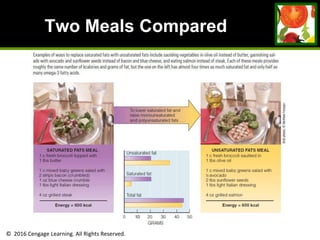
Two Meals Compared
© 2016 Cengage Learning. All Rights Reserved.
The Mediterranean Diet
• Features of a traditional Mediterranean diet
• Low in saturated fat
• Very low in trans fat
• Rich in monounsaturated and polyunsaturated fat
• Rich in complex carbohydrate and fiber
• Rich in nutrients and phytochemicals
• Benefits for heart disease risk
© 2016 Cengage Learning. All Rights Reserved.
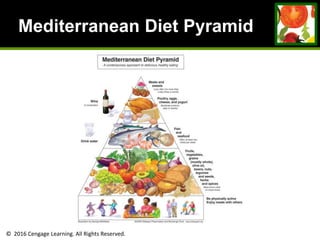
Mediterranean Diet Pyramid

The Lipids Chapter 5

  • 1.
    © 2016 CengageLearning. All Rights Reserved. The Lipids: Triglycerides, Phospholipids, and Sterols Chapter 5
  • 2.
    © 2016 CengageLearning. All Rights Reserved. Introduction • Poor health • Too much fat • Too little fat • Too much of some kinds of fat • Family of lipids • Triglycerides • Phospholipids • Sterols
  • 3.
    © 2016 CengageLearning. All Rights Reserved. Chemist’s View of Fatty Acids and Triglycerides • Energy provided per gram greater than carbohydrates • More carbons and hydrogens • Preview of lipids • Triglycerides: glycerol and three fatty acids • Fatty acids: even number of carbons • Saturated or unsaturated • Omega-3 and omega-6 fatty acids • 18-carbon polyunsaturated fatty acids
  • 4.
    © 2016 CengageLearning. All Rights Reserved. Fatty Acids • Methyl group at one end • Acid group at other end • Usually even number of carbons • 18-carbon fatty acids abundant in food • Saturations • Saturated – full of hydrogens • Unsaturated – missing hydrogens
  • 5.
    © 2016 CengageLearning. All Rights Reserved. 18-Carbon Fatty Acids NOTE: Chemists use a shorthand notation to describe fatty acids. The first number indicates the number of carbon atoms; the second, the number of the double bonds. For example, the notation for stearic acid is 18:0. Name Number of Carbon Atoms Number of Double Bonds Saturation Common Food Sources Stearic acid 18 0 Saturated Most animal fats Oleic acid 18 1 Monounsaturated Olive and canola oils Linoleic acid 18 2 Polyunsaturated Sunflower, safflower, corn, and soybean oils Linolenic acid 18 3 Polyunsaturated Soybean and canola oils, flaxseed, walnuts
  • 6.
    © 2016 CengageLearning. All Rights Reserved. Bonds in the Fatty Acid Chain • Double bonds • Nearest the methyl end of the carbon chain • Omega number represents location of the closest double bond from methyl end • Omega-3’s closest double bond is three carbons away from methyl end • Linolenic acid • Monounsaturated fatty acids • Omega-9 groups
  • 7.
    © 2016 CengageLearning. All Rights Reserved. Omega-3 and Omega-6 Fatty Acids Compared
  • 8.
    © 2016 CengageLearning. All Rights Reserved. Triglycerides • Three fatty acids attached to a glycerol • Formed via series of condensation reactions • Usually contain mixture of fatty acids
  • 9.
    © 2016 CengageLearning. All Rights Reserved. Condensation of Glycerol and Fatty Acids to Form a Triglyceride
  • 10.
    © 2016 CengageLearning. All Rights Reserved. Characteristics of Solid Fats and Oils • Firmness • Polyunsaturated fats tend to be liquid at room temperature • Saturated fats tend to be solid • Length of carbon chain influences degree of firmness • Stability • Fats spoil when exposed to oxygen • Polyunsaturated fats spoil most readily
  • 11.
    © 2016 CengageLearning. All Rights Reserved. Diagram of Saturated and Unsaturated Fatty Acids Compared
  • 12.
    © 2016 CengageLearning. All Rights Reserved. Fatty Acid Composition of Common Food Fats
  • 13.
    © 2016 CengageLearning. All Rights Reserved. Hydrogenation • Protects against oxidation • Makes liquid oils more solid • Partial hydrogenation most common • Trans-fatty acids • Configurations – cis and trans • Relatively few natural sources of trans fats • Similarity to other types of fat
  • 14.
    © 2016 CengageLearning. All Rights Reserved. Illustration of Hydrogenation
  • 15.
    © 2016 CengageLearning. All Rights Reserved. Cis- and Trans-Fatty Acids Compared
  • 16.
    © 2016 CengageLearning. All Rights Reserved. Phospholipids • Solubility in fat and water • Emulsifiers in food industry • Lecithin is best-known • Food sources • Roles • Part of cell membranes • Emulsifiers
  • 17.
    © 2016 CengageLearning. All Rights Reserved. Lecithin
  • 18.
    © 2016 CengageLearning. All Rights Reserved. Sterols • Food sources • Cholesterol • Plant sterols • Roles of sterols • Made in the body • Structural component of cell membranes
  • 19.
    © 2016 CengageLearning. All Rights Reserved. Lipid Digestion • Fats are hydrophobic • Digestive enzymes are hydrophilic • Goal of fat digestion • Dismantle triglycerides • Monoglycerides, fatty acids, and glycerol
  • 20.
    © 2016 CengageLearning. All Rights Reserved. Fat Digestion in the GI Tract
  • 21.
    © 2016 CengageLearning. All Rights Reserved. The Beginning of Fat Digestion • Mouth • Lingual lipase plays role in fat digestion in infants • Stomach • Strong muscle contractions • Gastric lipase
  • 22.
    © 2016 CengageLearning. All Rights Reserved. Lipid Digestion in the Small Intestine • Cholecystokinin (CCK) • Gall bladder releases bile • Bile acts as emulsifier • Pancreatic lipase • Hydrolysis • Triglycerides and phospholipids • Bile routes • Effect on blood cholesterol levels
  • 23.
    © 2016 CengageLearning. All Rights Reserved. Emulsification of Fat by Bile
  • 24.
    Stepped Art- Emulsification offat by bile Fat Watery GI juices Fat In the stomach, the fat and watery GI juices tend to separate. The enzymes in the GI juices can’t get at the fat. When fat enters the small intestine, the gallbladder secretes bile. Bile has an affinity for both fat and water, so it can bring the fat into the water. Bile’s emulsifying action converts large fat globules into small droplets that repel each other. After emulsification, more fat is exposed to the enzymes, making fat digestion more efficient. Enzyme Bile Enzymes Emulsified fatEmulsified fat Emulsified fat
  • 25.
    © 2016 CengageLearning. All Rights Reserved. Hydrolysis of a Triglyceride
  • 26.
    © 2016 CengageLearning. All Rights Reserved. Enterohepatic Circulation
  • 27.
    Stepped Art- Enterohepatic Circulation Inthe gallbladder, bile is stored. In the liver, bile is made from cholesterol. In the colon, bile that has been trapped by soluble fibers is lost in feces. In the small intestine, bile emulsifies fats.
  • 28.
    © 2016 CengageLearning. All Rights Reserved. Lipid Absorption • Directly into bloodstream • Glycerol and short- and medium-chain fatty acids • Lymphatic system • Micelles diffuse into intestinal cells • Reassembled into triglycerides • Packed with proteins into transport vehicles called chylomicrons • Bypass liver at first
  • 29.
    © 2016 CengageLearning. All Rights Reserved. Absorption of Fat
  • 30.
    © 2016 CengageLearning. All Rights Reserved. Lipid Transport • Four main types of lipoproteins • Chylomicrons • Largest and least dense • Transport diet-derived lipids • Liver removes remnants from blood • Very-low-density lipoproteins (VLDL) • Made in the liver • Proportion of lipids shifts
  • 31.
    © 2016 CengageLearning. All Rights Reserved. Lipoprotein Types • Low-density lipoproteins (LDL) • Cell needs • Liver regulation • High-density lipoproteins (HDL) • Remove cholesterol from cells • Carry cholesterol to liver for recycling • Anti-inflammatory properties • Health implications
  • 32.
    © 2016 CengageLearning. All Rights Reserved. Sizes and Compositions of the Lipoproteins
  • 33.
    © 2016 CengageLearning. All Rights Reserved. Lipid Transport via Lipoproteins
  • 34.
    © 2016 CengageLearning. All Rights Reserved. Roles of Triglycerides • Provide the cells with energy • Virtually unlimited ability to store fat energy • Adipose tissue stores body fat • Secretes hormones (adipokines) • Other uses of fat in the body • Skin insulation • Shock absorption • Cell membrane material • Cell signaling pathways
  • 35.
    © 2016 CengageLearning. All Rights Reserved. An Adipose Cell
  • 36.
    © 2016 CengageLearning. All Rights Reserved. Essential Fatty Acids • Must be supplied by the diet • Linoleic acid • Linolenic acid • Can be used to make other fatty acids
  • 37.
    © 2016 CengageLearning. All Rights Reserved. Omega-6 and Omega-3 Fatty Acids • Linoleic acid – Omega-6 fatty acid • Sources: vegetable oils and meats • Linolenic acid – Omega-3 fatty acid • Cannot be made in the body • Must be supplied by food • DHA • EPA
  • 38.
    © 2016 CengageLearning. All Rights Reserved. Eicosanoids • Eicosanoids • “Hormonelike” • Health benefits • Omega-6 to Omega-3 ratio • Fatty acid deficiencies • Rare in the United States and Canada • Symptoms
  • 39.
    © 2016 CengageLearning. All Rights Reserved. A Preview of Lipid Metabolism • Adipose cells store fat after meals • Lipoprotein lipase • Hydrolyzes triglycerides • Triglycerides reassembled inside adipose cells • Using fat for energy • Fat supplies 60 percent of energy needs during rest • Energy deprivation • Fasting: fat and lean protein tissue used for energy
  • 40.
    © 2016 CengageLearning. All Rights Reserved. Health Effects of Saturated Fats, Trans Fats, and Cholesterol • Current American diet • Excessive amounts of solid fats • Blood lipid profile • Heart disease • Elevated LDL cholesterol a risk factor • Saturated fats increase LDL cholesterol, promote blood clotting • Dietary choices • Trans fats – increase LDL cholesterol • Dietary cholesterol
  • 41.
    © 2016 CengageLearning. All Rights Reserved. Fat Links to Cancer and Obesity • Cancer • Dietary fat and cancer risk • Differs for various types of cancer • Promotion rather than initiation of cancer • Obesity • Cutting fat from diet reduces kcalories • Dietary recommendations
  • 42.
    © 2016 CengageLearning. All Rights Reserved. Recommended Intakes of Saturated Fat, Trans Fat, and Cholesterol • DRI and Dietary Guidelines • 20 to 35 percent of daily energy from fat • Less than 10 percent of daily intake from saturated fat • As little trans fat as possible • Less than 300 mg cholesterol • Avoid getting too little fat • Recommendation: one teaspoon of fat with every meal
  • 43.
    © 2016 CengageLearning. All Rights Reserved. Health Effects of Monounsaturated and Polyunsaturated Fats • Heart disease • Replace saturated fats with unsaturated fats • Regular consumption of omega-3 fatty acids • Suppresses inflammation • Cancer • Omega-3 fatty acids from food • Supplements
  • 44.
    © 2016 CengageLearning. All Rights Reserved. Replacing Saturated Fat with Unsaturated Fat Portion sizes have been adjusted so that each of these foods provides approximately 100 kcalories. Notice that for a similar number of kcalories and grams of fat, the second choices offer less saturated fat and more unsaturated fat. Replace these foods… Saturated Fat (g) Unsaturated Fat (g) Total Fat (g) Butter (1 tbs) 7 4 11 Bacon (2 slices) 3 6 9 Potato chips (10 chips) 2 5 7 Cheese (1 slice) 4 4 8 Steak (1'/2 0z) 2 3 5 Totals 18 22 40 …with these foods Saturated Fat (g) Unsaturated Fat (g) Total Fat (g) Olive oil (1 tbs) 2 9 11 Sunflower seeds (2 tbs) 1 7 8 Mixed nuts (2 tbs) 1 8 9 Avocado (6 slices) 2 8 10 Salmon (2 oz) 1 3 4 Totals 7 35 42
  • 45.
    © 2016 CengageLearning. All Rights Reserved. Recommended Intakes of Mono- and Polyunsaturated Fats • 20 to 35 percent of kcalories from fat • Includes essential fatty acids • AI have been established • DRI • Linoleic acid: 5-10% of daily energy • Linolenic acid: 0.6-1.2% of daily energy
  • 46.
    © 2016 CengageLearning. All Rights Reserved. Selecting Groceries • Fat-soluble vitamins • A, D, E, and K • Flavor, texture, and palatability • Protein foods • Selections • Milk and milk products • Selections
  • 47.
    © 2016 CengageLearning. All Rights Reserved. Cutting Fat Cuts kCalories and Saturated Fat
  • 48.
    © 2016 CengageLearning. All Rights Reserved. Grocery Choices • Vegetables, fruits, and grains • Lowers consumption of various fats in the diet • Provides phytochemicals • Solid fats and oils • Fried and baked goods • Choose wisely • Unprocessed foods
  • 49.
    © 2016 CengageLearning. All Rights Reserved. Food Labeling • Total fat, saturated fat, trans fat, and cholesterol • Compare products • Percent Daily Value versus percent kcalories from fat • Fat replacers • Types • Risks
  • 50.
    © 2016 CengageLearning. All Rights Reserved. High-Fat Foods – Friend or Foe? Highlight 5
  • 51.
    © 2016 CengageLearning. All Rights Reserved. Guidelines for Fat Intake • Limit saturated fat and trans fat intake • Moderate kcalories • Enough fat for good health • Not too much of the harmful fats • DRI recommendations • Compatible with low rates of disease
  • 52.
    © 2016 CengageLearning. All Rights Reserved. High-Fat Foods and Heart Health • Olive oil • Benefits for heart health • Replace saturated fats • Nuts • LDL cholesterol • Fat composition • Benefits for heart health • Cautious advice for dietary inclusion
  • 53.
    © 2016 CengageLearning. All Rights Reserved. Fish • Omega-3 fatty acids • Benefits for heart health • Environmental contaminants • Farm raised versus wild • Dietary recommendations
  • 54.
    © 2016 CengageLearning. All Rights Reserved. High-Fat Foods and Heart Disease • Saturated fat the top dietary determinant of LDL cholesterol • Sources of saturated fat in the U.S. • Meats • Whole milk products • Tropical oils • Zero saturated fat is not possible • Trans fat • Limit hydrogenated foods
  • 55.
    © 2016 CengageLearning. All Rights Reserved. Two Meals Compared
  • 56.
    © 2016 CengageLearning. All Rights Reserved. The Mediterranean Diet • Features of a traditional Mediterranean diet • Low in saturated fat • Very low in trans fat • Rich in monounsaturated and polyunsaturated fat • Rich in complex carbohydrate and fiber • Rich in nutrients and phytochemicals • Benefits for heart disease risk
  • 57.
    © 2016 CengageLearning. All Rights Reserved. Mediterranean Diet Pyramid