Nursing Path
www.drjayeshpatidar.blogspot.com
Acute Peritonitis Nursing Care Plan &
Management
Description
Acute peritonitis is an inflammatory process within the peritoneal cavity most
commonly caused by a bacterial infection. Types of acute peritonitis include primary and
secondary. Primary peritonitis, otherwise known as spontaneous bacterial peritonitis,
most commonly occur inpatients with cirrhosis and clinically significant ascites.
Secondary peritonitis most commonly occurs as a result of spillage of intestinal, biliary,
or urinary tract contents into the peritoneal space as a result of perforation, suppuration,
or ischemic injury. Patients at risk for developing secondary peritonitis include those with
recent abdominal surgery, a perforated ulcer or colon, a ruptured appendix or viscus, a
bowel obstruction, a gangrenous bowel, or ischemic bowel disease.
Signs and Symptoms
Patient assuming a knee-flexed position and complaining of severe localized or
generalized abdominal pain.
Nausea and vomiting
Physical Examination
Vital signs
HR: tachycardia
BP: hypotension
RR: increased and shallow
Temp : elevated
Nursing Path
www.drjayeshpatidar.blogspot.com
Neurologic
Normal to decreased mentation
Skin
Pale
Flushed
Diaphoretic
Cardiovascular
Pulse thready or wear or may be bounding in presence of fever.
Pulmonary
Breath sounds may be diminished secondary to shallow breathing.
Abdominal
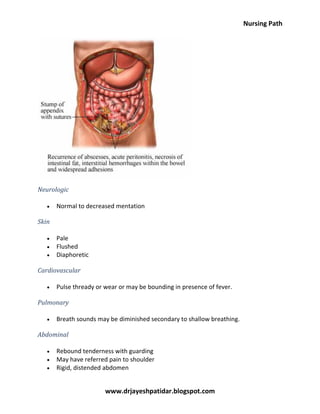
Rebound tenderness with guarding
May have referred pain to shoulder
Rigid, distended abdomen
Nursing Path
www.drjayeshpatidar.blogspot.com
Bowel sounds decrease to absent
Acute Care Management
Nursing Diagnosis: Deficient fluid volume related to intravascular fluid shift to the
peritoneal space and inability to ingest oral fluids.
Outcome Criteria
Central venous pressure 2 TO 6 MM Hg
BP 90 to 120 mm Hg
Mean arterial pressure 70 to 105 mm Hg
Pulmonary artery systolic 15 to 30 mm Hg
Pulmonary artery diastolic 5 to 15 mm Hg
HR 60 to 100 beats/min
Urine output 30 ml/hr
Patient Monitoring
1. Obtain pulmonary artery pressure and central venous pressure and monitor
mean arterial pressure hourly or more frequently if the patient’s hemodynamic
status is unstable.
2. Not the patient’s response to all therapy.
3. Monitor fluid volume status by measuring urine output hourly and measure
nasogastric and other bodily drainage.
4. Determine fluid balance every 8 hours.
5. Continuously monitor ECG fir dysrhythmias resulting from electrolyte
disturbances.
Patient Assessment
1. Assess tissue perfusion. Note level of consciousness, skin color and temperature,
pulses, and capillary refill.
2. Assess hydration status: note skin turgor on inner thigh or forehead, condition of
buccal membranes, and development of edema or crackles.
3. Assess the patient’s abdomen for resolution of rigidity, rebound tenderness, and
distention. Auscultate bowel sounds.
Nursing Path
www.drjayeshpatidar.blogspot.com
Diagnostic Assessment
1. Review serum sodium and potassium levels, which may become depleted with
nasogastric suctioning or fluid shifts.
2. Review serial WBC count and differentiated to evaluate the course of action.
Patient Management
1. Administer crystalloid or colloid solutions to improve intravascular volume.
2. Replace potassium as ordered; validate adequate urine output before
administration.
3. Keep the patient NPO during acute phase and before evaluation by a surgeon.
4. Provide nutritional support as indicated; most patient will benefit from
postpyloric delivery of early enteral nutrients at a minimal hourly rate to prevent
v=bacterial translocation and sepsis.
5. Administer antibiotics as prescribed after appropriate cultures obtained.

Acute peritonitis nursing care plan & management

  • 1.
    Nursing Path www.drjayeshpatidar.blogspot.com Acute PeritonitisNursing Care Plan & Management Description Acute peritonitis is an inflammatory process within the peritoneal cavity most commonly caused by a bacterial infection. Types of acute peritonitis include primary and secondary. Primary peritonitis, otherwise known as spontaneous bacterial peritonitis, most commonly occur inpatients with cirrhosis and clinically significant ascites. Secondary peritonitis most commonly occurs as a result of spillage of intestinal, biliary, or urinary tract contents into the peritoneal space as a result of perforation, suppuration, or ischemic injury. Patients at risk for developing secondary peritonitis include those with recent abdominal surgery, a perforated ulcer or colon, a ruptured appendix or viscus, a bowel obstruction, a gangrenous bowel, or ischemic bowel disease. Signs and Symptoms Patient assuming a knee-flexed position and complaining of severe localized or generalized abdominal pain. Nausea and vomiting Physical Examination Vital signs HR: tachycardia BP: hypotension RR: increased and shallow Temp : elevated
  • 2.
    Nursing Path www.drjayeshpatidar.blogspot.com Neurologic Normal todecreased mentation Skin Pale Flushed Diaphoretic Cardiovascular Pulse thready or wear or may be bounding in presence of fever. Pulmonary Breath sounds may be diminished secondary to shallow breathing. Abdominal Rebound tenderness with guarding May have referred pain to shoulder Rigid, distended abdomen
  • 3.
    Nursing Path www.drjayeshpatidar.blogspot.com Bowel soundsdecrease to absent Acute Care Management Nursing Diagnosis: Deficient fluid volume related to intravascular fluid shift to the peritoneal space and inability to ingest oral fluids. Outcome Criteria Central venous pressure 2 TO 6 MM Hg BP 90 to 120 mm Hg Mean arterial pressure 70 to 105 mm Hg Pulmonary artery systolic 15 to 30 mm Hg Pulmonary artery diastolic 5 to 15 mm Hg HR 60 to 100 beats/min Urine output 30 ml/hr Patient Monitoring 1. Obtain pulmonary artery pressure and central venous pressure and monitor mean arterial pressure hourly or more frequently if the patient’s hemodynamic status is unstable. 2. Not the patient’s response to all therapy. 3. Monitor fluid volume status by measuring urine output hourly and measure nasogastric and other bodily drainage. 4. Determine fluid balance every 8 hours. 5. Continuously monitor ECG fir dysrhythmias resulting from electrolyte disturbances. Patient Assessment 1. Assess tissue perfusion. Note level of consciousness, skin color and temperature, pulses, and capillary refill. 2. Assess hydration status: note skin turgor on inner thigh or forehead, condition of buccal membranes, and development of edema or crackles. 3. Assess the patient’s abdomen for resolution of rigidity, rebound tenderness, and distention. Auscultate bowel sounds.
  • 4.
    Nursing Path www.drjayeshpatidar.blogspot.com Diagnostic Assessment 1.Review serum sodium and potassium levels, which may become depleted with nasogastric suctioning or fluid shifts. 2. Review serial WBC count and differentiated to evaluate the course of action. Patient Management 1. Administer crystalloid or colloid solutions to improve intravascular volume. 2. Replace potassium as ordered; validate adequate urine output before administration. 3. Keep the patient NPO during acute phase and before evaluation by a surgeon. 4. Provide nutritional support as indicated; most patient will benefit from postpyloric delivery of early enteral nutrients at a minimal hourly rate to prevent v=bacterial translocation and sepsis. 5. Administer antibiotics as prescribed after appropriate cultures obtained.