Escharotomy Techniques
Definition
• Eschar: A thick, coagulated crust, slough which
  develops following a burn injury or chemical or
  physical cauterization of skin.
• In full thickness circumferential burns, coagulated
  collagen acts as a tourniquet in leading to vascular
  compromise of the affected body parts.
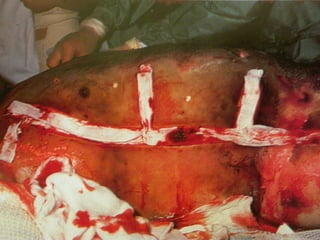
• Escharotomy: incision of eschar for decompressing
  the constrictive effects caused by deep
  circumferential burns.
Pathophysiology
• A circumferential deep or full thickness burn is inelastic and
  on an extremity will not stretch.
• Fluid resuscitation --> burn wound oedema & swelling of
  tissue beneath the inelastic burnt tissue.
• Increased tissue pressure may result in progressive
  obstruction of venous & lymphatic drainage, capillary
  perfusion, and ultimately, arterial flow.
• Prolonged tissue ischaemia --> irreversible muscle & nerve
  damage
• Systemic complications: myoglobinuria, hyperkalaemia,
  metabolic acidosis, renal failure.
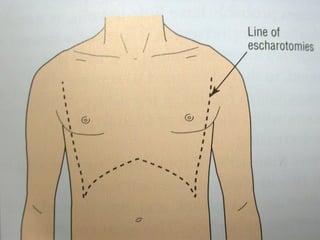
• Site-specific implications: extremities, chest, abdomen.
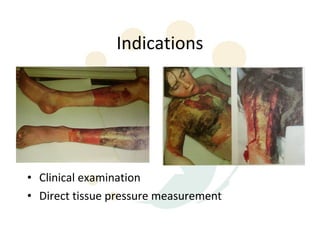
Indications


• Clinical examination
• Direct tissue pressure measurement
Indications - Clinical Examination
•   Circumferential deep dermal or full thickness burns
•   5 Ps: pain, pallor, paraesthesia, paresis, pulselessness.
•   Could be difficult in severely burned patients
•   Important features:
    –   Pain worse on passive stretch of affected muscle
    –   Pain disproportionate with that expected from the injury
    –   Extremity usually swollen, taut, and tender to palpation
    –   Sensory deficit - earliest & the most sensitive finding
    –   Motor deficit - late
    –   Pulselesness - irreversible tissue damage
Indications - Tissue pressure
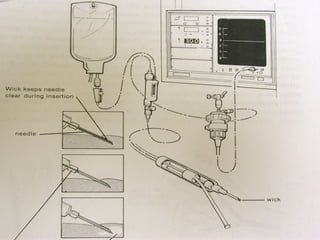
• Direct tissue pressure monitoring - objective means
  for measuring compartment pressures
• Invaluable adjunctive diagnostic technique for
  assessing the indications for and also the adequacy
  of escharotomy or fasciotomy.
• Several methods available: open needle, wick
  catheter, and slit catheter techniques.
Indications - Tissue pressure
• Normal intramuscular pressure: 0 - 10mmHg
• Starling equilibrium: capillary perfusion diminishes or ceases
  at pressures that exceed 30mmHg
• Therefore some recommended surgical decompression for
  compartment pressures > 30mmHg
• However, compartment syndromes were not observed to
  occur until the pressure exceeds 45mmHg
• Critical threshold pressure for surgical decompression:
   – Tissue pressure > 30-40mmHg;
   – Tissue pressure within 30mmHg of diastolic pressure.
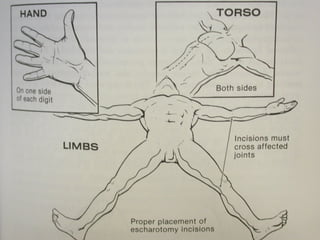
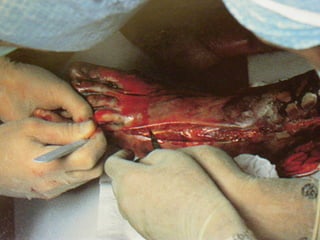
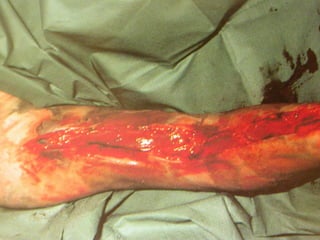
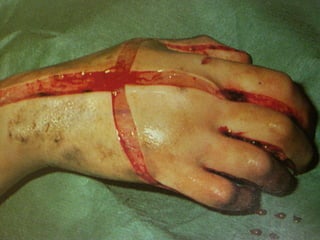
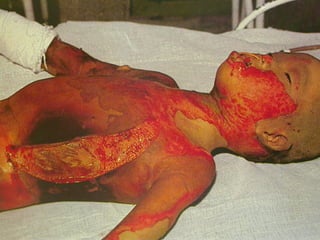
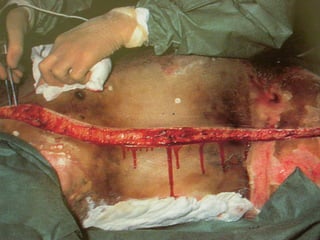
Incisions
• Medial and lateral aspects of the extremities to avoid
  damage to major neurovascular structures.
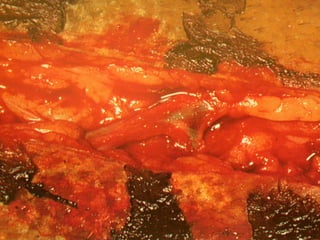
• Incisions must traverse the depth of the eschar to
  viable tissue as well as the length of the eschar to
  unburned skin.
• Must cross affected major joint areas where the
  attachment of skin to deep fascia is more secure
  than elsewhere
Complications
•   Bleeding
•   Damage to neurovascular structures
•   Infection
•   Inadequate or delayed decompression
Summary
•   Role of escharotomy in deep circumferential burns is crucial for relief of
    peripheral ischaemia or respiratory embarrassment.
•   Indications should be based on both careful clinical assessment and
    appropriate tissue pressure monitoring.
•   Proper escharotomy incisions should cover the full depth and length of
    the eschar over the circumferential burned area.
•   Timely escharotomy results in prompt improvement of distal ischaemia or
    respiratory compromise, with subsequent preservation of tissue and
    optimal functional results.
•   Further surgical decompression (eg. fasciotomy, laparotomy) may be
    required if escharotomy is not sufficient to relieve tissue ischaemia.

Escharotomy

  • 2.
  • 3.
    Definition • Eschar: Athick, coagulated crust, slough which develops following a burn injury or chemical or physical cauterization of skin. • In full thickness circumferential burns, coagulated collagen acts as a tourniquet in leading to vascular compromise of the affected body parts. • Escharotomy: incision of eschar for decompressing the constrictive effects caused by deep circumferential burns.
  • 4.
    Pathophysiology • A circumferentialdeep or full thickness burn is inelastic and on an extremity will not stretch. • Fluid resuscitation --> burn wound oedema & swelling of tissue beneath the inelastic burnt tissue. • Increased tissue pressure may result in progressive obstruction of venous & lymphatic drainage, capillary perfusion, and ultimately, arterial flow. • Prolonged tissue ischaemia --> irreversible muscle & nerve damage • Systemic complications: myoglobinuria, hyperkalaemia, metabolic acidosis, renal failure. • Site-specific implications: extremities, chest, abdomen.
  • 5.
    Indications • Clinical examination •Direct tissue pressure measurement
  • 6.
    Indications - ClinicalExamination • Circumferential deep dermal or full thickness burns • 5 Ps: pain, pallor, paraesthesia, paresis, pulselessness. • Could be difficult in severely burned patients • Important features: – Pain worse on passive stretch of affected muscle – Pain disproportionate with that expected from the injury – Extremity usually swollen, taut, and tender to palpation – Sensory deficit - earliest & the most sensitive finding – Motor deficit - late – Pulselesness - irreversible tissue damage
  • 7.
    Indications - Tissuepressure • Direct tissue pressure monitoring - objective means for measuring compartment pressures • Invaluable adjunctive diagnostic technique for assessing the indications for and also the adequacy of escharotomy or fasciotomy. • Several methods available: open needle, wick catheter, and slit catheter techniques.
  • 9.
    Indications - Tissuepressure • Normal intramuscular pressure: 0 - 10mmHg • Starling equilibrium: capillary perfusion diminishes or ceases at pressures that exceed 30mmHg • Therefore some recommended surgical decompression for compartment pressures > 30mmHg • However, compartment syndromes were not observed to occur until the pressure exceeds 45mmHg • Critical threshold pressure for surgical decompression: – Tissue pressure > 30-40mmHg; – Tissue pressure within 30mmHg of diastolic pressure.
  • 10.
    Incisions • Medial andlateral aspects of the extremities to avoid damage to major neurovascular structures. • Incisions must traverse the depth of the eschar to viable tissue as well as the length of the eschar to unburned skin. • Must cross affected major joint areas where the attachment of skin to deep fascia is more secure than elsewhere
  • 29.
    Complications • Bleeding • Damage to neurovascular structures • Infection • Inadequate or delayed decompression
  • 32.
    Summary • Role of escharotomy in deep circumferential burns is crucial for relief of peripheral ischaemia or respiratory embarrassment. • Indications should be based on both careful clinical assessment and appropriate tissue pressure monitoring. • Proper escharotomy incisions should cover the full depth and length of the eschar over the circumferential burned area. • Timely escharotomy results in prompt improvement of distal ischaemia or respiratory compromise, with subsequent preservation of tissue and optimal functional results. • Further surgical decompression (eg. fasciotomy, laparotomy) may be required if escharotomy is not sufficient to relieve tissue ischaemia.