Compartment Syndrome
in Lower Extremity
Introduction
 Compartment syndrome is a devastating complication
if not rapidly diagnosed and properly managed
 Classic symptoms can be deceiving as they occur late
 Both absolute compartment pressures above 30 mm Hg
and a pressure differential of less than 30 mm Hg are
used to make the diagnosis
 The treatment goal
 First  save the patient’s life
 second  salvage the affected limb
Cone J, Inaba K. Trauma Surg Acute Care Open 2017;2:1–6. doi:10.1136/tsaco-2017-000094
Definition
pressure within a defined compartmental space
increases past a critical pressure threshold
thereby decreasing the perfusion pressure to
that compartment
leading to cellular ischemia and necrosis.
Cone J, Inaba K. Trauma Surg Acute Care Open 2017;2:1–6. doi:10.1136/tsaco-2017-000094
Etiology
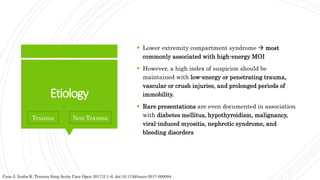
 Lower extremity compartment syndrome  most
commonly associated with high-energy MOI
 However, a high index of suspicion should be
maintained with low-energy or penetrating trauma,
vascular or crush injuries, and prolonged periods of
immobility.
 Rare presentations are even documented in association
with diabetes mellitus, hypothyroidism, malignancy,
viral-induced myositis, nephrotic syndrome, and
bleeding disorders
Cone J, Inaba K. Trauma Surg Acute Care Open 2017;2:1–6. doi:10.1136/tsaco-2017-000094
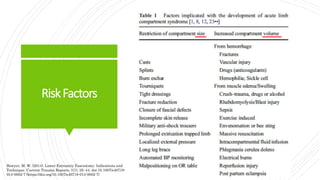
Trauma Non Trauma
RiskFactors
Bowyer, M. W. (2014). Lower Extremity Fasciotomy: Indications and
Technique. Current Trauma Reports, 1(1), 35–44. doi:10.1007/s40719-
014-0002-7 (https://doi.org/10.1007/s40719-014-0002-7)
Pathophysiology
Inadequate
perfusion
Decreasing the
arteriovenous gradient
Increase in venous &
tissue pressure
Local tissue
edema
Volume increase
Bleeding/
inflammation
Trauma
Further increases to
vessel wall
permeability
Anoxic damage to
endothelial cells
Ischemic changes
Muscle necrosis
Local edema and
pressure increases
Tillinghast CM, Gary JL. Compartment Syndrome of the Lower Extremity. 2019 Sep 3. In:
Mauffrey C, Hak DJ, Martin III MP, editors. Compartment Syndrome: A Guide to Diagnosis
and Management [Internet]. Cham (CH): Springer; 2019. Chapter 8. Available from:
https://www.ncbi.nlm.nih.gov/books/NBK553915/ doi: 10.1007/978-3-030-22331-1_8
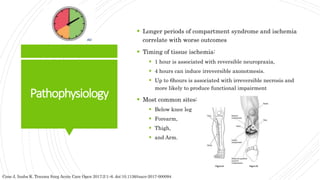
Pathophysiology
 Longer periods of compartment syndrome and ischemia
correlate with worse outcomes
 Timing of tissue ischemia:
 1 hour is associated with reversible neuropraxia,
 4 hours can induce irreversible axonotmesis.
 Up to 6hours is associated with irreversible necrosis and
more likely to produce functional impairment
 Most common sites:
 Below knee leg
 Forearm,
 Thigh,
 and Arm.
Cone J, Inaba K. Trauma Surg Acute Care Open 2017;2:1–6. doi:10.1136/tsaco-2017-000094
Diagnosis
 Classic signs of the 5 ‘P’s’:
 Pain, mostly pain on passive stretch
 Paresthesia
 Pallor
 Paralysis,
 and Pulselessness
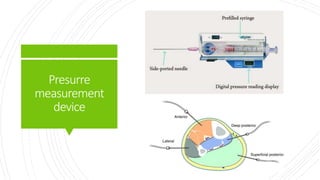
 Intramuscular compartment pressure: N: < 30 mmHg
 Tissue/muscle perfusion pressure (delta pressure):
 which is calculated as diastolic blood pressure minus the
compartment pressure
 N: > 30 mmHg
Cone J, Inaba K. Trauma Surg Acute Care Open 2017;2:1–6. doi:10.1136/tsaco-2017-000094
Tillinghast CM, Gary JL. Compartment Syndrome of the Lower Extremity. 2019 Sep 3. In: Mauffrey C, Hak DJ, Martin III MP, editors. Compartment Syndrome: A Guide to Diagnosis
and Management [Internet]. Cham (CH): Springer; 2019. Chapter 8. Available from: https://www.ncbi.nlm.nih.gov/books/NBK553915/ doi: 10.1007/978-3-030-22331-1_8
Presurre
measurement
device
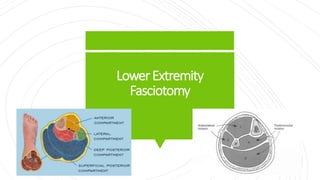
LowerExtremity
Fasciotomy
LowerExtremity
Fasciotomy
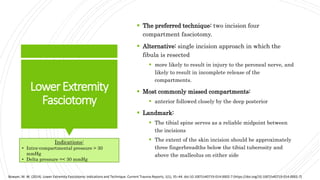
 The preferred technique: two incision four
compartment fasciotomy.
 Alternative: single incision approach in which the
fibula is resected
 more likely to result in injury to the peroneal nerve, and
likely to result in incomplete release of the
compartments.
 Most commonly missed compartments:
 anterior followed closely by the deep posterior
 Landmark:
 The tibial spine serves as a reliable midpoint between
the incisions
 The extent of the skin incision should be approximately
three fingerbreadths below the tibial tuberosity and
above the malleolus on either side
Bowyer, M. W. (2014). Lower Extremity Fasciotomy: Indications and Technique. Current Trauma Reports, 1(1), 35–44. doi:10.1007/s40719-014-0002-7 (https://doi.org/10.1007/s40719-014-0002-7)
Indications:
• Intra-compartmental pressure > 30
mmHg
• Delta pressure =< 30 mmHg
Lateralincision
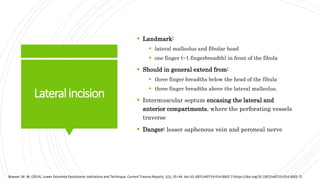
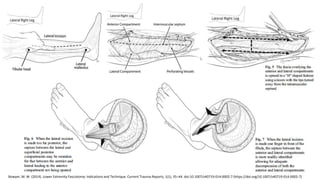
 Landmark:
 lateral malleolus and fibular head
 one finger (~1 fingerbreadth) in front of the fibula
 Should in general extend from:
 three finger breadths below the head of the fibula
 three finger breadths above the lateral malleolus.
 Intermuscular septum encasing the lateral and
anterior compartments, where the perforating vessels
traverse
 Danger: lesser saphenous vein and peroneal nerve
Bowyer, M. W. (2014). Lower Extremity Fasciotomy: Indications and Technique. Current Trauma Reports, 1(1), 35–44. doi:10.1007/s40719-014-0002-7 (https://doi.org/10.1007/s40719-014-0002-7)
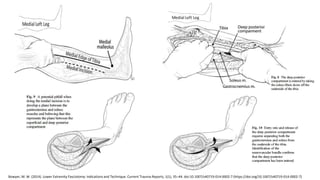
Medialincision
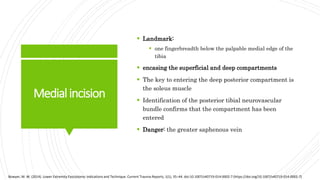
 Landmark:
 one fingerbreadth below the palpable medial edge of the
tibia
 encasing the superficial and deep compartments
 The key to entering the deep posterior compartment is
the soleus muscle
 Identification of the posterior tibial neurovascular
bundle confirms that the compartment has been
entered
 Danger: the greater saphenous vein
Bowyer, M. W. (2014). Lower Extremity Fasciotomy: Indications and Technique. Current Trauma Reports, 1(1), 35–44. doi:10.1007/s40719-014-0002-7 (https://doi.org/10.1007/s40719-014-0002-7)
WoundCare
 Focuses on swelling control, allowing recovery of
injured tissues, and minimizing skin retraction.
 Dressing changes, re-evaluation of muscle viability,
and gradual closure of the wound every 24 to 72 h
 Fasciotomy performed for both therapeutic and
prophylactic purposes should be managed as an open
wound during the first 2–3 days followed by a primary
closure of the wound (Alkhalifah & Almutairi, 2019)
 Wound closure options:
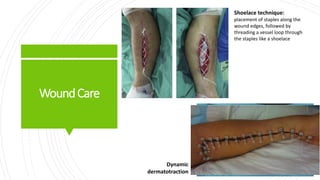
 Vessel-loop or shoelace technique
 Dynamic dermatotraction
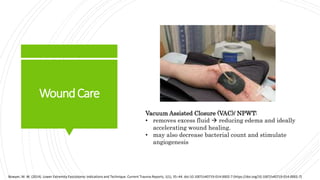
 Subatmospheric (negative pressure) wound dressings
 If the wounds cannot be primarily closed within 7–10
days  split-thickness skin grafts (STSG)
Bowyer, M. W. (2014). Lower Extremity Fasciotomy: Indications and Technique. Current Trauma Reports, 1(1), 35–44. doi:10.1007/s40719-014-0002-7
Alkhalifah, M. K., & Almutairi, F. S. H. (2019). Optimising Wound Closure Following a Fasciotomy: A narrative review. Sultan Qaboos University Medical Journal
[SQUMJ], 19(3), e192–200. https://doi.org/10.18295/squmj.2019.19.03.004
WoundCare
Shoelace technique:
placement of staples along the
wound edges, followed by
threading a vessel loop through
the staples like a shoelace
Dynamic
dermatotraction
WoundCare
Bowyer, M. W. (2014). Lower Extremity Fasciotomy: Indications and Technique. Current Trauma Reports, 1(1), 35–44. doi:10.1007/s40719-014-0002-7 (https://doi.org/10.1007/s40719-014-0002-7)
Vacuum Assisted Closure (VAC)/ NPWT:
• removes excess fluid  reducing edema and ideally
accelerating wound healing.
• may also decrease bacterial count and stimulate
angiogenesis
THANKYOU

Compartment Syndrome.pptx

  • 1.
  • 2.
    Introduction  Compartment syndromeis a devastating complication if not rapidly diagnosed and properly managed  Classic symptoms can be deceiving as they occur late  Both absolute compartment pressures above 30 mm Hg and a pressure differential of less than 30 mm Hg are used to make the diagnosis  The treatment goal  First  save the patient’s life  second  salvage the affected limb Cone J, Inaba K. Trauma Surg Acute Care Open 2017;2:1–6. doi:10.1136/tsaco-2017-000094
  • 3.
    Definition pressure within adefined compartmental space increases past a critical pressure threshold thereby decreasing the perfusion pressure to that compartment leading to cellular ischemia and necrosis. Cone J, Inaba K. Trauma Surg Acute Care Open 2017;2:1–6. doi:10.1136/tsaco-2017-000094
  • 4.
    Etiology  Lower extremitycompartment syndrome  most commonly associated with high-energy MOI  However, a high index of suspicion should be maintained with low-energy or penetrating trauma, vascular or crush injuries, and prolonged periods of immobility.  Rare presentations are even documented in association with diabetes mellitus, hypothyroidism, malignancy, viral-induced myositis, nephrotic syndrome, and bleeding disorders Cone J, Inaba K. Trauma Surg Acute Care Open 2017;2:1–6. doi:10.1136/tsaco-2017-000094 Trauma Non Trauma
  • 5.
    RiskFactors Bowyer, M. W.(2014). Lower Extremity Fasciotomy: Indications and Technique. Current Trauma Reports, 1(1), 35–44. doi:10.1007/s40719- 014-0002-7 (https://doi.org/10.1007/s40719-014-0002-7)
  • 6.
    Pathophysiology Inadequate perfusion Decreasing the arteriovenous gradient Increasein venous & tissue pressure Local tissue edema Volume increase Bleeding/ inflammation Trauma Further increases to vessel wall permeability Anoxic damage to endothelial cells Ischemic changes Muscle necrosis Local edema and pressure increases Tillinghast CM, Gary JL. Compartment Syndrome of the Lower Extremity. 2019 Sep 3. In: Mauffrey C, Hak DJ, Martin III MP, editors. Compartment Syndrome: A Guide to Diagnosis and Management [Internet]. Cham (CH): Springer; 2019. Chapter 8. Available from: https://www.ncbi.nlm.nih.gov/books/NBK553915/ doi: 10.1007/978-3-030-22331-1_8
  • 7.
    Pathophysiology  Longer periodsof compartment syndrome and ischemia correlate with worse outcomes  Timing of tissue ischemia:  1 hour is associated with reversible neuropraxia,  4 hours can induce irreversible axonotmesis.  Up to 6hours is associated with irreversible necrosis and more likely to produce functional impairment  Most common sites:  Below knee leg  Forearm,  Thigh,  and Arm. Cone J, Inaba K. Trauma Surg Acute Care Open 2017;2:1–6. doi:10.1136/tsaco-2017-000094
  • 8.
    Diagnosis  Classic signsof the 5 ‘P’s’:  Pain, mostly pain on passive stretch  Paresthesia  Pallor  Paralysis,  and Pulselessness  Intramuscular compartment pressure: N: < 30 mmHg  Tissue/muscle perfusion pressure (delta pressure):  which is calculated as diastolic blood pressure minus the compartment pressure  N: > 30 mmHg Cone J, Inaba K. Trauma Surg Acute Care Open 2017;2:1–6. doi:10.1136/tsaco-2017-000094 Tillinghast CM, Gary JL. Compartment Syndrome of the Lower Extremity. 2019 Sep 3. In: Mauffrey C, Hak DJ, Martin III MP, editors. Compartment Syndrome: A Guide to Diagnosis and Management [Internet]. Cham (CH): Springer; 2019. Chapter 8. Available from: https://www.ncbi.nlm.nih.gov/books/NBK553915/ doi: 10.1007/978-3-030-22331-1_8
  • 9.
  • 10.
  • 11.
    LowerExtremity Fasciotomy  The preferredtechnique: two incision four compartment fasciotomy.  Alternative: single incision approach in which the fibula is resected  more likely to result in injury to the peroneal nerve, and likely to result in incomplete release of the compartments.  Most commonly missed compartments:  anterior followed closely by the deep posterior  Landmark:  The tibial spine serves as a reliable midpoint between the incisions  The extent of the skin incision should be approximately three fingerbreadths below the tibial tuberosity and above the malleolus on either side Bowyer, M. W. (2014). Lower Extremity Fasciotomy: Indications and Technique. Current Trauma Reports, 1(1), 35–44. doi:10.1007/s40719-014-0002-7 (https://doi.org/10.1007/s40719-014-0002-7) Indications: • Intra-compartmental pressure > 30 mmHg • Delta pressure =< 30 mmHg
  • 12.
    Lateralincision  Landmark:  lateralmalleolus and fibular head  one finger (~1 fingerbreadth) in front of the fibula  Should in general extend from:  three finger breadths below the head of the fibula  three finger breadths above the lateral malleolus.  Intermuscular septum encasing the lateral and anterior compartments, where the perforating vessels traverse  Danger: lesser saphenous vein and peroneal nerve Bowyer, M. W. (2014). Lower Extremity Fasciotomy: Indications and Technique. Current Trauma Reports, 1(1), 35–44. doi:10.1007/s40719-014-0002-7 (https://doi.org/10.1007/s40719-014-0002-7)
  • 13.
    Bowyer, M. W.(2014). Lower Extremity Fasciotomy: Indications and Technique. Current Trauma Reports, 1(1), 35–44. doi:10.1007/s40719-014-0002-7 (https://doi.org/10.1007/s40719-014-0002-7)
  • 14.
    Medialincision  Landmark:  onefingerbreadth below the palpable medial edge of the tibia  encasing the superficial and deep compartments  The key to entering the deep posterior compartment is the soleus muscle  Identification of the posterior tibial neurovascular bundle confirms that the compartment has been entered  Danger: the greater saphenous vein Bowyer, M. W. (2014). Lower Extremity Fasciotomy: Indications and Technique. Current Trauma Reports, 1(1), 35–44. doi:10.1007/s40719-014-0002-7 (https://doi.org/10.1007/s40719-014-0002-7)
  • 15.
    Bowyer, M. W.(2014). Lower Extremity Fasciotomy: Indications and Technique. Current Trauma Reports, 1(1), 35–44. doi:10.1007/s40719-014-0002-7 (https://doi.org/10.1007/s40719-014-0002-7)
  • 16.
    WoundCare  Focuses onswelling control, allowing recovery of injured tissues, and minimizing skin retraction.  Dressing changes, re-evaluation of muscle viability, and gradual closure of the wound every 24 to 72 h  Fasciotomy performed for both therapeutic and prophylactic purposes should be managed as an open wound during the first 2–3 days followed by a primary closure of the wound (Alkhalifah & Almutairi, 2019)  Wound closure options:  Vessel-loop or shoelace technique  Dynamic dermatotraction  Subatmospheric (negative pressure) wound dressings  If the wounds cannot be primarily closed within 7–10 days  split-thickness skin grafts (STSG) Bowyer, M. W. (2014). Lower Extremity Fasciotomy: Indications and Technique. Current Trauma Reports, 1(1), 35–44. doi:10.1007/s40719-014-0002-7 Alkhalifah, M. K., & Almutairi, F. S. H. (2019). Optimising Wound Closure Following a Fasciotomy: A narrative review. Sultan Qaboos University Medical Journal [SQUMJ], 19(3), e192–200. https://doi.org/10.18295/squmj.2019.19.03.004
  • 17.
    WoundCare Shoelace technique: placement ofstaples along the wound edges, followed by threading a vessel loop through the staples like a shoelace Dynamic dermatotraction
  • 18.
    WoundCare Bowyer, M. W.(2014). Lower Extremity Fasciotomy: Indications and Technique. Current Trauma Reports, 1(1), 35–44. doi:10.1007/s40719-014-0002-7 (https://doi.org/10.1007/s40719-014-0002-7) Vacuum Assisted Closure (VAC)/ NPWT: • removes excess fluid  reducing edema and ideally accelerating wound healing. • may also decrease bacterial count and stimulate angiogenesis
  • 19.