Career Point Cares
Fundamentals of Soil and Water Conservation
Engineering
(AGL308)
Mr. Rohitashv Nagar
Assistant Professor
Department of Agronomy
School of Agricultural Sciences
Career Point University, Kota (Raj.)
Career Point Cares
Lecture-5
Farm Pond
Career Point Cares
Farm Pond
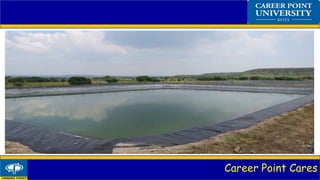
Small tank or reservoir like constructions used for the purpose of stocking
fish by storing the surface runoff generated from the catchment area.
The ponds are also water harvesting structures; solve several purposes of
village needs such as supply of water for irrigation, cattle needs, social
activities etc. apart from fish production.
Ponds also play a key role in flood and sediment control if constructed in
large numbers. They have also significant role in rain fed farming
cultivation.
Career Point Cares
Career Point Cares
Embankment Type
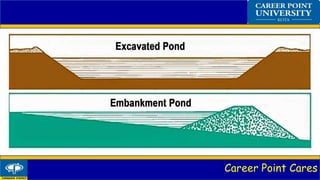
Embankment type fish ponds are generally constructed across the
stream or water course. Such ponds consist of an earthen dam, whose
dimensions are evaluated on the basis of volume of water to be stored
etc. These ponds are generally built in an area where land slope
ranges from gentle to moderately steep and also where stream valleys
are sufficiently depressed to permit a maximum storage volume with
minimum earthwork.
Career Point Cares
Career Point Cares
Excavated Type
Excavated type fish ponds are constructed by excavating the soil from
the ground, relatively in level areas. The depth of pond is decided on
the basis of its desired capacity obtained almost by excavation. The
use of this type of pond is suitable, particularly where a small supply
of water is required or small volume is available.
Career Point Cares
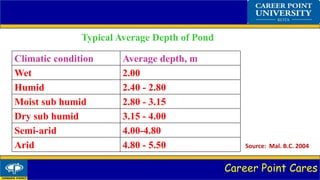
Typical Average Depth of Pond
Climatic condition Average depth, m
Wet 2.00
Humid 2.40 - 2.80
Moist sub humid 2.80 - 3.15
Dry sub humid 3.15 - 4.00
Semi-arid 4.00-4.80
Arid 4.80 - 5.50 Source: Mal. B.C. 2004
Career Point Cares
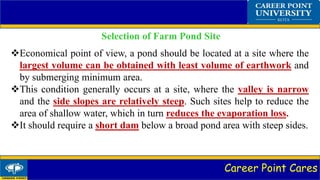
Selection of Farm Pond Site
Economical point of view, a pond should be located at a site where the
largest volume can be obtained with least volume of earthwork and
by submerging minimum area.
This condition generally occurs at a site, where the valley is narrow
and the side slopes are relatively steep. Such sites help to reduce the
area of shallow water, which in turn reduces the evaporation loss.
It should require a short dam below a broad pond area with steep sides.
Career Point Cares
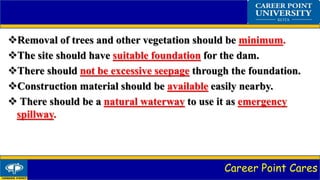
Removal of trees and other vegetation should be minimum.
The site should have suitable foundation for the dam.
There should not be excessive seepage through the foundation.
Construction material should be available easily nearby.
 There should be a natural waterway to use it as emergency
spillway.
Career Point Cares
When the ponds are constructed for livestock use, they should be
at a minimum possible distance so that the transportation cost
becomes minimum.
The pond site should be such that, water can be conveyed for
various purposes such as irrigation or fire protection easily.
Ponds to be used for fishing or other recreation purposes should
be readily accessible by transportation facilities
Career Point Cares
Career Point Cares

Farm pond

  • 1.
    Career Point Cares Fundamentalsof Soil and Water Conservation Engineering (AGL308) Mr. Rohitashv Nagar Assistant Professor Department of Agronomy School of Agricultural Sciences Career Point University, Kota (Raj.)
  • 2.
  • 3.
    Career Point Cares FarmPond Small tank or reservoir like constructions used for the purpose of stocking fish by storing the surface runoff generated from the catchment area. The ponds are also water harvesting structures; solve several purposes of village needs such as supply of water for irrigation, cattle needs, social activities etc. apart from fish production. Ponds also play a key role in flood and sediment control if constructed in large numbers. They have also significant role in rain fed farming cultivation.
  • 4.
  • 5.
    Career Point Cares EmbankmentType Embankment type fish ponds are generally constructed across the stream or water course. Such ponds consist of an earthen dam, whose dimensions are evaluated on the basis of volume of water to be stored etc. These ponds are generally built in an area where land slope ranges from gentle to moderately steep and also where stream valleys are sufficiently depressed to permit a maximum storage volume with minimum earthwork.
  • 6.
  • 7.
    Career Point Cares ExcavatedType Excavated type fish ponds are constructed by excavating the soil from the ground, relatively in level areas. The depth of pond is decided on the basis of its desired capacity obtained almost by excavation. The use of this type of pond is suitable, particularly where a small supply of water is required or small volume is available.
  • 8.
    Career Point Cares TypicalAverage Depth of Pond Climatic condition Average depth, m Wet 2.00 Humid 2.40 - 2.80 Moist sub humid 2.80 - 3.15 Dry sub humid 3.15 - 4.00 Semi-arid 4.00-4.80 Arid 4.80 - 5.50 Source: Mal. B.C. 2004
  • 9.
    Career Point Cares Selectionof Farm Pond Site Economical point of view, a pond should be located at a site where the largest volume can be obtained with least volume of earthwork and by submerging minimum area. This condition generally occurs at a site, where the valley is narrow and the side slopes are relatively steep. Such sites help to reduce the area of shallow water, which in turn reduces the evaporation loss. It should require a short dam below a broad pond area with steep sides.
  • 10.
    Career Point Cares Removalof trees and other vegetation should be minimum. The site should have suitable foundation for the dam. There should not be excessive seepage through the foundation. Construction material should be available easily nearby.  There should be a natural waterway to use it as emergency spillway.
  • 11.
    Career Point Cares Whenthe ponds are constructed for livestock use, they should be at a minimum possible distance so that the transportation cost becomes minimum. The pond site should be such that, water can be conveyed for various purposes such as irrigation or fire protection easily. Ponds to be used for fishing or other recreation purposes should be readily accessible by transportation facilities
  • 12.
  • 13.