
Career Point Cares
Fundamentals of Soil and Water Conservation
Engineering
(AGL308)
Mr. Rohitashv Nagar
Assistant Professor
Department of Agronomy
School of Agricultural Sciences
Career Point University, Kota (Raj.)
Career Point Cares
Lecture-4
Watershed Management
Career Point Cares
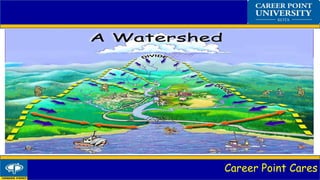
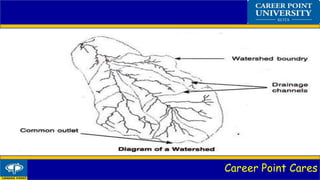
Watershed : Watershed is defined as any surface area from which
rainfall is collected and drains through a common point.
Watershed Management: Watershed management is a term used
to describe the process of implementing land use practices and
water management practices to protect and improve the quality of
the water and other natural resources within a watershed by
managing the use of those land and water resources in a
comprehensive manner.
Career Point Cares
Career Point Cares
Career Point Cares
TYPES OF WATERSHED:
Watersheds is classified depending upon the size, drainage, shape and
land use pattern.
Macro watershed (400-1000 ha.)
Sub-watershed (200 to 400 ha.)
Milli-watershed (10 to 40 ha.)
Micro watershed (0 to 10 ha.)
Mini watershed (40 to 200 ha.)
Career Point Cares
Objectives of watershed management
The different objectives of watershed management programmers are:
1. To control damaging runoff and degradation and thereby conservation of
soil and water.
2. To manage and utilize the runoff water for useful purpose.
3. To protect, conserve and improve the land of watershed for more
efficient and sustained production.
4. To protect and enhance the water resource originating in the watershed.
5. To check soil erosion and to reduce the effect of sediment yield on the
watershed.
Career Point Cares
6. To rehabilitate the deteriorating lands.
7. To moderate the floods peaks at down stream areas.
8. To increase infiltration of rainwater.
9. To improve and increase the production of timbers, fodder and
wild life resource.
10. To enhance the ground water recharge, wherever applicable.
Career Point Cares
Concepts of Watershed Management
Soil, vegetation and water are most important vital natural
resources for the existence of the man and his animals. These
three interdependent resources can bee managed collectively,
conveniently, simultaneously and efficiently on watershed
basis.
Career Point Cares
Principles of Watershed Management
1. Utilizing the land according to its capability based on land use
classification.
2. Conserving as much rainwater as possible at the place where it falls
“in situ” Conservation.
3. Draining out excess water with a safe velocity and diverting it to
storage structure (farm ponds, tanks) for future use.
4. Avoiding gully formation and putting up check dams at suitable places
to control soil erosion, to store rain water and recharge groundwater.
Career Point Cares
5. Identifying a suitable cropping pattern for the watershed area.
6. Maximizing productivity per unit time and per unit water.
7. Increasing cropping intensity and land equivalent ratio through
intercropping and sequence cropping.
8. Safe utilization of marginal and waste lands through alternate
land use systems such as agro-forestry.
9. Ensuring sustainability of the ecosystem benefiting the man-
animal plant-land-water complex in the watershed.
Career Point Cares

Watershed Management

  • 1.
    Career Point Cares Fundamentalsof Soil and Water Conservation Engineering (AGL308) Mr. Rohitashv Nagar Assistant Professor Department of Agronomy School of Agricultural Sciences Career Point University, Kota (Raj.)
  • 2.
  • 3.
    Career Point Cares Watershed: Watershed is defined as any surface area from which rainfall is collected and drains through a common point. Watershed Management: Watershed management is a term used to describe the process of implementing land use practices and water management practices to protect and improve the quality of the water and other natural resources within a watershed by managing the use of those land and water resources in a comprehensive manner.
  • 4.
  • 5.
  • 6.
    Career Point Cares TYPESOF WATERSHED: Watersheds is classified depending upon the size, drainage, shape and land use pattern. Macro watershed (400-1000 ha.) Sub-watershed (200 to 400 ha.) Milli-watershed (10 to 40 ha.) Micro watershed (0 to 10 ha.) Mini watershed (40 to 200 ha.)
  • 7.
    Career Point Cares Objectivesof watershed management The different objectives of watershed management programmers are: 1. To control damaging runoff and degradation and thereby conservation of soil and water. 2. To manage and utilize the runoff water for useful purpose. 3. To protect, conserve and improve the land of watershed for more efficient and sustained production. 4. To protect and enhance the water resource originating in the watershed. 5. To check soil erosion and to reduce the effect of sediment yield on the watershed.
  • 8.
    Career Point Cares 6.To rehabilitate the deteriorating lands. 7. To moderate the floods peaks at down stream areas. 8. To increase infiltration of rainwater. 9. To improve and increase the production of timbers, fodder and wild life resource. 10. To enhance the ground water recharge, wherever applicable.
  • 9.
    Career Point Cares Conceptsof Watershed Management Soil, vegetation and water are most important vital natural resources for the existence of the man and his animals. These three interdependent resources can bee managed collectively, conveniently, simultaneously and efficiently on watershed basis.
  • 10.
    Career Point Cares Principlesof Watershed Management 1. Utilizing the land according to its capability based on land use classification. 2. Conserving as much rainwater as possible at the place where it falls “in situ” Conservation. 3. Draining out excess water with a safe velocity and diverting it to storage structure (farm ponds, tanks) for future use. 4. Avoiding gully formation and putting up check dams at suitable places to control soil erosion, to store rain water and recharge groundwater.
  • 11.
    Career Point Cares 5.Identifying a suitable cropping pattern for the watershed area. 6. Maximizing productivity per unit time and per unit water. 7. Increasing cropping intensity and land equivalent ratio through intercropping and sequence cropping. 8. Safe utilization of marginal and waste lands through alternate land use systems such as agro-forestry. 9. Ensuring sustainability of the ecosystem benefiting the man- animal plant-land-water complex in the watershed.
  • 12.