SOIL AND WATER
CONSERVATION ENGINEERING
S.Satheeshkumar
AP/AGE
Kongunadu College of Engineering and
Technology
Trichy
UNIT IV WATER CONSERVATION MEASURES
In-situ soil moisture conservation – Water harvesting principles and
techniques: Micro catchments, catchment yield using morphometric
analysis – Farm ponds: Components, Design, Construction and
Protection – Check dams – Earthen dam – Retaining wall.
Farm ponds are small tank or reservoir-like constructions,
built for the purpose of storing the surface runoff,
generated from the catchment area. Farm ponds are
water harvesting structures that meet many farm needs.
 Supply of water for irrigation
 Cattle feed
 Fish farming, etc.
FARM PONDS
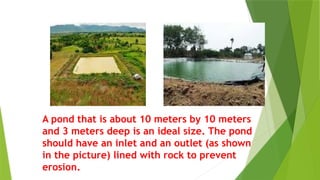
A pond that is about 10 meters by 10 meters
and 3 meters deep is an ideal size. The pond
should have an inlet and an outlet (as shown
in the picture) lined with rock to prevent
erosion.
The design of farm ponds includes
determination of capacity, its location,
utilization plan and shape and size. Where
CWR is the crop water requirement, DR is
the design rainfall, RC is the runoff
coefficient, RE is runoff efficiency factor,
Aca is the catchment area and Acu is the
cultivable area.
THE DESIGN OF FARM PONDS
DESIGN OF FARM POND
• S election of site
• Determination of the capacity of the pond
• Design of the embankment
• Design of the mechanical spillway
• Design of the emergency spillway
• Providing for seepage control from the bottom
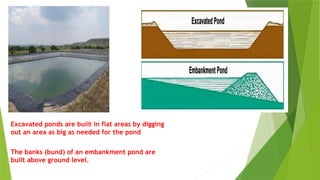
Excavated ponds are built in flat areas by digging
out an area as big as needed for the pond
The banks (bund) of an embankment pond are
built above ground level.
TYPES OF POND
Depending on the source of water and their location with respect to
the land surface, farm ponds are grouped into four types.
These are
• Dug out ponds
• Surface ponds
• Spring or Creek fed ponds and
• Off stream storage ponds
DUG OUT PONDS
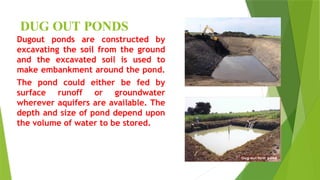
Dugout ponds are constructed by
excavating the soil from the ground
and the excavated soil is used to
make embankment around the pond.
The pond could either be fed by
surface runoff or groundwater
wherever aquifers are available. The
depth and size of pond depend upon
the volume of water to be stored.
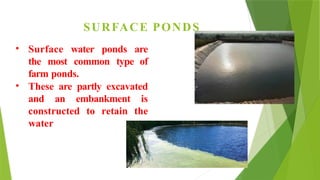
SURFACE PONDS
• Surface water ponds are
the most common type of
farm ponds.
• These are partly excavated
and an embankment is
constructed to retain the
water
SPRING OR CREEK FED PONDS
• Spring or creek fed
ponds are those where a
spring or a creek is the
source of water supply to
the pond.
• Construction of these
ponds, therefore, depend
upon the availability of
natural springs or creeks.
OFF STREAM STORAGE PONDS
• Off stream storage ponds are
constructed by the side of streams
which flow only seasonally.
• The idea is to store the water
obtained from the seasonal flow in
the streams.
• Suitable arrangements need to be
made for conveying the water from
the stream to the storage ponds.
factors to consider in farm pond site selection
 Land topography. -shape, height, and depth
 Vegetation cover.
 Water supply – quantity and quality.
 Soil type. – physical and chemical properties
 Proximity to farm produce market. –Nearness or Closeness
 Proximity to good road network.
 Power supply.
 Largest volume of water can obtained with less earthwork
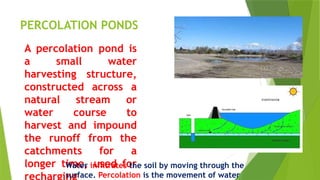
PERCOLATION PONDS
A percolation pond is
a small water
harvesting structure,
constructed across a
natural stream or
water course to
harvest and impound
the runoff from the
catchments for a
longer time, used for
recharging
Water infiltrates the soil by moving through the
surface. Percolation is the movement of water
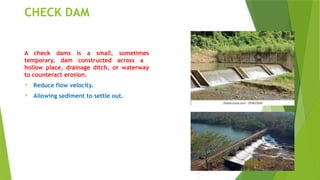
CHECK DAM
A check dams is a small, sometimes
temporary, dam constructed across a
hollow place, drainage ditch, or waterway
to counteract erosion.
 Reduce flow velocity.
 Allowing sediment to settle out.
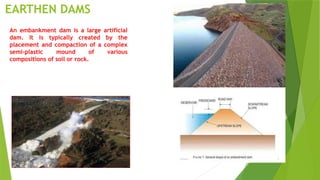
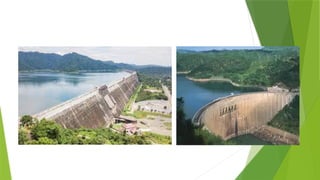
EARTHEN DAMS
An embankment dam is a large artificial
dam. It is typically created by the
placement and compaction of a complex
semi-plastic mound of various
compositions of soil or rock.
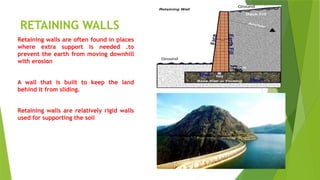
RETAINING WALLS
Retaining walls are often found in places
where extra support is needed .to
prevent the earth from moving downhill
with erosion
A wall that is built to keep the land
behind it from sliding.
Retaining walls are relatively rigid walls
used for supporting the soil
Macrocatchment water harvesting
 Macrocatchment water harvesting (MacroWH) systems usually consist of four
components:
 The catchment area
 The runoff conveyance system
 The storage system
 Application area.
In the catchment area, rainwater runoff is collected from compacted surfaces,
including hillsides, roads, rocky areas, open rangelands, cultivated and
uncultivated land and natural slopes. Most MacroWH practices have a catchment
area of less than 2 ha, in some cases however runoff is collected from
catchments as large as 200 ha. The runoff is conveyed through overland, rill,
gully or channel flow and either diverted onto cultivated fields
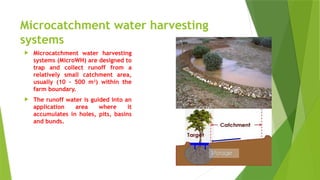
Microcatchment water harvesting
systems
 Microcatchment water harvesting
systems (MicroWH) are designed to
trap and collect runoff from a
relatively small catchment area,
usually (10 – 500 m2
) within the
farm boundary.
 The runoff water is guided into an
application area where it
accumulates in holes, pits, basins
and bunds.
Thank you

UNIT 4 WATER CONSERVATION MEASURES IN WATERSHED

  • 1.
    SOIL AND WATER CONSERVATIONENGINEERING S.Satheeshkumar AP/AGE Kongunadu College of Engineering and Technology Trichy
  • 2.
    UNIT IV WATERCONSERVATION MEASURES In-situ soil moisture conservation – Water harvesting principles and techniques: Micro catchments, catchment yield using morphometric analysis – Farm ponds: Components, Design, Construction and Protection – Check dams – Earthen dam – Retaining wall.
  • 12.
    Farm ponds aresmall tank or reservoir-like constructions, built for the purpose of storing the surface runoff, generated from the catchment area. Farm ponds are water harvesting structures that meet many farm needs.  Supply of water for irrigation  Cattle feed  Fish farming, etc. FARM PONDS
  • 13.
    A pond thatis about 10 meters by 10 meters and 3 meters deep is an ideal size. The pond should have an inlet and an outlet (as shown in the picture) lined with rock to prevent erosion.
  • 14.
    The design offarm ponds includes determination of capacity, its location, utilization plan and shape and size. Where CWR is the crop water requirement, DR is the design rainfall, RC is the runoff coefficient, RE is runoff efficiency factor, Aca is the catchment area and Acu is the cultivable area. THE DESIGN OF FARM PONDS
  • 15.
    DESIGN OF FARMPOND • S election of site • Determination of the capacity of the pond • Design of the embankment • Design of the mechanical spillway • Design of the emergency spillway • Providing for seepage control from the bottom
  • 16.
    Excavated ponds arebuilt in flat areas by digging out an area as big as needed for the pond The banks (bund) of an embankment pond are built above ground level.
  • 17.
    TYPES OF POND Dependingon the source of water and their location with respect to the land surface, farm ponds are grouped into four types. These are • Dug out ponds • Surface ponds • Spring or Creek fed ponds and • Off stream storage ponds
  • 18.
    DUG OUT PONDS Dugoutponds are constructed by excavating the soil from the ground and the excavated soil is used to make embankment around the pond. The pond could either be fed by surface runoff or groundwater wherever aquifers are available. The depth and size of pond depend upon the volume of water to be stored.
  • 19.
    SURFACE PONDS • Surfacewater ponds are the most common type of farm ponds. • These are partly excavated and an embankment is constructed to retain the water
  • 20.
    SPRING OR CREEKFED PONDS • Spring or creek fed ponds are those where a spring or a creek is the source of water supply to the pond. • Construction of these ponds, therefore, depend upon the availability of natural springs or creeks.
  • 21.
    OFF STREAM STORAGEPONDS • Off stream storage ponds are constructed by the side of streams which flow only seasonally. • The idea is to store the water obtained from the seasonal flow in the streams. • Suitable arrangements need to be made for conveying the water from the stream to the storage ponds.
  • 22.
    factors to considerin farm pond site selection  Land topography. -shape, height, and depth  Vegetation cover.  Water supply – quantity and quality.  Soil type. – physical and chemical properties  Proximity to farm produce market. –Nearness or Closeness  Proximity to good road network.  Power supply.  Largest volume of water can obtained with less earthwork
  • 23.
    PERCOLATION PONDS A percolationpond is a small water harvesting structure, constructed across a natural stream or water course to harvest and impound the runoff from the catchments for a longer time, used for recharging Water infiltrates the soil by moving through the surface. Percolation is the movement of water
  • 24.
    CHECK DAM A checkdams is a small, sometimes temporary, dam constructed across a hollow place, drainage ditch, or waterway to counteract erosion.  Reduce flow velocity.  Allowing sediment to settle out.
  • 25.
    EARTHEN DAMS An embankmentdam is a large artificial dam. It is typically created by the placement and compaction of a complex semi-plastic mound of various compositions of soil or rock.
  • 26.
    RETAINING WALLS Retaining wallsare often found in places where extra support is needed .to prevent the earth from moving downhill with erosion A wall that is built to keep the land behind it from sliding. Retaining walls are relatively rigid walls used for supporting the soil
  • 27.
    Macrocatchment water harvesting Macrocatchment water harvesting (MacroWH) systems usually consist of four components:  The catchment area  The runoff conveyance system  The storage system  Application area. In the catchment area, rainwater runoff is collected from compacted surfaces, including hillsides, roads, rocky areas, open rangelands, cultivated and uncultivated land and natural slopes. Most MacroWH practices have a catchment area of less than 2 ha, in some cases however runoff is collected from catchments as large as 200 ha. The runoff is conveyed through overland, rill, gully or channel flow and either diverted onto cultivated fields
  • 29.
    Microcatchment water harvesting systems Microcatchment water harvesting systems (MicroWH) are designed to trap and collect runoff from a relatively small catchment area, usually (10 – 500 m2 ) within the farm boundary.  The runoff water is guided into an application area where it accumulates in holes, pits, basins and bunds.
  • 30.