Career Point Cares
Soil Chemistry, Fertility and Nutrient Management
(AGL406)
Mr. Rohitashv Nagar
Assistant Professor & HOD
Department of Agronomy
School of Agricultural Sciences
Career Point University, Kota (Raj.)
Career Point Cares
Lecture-5
Problem Soil (Acidic, Alkaline, Saline Soil)
Career Point Cares
Problem Soils: The soil that causes additional problems from the
engineering point of view as a result of the circumstances of its
composition or a change in environmental conditions.
There are three major problematic soils:
1. Acidic Soil
2. Alkaline Soil
3. Saline Soil
Career Point Cares
Career Point Cares
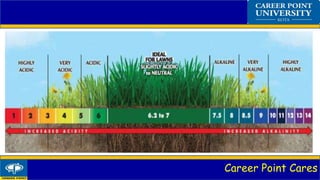
Acid Soils: The soils with pH less than 6.5 and which respond to liming may be
considered as acidic soils.
(a) Reasons for Acidity:
 Humus decomposition results in release of large amounts of acids. There by
lowering the pH.
 Rainfall: In areas with more than 100 cm rainfall associated with high Ca, Mg is
dissolved in water and leached out due to this base saturation of soil decreases.
 Continuous application of acid forming fertilizers like ammonium sulphates or
ammonium chlorides results in depletion of Ca by CEC phenomenon.
 Parent Material: Generally rocks are considered as acidic, which contain large
amount of silica when this combined with water, acidity increases.
Career Point Cares
(b) Characteristics:
 pH is less than 6.5.
 Low in Ca, Mg with negligible amount of soluble salts.
This soils appear as brown or reddish brown, sandy loams or sands.
(C) Injury to Crops:
(i) Direct Affects:
 Plant root system does not grow normally due to toxic hydrogen ions.
Permeability of plant membranes are adversely affected due to soil
acidity.
Enzyme actions may be altered, since they are sensitive to pH changes.
Career Point Cares
(ii) Indirect Affects:
 Deficiency of Ca and Mg occur by leaching
 Al, Mn and Fe available in toxic amounts.
 All the micro nutrients except molybdenum are available. So ‘Mo’
deficiency has been identified in leguminous crops.
 Phosphorus gets immobilized and its availability is reduced.
(iii) Effect on activity of microorganisms:
Most of the activities of beneficial organisms like azotobacter and nodule
forming bacteria of legumes are adversely affected as acidity increases.
Career Point Cares
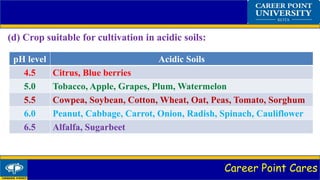
(d) Crop suitable for cultivation in acidic soils:
pH level Acidic Soils
4.5 Citrus, Blue berries
5.0 Tobacco, Apple, Grapes, Plum, Watermelon
5.5 Cowpea, Soybean, Cotton, Wheat, Oat, Peas, Tomato, Sorghum
6.0 Peanut, Cabbage, Carrot, Onion, Radish, Spinach, Cauliflower
6.5 Alfalfa, Sugarbeet
Career Point Cares
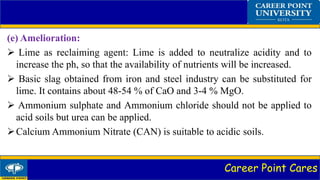
(e) Amelioration:
 Lime as reclaiming agent: Lime is added to neutralize acidity and to
increase the ph, so that the availability of nutrients will be increased.
 Basic slag obtained from iron and steel industry can be substituted for
lime. It contains about 48-54 % of CaO and 3-4 % MgO.
 Ammonium sulphate and Ammonium chloride should not be applied to
acid soils but urea can be applied.
Calcium Ammonium Nitrate (CAN) is suitable to acidic soils.
Career Point Cares
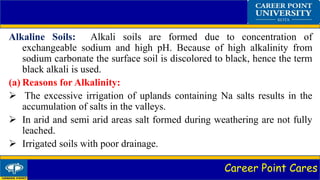
Alkaline Soils: Alkali soils are formed due to concentration of
exchangeable sodium and high pH. Because of high alkalinity from
sodium carbonate the surface soil is discolored to black, hence the term
black alkali is used.
(a) Reasons for Alkalinity:
 The excessive irrigation of uplands containing Na salts results in the
accumulation of salts in the valleys.
 In arid and semi arid areas salt formed during weathering are not fully
leached.
 Irrigated soils with poor drainage.
Career Point Cares
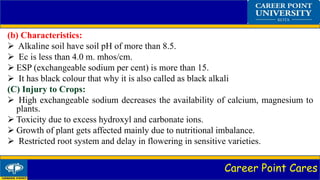
(b) Characteristics:
 Alkaline soil have soil pH of more than 8.5.
 Ec is less than 4.0 m. mhos/cm.
 ESP (exchangeable sodium per cent) is more than 15.
 It has black colour that why it is also called as black alkali
(C) Injury to Crops:
 High exchangeable sodium decreases the availability of calcium, magnesium to
plants.
 Toxicity due to excess hydroxyl and carbonate ions.
 Growth of plant gets affected mainly due to nutritional imbalance.
 Restricted root system and delay in flowering in sensitive varieties.
Career Point Cares
(d) Crop suitable for cultivation in alkaline soils: Barley, Sugarbeet,
Cotton, Sugarcane, Mustard, Rice, Maize.
(e) Amelioration: The process of amelioration consists of two steps:
 To convert exchangeable sodium into water soluble form.
 To leach out the soluble sodium from the field. Amendments used for
reclamation of Alkali soils.
 Gypsum: It is slightly soluble in water. So it should be applied well in
advance.
Use of pyrites (FeS2).
Career Point Cares
 Sulphur present in pyrites causes decrease in ph of soil due to formation
of H2SO4.
 Drainage channels must be arranged around the field.
 Growing the green manure crops and incorporate in the field.
Career Point Cares
Saline Soils: The saline soils contain toxic concentration of soluble salts in
the root zone. Soluble salts consists of chlorides and sulphates of
sodium, calcium, magnesium. Because of the white encrustation formed
due to salts, the saline soils are also called white alkali soils.
(a) Reasons for Salinity:
 The excessive irrigation of uplands containing salts results in the
accumulation of salts in the valleys.
 Salinity is also caused if the soils are irrigated with saline water.
 In areas having salt layer at lower depths in the profile, seasonal
irrigation may favour the upward movement of salts.
Career Point Cares
(b) Characteristics:
 Saline soil have soil pH of less than 8.5.
 Ec is more than 4.0 m. mhos/cm.
 ESP (exchangeable sodium per cent) is less than 15.
 It has white colour that why it is also called as white alkali.
(C) Injury to Crops:
 High osmotic pressure decreases the water availability to plants hence retardation
of growth rate.
 As a result of retarded growth rate, leaves and stems of affected plants are
stunted.
 Due to high EC germination per cent of seeds is reduced.
Career Point Cares
(d) Crop suitable for cultivation in saline soils: Barley, Sugarbeet,
Cotton, Sugarcane, Mustard,
(e) Amelioration:
 The salts are to be leached below the root zone and not allowed to come
up. However this practice is some what difficult in deep and fine textured
soils containing more salts in the lower layers. Under these conditions, a
provision of some kind of sub-surface drains becomes important.
 Green manure crops like daincha can be grown up to flowering stage and
incorporated into the soil. Paddy straw can also be used.
Scrape the salt layer on the surface of the soil with spade.
Career Point Cares

Problem soils

  • 1.
    Career Point Cares SoilChemistry, Fertility and Nutrient Management (AGL406) Mr. Rohitashv Nagar Assistant Professor & HOD Department of Agronomy School of Agricultural Sciences Career Point University, Kota (Raj.)
  • 2.
    Career Point Cares Lecture-5 ProblemSoil (Acidic, Alkaline, Saline Soil)
  • 3.
    Career Point Cares ProblemSoils: The soil that causes additional problems from the engineering point of view as a result of the circumstances of its composition or a change in environmental conditions. There are three major problematic soils: 1. Acidic Soil 2. Alkaline Soil 3. Saline Soil
  • 4.
  • 5.
    Career Point Cares AcidSoils: The soils with pH less than 6.5 and which respond to liming may be considered as acidic soils. (a) Reasons for Acidity:  Humus decomposition results in release of large amounts of acids. There by lowering the pH.  Rainfall: In areas with more than 100 cm rainfall associated with high Ca, Mg is dissolved in water and leached out due to this base saturation of soil decreases.  Continuous application of acid forming fertilizers like ammonium sulphates or ammonium chlorides results in depletion of Ca by CEC phenomenon.  Parent Material: Generally rocks are considered as acidic, which contain large amount of silica when this combined with water, acidity increases.
  • 6.
    Career Point Cares (b)Characteristics:  pH is less than 6.5.  Low in Ca, Mg with negligible amount of soluble salts. This soils appear as brown or reddish brown, sandy loams or sands. (C) Injury to Crops: (i) Direct Affects:  Plant root system does not grow normally due to toxic hydrogen ions. Permeability of plant membranes are adversely affected due to soil acidity. Enzyme actions may be altered, since they are sensitive to pH changes.
  • 7.
    Career Point Cares (ii)Indirect Affects:  Deficiency of Ca and Mg occur by leaching  Al, Mn and Fe available in toxic amounts.  All the micro nutrients except molybdenum are available. So ‘Mo’ deficiency has been identified in leguminous crops.  Phosphorus gets immobilized and its availability is reduced. (iii) Effect on activity of microorganisms: Most of the activities of beneficial organisms like azotobacter and nodule forming bacteria of legumes are adversely affected as acidity increases.
  • 8.
    Career Point Cares (d)Crop suitable for cultivation in acidic soils: pH level Acidic Soils 4.5 Citrus, Blue berries 5.0 Tobacco, Apple, Grapes, Plum, Watermelon 5.5 Cowpea, Soybean, Cotton, Wheat, Oat, Peas, Tomato, Sorghum 6.0 Peanut, Cabbage, Carrot, Onion, Radish, Spinach, Cauliflower 6.5 Alfalfa, Sugarbeet
  • 9.
    Career Point Cares (e)Amelioration:  Lime as reclaiming agent: Lime is added to neutralize acidity and to increase the ph, so that the availability of nutrients will be increased.  Basic slag obtained from iron and steel industry can be substituted for lime. It contains about 48-54 % of CaO and 3-4 % MgO.  Ammonium sulphate and Ammonium chloride should not be applied to acid soils but urea can be applied. Calcium Ammonium Nitrate (CAN) is suitable to acidic soils.
  • 10.
    Career Point Cares AlkalineSoils: Alkali soils are formed due to concentration of exchangeable sodium and high pH. Because of high alkalinity from sodium carbonate the surface soil is discolored to black, hence the term black alkali is used. (a) Reasons for Alkalinity:  The excessive irrigation of uplands containing Na salts results in the accumulation of salts in the valleys.  In arid and semi arid areas salt formed during weathering are not fully leached.  Irrigated soils with poor drainage.
  • 11.
    Career Point Cares (b)Characteristics:  Alkaline soil have soil pH of more than 8.5.  Ec is less than 4.0 m. mhos/cm.  ESP (exchangeable sodium per cent) is more than 15.  It has black colour that why it is also called as black alkali (C) Injury to Crops:  High exchangeable sodium decreases the availability of calcium, magnesium to plants.  Toxicity due to excess hydroxyl and carbonate ions.  Growth of plant gets affected mainly due to nutritional imbalance.  Restricted root system and delay in flowering in sensitive varieties.
  • 12.
    Career Point Cares (d)Crop suitable for cultivation in alkaline soils: Barley, Sugarbeet, Cotton, Sugarcane, Mustard, Rice, Maize. (e) Amelioration: The process of amelioration consists of two steps:  To convert exchangeable sodium into water soluble form.  To leach out the soluble sodium from the field. Amendments used for reclamation of Alkali soils.  Gypsum: It is slightly soluble in water. So it should be applied well in advance. Use of pyrites (FeS2).
  • 13.
    Career Point Cares Sulphur present in pyrites causes decrease in ph of soil due to formation of H2SO4.  Drainage channels must be arranged around the field.  Growing the green manure crops and incorporate in the field.
  • 14.
    Career Point Cares SalineSoils: The saline soils contain toxic concentration of soluble salts in the root zone. Soluble salts consists of chlorides and sulphates of sodium, calcium, magnesium. Because of the white encrustation formed due to salts, the saline soils are also called white alkali soils. (a) Reasons for Salinity:  The excessive irrigation of uplands containing salts results in the accumulation of salts in the valleys.  Salinity is also caused if the soils are irrigated with saline water.  In areas having salt layer at lower depths in the profile, seasonal irrigation may favour the upward movement of salts.
  • 15.
    Career Point Cares (b)Characteristics:  Saline soil have soil pH of less than 8.5.  Ec is more than 4.0 m. mhos/cm.  ESP (exchangeable sodium per cent) is less than 15.  It has white colour that why it is also called as white alkali. (C) Injury to Crops:  High osmotic pressure decreases the water availability to plants hence retardation of growth rate.  As a result of retarded growth rate, leaves and stems of affected plants are stunted.  Due to high EC germination per cent of seeds is reduced.
  • 16.
    Career Point Cares (d)Crop suitable for cultivation in saline soils: Barley, Sugarbeet, Cotton, Sugarcane, Mustard, (e) Amelioration:  The salts are to be leached below the root zone and not allowed to come up. However this practice is some what difficult in deep and fine textured soils containing more salts in the lower layers. Under these conditions, a provision of some kind of sub-surface drains becomes important.  Green manure crops like daincha can be grown up to flowering stage and incorporated into the soil. Paddy straw can also be used. Scrape the salt layer on the surface of the soil with spade.
  • 17.