1
Submitted To:
Mousumi Das
Lecturer,
Department of Aquaculture
Faculty of Fisheries.
Submitted By:
Level: III
Term: Summer’14
Name Reg. No.
Md. Afzal Hossain 12-05-2853
Md. Rayhanur Rahman 12-05-2854
Sulav Indra Paul 12-05-2860
Doly Sultana 12-05-2861
Khandakar Tahmida Tafhim 12-05-2862
Imran Nagar 12-05-2864
Course title: Aquaculture Engineering
Course code: AQC 302
Bangabandhu Sheikh Mujibur Rahman Agricultural
University
Salna, Gazipur-1706
2
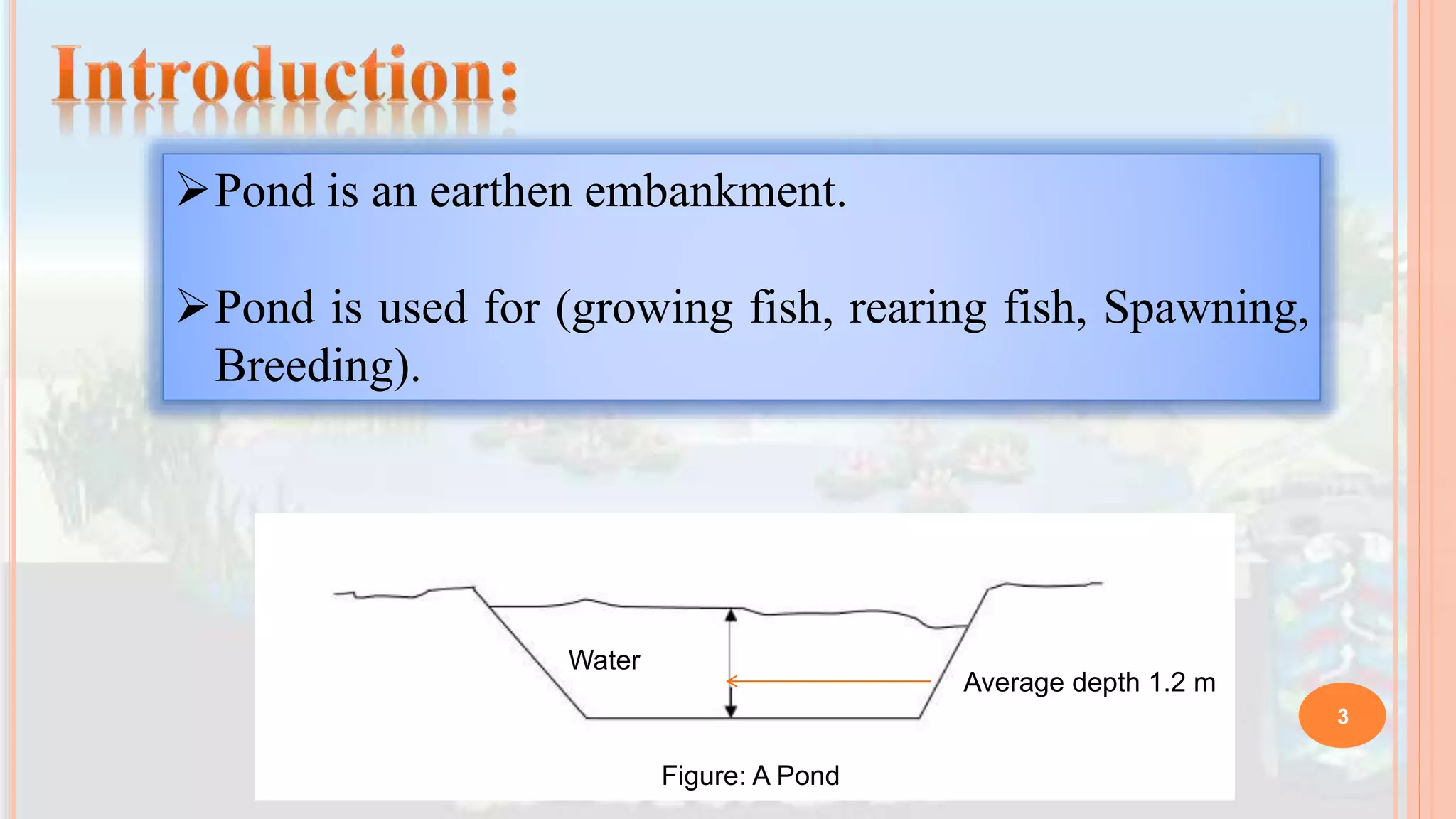
Pond is an earthen embankment.
Pond is used for (growing fish, rearing fish, Spawning,
Breeding).
3
Average depth 1.2 m
Water
Figure: A Pond
4
Figure: A complete pond.
There are 6 types of pond. These are-
a. Nursery Pond
b. Rearing Pond
c. Stocking Pond
d. Marketing P0nd
e. Brood Stock Pond
f. Quarantine Pond
5
Short Description.
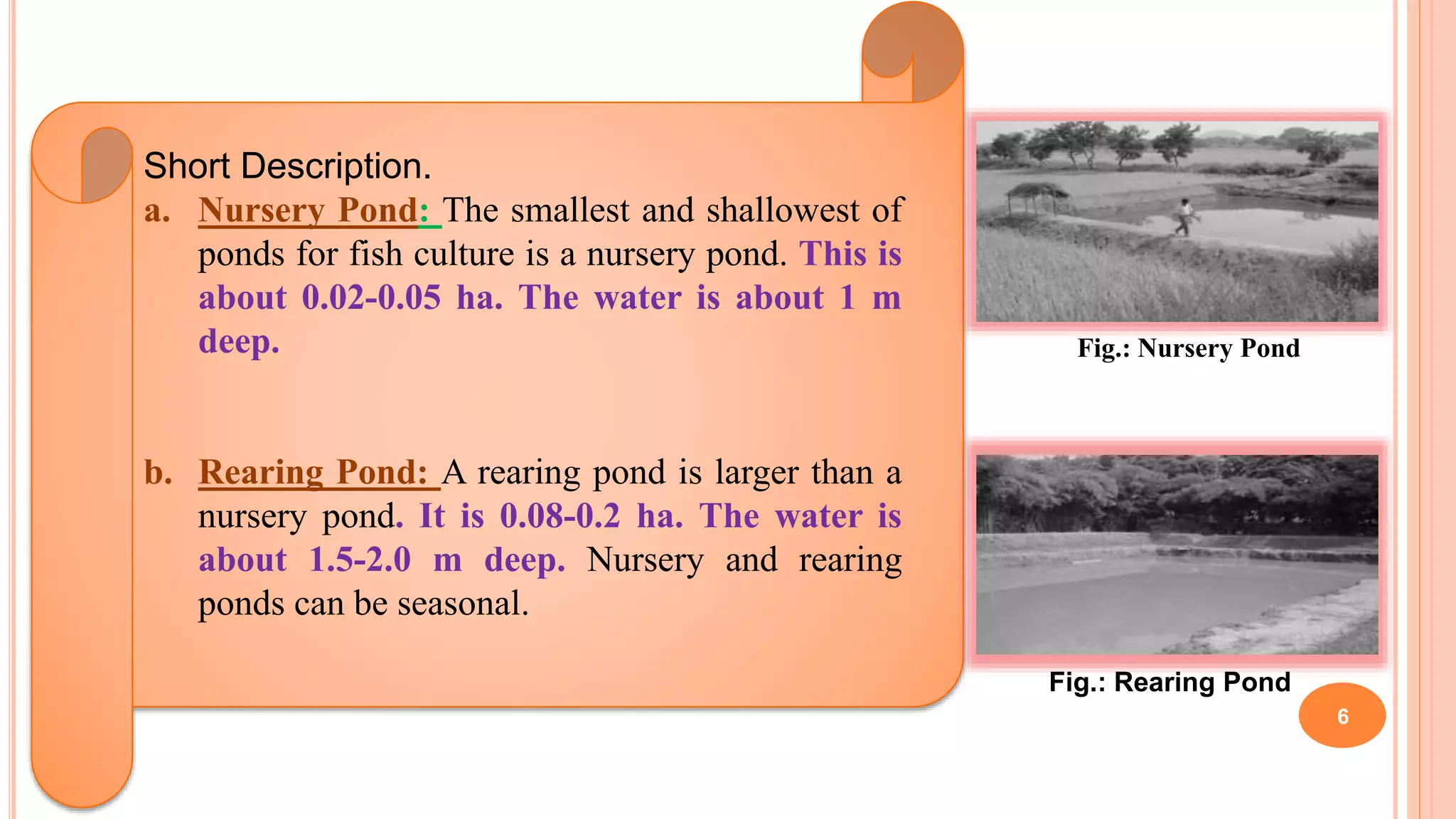
a. Nursery Pond: The smallest and shallowest of
ponds for fish culture is a nursery pond. This is
about 0.02-0.05 ha. The water is about 1 m
deep.
b. Rearing Pond: A rearing pond is larger than a
nursery pond. It is 0.08-0.2 ha. The water is
about 1.5-2.0 m deep. Nursery and rearing
ponds can be seasonal.
Fig.: Nursery Pond
Fig.: Rearing Pond
6
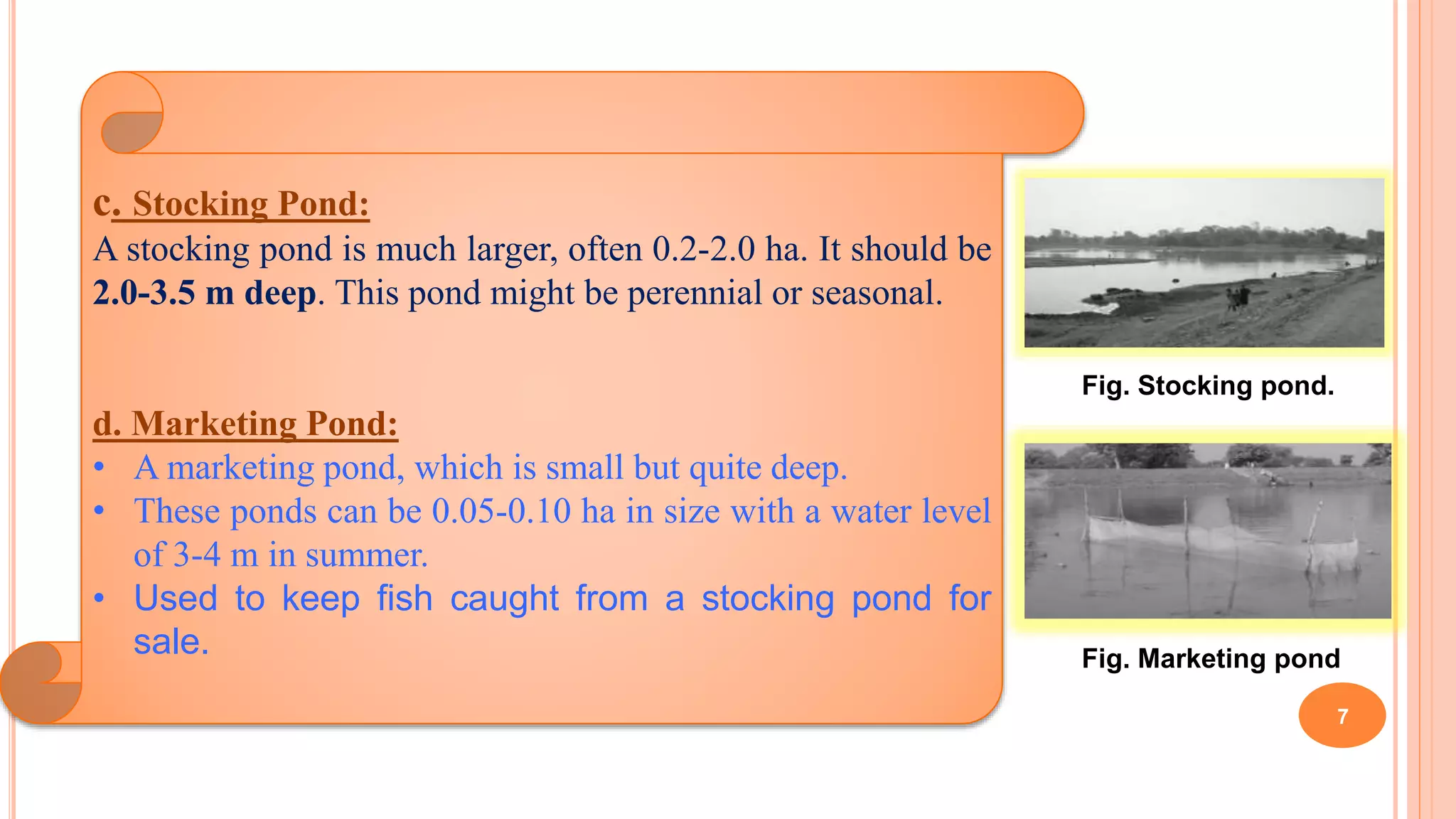
c. Stocking Pond:
A stocking pond is much larger, often 0.2-2.0 ha. It should be
2.0-3.5 m deep. This pond might be perennial or seasonal.
d. Marketing Pond:
• A marketing pond, which is small but quite deep.
• These ponds can be 0.05-0.10 ha in size with a water level
of 3-4 m in summer.
• Used to keep fish caught from a stocking pond for
sale.
Fig. Stocking pond.
Fig. Marketing pond
7
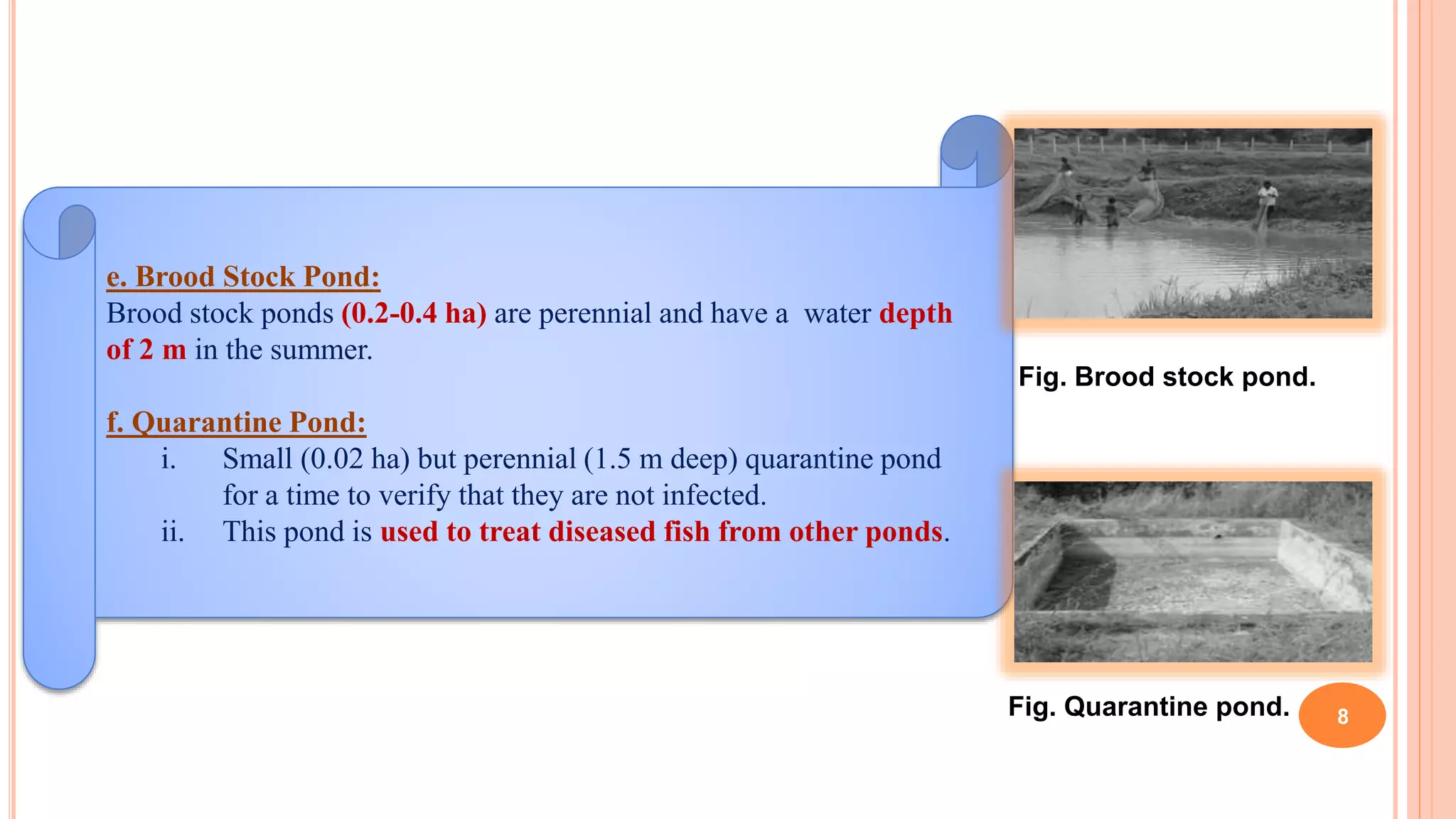
e. Brood Stock Pond:
Brood stock ponds (0.2-0.4 ha) are perennial and have a water depth
of 2 m in the summer.
f. Quarantine Pond:
i. Small (0.02 ha) but perennial (1.5 m deep) quarantine pond
for a time to verify that they are not infected.
ii. This pond is used to treat diseased fish from other ponds.
Fig. Brood stock pond.
Fig. Quarantine pond. 8
Importance Of Site Selection:
Good site selection is a pre-requisite in pond construction.
Improper site selection may lead to:
I. Difficulties in holding water in the pond.
II. High seepage.
III.Dike erosion.
IV.Low productivity of the pond
V. Inability to drain water completely, and
VI.Difficulties in harvesting. 9
A. Space Availability And Topography:
 Space of 200 m2 to construct a pond.
 Better to select flat land with a slight gradient.
 Sites with slight gradients (0.5 to 3 percent is better)
 Avoid areas with large undulations and rocks and with large
trees.
10
B. Water Supply And Water Quality:
Water Supply:
 The source of water should have adequate amount of water
 Streams, large rivers, small rivers, lakes and reservoirs can
be used.
Water Quality:
 Temperature (25 to 300 C)
 Dissolved oxygen (5-9ppm)
 pH (6.5-8.5)
11
C. Soil Quality:
Physical quality:
Pond soil should have enough clay to hold water
100% clay may crack pond dike for exposing sunlight
Chemical quality:
Pond soil should not be acidic.
Acidic-soils make the pond water acidic.
Acidic-water retards growth of fish
Acidic water causes stress situation & disease.
12
Two kinds of pond may found:
1. Series Pond: Cost effective, Easily maintain.
2. Parallel Pond: Difficult to maintain, Contamination occur.
13
14
Series Pond
Parallel Pond
1
2
3
Front Side
Back Side
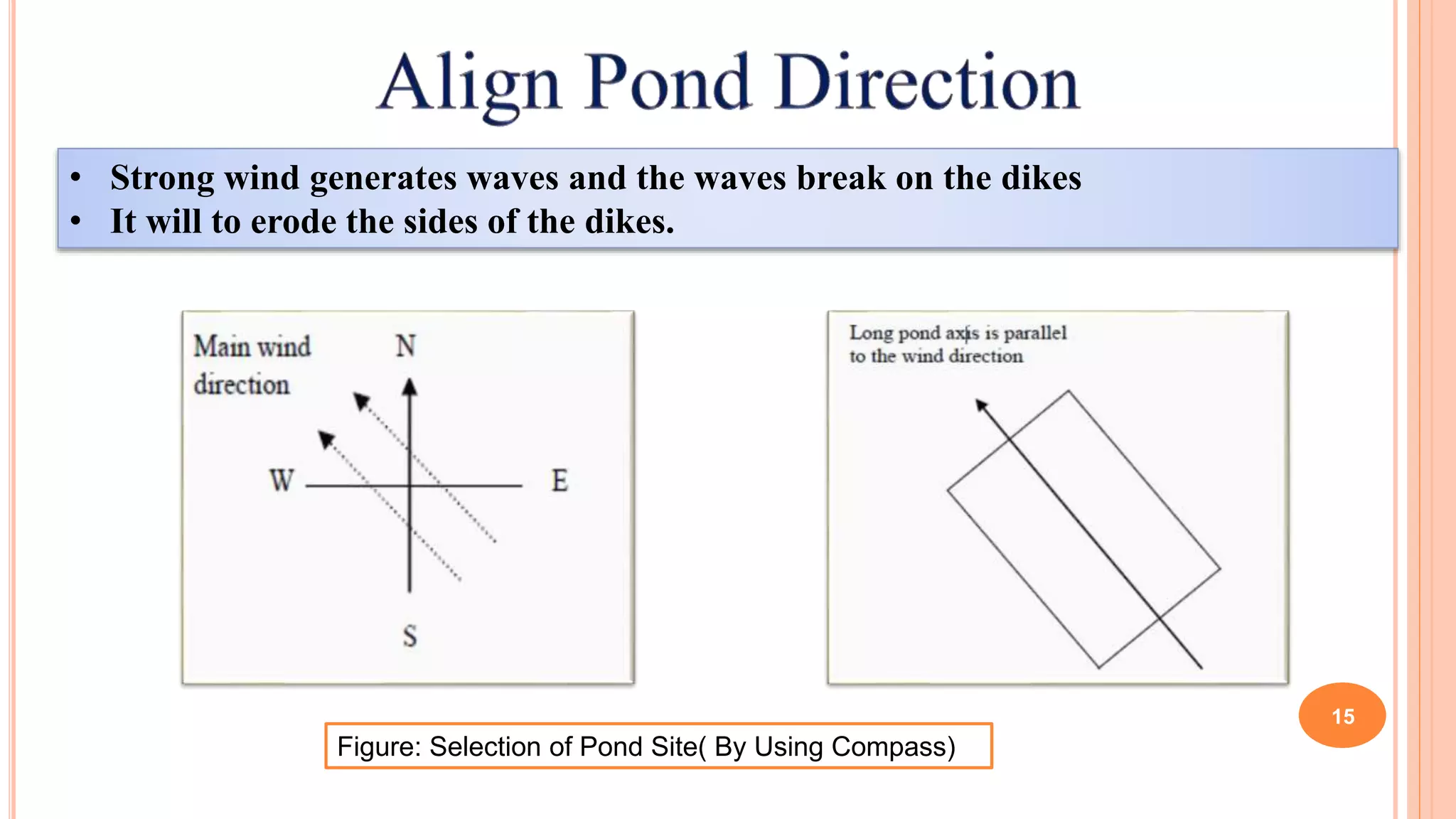
• Strong wind generates waves and the waves break on the dikes
• It will to erode the sides of the dikes.
Figure: Selection of Pond Site( By Using Compass)
15
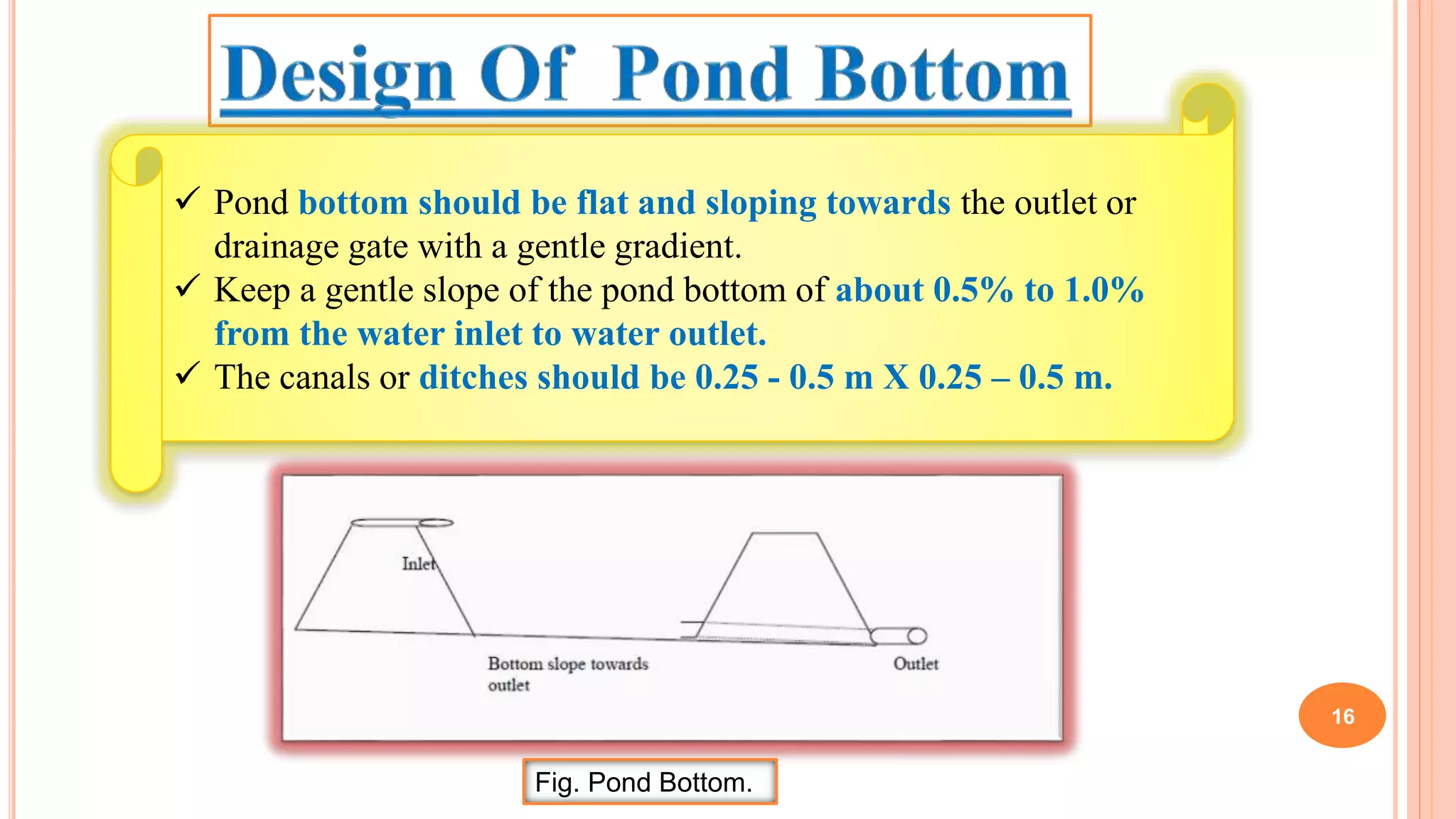
 Pond bottom should be flat and sloping towards the outlet or
drainage gate with a gentle gradient.
 Keep a gentle slope of the pond bottom of about 0.5% to 1.0%
from the water inlet to water outlet.
 The canals or ditches should be 0.25 - 0.5 m X 0.25 – 0.5 m.
Fig. Pond Bottom.
16
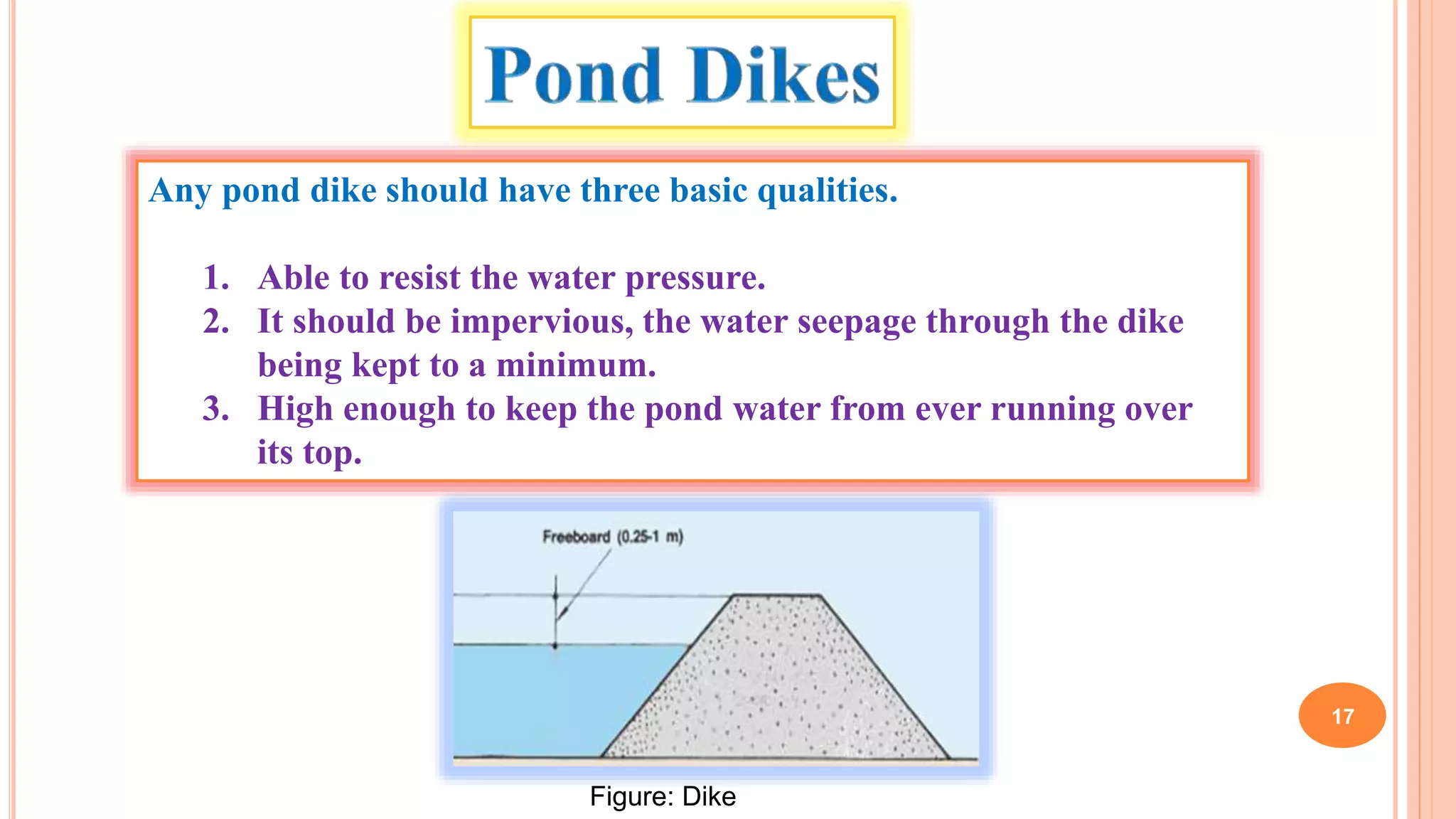
Any pond dike should have three basic qualities.
1. Able to resist the water pressure.
2. It should be impervious, the water seepage through the dike
being kept to a minimum.
3. High enough to keep the pond water from ever running over
its top.
17
Figure: Dike
18
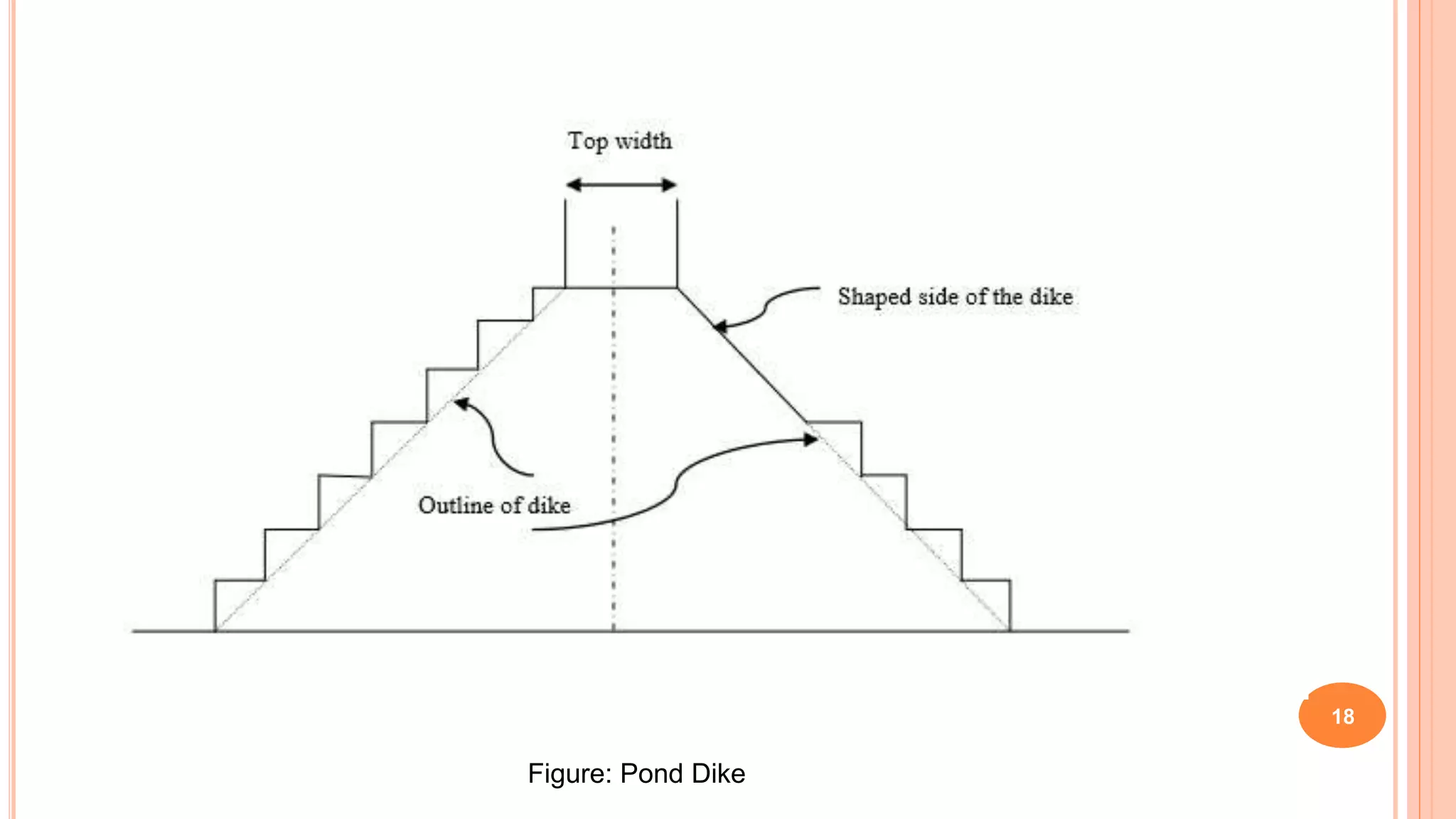
Figure: Pond Dike
19
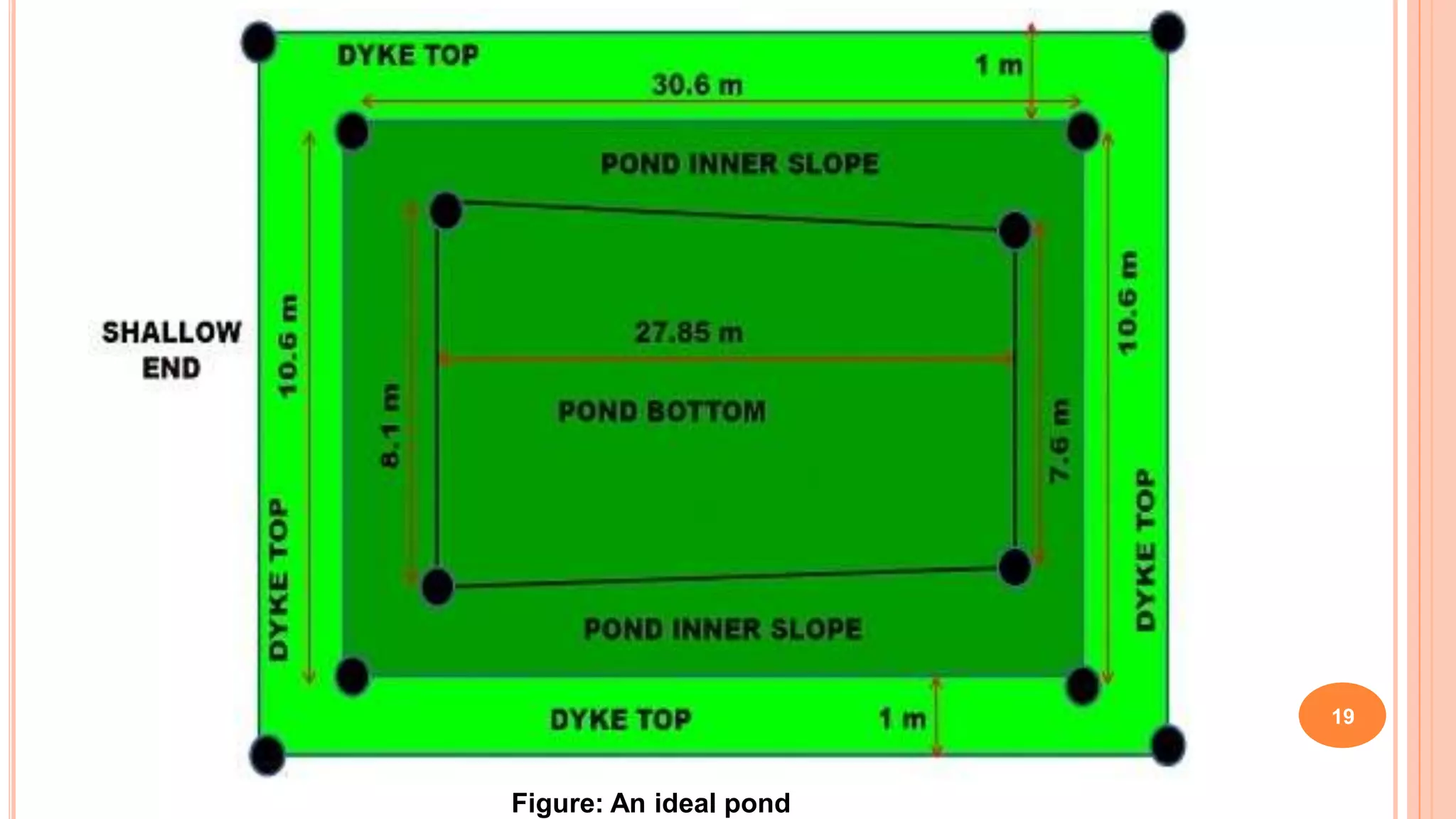
Figure: An ideal pond
 Using good soil that contains enough clay
 Building a central clayey core when using pervious soil material;
 Applying good construction practices
20
Figure; Impermeability of dike.
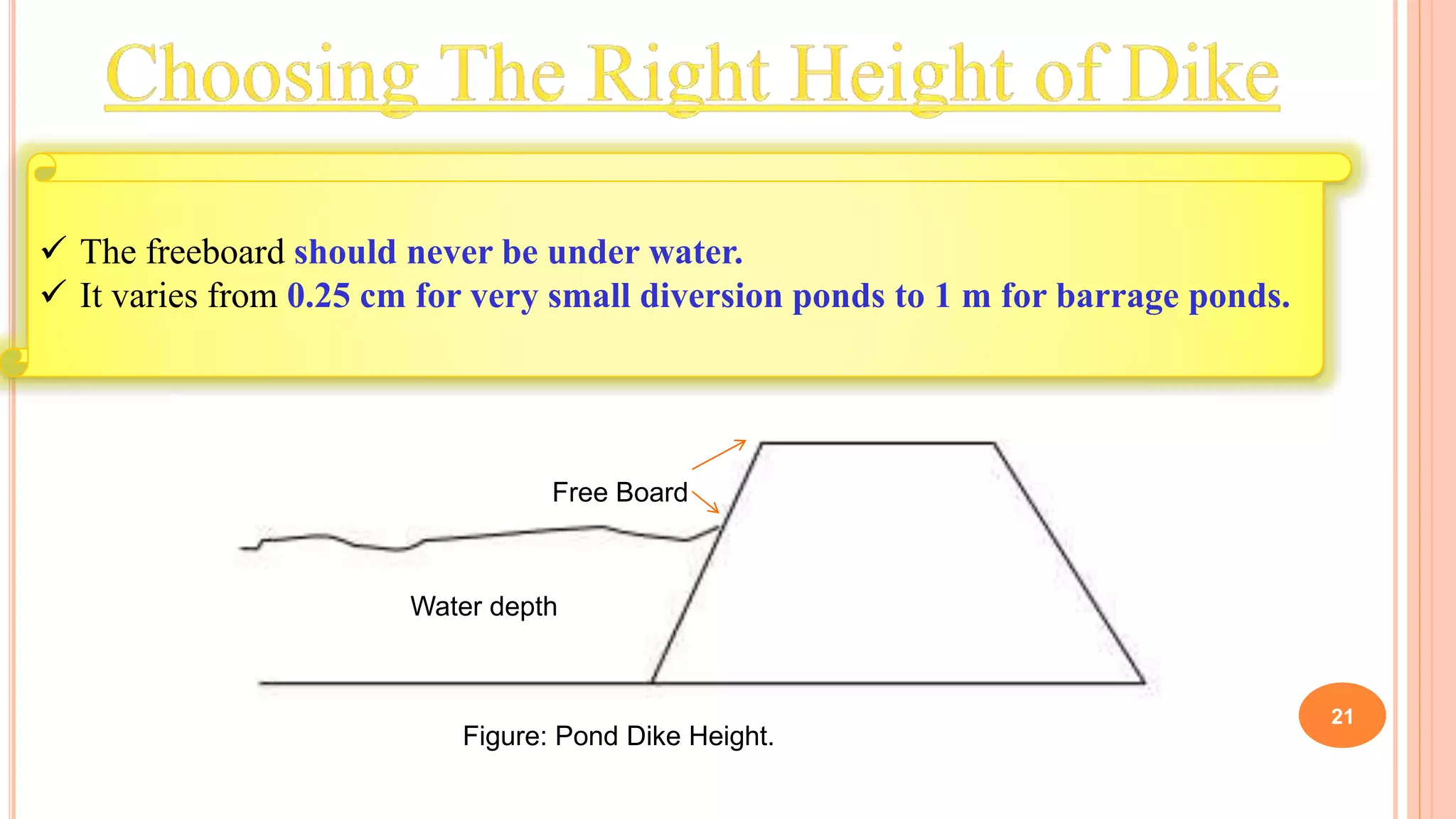
 The freeboard should never be under water.
 It varies from 0.25 cm for very small diversion ponds to 1 m for barrage ponds.
21
Free Board
Water depth
Figure: Pond Dike Height.
The foundations of the dike should be prepared. This may include:
 Treating the surface of the foundations;
 Excavating and backfilling the cut-off trench;
 Excavating and backfilling an existing stream channel.
22
 Dikes should be protected against erosion by planting or seeding a grass.
 Using temporary protection from rain, such as hay or other suitable
materials.
 Should not plant large trees on or near dikes. Root may destroy pond
dike.
23
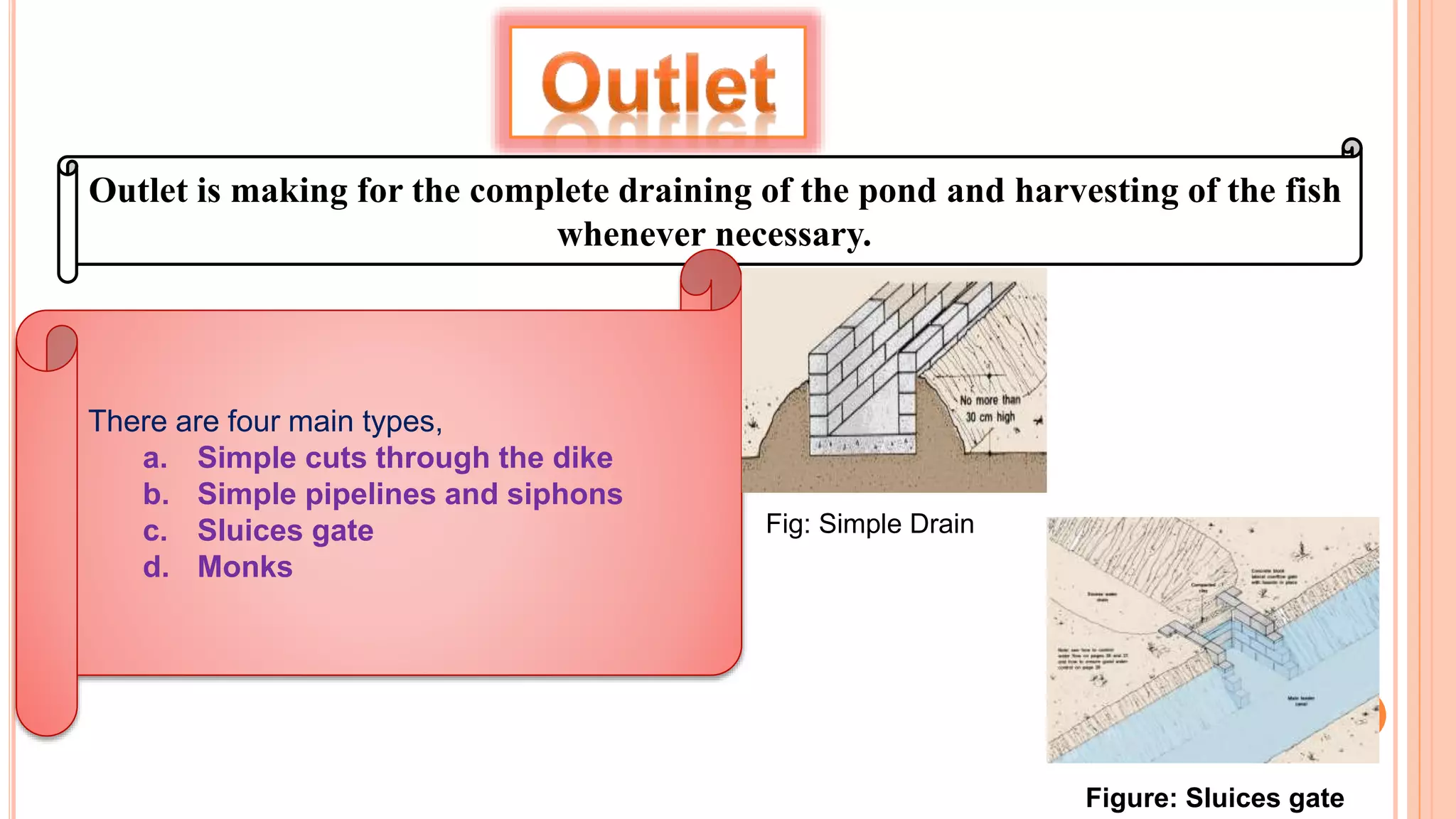
Outlet is making for the complete draining of the pond and harvesting of the fish
whenever necessary.
There are four main types,
a. Simple cuts through the dike
b. Simple pipelines and siphons
c. Sluices gate
d. Monks
24
Figure: Sluices gate
Fig: Simple Drain
25
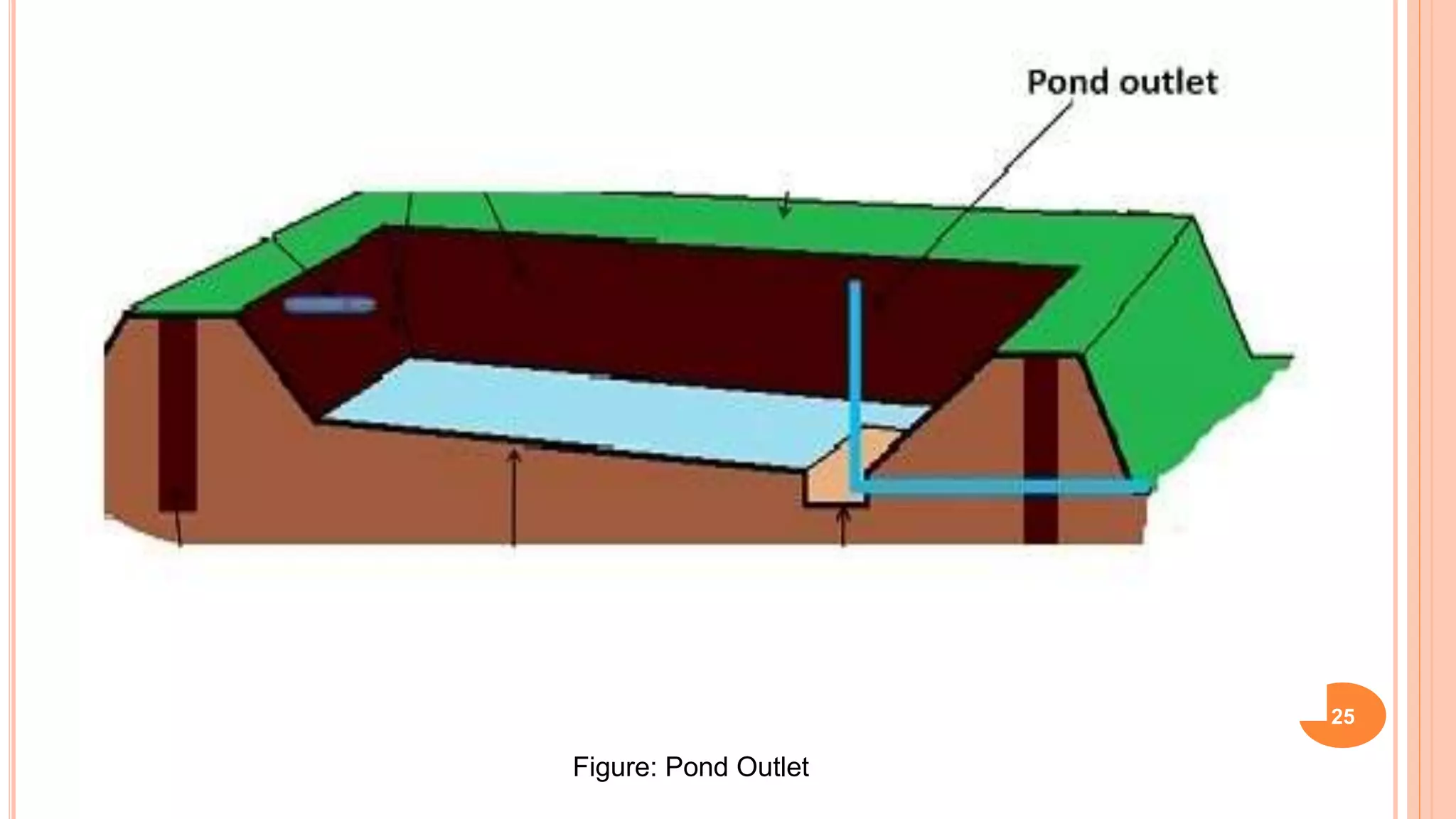
Figure: Pond Outlet
 A means for getting the water to the outside of the pond.
 Water can be drained from the top, bottom or intermediate levels of the pond;
 Any reasonable excess of water is carried away;
 The outlet can be easily cleaned and serviced;
 The construction cost and maintenance are relatively low..
26
The most common structure is the open canal, which we will consider in detail
first.
Then we will look at other common structures, including:
 Simple aqueducts to transport water above ground level
 Short pipelines to transport water above or under another structure
such as a water canal or an access road
 Simple siphons to transport water over an obstacle such as a pond dike
27
 Pond-bottom drains are ditches that are dug on the bottom of the pond to
help the water flow out and to direct the fish toward the pond outlet when
harvesting.
 However, it is better to build bottom drains:
 When the bottom slope is insufficient;
 In large ponds more than 75 m long;
 In barrage ponds with an uneven bottom relief.
28
 Pond is the basic thing for aquaculture.
 Successful aquaculture depends on good pond
construction .
 We need to construct pond properly for better profit.
29
30

CONSTRUCTION OF FISH POND

  • 1.
  • 2.
    Submitted To: Mousumi Das Lecturer, Departmentof Aquaculture Faculty of Fisheries. Submitted By: Level: III Term: Summer’14 Name Reg. No. Md. Afzal Hossain 12-05-2853 Md. Rayhanur Rahman 12-05-2854 Sulav Indra Paul 12-05-2860 Doly Sultana 12-05-2861 Khandakar Tahmida Tafhim 12-05-2862 Imran Nagar 12-05-2864 Course title: Aquaculture Engineering Course code: AQC 302 Bangabandhu Sheikh Mujibur Rahman Agricultural University Salna, Gazipur-1706 2
  • 3.
    Pond is anearthen embankment. Pond is used for (growing fish, rearing fish, Spawning, Breeding). 3 Average depth 1.2 m Water Figure: A Pond
  • 4.
  • 5.
    There are 6types of pond. These are- a. Nursery Pond b. Rearing Pond c. Stocking Pond d. Marketing P0nd e. Brood Stock Pond f. Quarantine Pond 5
  • 6.
    Short Description. a. NurseryPond: The smallest and shallowest of ponds for fish culture is a nursery pond. This is about 0.02-0.05 ha. The water is about 1 m deep. b. Rearing Pond: A rearing pond is larger than a nursery pond. It is 0.08-0.2 ha. The water is about 1.5-2.0 m deep. Nursery and rearing ponds can be seasonal. Fig.: Nursery Pond Fig.: Rearing Pond 6
  • 7.
    c. Stocking Pond: Astocking pond is much larger, often 0.2-2.0 ha. It should be 2.0-3.5 m deep. This pond might be perennial or seasonal. d. Marketing Pond: • A marketing pond, which is small but quite deep. • These ponds can be 0.05-0.10 ha in size with a water level of 3-4 m in summer. • Used to keep fish caught from a stocking pond for sale. Fig. Stocking pond. Fig. Marketing pond 7
  • 8.
    e. Brood StockPond: Brood stock ponds (0.2-0.4 ha) are perennial and have a water depth of 2 m in the summer. f. Quarantine Pond: i. Small (0.02 ha) but perennial (1.5 m deep) quarantine pond for a time to verify that they are not infected. ii. This pond is used to treat diseased fish from other ponds. Fig. Brood stock pond. Fig. Quarantine pond. 8
  • 9.
    Importance Of SiteSelection: Good site selection is a pre-requisite in pond construction. Improper site selection may lead to: I. Difficulties in holding water in the pond. II. High seepage. III.Dike erosion. IV.Low productivity of the pond V. Inability to drain water completely, and VI.Difficulties in harvesting. 9
  • 10.
    A. Space AvailabilityAnd Topography:  Space of 200 m2 to construct a pond.  Better to select flat land with a slight gradient.  Sites with slight gradients (0.5 to 3 percent is better)  Avoid areas with large undulations and rocks and with large trees. 10
  • 11.
    B. Water SupplyAnd Water Quality: Water Supply:  The source of water should have adequate amount of water  Streams, large rivers, small rivers, lakes and reservoirs can be used. Water Quality:  Temperature (25 to 300 C)  Dissolved oxygen (5-9ppm)  pH (6.5-8.5) 11
  • 12.
    C. Soil Quality: Physicalquality: Pond soil should have enough clay to hold water 100% clay may crack pond dike for exposing sunlight Chemical quality: Pond soil should not be acidic. Acidic-soils make the pond water acidic. Acidic-water retards growth of fish Acidic water causes stress situation & disease. 12
  • 13.
    Two kinds ofpond may found: 1. Series Pond: Cost effective, Easily maintain. 2. Parallel Pond: Difficult to maintain, Contamination occur. 13
  • 14.
  • 15.
    • Strong windgenerates waves and the waves break on the dikes • It will to erode the sides of the dikes. Figure: Selection of Pond Site( By Using Compass) 15
  • 16.
     Pond bottomshould be flat and sloping towards the outlet or drainage gate with a gentle gradient.  Keep a gentle slope of the pond bottom of about 0.5% to 1.0% from the water inlet to water outlet.  The canals or ditches should be 0.25 - 0.5 m X 0.25 – 0.5 m. Fig. Pond Bottom. 16
  • 17.
    Any pond dikeshould have three basic qualities. 1. Able to resist the water pressure. 2. It should be impervious, the water seepage through the dike being kept to a minimum. 3. High enough to keep the pond water from ever running over its top. 17 Figure: Dike
  • 18.
  • 19.
  • 20.
     Using goodsoil that contains enough clay  Building a central clayey core when using pervious soil material;  Applying good construction practices 20 Figure; Impermeability of dike.
  • 21.
     The freeboardshould never be under water.  It varies from 0.25 cm for very small diversion ponds to 1 m for barrage ponds. 21 Free Board Water depth Figure: Pond Dike Height.
  • 22.
    The foundations ofthe dike should be prepared. This may include:  Treating the surface of the foundations;  Excavating and backfilling the cut-off trench;  Excavating and backfilling an existing stream channel. 22
  • 23.
     Dikes shouldbe protected against erosion by planting or seeding a grass.  Using temporary protection from rain, such as hay or other suitable materials.  Should not plant large trees on or near dikes. Root may destroy pond dike. 23
  • 24.
    Outlet is makingfor the complete draining of the pond and harvesting of the fish whenever necessary. There are four main types, a. Simple cuts through the dike b. Simple pipelines and siphons c. Sluices gate d. Monks 24 Figure: Sluices gate Fig: Simple Drain
  • 25.
  • 26.
     A meansfor getting the water to the outside of the pond.  Water can be drained from the top, bottom or intermediate levels of the pond;  Any reasonable excess of water is carried away;  The outlet can be easily cleaned and serviced;  The construction cost and maintenance are relatively low.. 26
  • 27.
    The most commonstructure is the open canal, which we will consider in detail first. Then we will look at other common structures, including:  Simple aqueducts to transport water above ground level  Short pipelines to transport water above or under another structure such as a water canal or an access road  Simple siphons to transport water over an obstacle such as a pond dike 27
  • 28.
     Pond-bottom drainsare ditches that are dug on the bottom of the pond to help the water flow out and to direct the fish toward the pond outlet when harvesting.  However, it is better to build bottom drains:  When the bottom slope is insufficient;  In large ponds more than 75 m long;  In barrage ponds with an uneven bottom relief. 28
  • 29.
     Pond isthe basic thing for aquaculture.  Successful aquaculture depends on good pond construction .  We need to construct pond properly for better profit. 29
  • 30.