FURROW IRRIGATION
Furrow Irrigation
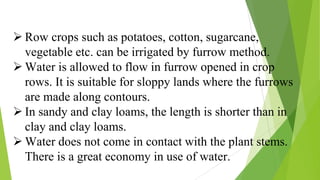
Furrows are small channels, which carry water down
the land slope between the crop rows.
Water infiltrates into the soil as it moves along the
slope.
This method is suitable for all row crops and for
crops that cannot stand water for long periods, like 12
to 24 hours, as is generally encountered in the border
or basin methods of irrigation.
Furrow Irrigation
 Water is applied to the furrows by letting in water from the
supply channel, either by pipe siphons or by making temporary
breaches in the supply channel embankment.
 The length of time the water is to flow in the furrows depends on
the amount of water required to replenish the root zone
the infiltration rate of the soil
the rate of lateral spread of water in the soil.
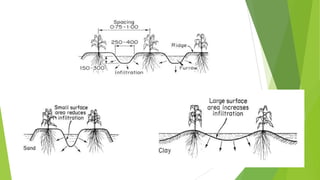
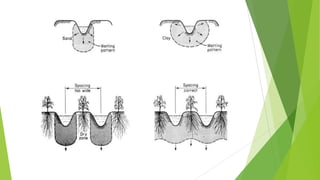
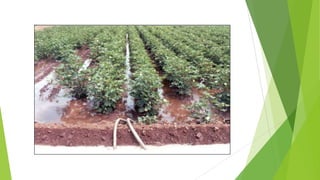
 Furrow irrigation is suitable to most soils except sandy soils that
have very high infiltration water and provide poor lateral
distribution water between furrows
 Row crops such as potatoes, cotton, sugarcane,
vegetable etc. can be irrigated by furrow method.
 Water is allowed to flow in furrow opened in crop
rows. It is suitable for sloppy lands where the furrows
are made along contours.
 In sandy and clay loams, the length is shorter than in
clay and clay loams.
 Water does not come in contact with the plant stems.
There is a great economy in use of water.
Advantages:
 High water efficiency
 Can be used in any row crop
 Relatively easy in stall
 Not expensive to maintain
 Adapted to most soils.
Disadvantages:
1. Requirement of skilled labour is more
2. A hazard to operation of machinery
3. Drainage must be provided.
Kinds of Furrow Irrigation
● Level furrows
● Graded straight furrows
● Graded contour furrows
● Corrugations
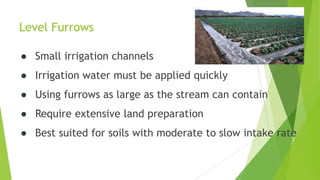
Level Furrows
● Small irrigation channels
● Irrigation water must be applied quickly
● Using furrows as large as the stream can contain
● Require extensive land preparation
● Best suited for soils with moderate to slow intake rate
Advantages
● Adjustability of water quantity applied
● Doesn’t require change in land layout
● Efficient application
● No irrigation water needs to be lost from runoff
● Use of rainfall can be maximized
Disadvantages
● Difficult to apply in areas of high wind
● Water ponds damage some crops(potato)
● Drainage of rainfall can be extensive
● Furrow needs to be large enough to carry rainfall
excess
● Topography needs to be carefully and regularly
maintained
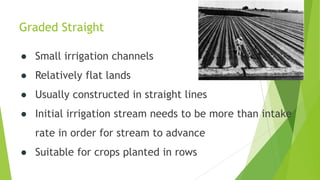
Graded Straight
● Small irrigation channels
● Relatively flat lands
● Usually constructed in straight lines
● Initial irrigation stream needs to be more than intake
rate in order for stream to advance
● Suitable for crops planted in rows
Advantages
● Can be used with both large and small
irrigation streams
● Furrows can act as channels to carry and
dispose excess surface water
● High application efficiency
Disadvantages
● High labor requirements (unless automated)
● Uniform application is difficult for soils with high
intake rates
● Land needs to be relatively flat and have very little
slope
● Field must be carefully leveled
● Surface runoff collecting facilities need to be provided
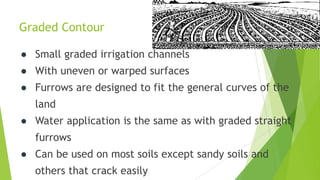
Graded Contour
● Small graded irrigation channels
● With uneven or warped surfaces
● Furrows are designed to fit the general curves of the
land
● Water application is the same as with graded straight
furrows
● Can be used on most soils except sandy soils and
others that crack easily
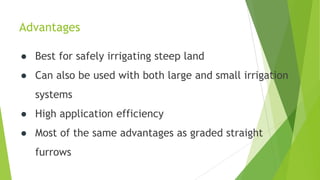
Advantages
● Best for safely irrigating steep land
● Can also be used with both large and small irrigation
systems
● High application efficiency
● Most of the same advantages as graded straight
furrows
Disadvantages
● Takes a lot of time to layout field
● Grassed waterways and structures are usually needed to carry
tailwater down the slope
● Large capacity furrows need to built and maintained through the
whole season
● Rodent control is necessary to avoid breakage and flow of water
from high to low streams
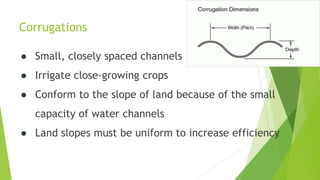
Corrugations
● Small, closely spaced channels
● Irrigate close-growing crops
● Conform to the slope of land because of the small
capacity of water channels
● Land slopes must be uniform to increase efficiency
Advantages
● Low costs for land preparation
● Best suited for areas of low rainfall
● Especially good for irrigating soils that tend to
bake or crust
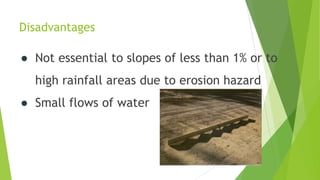
Disadvantages
● Not essential to slopes of less than 1% or to
high rainfall areas due to erosion hazard
● Small flows of water
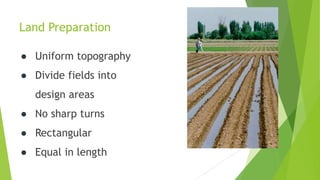
Land Preparation
● Uniform topography
● Divide fields into
design areas
● No sharp turns
● Rectangular
● Equal in length
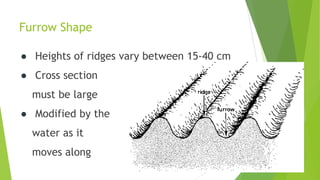
Furrow Shape
● Heights of ridges vary between 15-40 cm
● Cross section
must be large
● Modified by the
water as it
moves along
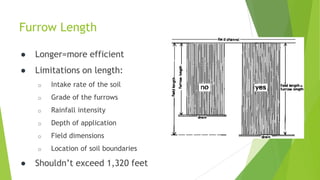
Furrow Length
● Longer=more efficient
● Limitations on length:
o Intake rate of the soil
o Grade of the furrows
o Rainfall intensity
o Depth of application
o Field dimensions
o Location of soil boundaries
● Shouldn’t exceed 1,320 feet
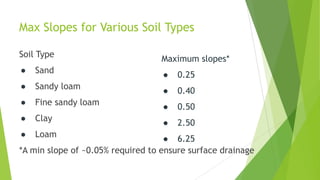
Max Slopes for Various Soil Types
Soil Type
● Sand
● Sandy loam
● Fine sandy loam
● Clay
● Loam
*A min slope of ~0.05% required to ensure surface drainage
Maximum slopes*
● 0.25
● 0.40
● 0.50
● 2.50
● 6.25
Subsurface irrigation methods
 As suggested by the name, the application of water to fields in
this type of irrigation system is below the ground surface so that
it is supplied directly to the root zone of the plants.
 The main advantages of these types of irrigation is reduction of
evaporation losses and less hindrance to cultivation works which
takes place on the surface.
 There may be two ways by which irrigation water may be applied
below ground and these are termed as:
• Natural sub-surface irrigation method
• Artificial sub-surface irrigation method
Natural Sub-surface irrigation method
 Under favorable conditions of topography and soil conditions,
the water table may be close enough to the root zone of the
field of crops which gets its moisture due to the upward
capillary movement of water from the water table.
 The natural presence of the water table may not be able to
supply the requisite water throughout the crop growing season.
However, it may be done artificially by constructing deep
channels in the field which may be filled with water at all times
to ensure the presence of water table at a desired elevation
below the root zone depth.
Natural Sub-surface irrigation method
 Though this method of irrigation is excellent from both water
distribution and labour saving points of view.
 it is favorable mostly for the following
• The soil in the root zone should be quite permeable
• There should be an impermeable substratum below the water
table to prevent deep percolation of water.
• There must be abundant supply of quality water that is one
which is salt free, otherwise there are chances of upward
movement of these salts along with the moisture likely to
lead the conditions of salt incrustation on the surface.
Artificial subsurface irrigation method
 The concept of maintaining a suitable water table just below
the root zone is obtained by providing perforated pipes laid in a
network pattern below the soil surface at a desired depth.
 This method of irrigation will function only if the soil in the
root zone has high horizontal permeability to permit free lateral
movement of water and low vertical permeability to prevent
deep percolation of water.
 For uniform distribution of water percolating into the soil, the
pipes are required to be very closely spaced, say at about 0.5m.
Artificial subsurface irrigation method
 Further, in order to avoid interference with cultivation the pipes
have to be buried not less than about 0.4m below the ground
surface.
 This method of irrigation is not very popular because of the
high expenses involved, unsuitable distribution of subsurface
moisture in may cases, and possibility of clogging of the
perforation of the pipes.
Sprinkler Irrigation System
 Sprinkler irrigation is a method of applying water which is
similar to natural rainfall but spread uniformly over the land
surface just when needed and at a rate less than the infiltration
rate of the soil so as to avoid surface runoff from irrigation.
 This is achieved by distributing water through a system of
pipes usually by pumping which is then sprayed into the air
through sprinklers so that it breaks up into small water drops
which fall to the ground.
Sprinkler Irrigation System
 The system of irrigation is suitable for undulating lands, with
poor water availability, sandy or shallow soils, or where
uniform application of water is desired.
 No land leveling is required as with the surface irrigation
methods.
 Sprinklers are, however, not suitable for soils which easily
form a crust.
 The water that is pumped through the pump pipe sprinkler
system must be free of suspended sediments. As otherwise
there would be chances of blockage of the sprinkler nozzles.
Sprinkler Irrigation System
 In sprinkler irrigation, water is conveyed under pressure
through pipes to the area to be irrigated where it is passed out
through or sprinklers the system comprises four main parts
i. Power generator
ii. Pump
iii. Pipeline and
iv. Sprinkler
Sprinkler Irrigation System
 The power generator may be electrical or mechanical. A
centrifugal pump may be used for suction lift up to 37 to 50 cm.
 A piston type pump is preferable where water is very deep. The
pipe consists of two sections, the main line and the laterals.
 The main line may be permanently buried underground or may
be laid above ground, if it is to be used on a number of fields.
 The main pipes are usually made of steel or iron.
Sprinkler Irrigation System
 The laterals are lightweight aluminum pipes and are usually
portable.
 The sprinkler nozzles may be single or double, revolving or
stationery and mounted or riser pipes attached to riser.
 Each sprinkler head applies water to circular area whose
diameter depends up on the size of water, which varies from ¼ to
¾ inch per hour is determined by selecting the proper
combination of nozzles.
Sprinkler Irrigation System
Adaptations:
1) A dependable supply of water
2) Uneven topography
3) Shallow soils.
4) Close growing crops.
Sprinkler Irrigation System
Advantages:
1) It ensures uniform distribution of water
2) It is adaptable to most kinds of soil.
3) It offers no hindrance to the use of farm implements
4) Fertilizers material may be evenly applied through sprinklers.
This is done by drawing liquid fertilizer solution slowly in to the
pipes on the suction side of the pump so that the time of
application varies from 10 to 30 minutes.
Sprinkler Irrigation System
Advantages:
5) Water losses are reduced to a minimum extent
6) More land can be irrigated
7) Costly land leveling operations are not necessary and
8) The amount of water can be controlled to meet the needs of
young seedling or mature crops.
Sprinkler Irrigation System
 Disadvantage:
1) The initial cost is rather very high.
2) Any cost of power to provide pressure must be added to the
irrigation charges.
3) Wind interferes with the distribution pattern, reducing spread
or increasing application rate near lateral pipe.
4) There is often trouble from clogged nozzle or the failure of
sprinklers to revolve.
Sprinkler Irrigation System
 Disadvantage:
5) The cost of operations and maintaince is very high. Labour
requirement for moving a pipe and related work approximately
nearly one hour per irrigation.
6) It requires a dependable constant supply of water free slit and
suspended matter and
7) It is suitable for high value crops

Furrow irrigation

  • 1.
  • 2.
    Furrow Irrigation Furrows aresmall channels, which carry water down the land slope between the crop rows. Water infiltrates into the soil as it moves along the slope. This method is suitable for all row crops and for crops that cannot stand water for long periods, like 12 to 24 hours, as is generally encountered in the border or basin methods of irrigation.
  • 3.
    Furrow Irrigation  Wateris applied to the furrows by letting in water from the supply channel, either by pipe siphons or by making temporary breaches in the supply channel embankment.  The length of time the water is to flow in the furrows depends on the amount of water required to replenish the root zone the infiltration rate of the soil the rate of lateral spread of water in the soil.  Furrow irrigation is suitable to most soils except sandy soils that have very high infiltration water and provide poor lateral distribution water between furrows
  • 7.
     Row cropssuch as potatoes, cotton, sugarcane, vegetable etc. can be irrigated by furrow method.  Water is allowed to flow in furrow opened in crop rows. It is suitable for sloppy lands where the furrows are made along contours.  In sandy and clay loams, the length is shorter than in clay and clay loams.  Water does not come in contact with the plant stems. There is a great economy in use of water.
  • 8.
    Advantages:  High waterefficiency  Can be used in any row crop  Relatively easy in stall  Not expensive to maintain  Adapted to most soils.
  • 9.
    Disadvantages: 1. Requirement ofskilled labour is more 2. A hazard to operation of machinery 3. Drainage must be provided.
  • 10.
    Kinds of FurrowIrrigation ● Level furrows ● Graded straight furrows ● Graded contour furrows ● Corrugations
  • 11.
    Level Furrows ● Smallirrigation channels ● Irrigation water must be applied quickly ● Using furrows as large as the stream can contain ● Require extensive land preparation ● Best suited for soils with moderate to slow intake rate
  • 12.
    Advantages ● Adjustability ofwater quantity applied ● Doesn’t require change in land layout ● Efficient application ● No irrigation water needs to be lost from runoff ● Use of rainfall can be maximized
  • 13.
    Disadvantages ● Difficult toapply in areas of high wind ● Water ponds damage some crops(potato) ● Drainage of rainfall can be extensive ● Furrow needs to be large enough to carry rainfall excess ● Topography needs to be carefully and regularly maintained
  • 14.
    Graded Straight ● Smallirrigation channels ● Relatively flat lands ● Usually constructed in straight lines ● Initial irrigation stream needs to be more than intake rate in order for stream to advance ● Suitable for crops planted in rows
  • 15.
    Advantages ● Can beused with both large and small irrigation streams ● Furrows can act as channels to carry and dispose excess surface water ● High application efficiency
  • 16.
    Disadvantages ● High laborrequirements (unless automated) ● Uniform application is difficult for soils with high intake rates ● Land needs to be relatively flat and have very little slope ● Field must be carefully leveled ● Surface runoff collecting facilities need to be provided
  • 17.
    Graded Contour ● Smallgraded irrigation channels ● With uneven or warped surfaces ● Furrows are designed to fit the general curves of the land ● Water application is the same as with graded straight furrows ● Can be used on most soils except sandy soils and others that crack easily
  • 18.
    Advantages ● Best forsafely irrigating steep land ● Can also be used with both large and small irrigation systems ● High application efficiency ● Most of the same advantages as graded straight furrows
  • 19.
    Disadvantages ● Takes alot of time to layout field ● Grassed waterways and structures are usually needed to carry tailwater down the slope ● Large capacity furrows need to built and maintained through the whole season ● Rodent control is necessary to avoid breakage and flow of water from high to low streams
  • 20.
    Corrugations ● Small, closelyspaced channels ● Irrigate close-growing crops ● Conform to the slope of land because of the small capacity of water channels ● Land slopes must be uniform to increase efficiency
  • 21.
    Advantages ● Low costsfor land preparation ● Best suited for areas of low rainfall ● Especially good for irrigating soils that tend to bake or crust
  • 22.
    Disadvantages ● Not essentialto slopes of less than 1% or to high rainfall areas due to erosion hazard ● Small flows of water
  • 23.
    Land Preparation ● Uniformtopography ● Divide fields into design areas ● No sharp turns ● Rectangular ● Equal in length
  • 24.
    Furrow Shape ● Heightsof ridges vary between 15-40 cm ● Cross section must be large ● Modified by the water as it moves along
  • 25.
    Furrow Length ● Longer=moreefficient ● Limitations on length: o Intake rate of the soil o Grade of the furrows o Rainfall intensity o Depth of application o Field dimensions o Location of soil boundaries ● Shouldn’t exceed 1,320 feet
  • 26.
    Max Slopes forVarious Soil Types Soil Type ● Sand ● Sandy loam ● Fine sandy loam ● Clay ● Loam *A min slope of ~0.05% required to ensure surface drainage Maximum slopes* ● 0.25 ● 0.40 ● 0.50 ● 2.50 ● 6.25
  • 27.
    Subsurface irrigation methods As suggested by the name, the application of water to fields in this type of irrigation system is below the ground surface so that it is supplied directly to the root zone of the plants.  The main advantages of these types of irrigation is reduction of evaporation losses and less hindrance to cultivation works which takes place on the surface.  There may be two ways by which irrigation water may be applied below ground and these are termed as: • Natural sub-surface irrigation method • Artificial sub-surface irrigation method
  • 28.
    Natural Sub-surface irrigationmethod  Under favorable conditions of topography and soil conditions, the water table may be close enough to the root zone of the field of crops which gets its moisture due to the upward capillary movement of water from the water table.  The natural presence of the water table may not be able to supply the requisite water throughout the crop growing season. However, it may be done artificially by constructing deep channels in the field which may be filled with water at all times to ensure the presence of water table at a desired elevation below the root zone depth.
  • 29.
    Natural Sub-surface irrigationmethod  Though this method of irrigation is excellent from both water distribution and labour saving points of view.  it is favorable mostly for the following • The soil in the root zone should be quite permeable • There should be an impermeable substratum below the water table to prevent deep percolation of water. • There must be abundant supply of quality water that is one which is salt free, otherwise there are chances of upward movement of these salts along with the moisture likely to lead the conditions of salt incrustation on the surface.
  • 30.
    Artificial subsurface irrigationmethod  The concept of maintaining a suitable water table just below the root zone is obtained by providing perforated pipes laid in a network pattern below the soil surface at a desired depth.  This method of irrigation will function only if the soil in the root zone has high horizontal permeability to permit free lateral movement of water and low vertical permeability to prevent deep percolation of water.  For uniform distribution of water percolating into the soil, the pipes are required to be very closely spaced, say at about 0.5m.
  • 31.
    Artificial subsurface irrigationmethod  Further, in order to avoid interference with cultivation the pipes have to be buried not less than about 0.4m below the ground surface.  This method of irrigation is not very popular because of the high expenses involved, unsuitable distribution of subsurface moisture in may cases, and possibility of clogging of the perforation of the pipes.
  • 32.
    Sprinkler Irrigation System Sprinkler irrigation is a method of applying water which is similar to natural rainfall but spread uniformly over the land surface just when needed and at a rate less than the infiltration rate of the soil so as to avoid surface runoff from irrigation.  This is achieved by distributing water through a system of pipes usually by pumping which is then sprayed into the air through sprinklers so that it breaks up into small water drops which fall to the ground.
  • 33.
    Sprinkler Irrigation System The system of irrigation is suitable for undulating lands, with poor water availability, sandy or shallow soils, or where uniform application of water is desired.  No land leveling is required as with the surface irrigation methods.  Sprinklers are, however, not suitable for soils which easily form a crust.  The water that is pumped through the pump pipe sprinkler system must be free of suspended sediments. As otherwise there would be chances of blockage of the sprinkler nozzles.
  • 34.
    Sprinkler Irrigation System In sprinkler irrigation, water is conveyed under pressure through pipes to the area to be irrigated where it is passed out through or sprinklers the system comprises four main parts i. Power generator ii. Pump iii. Pipeline and iv. Sprinkler
  • 35.
    Sprinkler Irrigation System The power generator may be electrical or mechanical. A centrifugal pump may be used for suction lift up to 37 to 50 cm.  A piston type pump is preferable where water is very deep. The pipe consists of two sections, the main line and the laterals.  The main line may be permanently buried underground or may be laid above ground, if it is to be used on a number of fields.  The main pipes are usually made of steel or iron.
  • 36.
    Sprinkler Irrigation System The laterals are lightweight aluminum pipes and are usually portable.  The sprinkler nozzles may be single or double, revolving or stationery and mounted or riser pipes attached to riser.  Each sprinkler head applies water to circular area whose diameter depends up on the size of water, which varies from ¼ to ¾ inch per hour is determined by selecting the proper combination of nozzles.
  • 37.
    Sprinkler Irrigation System Adaptations: 1)A dependable supply of water 2) Uneven topography 3) Shallow soils. 4) Close growing crops.
  • 38.
    Sprinkler Irrigation System Advantages: 1)It ensures uniform distribution of water 2) It is adaptable to most kinds of soil. 3) It offers no hindrance to the use of farm implements 4) Fertilizers material may be evenly applied through sprinklers. This is done by drawing liquid fertilizer solution slowly in to the pipes on the suction side of the pump so that the time of application varies from 10 to 30 minutes.
  • 39.
    Sprinkler Irrigation System Advantages: 5)Water losses are reduced to a minimum extent 6) More land can be irrigated 7) Costly land leveling operations are not necessary and 8) The amount of water can be controlled to meet the needs of young seedling or mature crops.
  • 40.
    Sprinkler Irrigation System Disadvantage: 1) The initial cost is rather very high. 2) Any cost of power to provide pressure must be added to the irrigation charges. 3) Wind interferes with the distribution pattern, reducing spread or increasing application rate near lateral pipe. 4) There is often trouble from clogged nozzle or the failure of sprinklers to revolve.
  • 41.
    Sprinkler Irrigation System Disadvantage: 5) The cost of operations and maintaince is very high. Labour requirement for moving a pipe and related work approximately nearly one hour per irrigation. 6) It requires a dependable constant supply of water free slit and suspended matter and 7) It is suitable for high value crops

Editor's Notes

  • #10 Salts from the water used in irrigation and salt already present in the soil may lead to concentration of salts
  • #11 Each system requires specific designs and layouts
  • #12 Small irrigation channels with small or b
  • #21 Corrugations are small, closely spaced irrigation channels used to irrigate close-growing crops on moderately steep land Corrugations generally must conform to the slope of the land because of the small capacity of the water channels For efficient irrigation by the corrugation method, land slopes must be uniform and the water applied according to an irrigation water management plan
  • #24 Efficient irrigation is most easily accomplished on land with uniform topography Since neither soil nor topography is normally uniform over large areas, it is generally advisable to divide fields into design areas according to soul uniformity and do the land leveling needed to develop uniform land slopes within the limitations imposed by the design criteria Sharp turns or acute angles must be avoided Fields should be as nearly rectangular as possible Furrows should be nearly as nearly equal in length
  • #25 15-40 cm The furrow cross section must be large enough to contain the largest irrigation stream to be introduced without overtopping and to contain the runoff resulting from expected rainstorms Furrow shape is modified by the water as it moves down the slope. On steep slopes the water tends to form a narrow channel, whereas or flatter slopes it forms a broad channel
  • #26 Long furrows are more efficient because they require fewer turns for farm equipment and provides adequate drainage