Supervised : Prof. Abd Al- Hamade Sbata
Prepared by:
Salem Omar Mansour
Ibrahim Mustafa Al-Osta
Ion detection through Faraday Cup
Spring 2024
Introduction
Ion detector
inducing current
from moving
charged ions.
generating and
amplifying
secondary
electrons
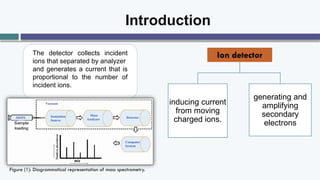
The detector collects incident
ions that separated by analyzer
and generates a current that is
proportional to the number of
incident ions.
Figure (1): Diagrammatical representation of mass spectrometry.
Faraday cup detector
The Faraday cup (FC) is a simple effective device for
detecting charged particles.
Consist of metal cup or cylinder with small orifice and
coated with dynode surface.
This cup placed within a vacuum system and connected
to the ground through a high resistor.
In front of collector there are electron repeller and weak
magnetic filed to prevent escaping of any secondary
electrons produced inside
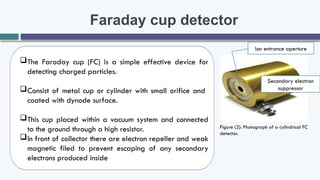
Secondary electron
suppressor
Ion entrance aperture
Figure (2): Photograph of a cylindrical FC
detector.
Faraday cup design
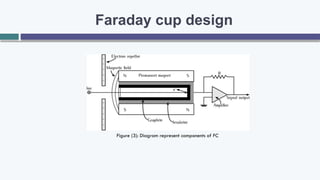
Figure (3): Diagram represent components of FC
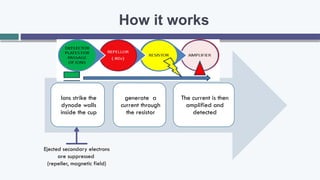
How it works
Ions strike the
dynode walls
inside the cup
generate a
current through
the resistor
The current is then
amplified and
detected
Ejected secondary electrons
are suppressed
(repeller, magnetic field)
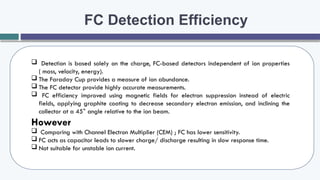
FC Detection Efficiency
 Detection is based solely on the charge, FC-based detectors independent of ion properties
( mass, velocity, energy).
 The Faraday Cup provides a measure of ion abundance.
 The FC detector provide highly accurate measurements.
 FC efficiency improved using magnetic fields for electron suppression instead of electric
fields, applying graphite coating to decrease secondary electron emission, and inclining the
collector at a 45° angle relative to the ion beam.
However
 Comparing with Channel Electron Multiplier (CEM) ; FC has lower sensitivity.
 FC acts as capacitor leads to slower charge/ discharge resulting in slow response time.
 Not suitable for unstable ion current.
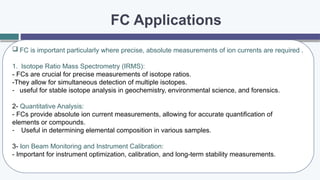
FC Applications
 FC is important particularly where precise, absolute measurements of ion currents are required .
1. Isotope Ratio Mass Spectrometry (IRMS):
- FCs are crucial for precise measurements of isotope ratios.
-They allow for simultaneous detection of multiple isotopes.
- useful for stable isotope analysis in geochemistry, environmental science, and forensics.
2- Quantitative Analysis:
- FCs provide absolute ion current measurements, allowing for accurate quantification of
elements or compounds.
- Useful in determining elemental composition in various samples.
3- Ion Beam Monitoring and Instrument Calibration:
- Important for instrument optimization, calibration, and long-term stability measurements.
Conclusions
- Faraday cup detector is simple and accurate detector depends on
generation of current as a results of striking of the ions on its wall and the
detected charge is independent of the mass, the speed and the energy of
the detected ions.
- Gives highly accurate quantitative measurements so its used mainly in
quantitative elemental analysis, isotope ratio studies, in addition, FCs
provide stable and reproducible signals, which are crucial for long-term
measurements and comparisons.
- Faraday collectors have lower sensitivity and slower response time, making
them less suitable for detecting very low ion currents and fast-scanning
applications.
References
 Bhatia, R. K., Yadav, V. K., Kumar, Y., Gonde, B. R., Ravisankar, E., Saha, T. K., Nataraju, V., & Gupta,
S. K. (2015). Improved Faraday collector for magnetic sector mass spectrometers. International
Journal of Mass Spectrometry, 393: 58-62.
 De Hoffmann, E., & Stroobant, V. (2007). Mass spectrometry: Principles and applications. Wiley.
 Di, Y., Li, Z., & Amelin, Y. (2021). Monitoring and quantitative evaluation of Faraday cup deterioration in
a thermal ionization mass spectrometer using multidynamic analyses of laboratory standards. Journal
of Analytical Atomic Spectrometry, 36(7), 1489-1502.
 Vadakedath, S. , Kandi, V. , Godishala, V. , Pinnelli, V. B. K. , Alkafaas, S. S. , & EIkafas, S. S. (2022).
The Principle, Types, and Applications of Mass Spectrometry: A Comprehensive Review. Biomedicine
and Biotechnology, 7(1), 6-22.

Faraday cup Mass spectroscopy Faraday cup.pptx

  • 1.
    Supervised : Prof.Abd Al- Hamade Sbata Prepared by: Salem Omar Mansour Ibrahim Mustafa Al-Osta Ion detection through Faraday Cup Spring 2024
  • 2.
    Introduction Ion detector inducing current frommoving charged ions. generating and amplifying secondary electrons The detector collects incident ions that separated by analyzer and generates a current that is proportional to the number of incident ions. Figure (1): Diagrammatical representation of mass spectrometry.
  • 3.
    Faraday cup detector TheFaraday cup (FC) is a simple effective device for detecting charged particles. Consist of metal cup or cylinder with small orifice and coated with dynode surface. This cup placed within a vacuum system and connected to the ground through a high resistor. In front of collector there are electron repeller and weak magnetic filed to prevent escaping of any secondary electrons produced inside Secondary electron suppressor Ion entrance aperture Figure (2): Photograph of a cylindrical FC detector.
  • 4.
    Faraday cup design Figure(3): Diagram represent components of FC
  • 5.
    How it works Ionsstrike the dynode walls inside the cup generate a current through the resistor The current is then amplified and detected Ejected secondary electrons are suppressed (repeller, magnetic field)
  • 6.
    FC Detection Efficiency Detection is based solely on the charge, FC-based detectors independent of ion properties ( mass, velocity, energy).  The Faraday Cup provides a measure of ion abundance.  The FC detector provide highly accurate measurements.  FC efficiency improved using magnetic fields for electron suppression instead of electric fields, applying graphite coating to decrease secondary electron emission, and inclining the collector at a 45° angle relative to the ion beam. However  Comparing with Channel Electron Multiplier (CEM) ; FC has lower sensitivity.  FC acts as capacitor leads to slower charge/ discharge resulting in slow response time.  Not suitable for unstable ion current.
  • 7.
    FC Applications  FCis important particularly where precise, absolute measurements of ion currents are required . 1. Isotope Ratio Mass Spectrometry (IRMS): - FCs are crucial for precise measurements of isotope ratios. -They allow for simultaneous detection of multiple isotopes. - useful for stable isotope analysis in geochemistry, environmental science, and forensics. 2- Quantitative Analysis: - FCs provide absolute ion current measurements, allowing for accurate quantification of elements or compounds. - Useful in determining elemental composition in various samples. 3- Ion Beam Monitoring and Instrument Calibration: - Important for instrument optimization, calibration, and long-term stability measurements.
  • 8.
    Conclusions - Faraday cupdetector is simple and accurate detector depends on generation of current as a results of striking of the ions on its wall and the detected charge is independent of the mass, the speed and the energy of the detected ions. - Gives highly accurate quantitative measurements so its used mainly in quantitative elemental analysis, isotope ratio studies, in addition, FCs provide stable and reproducible signals, which are crucial for long-term measurements and comparisons. - Faraday collectors have lower sensitivity and slower response time, making them less suitable for detecting very low ion currents and fast-scanning applications.
  • 9.
    References  Bhatia, R.K., Yadav, V. K., Kumar, Y., Gonde, B. R., Ravisankar, E., Saha, T. K., Nataraju, V., & Gupta, S. K. (2015). Improved Faraday collector for magnetic sector mass spectrometers. International Journal of Mass Spectrometry, 393: 58-62.  De Hoffmann, E., & Stroobant, V. (2007). Mass spectrometry: Principles and applications. Wiley.  Di, Y., Li, Z., & Amelin, Y. (2021). Monitoring and quantitative evaluation of Faraday cup deterioration in a thermal ionization mass spectrometer using multidynamic analyses of laboratory standards. Journal of Analytical Atomic Spectrometry, 36(7), 1489-1502.  Vadakedath, S. , Kandi, V. , Godishala, V. , Pinnelli, V. B. K. , Alkafaas, S. S. , & EIkafas, S. S. (2022). The Principle, Types, and Applications of Mass Spectrometry: A Comprehensive Review. Biomedicine and Biotechnology, 7(1), 6-22.