HYPHENATED TECHNIQUES
Presented By : Biji Saro Varghese
M.Sc. II Sem-IV
1
RASHTRASANT TUKADOJI MAHARAJ NAGPUR UNIVERSITY
P. G. T. DEPARTMENT OF CHEMISTRY
7/10/2019
CONTENTS
• INTRODUCTION
• GC-MS
• LC-MS
• ICP-MS
• MS-MS
7/10/2019 2
INTRODUCTION
Hyphenated technique is a combination or coupling
of two analytical techniques with the help of proper
interface.
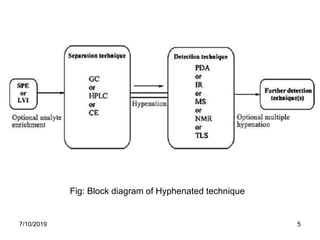
The hyphenated technique is developed from the
coupling of a separation technique and detection
technique.
The term “hyphenation” was first adapted by
Hirschfeld in 1980 to refer to the on-line
combination of a separation technique and one or
more spectroscopic detection techniques.
7/10/2019 3
List of hyphenated techniques
• GC-MS
• LC-MS
• LC-NMR
• EC-MS
• CE-MS
• ICP-MS
• GC-IR
• LC-MS-MS
• MS-MS
• GC-MS-MS
• GC-NMR
• GC-AES
• ICP-AAS7/10/2019 4
Fig: Block diagram of Hyphenated technique
7/10/2019 5
Gas
chromatography
Mass
spectrometry
GC-MS
Separates
mixture of
components
into individual
Identifies
molecules
based on their
mass
A chemical analysis
technique
combining two
instruments to
provide for powerful
separation &
identification.
GC-MS
7/10/2019 6
• Gas chromatography–mass spectrometry(GC-MS, or alternatively
HPLC-MS) is an advanced analytical instrumental technique
that combines the physical separation capabilities of gas
chromatography with the mass analysis capabilities of mass
spectrometer
• It is one of the most accurate and efficient tools for analyzing
volatile organic samples.
• After separation in the GC column, analyte species have to be
transported to the mass spectrometer to be ionized, mass filtered
and detected.
• The column outlet needs to be connected to the ion source of the
mass spectrometer and different strategies had been implemented
which needs to fulfill the following conditions:
o Analyte must not condense in the interface.
o Analyte must not decompose before entering the mass
spectrometer ion source.
o The gas load (dictated by the mobile phase gas flow rate) entering
the ion source must be within the pumping capacity of the mass
spectrometer.
7/10/2019 7
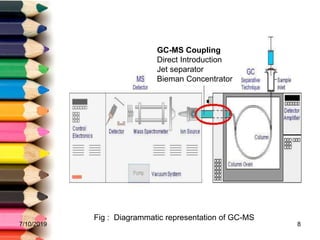
GC-MS Coupling
Direct Introduction
Jet separator
Bieman Concentrator
Fig : Diagrammatic representation of GC-MS
7/10/2019 8
Types of interfaces:
Direct Introduction
7/10/2019 9
Direct Introduction
GC-MS systems use capillary columns & fused silica tubing
permits an inert, high efficiency, direct transfer between the
2 systems.
Flow rates is 5ml/min.
sdfssdhj
fh
7/10/2019 10
Jet Separator
The jet separator consist of two glass tubes
aligned with a Small distance between them.
Carrier gas entering from the GC column is
pumped away by a separate vacuumed system.
The larger sample molecules maintain their
momentum &pass preferentially in to the second
capillary. Sample enrichment occurs & the initial
atmospheric pressure is reduced.
sdfssdhj
fh
7/10/2019 11
Watson-Biemann effusion separator
It consists of a sintered glass tube . The carrier
gas usually helium passes preferentially through
the sintered glass tube and the effluent is
concentrated . The gas flow rates in the order of
20-60ml/min.
sdfssdhj
fh
7/10/2019 12
LC-MS
• Liquid chromatography-mass spectrometry is the technique
which performs separation by liquid chromatography and
mass analysis with the help of the mass spectrometry.
• Electrospray needle is used as bridge to connect the liquid
chromatography with that of the mass spectrometry. LC-MS
is mainly separated into the three parts-
 Chromatography
In liquid chromatography separation is performed which is
detected with the help of Photo diode Array. These separated
components then transferred to the Interface.
 Interface
In interface the liquid is volatilized and transferred to the MS.
 Spectrometry
With the help of various ionization techniques the compound
is ionized and then it is analyzed by mass analyzer.
7/10/2019 13
7/10/2019 14
Fig: Schematic diagram of LC-MS
7/10/2019 15
ICP-MS
• Inductively coupled plasma mass
spectrometry (ICP-MS) is a type of mass
spectrometry which is capable of
detecting metals and several non-metals at
concentrations as low as one part in 1015 (part
per quadrillion, ppq) .
• This is achieved by ionizing the sample
with inductively coupled plasma and then using
a mass spectrometer to separate and quantify
those ions.
7/10/2019 16
Fig: Schematic representation of ICP-MS7/10/2019 17
MS-MS Tandem
In a tandem mass spectrometer, ions are formed in
the ion source and separated by mass-to-charge in
the first stage of mass spectrometry (MS1). Ions of
a particular mass-to-charge ratio (precursor ions)
are selected and fragment ions (product ions) are
created by collision-induced dissociation, ion-
molecule reaction, photo dissociation, or other
process. The resulting ions are then separated and
detected in a second stage of mass spectrometry
(MS2). A common use is for analysis of
biomolecules such as proteins and peptides.
7/10/2019 18
Fig :Diagrammatic representation of tandem mass spectrometry
7/10/2019 19
Advantages of hyphenated techniques
 Fast and accurate analysis.
 Higher degree of automation.
 Higher sample throughput.
 Better reproducibility.
 Reduction of contamination due to its
closed system.
 Separation and quantification achieved
at same time.
7/10/2019 20
References
• https://en.wikipedia.org/wiki/Tandem_mass_spectrometry
• https://en.wikipedia.org/wiki/Inductively_coupled_plasma_mass_spectrometry
• https://en.wikipedia.org/wiki/Liquid_chromatography%E2%80%93mass_spectrometry
• https://www.chromacademy.com/subscribe-warning.asp
1. Trace analysis by Susanta Lahiri, Narosa Publishing House
2. Web references
7/10/2019 21
THANK YOU
7/10/2019 22

Hyphenated techniques

  • 1.
    HYPHENATED TECHNIQUES Presented By: Biji Saro Varghese M.Sc. II Sem-IV 1 RASHTRASANT TUKADOJI MAHARAJ NAGPUR UNIVERSITY P. G. T. DEPARTMENT OF CHEMISTRY 7/10/2019
  • 2.
    CONTENTS • INTRODUCTION • GC-MS •LC-MS • ICP-MS • MS-MS 7/10/2019 2
  • 3.
    INTRODUCTION Hyphenated technique isa combination or coupling of two analytical techniques with the help of proper interface. The hyphenated technique is developed from the coupling of a separation technique and detection technique. The term “hyphenation” was first adapted by Hirschfeld in 1980 to refer to the on-line combination of a separation technique and one or more spectroscopic detection techniques. 7/10/2019 3
  • 4.
    List of hyphenatedtechniques • GC-MS • LC-MS • LC-NMR • EC-MS • CE-MS • ICP-MS • GC-IR • LC-MS-MS • MS-MS • GC-MS-MS • GC-NMR • GC-AES • ICP-AAS7/10/2019 4
  • 5.
    Fig: Block diagramof Hyphenated technique 7/10/2019 5
  • 6.
    Gas chromatography Mass spectrometry GC-MS Separates mixture of components into individual Identifies molecules basedon their mass A chemical analysis technique combining two instruments to provide for powerful separation & identification. GC-MS 7/10/2019 6
  • 7.
    • Gas chromatography–massspectrometry(GC-MS, or alternatively HPLC-MS) is an advanced analytical instrumental technique that combines the physical separation capabilities of gas chromatography with the mass analysis capabilities of mass spectrometer • It is one of the most accurate and efficient tools for analyzing volatile organic samples. • After separation in the GC column, analyte species have to be transported to the mass spectrometer to be ionized, mass filtered and detected. • The column outlet needs to be connected to the ion source of the mass spectrometer and different strategies had been implemented which needs to fulfill the following conditions: o Analyte must not condense in the interface. o Analyte must not decompose before entering the mass spectrometer ion source. o The gas load (dictated by the mobile phase gas flow rate) entering the ion source must be within the pumping capacity of the mass spectrometer. 7/10/2019 7
  • 8.
    GC-MS Coupling Direct Introduction Jetseparator Bieman Concentrator Fig : Diagrammatic representation of GC-MS 7/10/2019 8
  • 9.
    Types of interfaces: DirectIntroduction 7/10/2019 9
  • 10.
    Direct Introduction GC-MS systemsuse capillary columns & fused silica tubing permits an inert, high efficiency, direct transfer between the 2 systems. Flow rates is 5ml/min. sdfssdhj fh 7/10/2019 10
  • 11.
    Jet Separator The jetseparator consist of two glass tubes aligned with a Small distance between them. Carrier gas entering from the GC column is pumped away by a separate vacuumed system. The larger sample molecules maintain their momentum &pass preferentially in to the second capillary. Sample enrichment occurs & the initial atmospheric pressure is reduced. sdfssdhj fh 7/10/2019 11
  • 12.
    Watson-Biemann effusion separator Itconsists of a sintered glass tube . The carrier gas usually helium passes preferentially through the sintered glass tube and the effluent is concentrated . The gas flow rates in the order of 20-60ml/min. sdfssdhj fh 7/10/2019 12
  • 13.
    LC-MS • Liquid chromatography-massspectrometry is the technique which performs separation by liquid chromatography and mass analysis with the help of the mass spectrometry. • Electrospray needle is used as bridge to connect the liquid chromatography with that of the mass spectrometry. LC-MS is mainly separated into the three parts-  Chromatography In liquid chromatography separation is performed which is detected with the help of Photo diode Array. These separated components then transferred to the Interface.  Interface In interface the liquid is volatilized and transferred to the MS.  Spectrometry With the help of various ionization techniques the compound is ionized and then it is analyzed by mass analyzer. 7/10/2019 13
  • 14.
  • 15.
    Fig: Schematic diagramof LC-MS 7/10/2019 15
  • 16.
    ICP-MS • Inductively coupledplasma mass spectrometry (ICP-MS) is a type of mass spectrometry which is capable of detecting metals and several non-metals at concentrations as low as one part in 1015 (part per quadrillion, ppq) . • This is achieved by ionizing the sample with inductively coupled plasma and then using a mass spectrometer to separate and quantify those ions. 7/10/2019 16
  • 17.
    Fig: Schematic representationof ICP-MS7/10/2019 17
  • 18.
    MS-MS Tandem In atandem mass spectrometer, ions are formed in the ion source and separated by mass-to-charge in the first stage of mass spectrometry (MS1). Ions of a particular mass-to-charge ratio (precursor ions) are selected and fragment ions (product ions) are created by collision-induced dissociation, ion- molecule reaction, photo dissociation, or other process. The resulting ions are then separated and detected in a second stage of mass spectrometry (MS2). A common use is for analysis of biomolecules such as proteins and peptides. 7/10/2019 18
  • 19.
    Fig :Diagrammatic representationof tandem mass spectrometry 7/10/2019 19
  • 20.
    Advantages of hyphenatedtechniques  Fast and accurate analysis.  Higher degree of automation.  Higher sample throughput.  Better reproducibility.  Reduction of contamination due to its closed system.  Separation and quantification achieved at same time. 7/10/2019 20
  • 21.
    References • https://en.wikipedia.org/wiki/Tandem_mass_spectrometry • https://en.wikipedia.org/wiki/Inductively_coupled_plasma_mass_spectrometry •https://en.wikipedia.org/wiki/Liquid_chromatography%E2%80%93mass_spectrometry • https://www.chromacademy.com/subscribe-warning.asp 1. Trace analysis by Susanta Lahiri, Narosa Publishing House 2. Web references 7/10/2019 21
  • 22.