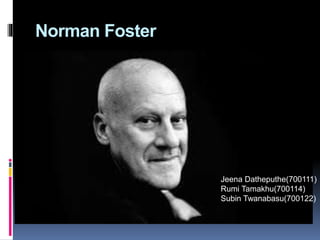
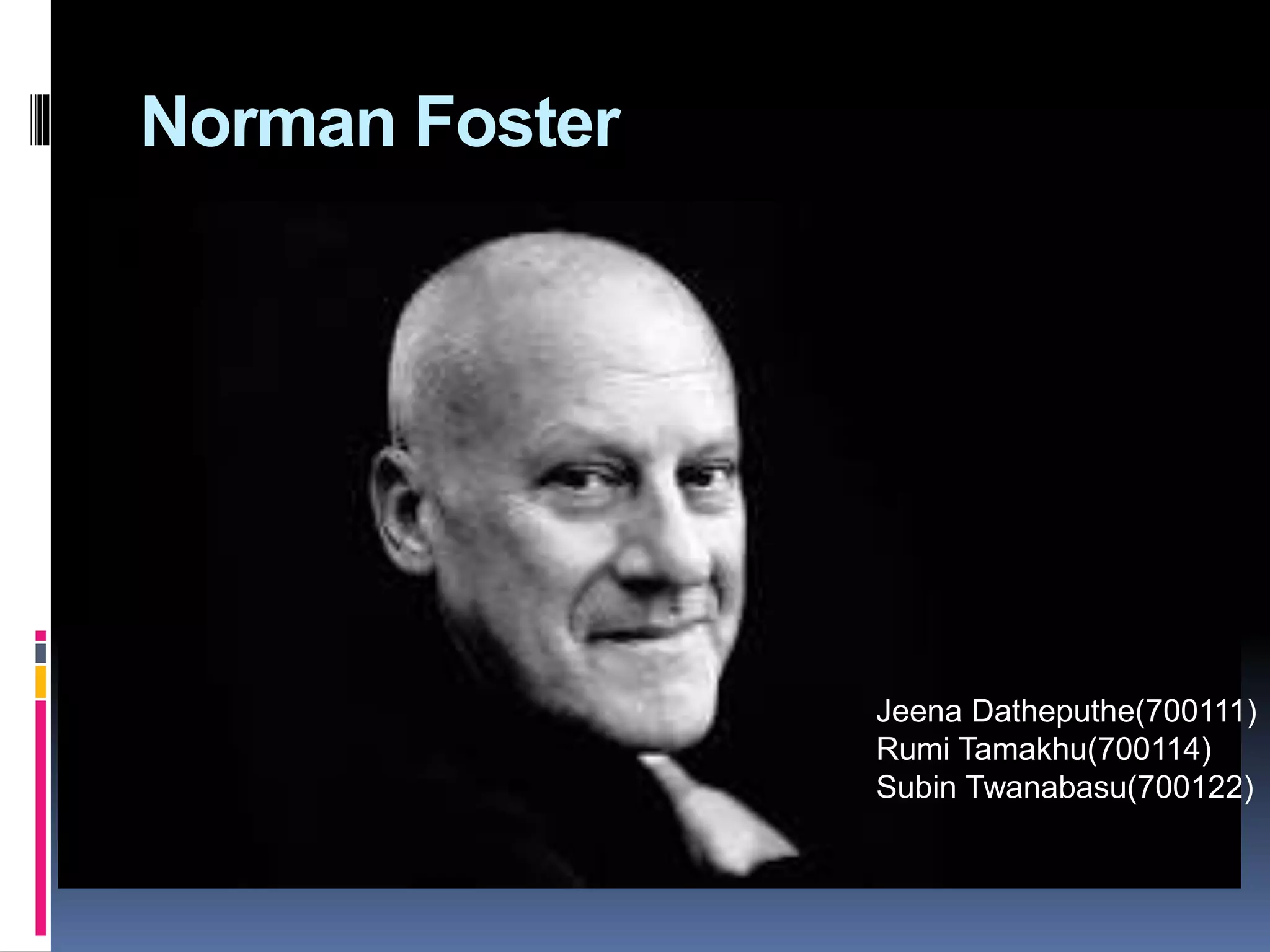
Norman Foster
Jeena Datheputhe(700111)
Rumi Tamakhu(700114)
Subin Twanabasu(700122)
Introduction
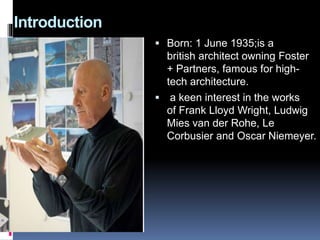
 Born: 1 June 1935;is a
british architect owning Foster
+ Partners, famous for high-
tech architecture.
 a keen interest in the works
of Frank Lloyd Wright, Ludwig
Mies van der Rohe, Le
Corbusier and Oscar Niemeyer.
Philosophies
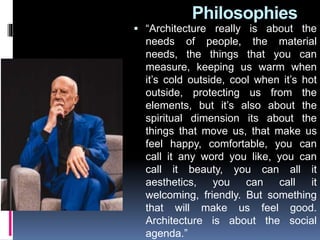
 “Architecture really is about the
needs of people, the material
needs, the things that you can
measure, keeping us warm when
it’s cold outside, cool when it’s hot
outside, protecting us from the
elements, but it’s also about the
spiritual dimension its about the
things that move us, that make us
feel happy, comfortable, you can
call it any word you like, you can
call it beauty, you can all it
aesthetics, you can call it
welcoming, friendly. But something
that will make us feel good.
Architecture is about the social
agenda.”
Philosophies
 wants his buildings to be environmentally friendly but
at the same time be pleasing places for people to be
in and look at.
 take full advantage of the latest technology,
searching for great energy efficiency, excellent
integration with the environment.
 well known for turning the forms of buildings into
works of art.
Contributions
 Some of his buildings are:
1. London City Hall(2002)
2. St. Mary Axe
3. Reichstag building Sainsbury Centre for Visual
Arts UK (1978)
4. The Sage Gateshead England(1997–2004)
5. Hearst Tower, New York City (June 2006)
Achievements and awards
 was awarded the Pritzker Architecture Prize in 1999.
 In 2009 Foster was awarded the Prince of Asturias
Award in the Arts category.
 In 1994, he received the AIA Gold Medal.
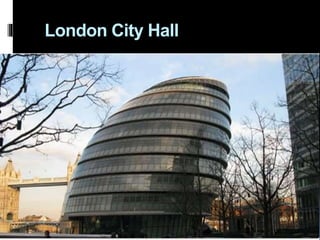
London City Hall
Introduction
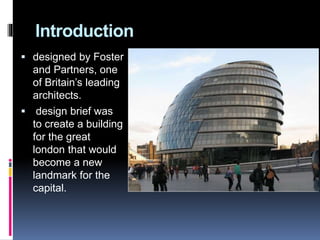
 designed by Foster
and Partners, one
of Britain’s leading
architects.
 design brief was
to create a building
for the great
london that would
become a new
landmark for the
capital.
Concept
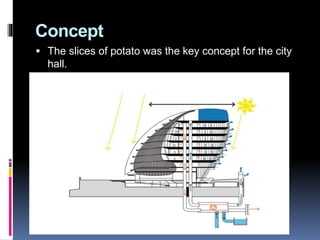
 The slices of potato was the key concept for the city
hall.
Design and Construction
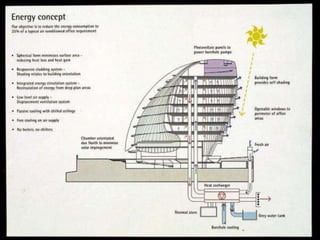
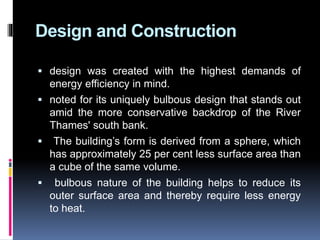
 design was created with the highest demands of
energy efficiency in mind.
 noted for its uniquely bulbous design that stands out
amid the more conservative backdrop of the River
Thames' south bank.
 The building’s form is derived from a sphere, which
has approximately 25 per cent less surface area than
a cube of the same volume.
 bulbous nature of the building helps to reduce its
outer surface area and thereby require less energy
to heat.
Design and Construction
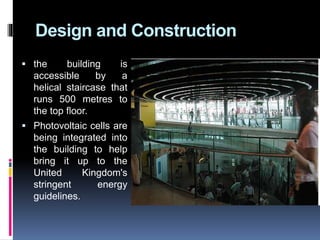
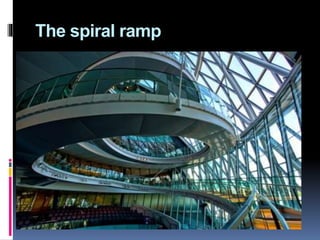
 the building is
accessible by a
helical staircase that
runs 500 metres to
the top floor.
 Photovoltaic cells are
being integrated into
the building to help
bring it up to the
United Kingdom's
stringent energy
guidelines.
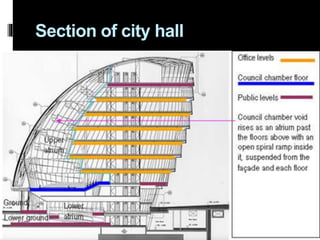
Section of city hall
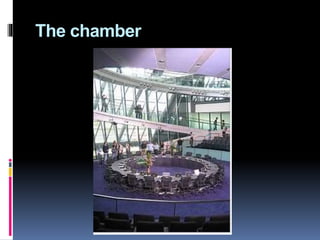
The chamber
Form analysis
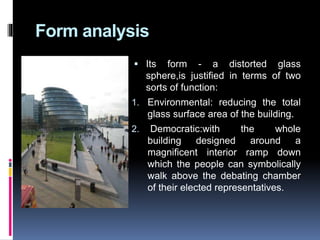
 Its form - a distorted glass
sphere,is justified in terms of two
sorts of function:
1. Environmental: reducing the total
glass surface area of the building.
2. Democratic:with the whole
building designed around a
magnificent interior ramp down
which the people can symbolically
walk above the debating chamber
of their elected representatives.
The spiral ramp
Materials
 Steel,glass and concrete as building elements.
 constructed using over 4 tonnes of steel and 13,100
square metres of concrete.
Sustainability approach
 During construction, two large pipes were installed
that tapped into the water table of the River Thames.
These pipes circulate cold water from these pipes
throughout the building during the summer months
as a cooling device. This has greatly lessened the
energy impact of the building.
 The water extracted is also used in toilets.
Sustainability approach
 Electrical consumption is reduced by avoiding
refrigeration and using cold ground water to air-
condition the building.
 In order to reduce the building’s electrical
consumption further, in 2007 solar panels are being
installed on the roof of the building, to allow City Hall
to generate its own solar power.
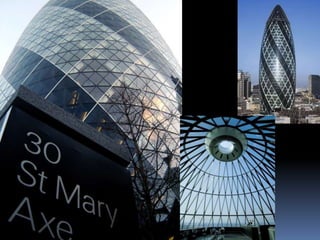
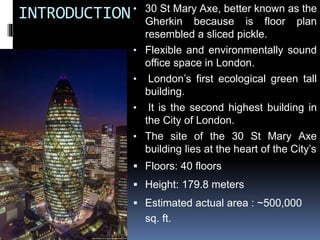
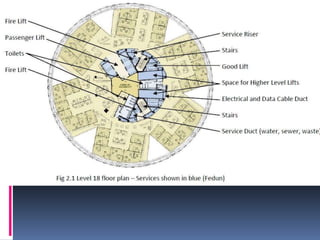
INTRODUCTION• 30 St Mary Axe, better known as the
Gherkin because is floor plan
resembled a sliced pickle.
• Flexible and environmentally sound
office space in London.
• London’s first ecological green tall
building.
• It is the second highest building in
the City of London.
• The site of the 30 St Mary Axe
building lies at the heart of the City’s
 Floors: 40 floors
 Height: 179.8 meters
 Estimated actual area : ~500,000
sq. ft.
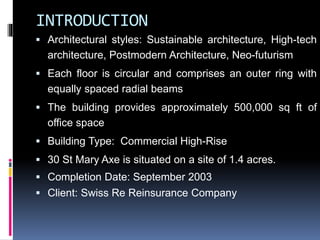
INTRODUCTION
 Architectural styles: Sustainable architecture, High-tech
architecture, Postmodern Architecture, Neo-futurism
 Each floor is circular and comprises an outer ring with
equally spaced radial beams
 The building provides approximately 500,000 sq ft of
office space
 Building Type: Commercial High-Rise
 30 St Mary Axe is situated on a site of 1.4 acres.
 Completion Date: September 2003
 Client: Swiss Re Reinsurance Company
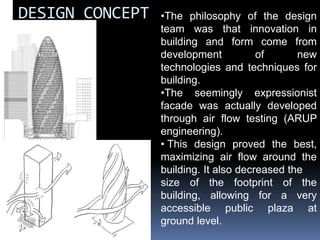
DESIGN CONCEPT •The philosophy of the design
team was that innovation in
building and form come from
development of new
technologies and techniques for
building.
•The seemingly expressionist
facade was actually developed
through air flow testing (ARUP
engineering).
• This design proved the best,
maximizing air flow around the
building. It also decreased the
size of the footprint of the
building, allowing for a very
accessible public plaza at
ground level.
Materials
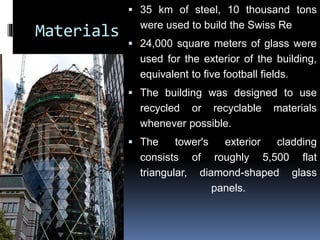
 35 km of steel, 10 thousand tons
were used to build the Swiss Re
 24,000 square meters of glass were
used for the exterior of the building,
equivalent to five football fields.
 The building was designed to use
recycled or recyclable materials
whenever possible.
 The tower's exterior cladding
consists of roughly 5,500 flat
triangular, diamond-shaped glass
panels.
Unique form
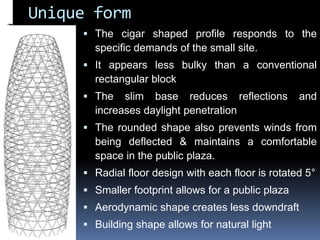
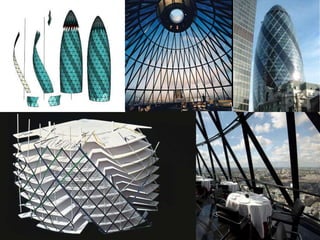
 The cigar shaped profile responds to the
specific demands of the small site.
 It appears less bulky than a conventional
rectangular block
 The slim base reduces reflections and
increases daylight penetration
 The rounded shape also prevents winds from
being deflected & maintains a comfortable
space in the public plaza.
 Radial floor design with each floor is rotated 5°
 Smaller footprint allows for a public plaza
 Aerodynamic shape creates less downdraft
 Building shape allows for natural light
SUSTAINABILITY & VENTILATION
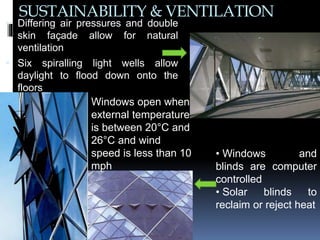
 Differing air pressures and double
skin façade allow for natural
ventilation
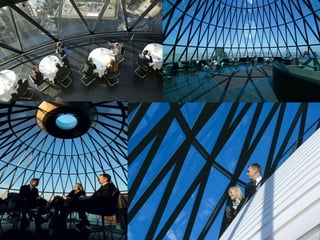
 Six spiralling light wells allow
daylight to flood down onto the
floors
• Windows and
blinds are computer
controlled
• Solar blinds to
reclaim or reject heat
Windows open when
external temperature
is between 20°C and
26°C and wind
speed is less than 10
mph
CIRCULATION
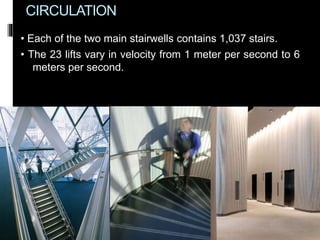
• Each of the two main stairwells contains 1,037 stairs.
• The 23 lifts vary in velocity from 1 meter per second to 6
meters per second.
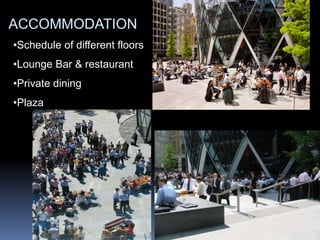
ACCOMMODATION
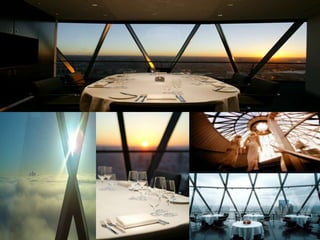
•Schedule of different floors
•Lounge Bar & restaurant
•Private dining
•Plaza
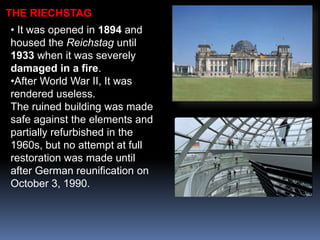
• It was opened in 1894 and
housed the Reichstag until
1933 when it was severely
damaged in a fire.
•After World War II, It was
rendered useless.
The ruined building was made
safe against the elements and
partially refurbished in the
1960s, but no attempt at full
restoration was made until
after German reunification on
October 3, 1990.
THE RIECHSTAG
• The building was then renovated by Norman Foster.
• This time his architecture was about power.
• Norman foster creates a landmark of cultures of very
different times to express who or what they are through his
architecture.
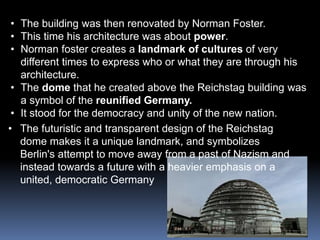
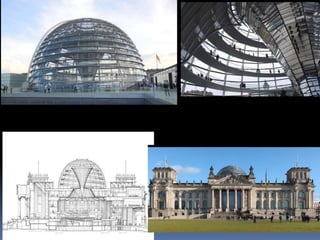
• The dome that he created above the Reichstag building was
a symbol of the reunified Germany.
• It stood for the democracy and unity of the new nation.
• The futuristic and transparent design of the Reichstag
dome makes it a unique landmark, and symbolizes
Berlin's attempt to move away from a past of Nazism and
instead towards a future with a heavier emphasis on a
united, democratic Germany
The challenges met by Foster were
• To restore damage
• To take what was left of the old building and make it look new
again.
• To show what once happened to the building, to show it’s
history
• He handles this very sensitively.
• He kept the Russian soldiers, sometimes obscene messages,
written on the stone walls.
• Since it was a part of the German history, a part of that
building, which should not be wiped out.
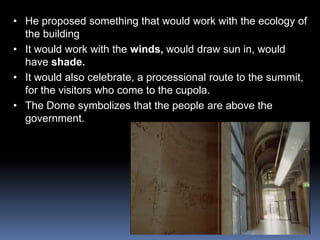
• He proposed something that would work with the ecology of
the building
• It would work with the winds, would draw sun in, would
have shade.
• It would also celebrate, a processional route to the summit,
for the visitors who come to the cupola.
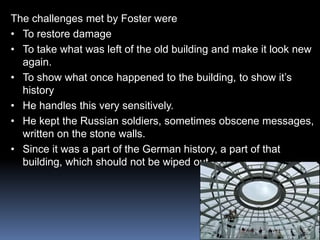
• The Dome symbolizes that the people are above the
government.
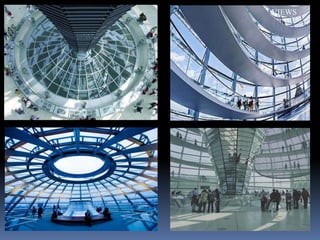
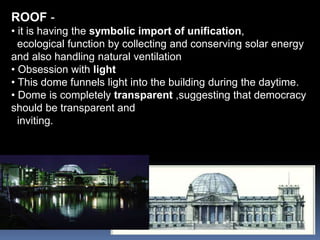
ROOF -
• it is having the symbolic import of unification,
ecological function by collecting and conserving solar energy
and also handling natural ventilation
• Obsession with light
• This dome funnels light into the building during the daytime.
• Dome is completely transparent ,suggesting that democracy
should be transparent and
inviting.
USE OF HIGH-TECHNOLOGY
• All of the elements in the building were computer tested and
even the dome was subjected to computer wind simulations in
order to maximize space and minimize excess.
• Its power station also burns a special linseed fuel mixture,
based on corn oil, not fossil fuels, minimizing energy
consumption.
•At night the mirrors, which bring daylight into the chamber work
in reverse by acting as a signal on the skyline to show that
Parliament was in session.
VIEWS

Norman foster

  • 1.
    Norman Foster Jeena Datheputhe(700111) RumiTamakhu(700114) Subin Twanabasu(700122)
  • 2.
    Introduction  Born: 1June 1935;is a british architect owning Foster + Partners, famous for high- tech architecture.  a keen interest in the works of Frank Lloyd Wright, Ludwig Mies van der Rohe, Le Corbusier and Oscar Niemeyer.
  • 3.
    Philosophies  “Architecture reallyis about the needs of people, the material needs, the things that you can measure, keeping us warm when it’s cold outside, cool when it’s hot outside, protecting us from the elements, but it’s also about the spiritual dimension its about the things that move us, that make us feel happy, comfortable, you can call it any word you like, you can call it beauty, you can all it aesthetics, you can call it welcoming, friendly. But something that will make us feel good. Architecture is about the social agenda.”
  • 4.
    Philosophies  wants hisbuildings to be environmentally friendly but at the same time be pleasing places for people to be in and look at.  take full advantage of the latest technology, searching for great energy efficiency, excellent integration with the environment.  well known for turning the forms of buildings into works of art.
  • 5.
    Contributions  Some ofhis buildings are: 1. London City Hall(2002) 2. St. Mary Axe 3. Reichstag building Sainsbury Centre for Visual Arts UK (1978) 4. The Sage Gateshead England(1997–2004) 5. Hearst Tower, New York City (June 2006)
  • 6.
    Achievements and awards was awarded the Pritzker Architecture Prize in 1999.  In 2009 Foster was awarded the Prince of Asturias Award in the Arts category.  In 1994, he received the AIA Gold Medal.
  • 7.
  • 8.
    Introduction  designed byFoster and Partners, one of Britain’s leading architects.  design brief was to create a building for the great london that would become a new landmark for the capital.
  • 9.
    Concept  The slicesof potato was the key concept for the city hall.
  • 11.
    Design and Construction design was created with the highest demands of energy efficiency in mind.  noted for its uniquely bulbous design that stands out amid the more conservative backdrop of the River Thames' south bank.  The building’s form is derived from a sphere, which has approximately 25 per cent less surface area than a cube of the same volume.  bulbous nature of the building helps to reduce its outer surface area and thereby require less energy to heat.
  • 12.
    Design and Construction the building is accessible by a helical staircase that runs 500 metres to the top floor.  Photovoltaic cells are being integrated into the building to help bring it up to the United Kingdom's stringent energy guidelines.
  • 13.
  • 14.
  • 15.
    Form analysis  Itsform - a distorted glass sphere,is justified in terms of two sorts of function: 1. Environmental: reducing the total glass surface area of the building. 2. Democratic:with the whole building designed around a magnificent interior ramp down which the people can symbolically walk above the debating chamber of their elected representatives.
  • 16.
  • 17.
    Materials  Steel,glass andconcrete as building elements.  constructed using over 4 tonnes of steel and 13,100 square metres of concrete.
  • 18.
    Sustainability approach  Duringconstruction, two large pipes were installed that tapped into the water table of the River Thames. These pipes circulate cold water from these pipes throughout the building during the summer months as a cooling device. This has greatly lessened the energy impact of the building.  The water extracted is also used in toilets.
  • 19.
    Sustainability approach  Electricalconsumption is reduced by avoiding refrigeration and using cold ground water to air- condition the building.  In order to reduce the building’s electrical consumption further, in 2007 solar panels are being installed on the roof of the building, to allow City Hall to generate its own solar power.
  • 21.
    INTRODUCTION• 30 StMary Axe, better known as the Gherkin because is floor plan resembled a sliced pickle. • Flexible and environmentally sound office space in London. • London’s first ecological green tall building. • It is the second highest building in the City of London. • The site of the 30 St Mary Axe building lies at the heart of the City’s  Floors: 40 floors  Height: 179.8 meters  Estimated actual area : ~500,000 sq. ft.
  • 22.
    INTRODUCTION  Architectural styles:Sustainable architecture, High-tech architecture, Postmodern Architecture, Neo-futurism  Each floor is circular and comprises an outer ring with equally spaced radial beams  The building provides approximately 500,000 sq ft of office space  Building Type: Commercial High-Rise  30 St Mary Axe is situated on a site of 1.4 acres.  Completion Date: September 2003  Client: Swiss Re Reinsurance Company
  • 23.
    DESIGN CONCEPT •Thephilosophy of the design team was that innovation in building and form come from development of new technologies and techniques for building. •The seemingly expressionist facade was actually developed through air flow testing (ARUP engineering). • This design proved the best, maximizing air flow around the building. It also decreased the size of the footprint of the building, allowing for a very accessible public plaza at ground level.
  • 24.
    Materials  35 kmof steel, 10 thousand tons were used to build the Swiss Re  24,000 square meters of glass were used for the exterior of the building, equivalent to five football fields.  The building was designed to use recycled or recyclable materials whenever possible.  The tower's exterior cladding consists of roughly 5,500 flat triangular, diamond-shaped glass panels.
  • 25.
    Unique form  Thecigar shaped profile responds to the specific demands of the small site.  It appears less bulky than a conventional rectangular block  The slim base reduces reflections and increases daylight penetration  The rounded shape also prevents winds from being deflected & maintains a comfortable space in the public plaza.  Radial floor design with each floor is rotated 5°  Smaller footprint allows for a public plaza  Aerodynamic shape creates less downdraft  Building shape allows for natural light
  • 27.
    SUSTAINABILITY & VENTILATION Differing air pressures and double skin façade allow for natural ventilation  Six spiralling light wells allow daylight to flood down onto the floors • Windows and blinds are computer controlled • Solar blinds to reclaim or reject heat Windows open when external temperature is between 20°C and 26°C and wind speed is less than 10 mph
  • 28.
    CIRCULATION • Each ofthe two main stairwells contains 1,037 stairs. • The 23 lifts vary in velocity from 1 meter per second to 6 meters per second.
  • 30.
    ACCOMMODATION •Schedule of differentfloors •Lounge Bar & restaurant •Private dining •Plaza
  • 33.
    • It wasopened in 1894 and housed the Reichstag until 1933 when it was severely damaged in a fire. •After World War II, It was rendered useless. The ruined building was made safe against the elements and partially refurbished in the 1960s, but no attempt at full restoration was made until after German reunification on October 3, 1990. THE RIECHSTAG
  • 34.
    • The buildingwas then renovated by Norman Foster. • This time his architecture was about power. • Norman foster creates a landmark of cultures of very different times to express who or what they are through his architecture. • The dome that he created above the Reichstag building was a symbol of the reunified Germany. • It stood for the democracy and unity of the new nation. • The futuristic and transparent design of the Reichstag dome makes it a unique landmark, and symbolizes Berlin's attempt to move away from a past of Nazism and instead towards a future with a heavier emphasis on a united, democratic Germany
  • 35.
    The challenges metby Foster were • To restore damage • To take what was left of the old building and make it look new again. • To show what once happened to the building, to show it’s history • He handles this very sensitively. • He kept the Russian soldiers, sometimes obscene messages, written on the stone walls. • Since it was a part of the German history, a part of that building, which should not be wiped out.
  • 36.
    • He proposedsomething that would work with the ecology of the building • It would work with the winds, would draw sun in, would have shade. • It would also celebrate, a processional route to the summit, for the visitors who come to the cupola. • The Dome symbolizes that the people are above the government.
  • 37.
    ROOF - • itis having the symbolic import of unification, ecological function by collecting and conserving solar energy and also handling natural ventilation • Obsession with light • This dome funnels light into the building during the daytime. • Dome is completely transparent ,suggesting that democracy should be transparent and inviting.
  • 38.
    USE OF HIGH-TECHNOLOGY •All of the elements in the building were computer tested and even the dome was subjected to computer wind simulations in order to maximize space and minimize excess. • Its power station also burns a special linseed fuel mixture, based on corn oil, not fossil fuels, minimizing energy consumption. •At night the mirrors, which bring daylight into the chamber work in reverse by acting as a signal on the skyline to show that Parliament was in session.
  • 41.