Case Study
on
The Falling Water House
Frank Lloyd Wright
Presentation by Tanjimul Hossain (ID: 21120000)
& Md. Shamim Hossen (ID: 21128000)
FALLING WATER HOUSE
THE ARCHITECT
FRANK LLOYD WRIGHT
Frank Lloyd Wright
Frank Lloyd Wright was born in Richland Center,
Wisconsin on June 8, 1867 and he died in Phoenix,
Arizona on April 9, 1959 (aged 91) . He was an American
architect. (June 8, 1867 – April 9, 1959)
 He was an American architect, designer, writer, and
educator.
 He was one of the leading masters of 20 century
architecture known for organic and functional
architecture their designs.
 He designed more than 1,000 structures, 532 of
which were completed over a creative period of 70
years.
Frank Lloyd Write (1914-1976)
Philosophy of Frank Lloyd Wright
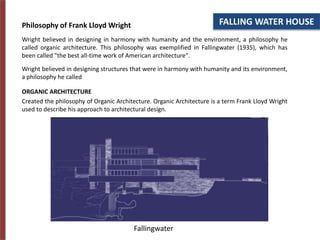
Wright believed in designing in harmony with humanity and the environment, a philosophy he
called organic architecture. This philosophy was exemplified in Fallingwater (1935), which has
been called "the best all-time work of American architecture".
Wright believed in designing structures that were in harmony with humanity and its environment,
a philosophy he called
ORGANIC ARCHITECTURE
Created the philosophy of Organic Architecture. Organic Architecture is a term Frank Lloyd Wright
used to describe his approach to architectural design.
FALLING WATER HOUSE
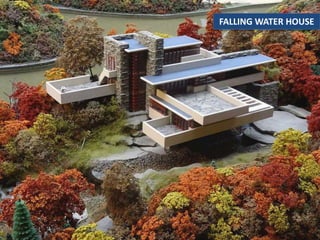
Fallingwater
Philosophy of Frank Lloyd Wright
CHARACTER OF WORKS:
 Use of natural materials like bricks, stone & wood
 Strong eastern influences.
 Use of textured concrete.
 Designs that blend well in its environment.
 Focused more on residential deigns.
FALLING WATER HOUSE
THE FALLING WATER HOUSE
INTRODUCTION
 Falling Water of the Kaufmann Residence is a
house designed by architect Frank Lloyd
Wright in 1935 in Laurel Highlands of
southwest Pennsylvania.
 The home was built partly over a waterfall,
and was designed as a weekend home for the
family of Kaufmann.
 Fallingwater was the family's weekend home
from 1937 to 1963. In 1963, Kaufmannm, Jr.
donated the property to the Western
Pensylvania Conservancy. In 1964, It was
opened to the public as a museum.
 It was designated a National Historic
Landmark in 1966 by AIA
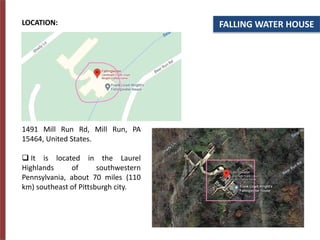
LOCATION: FALLING WATER HOUSE
1491 Mill Run Rd, Mill Run, PA
15464, United States.
 It is located in the Laurel
Highlands of southwestern
Pennsylvania, about 70 miles (110
km) southeast of Pittsburgh city.
FALLING WATER HOUSE
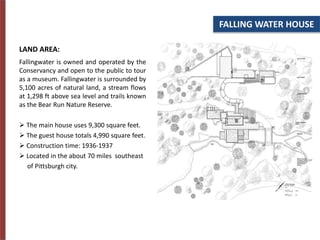
LAND AREA:
Fallingwater is owned and operated by the
Conservancy and open to the public to tour
as a museum. Fallingwater is surrounded by
5,100 acres of natural land, a stream flows
at 1,298 ft above sea level and trails known
as the Bear Run Nature Reserve.
 The main house uses 9,300 square feet.
 The guest house totals 4,990 square feet.
 Construction time: 1936-1937
 Located in the about 70 miles southeast
of Pittsburgh city.
FALLING WATER HOUSE
PLANNING CONCEPT:
 Bringing house and landscape into a more intimate relationship was a favorite device of
Wright .
 Cruciform plan with wings radiating from a central space.
 A central fireplace provided a visual pivot.
FALLING WATER HOUSE
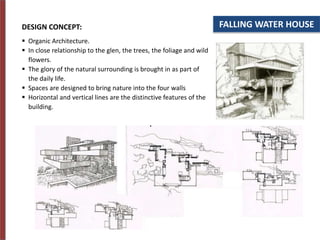
DESIGN CONCEPT:
 Organic Architecture.
 In close relationship to the glen, the trees, the foliage and wild
flowers.
 The glory of the natural surrounding is brought in as part of
the daily life.
 Spaces are designed to bring nature into the four walls
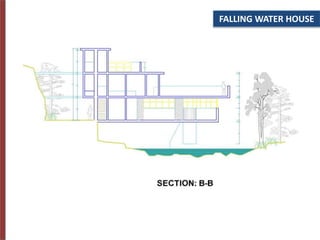
 Horizontal and vertical lines are the distinctive features of the
building.
FALLING WATER HOUSE
CONTEXT:
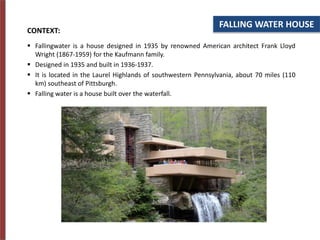
 Fallingwater is a house designed in 1935 by renowned American architect Frank Lloyd
Wright (1867-1959) for the Kaufmann family.
 Designed in 1935 and built in 1936-1937.
 It is located in the Laurel Highlands of southwestern Pennsylvania, about 70 miles (110
km) southeast of Pittsburgh.
 Falling water is a house built over the waterfall.
FALLING WATER HOUSE
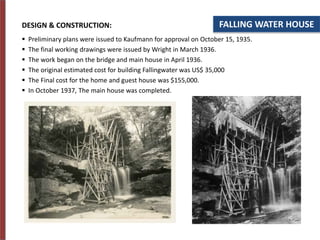
DESIGN & CONSTRUCTION:
 Preliminary plans were issued to Kaufmann for approval on October 15, 1935.
 The final working drawings were issued by Wright in March 1936.
 The work began on the bridge and main house in April 1936.
 The original estimated cost for building Fallingwater was US$ 35,000
 The Final cost for the home and guest house was $155,000.
 In October 1937, The main house was completed.
FALLING WATER HOUSE
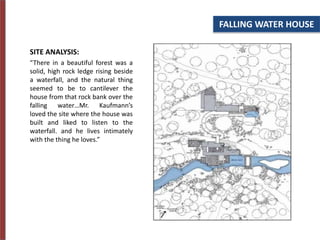
SITE ANALYSIS:
“There in a beautiful forest was a
solid, high rock ledge rising beside
a waterfall, and the natural thing
seemed to be to cantilever the
house from that rock bank over the
falling water…Mr. Kaufmann’s
loved the site where the house was
built and liked to listen to the
waterfall. and he lives intimately
with the thing he loves.”
FALLING WATER HOUSE
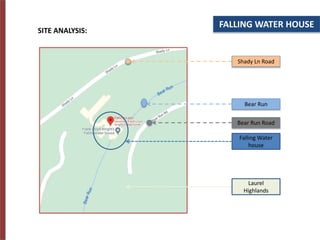
Shady Ln Road
Bear Run
Bear Run Road
Falling Water
house
Laurel
Highlands
SITE ANALYSIS:
FALLING WATER HOUSE
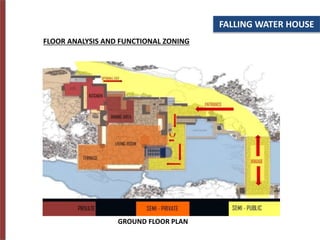
FLOOR ANALYSIS AND FUNCTIONAL ZONING
GROUND FLOOR PLAN
FALLING WATER HOUSE
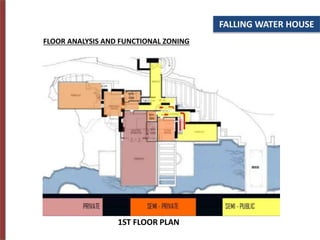
FLOOR ANALYSIS AND FUNCTIONAL ZONING
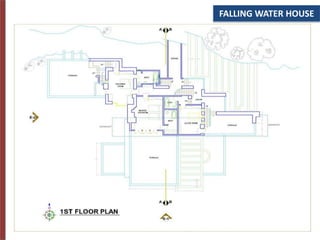
1ST FLOOR PLAN
FALLING WATER HOUSE
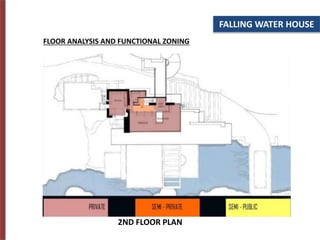
FLOOR ANALYSIS AND FUNCTIONAL ZONING
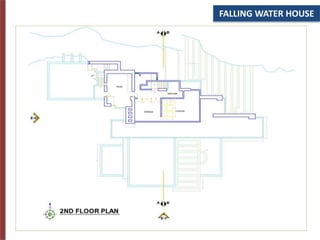
2ND FLOOR PLAN
FALLING WATER HOUSE
FALLING WATER HOUSE
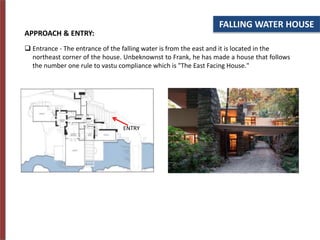
APPROACH & ENTRY:
 Entrance - The entrance of the falling water is from the east and it is located in the
northeast corner of the house. Unbeknownst to Frank, he has made a house that follows
the number one rule to vastu compliance which is "The East Facing House."
ENTRY
FALLING WATER HOUSE
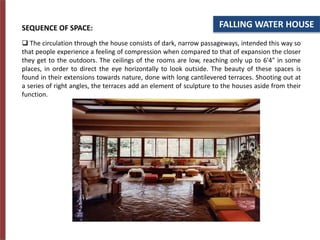
SEQUENCE OF SPACE:
 The circulation through the house consists of dark, narrow passageways, intended this way so
that people experience a feeling of compression when compared to that of expansion the closer
they get to the outdoors. The ceilings of the rooms are low, reaching only up to 6'4" in some
places, in order to direct the eye horizontally to look outside. The beauty of these spaces is
found in their extensions towards nature, done with long cantilevered terraces. Shooting out at
a series of right angles, the terraces add an element of sculpture to the houses aside from their
function.
FALLING WATER HOUSE
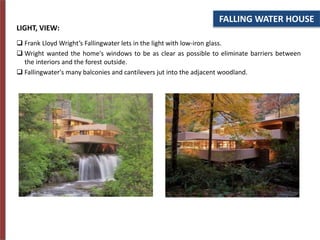
LIGHT, VIEW:
 Frank Lloyd Wright’s Fallingwater lets in the light with low-iron glass.
 Wright wanted the home's windows to be as clear as possible to eliminate barriers between
the interiors and the forest outside.
 Fallingwater's many balconies and cantilevers jut into the adjacent woodland.
FALLING WATER HOUSE
VENTILATION, VIEW:
FALLING WATER HOUSE
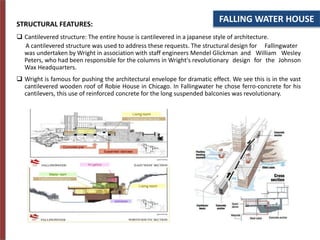
STRUCTURAL FEATURES:
 Cantilevered structure: The entire house is cantilevered in a japanese style of architecture.
A cantilevered structure was used to address these requests. The structural design for Fallingwater
was undertaken by Wright in association with staff engineers Mendel Glickman and William Wesley
Peters, who had been responsible for the columns in Wright's revolutionary design for the Johnson
Wax Headquarters.
 Wright is famous for pushing the architectural envelope for dramatic effect. We see this is in the vast
cantilevered wooden roof of Robie House in Chicago. In Fallingwater he chose ferro-concrete for his
cantilevers, this use of reinforced concrete for the long suspended balconies was revolutionary.
FALLING WATER HOUSE
MATERIALS USED FOR THE BUILDINGS:
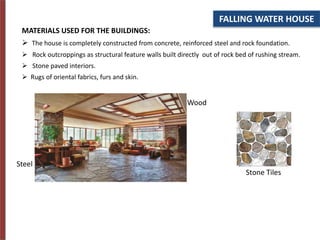
 The house is completely constructed from concrete, reinforced steel and rock foundation.
 Rock outcroppings as structural feature walls built directly out of rock bed of rushing stream.
 Stone paved interiors.
 Rugs of oriental fabrics, furs and skin.
Steel
Wood
Stone Tiles
FALLING WATER HOUSE
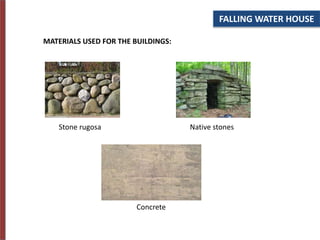
MATERIALS USED FOR THE BUILDINGS:
Stone rugosa Native stones
Concrete
FALLING WATER HOUSE
INTERIORS & EXTERIOR:
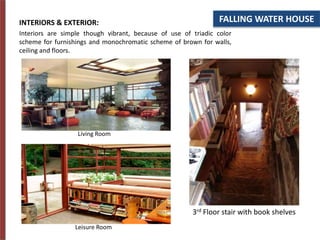
Interiors are simple though vibrant, because of use of triadic color
scheme for furnishings and monochromatic scheme of brown for walls,
ceiling and floors.
Living Room
Leisure Room
3rd Floor stair with book shelves
FALLING WATER HOUSE
INTERIORS & EXTERIOR:
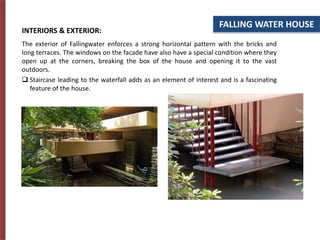
The exterior of Fallingwater enforces a strong horizontal pattern with the bricks and
long terraces. The windows on the facade have also have a special condition where they
open up at the corners, breaking the box of the house and opening it to the vast
outdoors.
 Staircase leading to the waterfall adds as an element of interest and is a fascinating
feature of the house.
FALLING WATER HOUSE
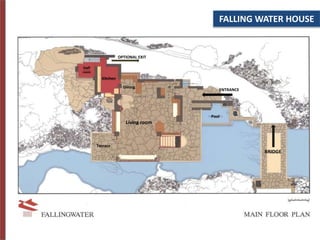
Living room
Dining
Kitchen
Staff
room
Terrace
Pool
BRIDGE
ENTRANCE
OPTIONAL EXIT
FALLING WATER HOUSE
1st FLOOR PLAN
FALLING WATER HOUSE
FALLING WATER HOUSE
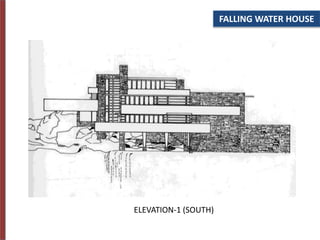
ELEVATION-1 (SOUTH)
FALLING WATER HOUSE
FALLING WATER HOUSE
FALLING WATER HOUSE
FALLING WATER HOUSE
B
I
R
D
S
E
Y
E
V
I
E
S
FALLING WATER HOUSE
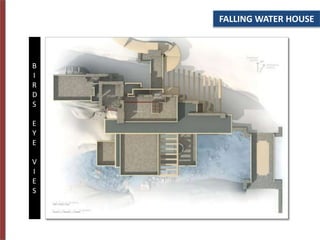
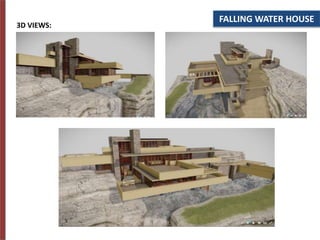
3D VIEWS:
FALLING WATER HOUSE
FINDINGS:
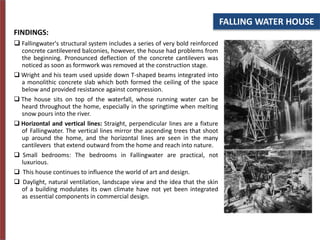
 Fallingwater's structural system includes a series of very bold reinforced
concrete cantilevered balconies, however, the house had problems from
the beginning. Pronounced deflection of the concrete cantilevers was
noticed as soon as formwork was removed at the construction stage.
 Wright and his team used upside down T-shaped beams integrated into
a monolithic concrete slab which both formed the ceiling of the space
below and provided resistance against compression.
 The house sits on top of the waterfall, whose running water can be
heard throughout the home, especially in the springtime when melting
snow pours into the river.
 Horizontal and vertical lines: Straight, perpendicular lines are a fixture
of Fallingwater. The vertical lines mirror the ascending trees that shoot
up around the home, and the horizontal lines are seen in the many
cantilevers that extend outward from the home and reach into nature.
 Small bedrooms: The bedrooms in Fallingwater are practical, not
luxurious.
 This house continues to influence the world of art and design.
 Daylight, natural ventilation, landscape view and the idea that the skin
of a building modulates its own climate have not yet been integrated
as essential components in commercial design.
REFERENCES:
1. https://en.wikipedia.org/wiki/Fallingwater
2. https://fallingwater.org/
3. https://www.archdaily.com/60022/ad-classics-fallingwater-frank-lloyd-wright
4. https://www.britannica.com/place/Fallingwater
THANK YOU

The Falling Water House Case Study

  • 1.
    Case Study on The FallingWater House Frank Lloyd Wright Presentation by Tanjimul Hossain (ID: 21120000) & Md. Shamim Hossen (ID: 21128000)
  • 2.
  • 3.
    THE ARCHITECT FRANK LLOYDWRIGHT Frank Lloyd Wright Frank Lloyd Wright was born in Richland Center, Wisconsin on June 8, 1867 and he died in Phoenix, Arizona on April 9, 1959 (aged 91) . He was an American architect. (June 8, 1867 – April 9, 1959)  He was an American architect, designer, writer, and educator.  He was one of the leading masters of 20 century architecture known for organic and functional architecture their designs.  He designed more than 1,000 structures, 532 of which were completed over a creative period of 70 years. Frank Lloyd Write (1914-1976)
  • 4.
    Philosophy of FrankLloyd Wright Wright believed in designing in harmony with humanity and the environment, a philosophy he called organic architecture. This philosophy was exemplified in Fallingwater (1935), which has been called "the best all-time work of American architecture". Wright believed in designing structures that were in harmony with humanity and its environment, a philosophy he called ORGANIC ARCHITECTURE Created the philosophy of Organic Architecture. Organic Architecture is a term Frank Lloyd Wright used to describe his approach to architectural design. FALLING WATER HOUSE Fallingwater
  • 5.
    Philosophy of FrankLloyd Wright CHARACTER OF WORKS:  Use of natural materials like bricks, stone & wood  Strong eastern influences.  Use of textured concrete.  Designs that blend well in its environment.  Focused more on residential deigns. FALLING WATER HOUSE
  • 6.
    THE FALLING WATERHOUSE INTRODUCTION  Falling Water of the Kaufmann Residence is a house designed by architect Frank Lloyd Wright in 1935 in Laurel Highlands of southwest Pennsylvania.  The home was built partly over a waterfall, and was designed as a weekend home for the family of Kaufmann.  Fallingwater was the family's weekend home from 1937 to 1963. In 1963, Kaufmannm, Jr. donated the property to the Western Pensylvania Conservancy. In 1964, It was opened to the public as a museum.  It was designated a National Historic Landmark in 1966 by AIA
  • 7.
    LOCATION: FALLING WATERHOUSE 1491 Mill Run Rd, Mill Run, PA 15464, United States.  It is located in the Laurel Highlands of southwestern Pennsylvania, about 70 miles (110 km) southeast of Pittsburgh city.
  • 8.
    FALLING WATER HOUSE LANDAREA: Fallingwater is owned and operated by the Conservancy and open to the public to tour as a museum. Fallingwater is surrounded by 5,100 acres of natural land, a stream flows at 1,298 ft above sea level and trails known as the Bear Run Nature Reserve.  The main house uses 9,300 square feet.  The guest house totals 4,990 square feet.  Construction time: 1936-1937  Located in the about 70 miles southeast of Pittsburgh city.
  • 9.
    FALLING WATER HOUSE PLANNINGCONCEPT:  Bringing house and landscape into a more intimate relationship was a favorite device of Wright .  Cruciform plan with wings radiating from a central space.  A central fireplace provided a visual pivot.
  • 10.
    FALLING WATER HOUSE DESIGNCONCEPT:  Organic Architecture.  In close relationship to the glen, the trees, the foliage and wild flowers.  The glory of the natural surrounding is brought in as part of the daily life.  Spaces are designed to bring nature into the four walls  Horizontal and vertical lines are the distinctive features of the building.
  • 11.
    FALLING WATER HOUSE CONTEXT: Fallingwater is a house designed in 1935 by renowned American architect Frank Lloyd Wright (1867-1959) for the Kaufmann family.  Designed in 1935 and built in 1936-1937.  It is located in the Laurel Highlands of southwestern Pennsylvania, about 70 miles (110 km) southeast of Pittsburgh.  Falling water is a house built over the waterfall.
  • 12.
    FALLING WATER HOUSE DESIGN& CONSTRUCTION:  Preliminary plans were issued to Kaufmann for approval on October 15, 1935.  The final working drawings were issued by Wright in March 1936.  The work began on the bridge and main house in April 1936.  The original estimated cost for building Fallingwater was US$ 35,000  The Final cost for the home and guest house was $155,000.  In October 1937, The main house was completed.
  • 13.
    FALLING WATER HOUSE SITEANALYSIS: “There in a beautiful forest was a solid, high rock ledge rising beside a waterfall, and the natural thing seemed to be to cantilever the house from that rock bank over the falling water…Mr. Kaufmann’s loved the site where the house was built and liked to listen to the waterfall. and he lives intimately with the thing he loves.”
  • 14.
    FALLING WATER HOUSE ShadyLn Road Bear Run Bear Run Road Falling Water house Laurel Highlands SITE ANALYSIS:
  • 15.
    FALLING WATER HOUSE FLOORANALYSIS AND FUNCTIONAL ZONING GROUND FLOOR PLAN
  • 16.
    FALLING WATER HOUSE FLOORANALYSIS AND FUNCTIONAL ZONING 1ST FLOOR PLAN
  • 17.
    FALLING WATER HOUSE FLOORANALYSIS AND FUNCTIONAL ZONING 2ND FLOOR PLAN
  • 18.
  • 19.
    FALLING WATER HOUSE APPROACH& ENTRY:  Entrance - The entrance of the falling water is from the east and it is located in the northeast corner of the house. Unbeknownst to Frank, he has made a house that follows the number one rule to vastu compliance which is "The East Facing House." ENTRY
  • 20.
    FALLING WATER HOUSE SEQUENCEOF SPACE:  The circulation through the house consists of dark, narrow passageways, intended this way so that people experience a feeling of compression when compared to that of expansion the closer they get to the outdoors. The ceilings of the rooms are low, reaching only up to 6'4" in some places, in order to direct the eye horizontally to look outside. The beauty of these spaces is found in their extensions towards nature, done with long cantilevered terraces. Shooting out at a series of right angles, the terraces add an element of sculpture to the houses aside from their function.
  • 21.
    FALLING WATER HOUSE LIGHT,VIEW:  Frank Lloyd Wright’s Fallingwater lets in the light with low-iron glass.  Wright wanted the home's windows to be as clear as possible to eliminate barriers between the interiors and the forest outside.  Fallingwater's many balconies and cantilevers jut into the adjacent woodland.
  • 22.
  • 23.
    FALLING WATER HOUSE STRUCTURALFEATURES:  Cantilevered structure: The entire house is cantilevered in a japanese style of architecture. A cantilevered structure was used to address these requests. The structural design for Fallingwater was undertaken by Wright in association with staff engineers Mendel Glickman and William Wesley Peters, who had been responsible for the columns in Wright's revolutionary design for the Johnson Wax Headquarters.  Wright is famous for pushing the architectural envelope for dramatic effect. We see this is in the vast cantilevered wooden roof of Robie House in Chicago. In Fallingwater he chose ferro-concrete for his cantilevers, this use of reinforced concrete for the long suspended balconies was revolutionary.
  • 24.
    FALLING WATER HOUSE MATERIALSUSED FOR THE BUILDINGS:  The house is completely constructed from concrete, reinforced steel and rock foundation.  Rock outcroppings as structural feature walls built directly out of rock bed of rushing stream.  Stone paved interiors.  Rugs of oriental fabrics, furs and skin. Steel Wood Stone Tiles

  • 25.
    FALLING WATER HOUSE MATERIALSUSED FOR THE BUILDINGS: Stone rugosa Native stones Concrete
  • 26.
    FALLING WATER HOUSE INTERIORS& EXTERIOR: Interiors are simple though vibrant, because of use of triadic color scheme for furnishings and monochromatic scheme of brown for walls, ceiling and floors. Living Room Leisure Room 3rd Floor stair with book shelves
  • 27.
    FALLING WATER HOUSE INTERIORS& EXTERIOR: The exterior of Fallingwater enforces a strong horizontal pattern with the bricks and long terraces. The windows on the facade have also have a special condition where they open up at the corners, breaking the box of the house and opening it to the vast outdoors.  Staircase leading to the waterfall adds as an element of interest and is a fascinating feature of the house.
  • 28.
    FALLING WATER HOUSE Livingroom Dining Kitchen Staff room Terrace Pool BRIDGE ENTRANCE OPTIONAL EXIT
  • 29.
  • 30.
  • 31.
  • 32.
  • 33.
  • 34.
  • 35.
  • 36.
  • 37.
    FALLING WATER HOUSE FINDINGS: Fallingwater's structural system includes a series of very bold reinforced concrete cantilevered balconies, however, the house had problems from the beginning. Pronounced deflection of the concrete cantilevers was noticed as soon as formwork was removed at the construction stage.  Wright and his team used upside down T-shaped beams integrated into a monolithic concrete slab which both formed the ceiling of the space below and provided resistance against compression.  The house sits on top of the waterfall, whose running water can be heard throughout the home, especially in the springtime when melting snow pours into the river.  Horizontal and vertical lines: Straight, perpendicular lines are a fixture of Fallingwater. The vertical lines mirror the ascending trees that shoot up around the home, and the horizontal lines are seen in the many cantilevers that extend outward from the home and reach into nature.  Small bedrooms: The bedrooms in Fallingwater are practical, not luxurious.  This house continues to influence the world of art and design.  Daylight, natural ventilation, landscape view and the idea that the skin of a building modulates its own climate have not yet been integrated as essential components in commercial design.
  • 38.
    REFERENCES: 1. https://en.wikipedia.org/wiki/Fallingwater 2. https://fallingwater.org/ 3.https://www.archdaily.com/60022/ad-classics-fallingwater-frank-lloyd-wright 4. https://www.britannica.com/place/Fallingwater
  • 39.