FALLING WATERS
(KAUFFMAN RESIDENCE)

By- Frank Lloyd Wright
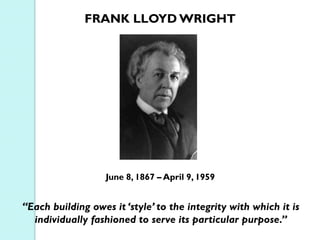
FRANK LLOYD WRIGHT

June 8, 1867 – April 9, 1959

“Each building owes it ‘style’ to the integrity with which it is
individually fashioned to serve its particular purpose.”
“REALITY OF A BUILDING IS THE
SPACE ENCLOSED WITHIN”
-FLW
BRIEF HISTORY





Started formal education in University of WinsconsinMadison School of Engeneering.
Left the college after 2 years and moved to Chicago,
Illinois; to join the firm of J.L. Silsbee.
Year later he moved to join Adler and Sulivan’s firm as a
chief assistant.
By 1893, Wright established his own practice and home
in the Chicago suburb of Oak Park, Illinois
IDEAS AND PHILOSOPHY
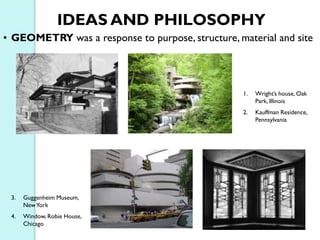
• GEOMETRY was a response to purpose, structure, material and site

1.
2.

3.

Guggenheim Museum,
New York

4.

Window, Robie House,
Chicago

Wright’s house, Oak
Park, Illinois
Kauffman Residence,
Pennsylvania
LANDMARK ACHIEVEMENTS
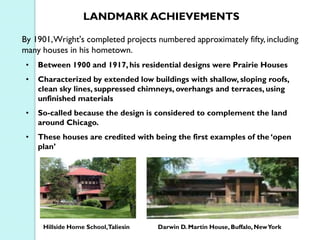
By 1901, Wright's completed projects numbered approximately fifty, including
many houses in his hometown.
•

Between 1900 and 1917, his residential designs were Prairie Houses

•

Characterized by extended low buildings with shallow, sloping roofs,
clean sky lines, suppressed chimneys, overhangs and terraces, using
unfinished materials

•

So-called because the design is considered to complement the land
around Chicago.

•

These houses are credited with being the first examples of the ‘open
plan’

Hillside Home School,Taliesin

Darwin D. Martin House, Buffalo, New York
PRAIRIE HOUSES
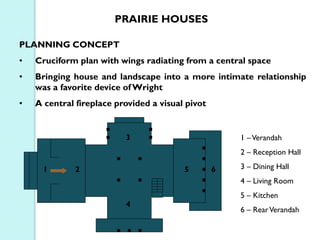
PLANNING CONCEPT
•

Cruciform plan with wings radiating from a central space

•

Bringing house and landscape into a more intimate relationship
was a favorite device of Wright

•

A central fireplace provided a visual pivot

3

1 – Verandah
2 – Reception Hall

1

2

5

6

3 – Dining Hall

4 – Living Room
4

5 – Kitchen
6 – Rear Verandah
THE CONCEPT OF THE USONIAN HOUSES
Usonian houses represented a modernization of the Prairie house concept,
both in their greater simplicity and in their plan:
• Kept in mind that servants were a vanishing breed
• Car port
• Floor slab with integral radiant heating
• Built in furniture, Open kitchen
• Utility core
• Modular plan
• Pinwheel growth out of a central fire place and the two-level roof
• All functions simplified, modernized, made more economical in
construction
USONIAN HOUSES
• Another major achievement of Wright in the 1930s – design of a
low-cost house prototype called the ‘Usonian’ home (from William
Butler’s term of the USA in his Utopian novel Erewhom of 1872)
• Logical evolution from the Prairie house design and American
Ready-Cut system
• Designed a kit of parts (as in the American Ready-Cut system)
including:
• A concrete slab foundation floated on a drained bed of cinders and
sand
• Into this slab, radiating hot-water inserted
INTRODUCTION
Fallingwater or Kaufmann Residence is a house
designed in 1935 at the rural southwestern Pensylvania,
50 miles from southeast of Pittsburgh.
 It was designated aa a National Historic Landmark in
1966 by AIA.
 Fallingwater was the family's weekend home from 1937
to 1963. In 1963, Kaufmann, Jr. donated the property to
the Western Pennsylvania Conservancy. In 1964, it was
opened to the public as a museum.

THE CONFLICT
Kaufmann was uncomfortable with what he perceived
as Wright's insufficient experience using reinforced
concrete, had the architect's daring cantilever design
reviewed by a firm of consulting engineers. Upon
receiving their report Wright took offense and
immediately requested Kaufmann to return his drawings
and indicated he was withdrawing from the project.
Kaufmann relented to Wright's gambit and the
engineer’s report was subsequently buried within a
stone wall of the house.
FALLING WATERS




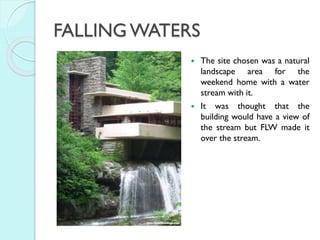
The site chosen was a natural
landscape area for the
weekend home with a water
stream with it.
It was thought that the
building would have a view of
the stream but FLW made it
over the stream.
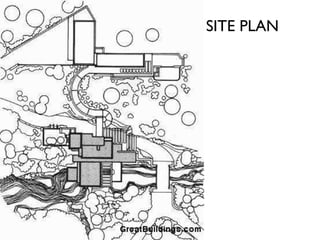
SITE PLAN
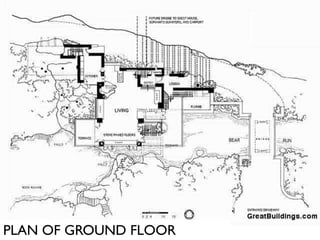
PLAN OF GROUND FLOOR
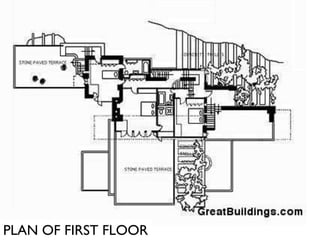
PLAN OF FIRST FLOOR
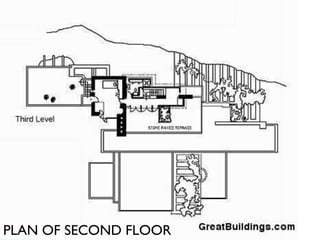
PLAN OF SECOND FLOOR
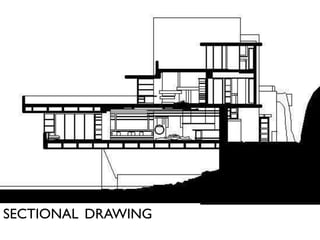
SECTIONAL DRAWING
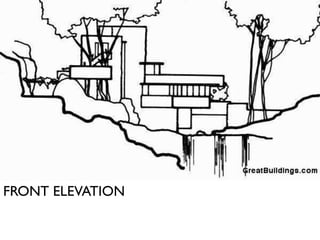
FRONT ELEVATION
FALLING WATERS




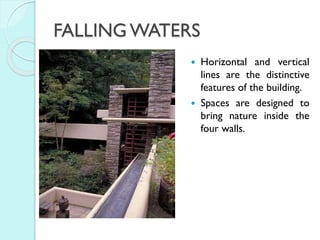
Horizontal and vertical
lines are the distinctive
features of the building.
Spaces are designed to
bring nature inside the
four walls.
FALLING WATERS




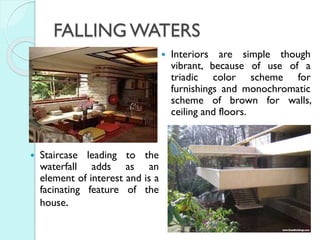
Staircase leading to the
waterfall adds as an
element of interest and is a
facinating feature of the
house.

Interiors are simple though
vibrant, because of use of a
triadic color scheme for
furnishings and monochromatic
scheme of brown for walls,
ceiling and floors.
FALLING WATERS


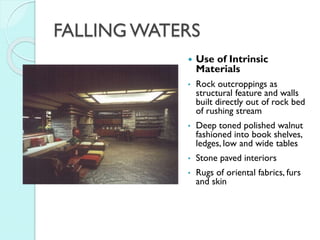
Use of Intrinsic
Materials

•

Rock outcroppings as
structural feature and walls
built directly out of rock bed
of rushing stream

•

Deep toned polished walnut
fashioned into book shelves,
ledges, low and wide tables

•

Stone paved interiors

•

Rugs of oriental fabrics, furs
and skin
FACTS




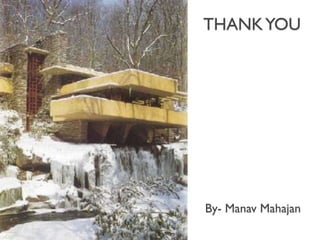
Fallingwater's structural system includes a series of very
bold reinforced concrete cantilevered balconies;
however, the house had problems from the beginning.
Pronounced deflection of the concrete cantilevers was
noticed as soon as formwork was removed at the
construction stage.
Wright and his team used upside down T-shaped beams
integrated into a monolithic concrete slab which both
formed the ceiling of the space below and provided
resistance against compression.
THANK YOU

By- Manav Mahajan

Frank L. Wright : Falling waters and key projects

  • 1.
  • 2.
    FRANK LLOYD WRIGHT June8, 1867 – April 9, 1959 “Each building owes it ‘style’ to the integrity with which it is individually fashioned to serve its particular purpose.”
  • 3.
    “REALITY OF ABUILDING IS THE SPACE ENCLOSED WITHIN” -FLW
  • 4.
    BRIEF HISTORY     Started formaleducation in University of WinsconsinMadison School of Engeneering. Left the college after 2 years and moved to Chicago, Illinois; to join the firm of J.L. Silsbee. Year later he moved to join Adler and Sulivan’s firm as a chief assistant. By 1893, Wright established his own practice and home in the Chicago suburb of Oak Park, Illinois
  • 5.
    IDEAS AND PHILOSOPHY •GEOMETRY was a response to purpose, structure, material and site 1. 2. 3. Guggenheim Museum, New York 4. Window, Robie House, Chicago Wright’s house, Oak Park, Illinois Kauffman Residence, Pennsylvania
  • 6.
    LANDMARK ACHIEVEMENTS By 1901,Wright's completed projects numbered approximately fifty, including many houses in his hometown. • Between 1900 and 1917, his residential designs were Prairie Houses • Characterized by extended low buildings with shallow, sloping roofs, clean sky lines, suppressed chimneys, overhangs and terraces, using unfinished materials • So-called because the design is considered to complement the land around Chicago. • These houses are credited with being the first examples of the ‘open plan’ Hillside Home School,Taliesin Darwin D. Martin House, Buffalo, New York
  • 7.
    PRAIRIE HOUSES PLANNING CONCEPT • Cruciformplan with wings radiating from a central space • Bringing house and landscape into a more intimate relationship was a favorite device of Wright • A central fireplace provided a visual pivot 3 1 – Verandah 2 – Reception Hall 1 2 5 6 3 – Dining Hall 4 – Living Room 4 5 – Kitchen 6 – Rear Verandah
  • 8.
    THE CONCEPT OFTHE USONIAN HOUSES Usonian houses represented a modernization of the Prairie house concept, both in their greater simplicity and in their plan: • Kept in mind that servants were a vanishing breed • Car port • Floor slab with integral radiant heating • Built in furniture, Open kitchen • Utility core • Modular plan • Pinwheel growth out of a central fire place and the two-level roof • All functions simplified, modernized, made more economical in construction
  • 9.
    USONIAN HOUSES • Anothermajor achievement of Wright in the 1930s – design of a low-cost house prototype called the ‘Usonian’ home (from William Butler’s term of the USA in his Utopian novel Erewhom of 1872) • Logical evolution from the Prairie house design and American Ready-Cut system • Designed a kit of parts (as in the American Ready-Cut system) including: • A concrete slab foundation floated on a drained bed of cinders and sand • Into this slab, radiating hot-water inserted
  • 10.
    INTRODUCTION Fallingwater or KaufmannResidence is a house designed in 1935 at the rural southwestern Pensylvania, 50 miles from southeast of Pittsburgh.  It was designated aa a National Historic Landmark in 1966 by AIA.  Fallingwater was the family's weekend home from 1937 to 1963. In 1963, Kaufmann, Jr. donated the property to the Western Pennsylvania Conservancy. In 1964, it was opened to the public as a museum. 
  • 11.
    THE CONFLICT Kaufmann wasuncomfortable with what he perceived as Wright's insufficient experience using reinforced concrete, had the architect's daring cantilever design reviewed by a firm of consulting engineers. Upon receiving their report Wright took offense and immediately requested Kaufmann to return his drawings and indicated he was withdrawing from the project. Kaufmann relented to Wright's gambit and the engineer’s report was subsequently buried within a stone wall of the house.
  • 12.
    FALLING WATERS   The sitechosen was a natural landscape area for the weekend home with a water stream with it. It was thought that the building would have a view of the stream but FLW made it over the stream.
  • 13.
  • 14.
  • 15.
  • 16.
  • 17.
  • 18.
  • 19.
    FALLING WATERS   Horizontal andvertical lines are the distinctive features of the building. Spaces are designed to bring nature inside the four walls.
  • 20.
    FALLING WATERS   Staircase leadingto the waterfall adds as an element of interest and is a facinating feature of the house. Interiors are simple though vibrant, because of use of a triadic color scheme for furnishings and monochromatic scheme of brown for walls, ceiling and floors.
  • 21.
    FALLING WATERS  Use ofIntrinsic Materials • Rock outcroppings as structural feature and walls built directly out of rock bed of rushing stream • Deep toned polished walnut fashioned into book shelves, ledges, low and wide tables • Stone paved interiors • Rugs of oriental fabrics, furs and skin
  • 22.
    FACTS   Fallingwater's structural systemincludes a series of very bold reinforced concrete cantilevered balconies; however, the house had problems from the beginning. Pronounced deflection of the concrete cantilevers was noticed as soon as formwork was removed at the construction stage. Wright and his team used upside down T-shaped beams integrated into a monolithic concrete slab which both formed the ceiling of the space below and provided resistance against compression.
  • 23.