




Fail to prepare,    prepare to fail October 2011
Introduction  to Sage
What Sage does Sage is a leading supplier of business management software and services to over 6 million customers worldwide. From small start-ups to larger organisations, we make it easier for companies to manage their business processes   Our vision is to be the most admired and respected business software and services provider in the world
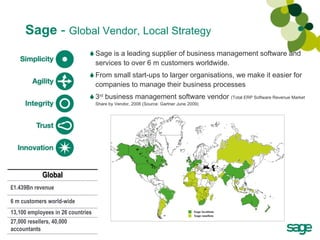
Sage  -   Global Vendor, Local Strategy Sage is a leading supplier of business management software and services to over 6 m customers worldwide.  From small start-ups to larger organisations, we make it easier for companies to manage their business processes  3 rd  business management software vendor  (Total ERP Software Revenue Market Share by Vendor, 2008 (Source: Gartner June 2009) Global £1.439Bn revenue 6 m customers world-wide 13,100 employees in 26 countries 27,000 resellers, 40,000 accountants
What we offer
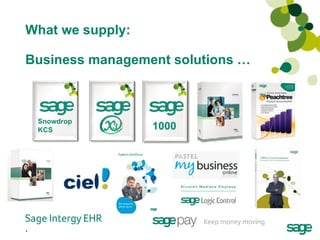
What we supply: Business management solutions …
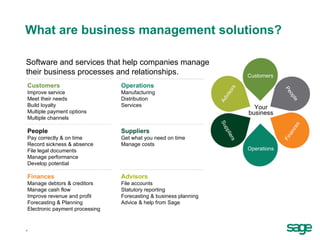
What are business management solutions?   Software and services that help companies manage their business processes and relationships. Your business Customers People Finances Operations Suppliers Advisors Customers Improve service Meet their needs Build loyalty Multiple payment options Multiple channels Operations Manufacturing Distribution Services People Pay correctly & on time Record sickness & absence File legal documents Manage performance Develop potential Suppliers Get what you need on time Manage costs Finances Manage debtors & creditors Manage cash flow Improve revenue and profit Forecasting & Planning Electronic payment processing Advisors File accounts  Statutory reporting Forecasting & business planning Advice & help from Sage
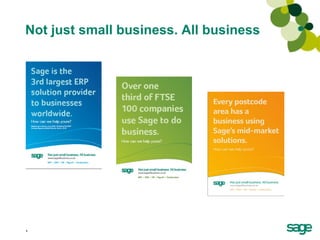
Not just small business. All business
Our view on  the market
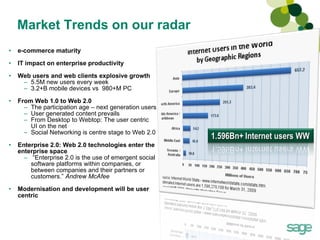
Market Trends on our radar e-commerce maturity IT impact on enterprise productivity Web users and web clients explosive growth 5.5M new users every week 3.2+B mobile devices vs  980+M PC From Web 1.0 to Web 2.0 The participation age – next generation users User generated content prevails From Desktop to Webtop: The user centric  UI on the net Social Networking is centre stage to Web 2.0 Enterprise 2.0: Web 2.0 technologies enter the enterprise space “ Enterprise 2.0 is the use of emergent social software platforms within companies, or between companies and their partners or customers.”  Andrew McAfee Modernisation and development will be user centric
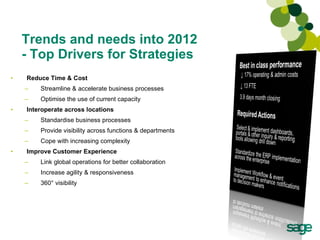
Trends and needs into  2012  -  Top Drivers for Strategies Reduce Time & Cost Streamline & accelerate business processes Optimise the use of current capacity Interoperate across locations Standardise business processes Provide visibility across functions & departments Cope with increasing complexity Improve Customer Experience Link global operations for better collaboration Increase agility & responsiveness  360° visibility
Benefits   Realisation
Benefits   Realisation - Why it matters
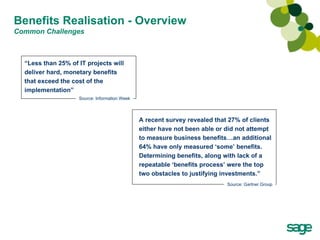
Benefits Realisation - Overview Common Challenges A recent survey revealed that 27% of clients either have not been able or did not attempt to measure business benefits…an additional 64% have only measured ‘some’ benefits. Determining benefits, along with lack of a repeatable ‘benefits process’ were the top two obstacles to justifying investments.” Source: Gartner Group “ Less than 25% of IT projects will deliver hard, monetary benefits that exceed the cost of the implementation” Source: Information Week
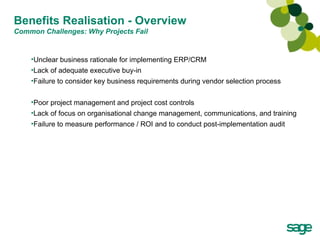
Benefits Realisation - Overview Common Challenges: Why Projects Fail Unclear business rationale for implementing ERP/CRM Lack of adequate executive buy-in Failure to consider key business requirements during vendor selection process Poor project management and project cost controls Lack of focus on organisational change management, communications, and training Failure to measure performance / ROI and to conduct post-implementation audit
Benefits Realisation - Overview Purpose of Benefits Realisation A comprehensive project approach that focuses on identifying, measuring, and ensuring the business benefits achievable through  applying  technology Enables alignment between mid-level managers and project benefits Holistic approach with a focus on Performance Measurement, Organisational Change Management (OCM), Program Management support, and process improvement
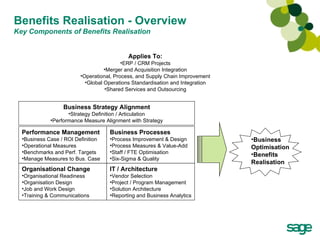
Performance Management Business Case / ROI Definition Operational Measures Benchmarks and Perf. Targets Manage Measures to Bus. Case Business Processes Process Improvement & Design Process Measures & Value-Add Staff / FTE Optimisation Six-Sigma & Quality Organisational Change Organisational Readiness Organisation Design Job and Work Design Training & Communications IT / Architecture Vendor Selection Project / Program Management Solution Architecture Reporting and Business Analytics Business Strategy Alignment Strategy Definition / Articulation Performance Measure Alignment with Strategy Applies To: ERP / CRM Projects Merger and Acquisition Integration Operational, Process, and Supply Chain Improvement Global Operations Standardisation and Integration Shared Services and Outsourcing Benefits Realisation - Overview Key Components of Benefits Realisation Business Optimisation Benefits Realisation
Benefits   Realisation - The approach
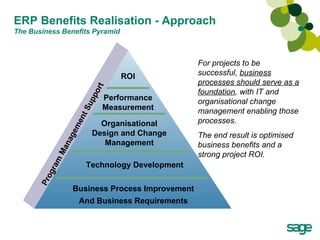
ERP Benefits Realisation - Approach The Business Benefits Pyramid Business Process Improvement And Business Requirements Technology Development Organisational Design and Change Management Performance Measurement For projects to be successful,  business processes should serve as a foundation , with IT and organisational change management enabling those processes.  The end result is optimised business benefits and a strong project ROI. ROI Program Management Support
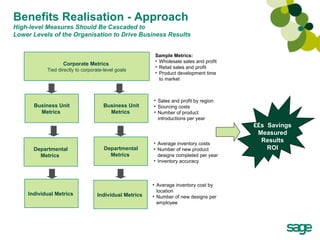
Corporate Metrics   Tied directly to corporate-level goals Sample Metrics: Wholesale sales and profit Retail sales and profit Product development time to market Sales and profit by region Sourcing costs Number of product introductions per year Business Unit Metrics  Business Unit Metrics  Average inventory costs Number of new product designs completed per year Inventory accuracy Departmental Metrics  Individual Metrics  Individual   Metrics   Departmental Metrics  ££s  Savings Measured Results ROI Benefits Realisation - Approach  High-level Measures Should Be Cascaded to  Lower Levels of the Organisation to Drive Business Results Average inventory cost by location Number of new designs per employee
Benefits   Realisation - In practice
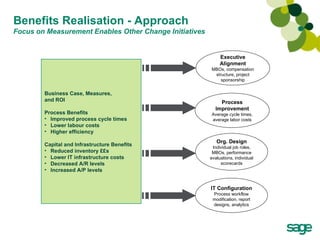
Business Case, Measures,  and ROI Process Benefits Improved process cycle times Lower labour costs Higher efficiency Capital and Infrastructure Benefits Reduced inventory ££s Lower IT infrastructure costs Decreased A/R levels Increased A/P levels Process Improvement Average cycle times, average labor costs Org. Design Individual job roles, MBOs, performance evaluations, individual scorecards Executive Alignment MBOs, compensation structure, project sponsorship IT Configuration Process workflow modification, report designs, analytics Benefits Realisation - Approach  Focus on Measurement Enables Other Change Initiatives
Benefits Realisation - Implementing Focus is on Integrated Set of Value-Add Activities Business Process Improvement / Optimisation and ERP/CRM Business Requirements Performance Measurement and Management Organisational Change Management, Training, and Communications Post Go-live Audit and Root Cause Analysis Program Management Support and Project Quality Assurance
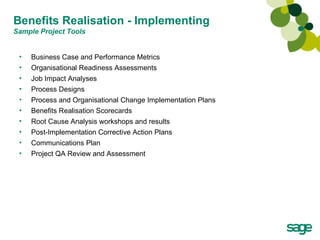
Benefits Realisation - Implementing  Sample Project Tools Business Case and Performance Metrics Organisational Readiness Assessments Job Impact Analyses Process Designs Process and Organisational Change Implementation Plans Benefits Realisation Scorecards Root Cause Analysis workshops and results Post-Implementation Corrective Action Plans Communications Plan Project QA Review and Assessment
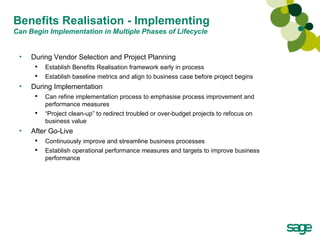
Benefits Realisation - Implementing Can Begin Implementation in Multiple Phases of Lifecycle During Vendor Selection and Project Planning Establish Benefits Realisation framework early in process Establish baseline metrics and align to business case before project begins During Implementation Can refine implementation process to emphasise process improvement and performance measures “ Project clean-up” to redirect troubled or over-budget projects to refocus on business value After Go-Live Continuously improve and streamline business processes Establish operational performance measures and targets to improve business performance
Benefits   Realisation - The outcome
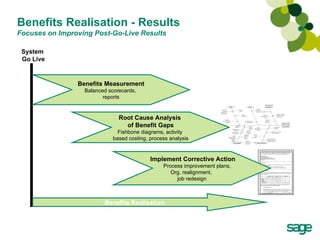
System  Go Live Benefits Measurement Balanced scorecards,  reports Root Cause Analysis  of Benefit Gaps Fishbone diagrams, activity  based costing, process analysis Implement Corrective Action Process improvement plans,  Org. realignment,  job redesign Benefits Realisation Benefits Realisation - Results  Focuses on Improving Post-Go-Live Results
Benefits Realisation - Results  Creates Measurable ROI and Business Value Reduces project risk Closely aligns business and technical activities Proactively identifies and addresses potential obstacles to realising project benefits Provides more thorough understanding of underperformance and lessons learned Improves justification for future IT project approvals Provides quality and continuity through ERP project lifecycle
Fail to prepare,    prepare to fail October 2011

Fail to prepare, prepare to fail: implementing ERP and CRM systems

  • 1.
    Fail to prepare, prepare to fail October 2011
  • 2.
  • 3.
    What Sage doesSage is a leading supplier of business management software and services to over 6 million customers worldwide. From small start-ups to larger organisations, we make it easier for companies to manage their business processes Our vision is to be the most admired and respected business software and services provider in the world
  • 4.
    Sage - Global Vendor, Local Strategy Sage is a leading supplier of business management software and services to over 6 m customers worldwide. From small start-ups to larger organisations, we make it easier for companies to manage their business processes 3 rd business management software vendor (Total ERP Software Revenue Market Share by Vendor, 2008 (Source: Gartner June 2009) Global £1.439Bn revenue 6 m customers world-wide 13,100 employees in 26 countries 27,000 resellers, 40,000 accountants
  • 5.
  • 6.
    What we supply:Business management solutions …
  • 7.
    What are businessmanagement solutions? Software and services that help companies manage their business processes and relationships. Your business Customers People Finances Operations Suppliers Advisors Customers Improve service Meet their needs Build loyalty Multiple payment options Multiple channels Operations Manufacturing Distribution Services People Pay correctly & on time Record sickness & absence File legal documents Manage performance Develop potential Suppliers Get what you need on time Manage costs Finances Manage debtors & creditors Manage cash flow Improve revenue and profit Forecasting & Planning Electronic payment processing Advisors File accounts Statutory reporting Forecasting & business planning Advice & help from Sage
  • 8.
    Not just smallbusiness. All business
  • 9.
    Our view on the market
  • 10.
    Market Trends onour radar e-commerce maturity IT impact on enterprise productivity Web users and web clients explosive growth 5.5M new users every week 3.2+B mobile devices vs 980+M PC From Web 1.0 to Web 2.0 The participation age – next generation users User generated content prevails From Desktop to Webtop: The user centric UI on the net Social Networking is centre stage to Web 2.0 Enterprise 2.0: Web 2.0 technologies enter the enterprise space “ Enterprise 2.0 is the use of emergent social software platforms within companies, or between companies and their partners or customers.” Andrew McAfee Modernisation and development will be user centric
  • 11.
    Trends and needsinto 2012 - Top Drivers for Strategies Reduce Time & Cost Streamline & accelerate business processes Optimise the use of current capacity Interoperate across locations Standardise business processes Provide visibility across functions & departments Cope with increasing complexity Improve Customer Experience Link global operations for better collaboration Increase agility & responsiveness 360° visibility
  • 12.
    Benefits Realisation
  • 13.
    Benefits Realisation - Why it matters
  • 14.
    Benefits Realisation -Overview Common Challenges A recent survey revealed that 27% of clients either have not been able or did not attempt to measure business benefits…an additional 64% have only measured ‘some’ benefits. Determining benefits, along with lack of a repeatable ‘benefits process’ were the top two obstacles to justifying investments.” Source: Gartner Group “ Less than 25% of IT projects will deliver hard, monetary benefits that exceed the cost of the implementation” Source: Information Week
  • 15.
    Benefits Realisation -Overview Common Challenges: Why Projects Fail Unclear business rationale for implementing ERP/CRM Lack of adequate executive buy-in Failure to consider key business requirements during vendor selection process Poor project management and project cost controls Lack of focus on organisational change management, communications, and training Failure to measure performance / ROI and to conduct post-implementation audit
  • 16.
    Benefits Realisation -Overview Purpose of Benefits Realisation A comprehensive project approach that focuses on identifying, measuring, and ensuring the business benefits achievable through applying technology Enables alignment between mid-level managers and project benefits Holistic approach with a focus on Performance Measurement, Organisational Change Management (OCM), Program Management support, and process improvement
  • 17.
    Performance Management BusinessCase / ROI Definition Operational Measures Benchmarks and Perf. Targets Manage Measures to Bus. Case Business Processes Process Improvement & Design Process Measures & Value-Add Staff / FTE Optimisation Six-Sigma & Quality Organisational Change Organisational Readiness Organisation Design Job and Work Design Training & Communications IT / Architecture Vendor Selection Project / Program Management Solution Architecture Reporting and Business Analytics Business Strategy Alignment Strategy Definition / Articulation Performance Measure Alignment with Strategy Applies To: ERP / CRM Projects Merger and Acquisition Integration Operational, Process, and Supply Chain Improvement Global Operations Standardisation and Integration Shared Services and Outsourcing Benefits Realisation - Overview Key Components of Benefits Realisation Business Optimisation Benefits Realisation
  • 18.
    Benefits Realisation - The approach
  • 19.
    ERP Benefits Realisation- Approach The Business Benefits Pyramid Business Process Improvement And Business Requirements Technology Development Organisational Design and Change Management Performance Measurement For projects to be successful, business processes should serve as a foundation , with IT and organisational change management enabling those processes. The end result is optimised business benefits and a strong project ROI. ROI Program Management Support
  • 20.
    Corporate Metrics Tied directly to corporate-level goals Sample Metrics: Wholesale sales and profit Retail sales and profit Product development time to market Sales and profit by region Sourcing costs Number of product introductions per year Business Unit Metrics Business Unit Metrics Average inventory costs Number of new product designs completed per year Inventory accuracy Departmental Metrics Individual Metrics Individual Metrics Departmental Metrics ££s Savings Measured Results ROI Benefits Realisation - Approach High-level Measures Should Be Cascaded to Lower Levels of the Organisation to Drive Business Results Average inventory cost by location Number of new designs per employee
  • 21.
    Benefits Realisation - In practice
  • 22.
    Business Case, Measures, and ROI Process Benefits Improved process cycle times Lower labour costs Higher efficiency Capital and Infrastructure Benefits Reduced inventory ££s Lower IT infrastructure costs Decreased A/R levels Increased A/P levels Process Improvement Average cycle times, average labor costs Org. Design Individual job roles, MBOs, performance evaluations, individual scorecards Executive Alignment MBOs, compensation structure, project sponsorship IT Configuration Process workflow modification, report designs, analytics Benefits Realisation - Approach Focus on Measurement Enables Other Change Initiatives
  • 23.
    Benefits Realisation -Implementing Focus is on Integrated Set of Value-Add Activities Business Process Improvement / Optimisation and ERP/CRM Business Requirements Performance Measurement and Management Organisational Change Management, Training, and Communications Post Go-live Audit and Root Cause Analysis Program Management Support and Project Quality Assurance
  • 24.
    Benefits Realisation -Implementing Sample Project Tools Business Case and Performance Metrics Organisational Readiness Assessments Job Impact Analyses Process Designs Process and Organisational Change Implementation Plans Benefits Realisation Scorecards Root Cause Analysis workshops and results Post-Implementation Corrective Action Plans Communications Plan Project QA Review and Assessment
  • 25.
    Benefits Realisation -Implementing Can Begin Implementation in Multiple Phases of Lifecycle During Vendor Selection and Project Planning Establish Benefits Realisation framework early in process Establish baseline metrics and align to business case before project begins During Implementation Can refine implementation process to emphasise process improvement and performance measures “ Project clean-up” to redirect troubled or over-budget projects to refocus on business value After Go-Live Continuously improve and streamline business processes Establish operational performance measures and targets to improve business performance
  • 26.
    Benefits Realisation - The outcome
  • 27.
    System GoLive Benefits Measurement Balanced scorecards, reports Root Cause Analysis of Benefit Gaps Fishbone diagrams, activity based costing, process analysis Implement Corrective Action Process improvement plans, Org. realignment, job redesign Benefits Realisation Benefits Realisation - Results Focuses on Improving Post-Go-Live Results
  • 28.
    Benefits Realisation -Results Creates Measurable ROI and Business Value Reduces project risk Closely aligns business and technical activities Proactively identifies and addresses potential obstacles to realising project benefits Provides more thorough understanding of underperformance and lessons learned Improves justification for future IT project approvals Provides quality and continuity through ERP project lifecycle
  • 29.
    Fail to prepare, prepare to fail October 2011