Role of KPI’s in Building 
Business Intelligence 
A Study on KPI’s in Telecom Industry 
Prepared by 
Sai Venkatesh Attaluri
Introduction 
 A Key Performance Indicator (KPI) is a 
measure of performance. Such measures 
are commonly used to help an organization 
define and evaluate how successful it is, 
typically in terms of making progress 
towards its goals. 
 KPIs may be monitored using BI techniques 
to assess the present state of the business 
and to assist in prescribing a course of 
action. The act of monitoring KPIs in real-time 
is known as Business Activity 
Monitoring (BAM).
Identifying KPI’s 
 Performance indicators differ from business 
drivers & goals. A school might consider the 
failure rate of its students as a KPI which 
might help the school understand its position 
in the educational community, whereas a 
business might consider the percentage of 
income from return customers as a potential 
KPI. 
 But it is necessary for any organization to at 
least identify its KPIs.
Identifying KPI’s 
The key environments in identifying KPIs are: 
 Having a pre-defined Business Process (BP). 
 Requirements for the Business Processes. 
 Having a quantitative/qualitative measurement of the 
results and comparison with set goals. 
 Investigating variances and tweaking processes or 
resources to achieve short-term goals. 
 A KPI has to follow the SMART criteria. This means the 
measure has a Specific purpose for the business, it is 
Measurable, Achievable, Relevant to measure and it 
must be Time phased.
Categorization Of Indicators 
 KPI’s define a set of values used to measure 
against. 
 Quantitative indicators which can be presented as 
a number. 
 Practical indicators that interface with existing 
company processes. 
 Directional indicators specifying whether an 
organization is getting better or not. 
 Actionable indicators are sufficiently in an 
organization's control to effect change. 
 Financial indicators used in performance 
measurement and when looking at an operating 
index
KPI’s of Telecom Industry 
 The KPI of a telecom field can be 
categorized as the following. 
Business & Marketing, 
Revenue / Financial Analysis 
Network Performance & Analysis 
Customer Satisfaction, 
Customer Analysis. 
Quality / Usage (Airtime) 
Coverage, 
Faults and complains, 
Etc
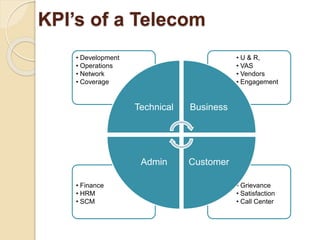
• Grievance 
• Satisfaction 
• Call Center 
KPI’s of a Telecom 
• Finance 
• HRM 
• SCM 
• U & R, 
• VAS 
• Vendors 
• Engagement 
• Development 
• Operations 
• Network 
• Coverage 
Technical Business 
Admin Customer
KPI’s of Network Performance 
 Service Availability 
 Grade of service 
 Service life of equipment 
 Bit error ratio 
 Bit rate 
 Downtime / Time out of service 
 Call completion ratio 
 Cost of support systems 
 Cost of operational system 
 Average call length 
 Analysis of ASR routes 
 Network traffic, congestion 
 Idle time on network 
 Dropped calls
KPI’s of Customer Satisfaction 
Average score from external surveys 
Average score from internal survey 
Average score from call monitoring 
Total number of complaints 
Total number of unresolved issues 
Number of responses generated
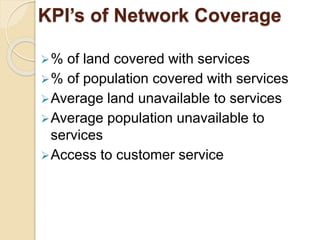
KPI’s of Network Coverage 
% of land covered with services 
% of population covered with services 
Average land unavailable to services 
Average population unavailable to 
services 
Access to customer service
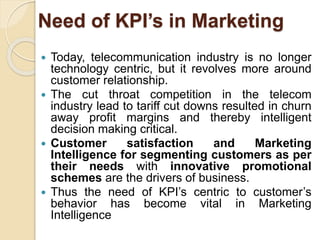
Need of KPI’s in Marketing 
 Today, telecommunication industry is no longer 
technology centric, but it revolves more around 
customer relationship. 
 The cut throat competition in the telecom 
industry lead to tariff cut downs resulted in churn 
away profit margins and thereby intelligent 
decision making critical. 
 Customer satisfaction and Marketing 
Intelligence for segmenting customers as per 
their needs with innovative promotional 
schemes are the drivers of business. 
 Thus the need of KPI’s centric to customer’s 
behavior has become vital in Marketing 
Intelligence
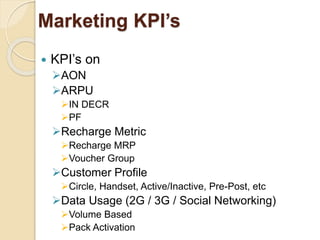
Marketing KPI’s 
 KPI’s on 
AON 
ARPU 
IN DECR 
PF 
Recharge Metric 
Recharge MRP 
Voucher Group 
Customer Profile 
Circle, Handset, Active/Inactive, Pre-Post, etc 
Data Usage (2G / 3G / Social Networking) 
Volume Based 
Pack Activation
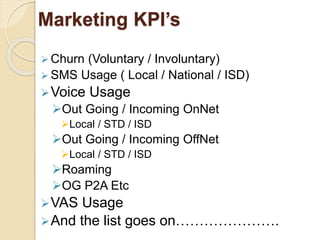
Marketing KPI’s 
 Churn (Voluntary / Involuntary) 
SMS Usage ( Local / National / ISD) 
Voice Usage 
Out Going / Incoming OnNet 
Local / STD / ISD 
Out Going / Incoming OffNet 
Local / STD / ISD 
Roaming 
OG P2A Etc 
VAS Usage 
And the list goes on………………….
Using KPI’s 
 If the performing indicators are few a simple 
spread sheet can help to figure out the factors 
impacting the business. But reality is far 
different. 
 The list of KPI’s and their subsets are 
innumerous in each vertical and yet dynamic in 
nature changing continuously becoming a reap 
of historical data making it difficult to take 
decisions at every level.
Using KPI’s for Intelligence 
 The data generated by KPI’s in its operations 
which is both accurate and timely needs to be 
processed and give a bird’s view to the decision 
makers . They require real-time, actionable 
business intelligence for proactive 
management rather than the “management by 
hindsight. 
 What is Business Intelligence? 
 First, all numbers are not analytics nor do 
they necessarily lead to any kind of 
“intelligence” . There are some clear 
definitional criteria that we can use to ensure 
we are talking about BI.
Bringing Intelligence 
 Business intelligence is intended to provide 
foresight by synthesizing to become useful 
mission-critical information that allows to make 
an executive decision. 
 BI is derived from real-time data. For decision-making, 
the data used has to be up-to-the-minute 
real time data in order to accurately 
represent the state of the business. 
 In telecom eco system, even yesterday’s data is 
“old” ― data a few hours old is many a times 
accounted to make decisions.
Bringing Intelligence 
 BI should empower users to have access to real-time 
analytic data to use in their daily work. Gone 
are the days where BI used to be under the purview 
of the statisticians or strategy experts. 
 Instead of choosing which employees can have 
access to what information, its imperative to ensure 
that the productivity and quality of employees work 
will be enhanced with all the data they need on their 
dashboards. 
 Research tells us that professionals spend 53 
percent of their time seeking out information. 
Collectively, the time spent gathering and 
looking for information translates to an 
estimated. 5.4 billion lost hours per year for US 
corporations.
Challenges without BI 
 Lack of Visibility 
◦ Leads Vs Conversions 
◦ Forecasts Vs Actual 
◦ Sales Vs Realization 
◦ Product A Vs Product B 
◦ Client A Vs Client B 
The above example appears to be “What complexity is there 
for the requirement of a system assisted intelligence?” 
But if the above data is drilled down – by region, by customer, 
by product, by time of purchase, by location, by frequency, 
by method / channel of campaign etc., can a normal 
reporting system easily slice and dice the data such that the 
best option of taking a quick decision making be done 
without any expertise of a Statiscian?
Intelligence in Displaying Data 
 To make day-to-day decisions smarter and faster, it is critical to 
have the data in hand is accurate, real-time, consistent, easy 
to retrieve, and displayed in a fashion that is easily 
understood by the user. The resulting intelligence has to be 
crystal clear so erroneous conclusions and faulty decisions are 
not made from the data presented at all levels be it 
Operational, Tactical or Strategic. 
 It is important that the data presented with intelligence to your 
users maintains the following characteristics: 
◦ Clear Insights 
◦ No ambiguity 
◦ Understandable format to the users 
◦ Simple and uncluttered 
◦ Flexible format to change to another format.
Conclusion 
 The goal of business is not to just track 
metrics of KPI’s but it is to use those 
metrics in conducting business to 
enhance revenue now and in the future 
by correct decision making now and for 
the future.
Thank You 
References 
www.KPIlibrary.com 
www.telecomasia.net 
www.smartkpis.com

Bi in telecom through kpi’s

  • 1.
    Role of KPI’sin Building Business Intelligence A Study on KPI’s in Telecom Industry Prepared by Sai Venkatesh Attaluri
  • 2.
    Introduction  AKey Performance Indicator (KPI) is a measure of performance. Such measures are commonly used to help an organization define and evaluate how successful it is, typically in terms of making progress towards its goals.  KPIs may be monitored using BI techniques to assess the present state of the business and to assist in prescribing a course of action. The act of monitoring KPIs in real-time is known as Business Activity Monitoring (BAM).
  • 3.
    Identifying KPI’s Performance indicators differ from business drivers & goals. A school might consider the failure rate of its students as a KPI which might help the school understand its position in the educational community, whereas a business might consider the percentage of income from return customers as a potential KPI.  But it is necessary for any organization to at least identify its KPIs.
  • 4.
    Identifying KPI’s Thekey environments in identifying KPIs are:  Having a pre-defined Business Process (BP).  Requirements for the Business Processes.  Having a quantitative/qualitative measurement of the results and comparison with set goals.  Investigating variances and tweaking processes or resources to achieve short-term goals.  A KPI has to follow the SMART criteria. This means the measure has a Specific purpose for the business, it is Measurable, Achievable, Relevant to measure and it must be Time phased.
  • 5.
    Categorization Of Indicators  KPI’s define a set of values used to measure against.  Quantitative indicators which can be presented as a number.  Practical indicators that interface with existing company processes.  Directional indicators specifying whether an organization is getting better or not.  Actionable indicators are sufficiently in an organization's control to effect change.  Financial indicators used in performance measurement and when looking at an operating index
  • 6.
    KPI’s of TelecomIndustry  The KPI of a telecom field can be categorized as the following. Business & Marketing, Revenue / Financial Analysis Network Performance & Analysis Customer Satisfaction, Customer Analysis. Quality / Usage (Airtime) Coverage, Faults and complains, Etc
  • 7.
    • Grievance •Satisfaction • Call Center KPI’s of a Telecom • Finance • HRM • SCM • U & R, • VAS • Vendors • Engagement • Development • Operations • Network • Coverage Technical Business Admin Customer
  • 8.
    KPI’s of NetworkPerformance  Service Availability  Grade of service  Service life of equipment  Bit error ratio  Bit rate  Downtime / Time out of service  Call completion ratio  Cost of support systems  Cost of operational system  Average call length  Analysis of ASR routes  Network traffic, congestion  Idle time on network  Dropped calls
  • 9.
    KPI’s of CustomerSatisfaction Average score from external surveys Average score from internal survey Average score from call monitoring Total number of complaints Total number of unresolved issues Number of responses generated
  • 10.
    KPI’s of NetworkCoverage % of land covered with services % of population covered with services Average land unavailable to services Average population unavailable to services Access to customer service
  • 11.
    Need of KPI’sin Marketing  Today, telecommunication industry is no longer technology centric, but it revolves more around customer relationship.  The cut throat competition in the telecom industry lead to tariff cut downs resulted in churn away profit margins and thereby intelligent decision making critical.  Customer satisfaction and Marketing Intelligence for segmenting customers as per their needs with innovative promotional schemes are the drivers of business.  Thus the need of KPI’s centric to customer’s behavior has become vital in Marketing Intelligence
  • 12.
    Marketing KPI’s KPI’s on AON ARPU IN DECR PF Recharge Metric Recharge MRP Voucher Group Customer Profile Circle, Handset, Active/Inactive, Pre-Post, etc Data Usage (2G / 3G / Social Networking) Volume Based Pack Activation
  • 13.
    Marketing KPI’s Churn (Voluntary / Involuntary) SMS Usage ( Local / National / ISD) Voice Usage Out Going / Incoming OnNet Local / STD / ISD Out Going / Incoming OffNet Local / STD / ISD Roaming OG P2A Etc VAS Usage And the list goes on………………….
  • 14.
    Using KPI’s If the performing indicators are few a simple spread sheet can help to figure out the factors impacting the business. But reality is far different.  The list of KPI’s and their subsets are innumerous in each vertical and yet dynamic in nature changing continuously becoming a reap of historical data making it difficult to take decisions at every level.
  • 15.
    Using KPI’s forIntelligence  The data generated by KPI’s in its operations which is both accurate and timely needs to be processed and give a bird’s view to the decision makers . They require real-time, actionable business intelligence for proactive management rather than the “management by hindsight.  What is Business Intelligence?  First, all numbers are not analytics nor do they necessarily lead to any kind of “intelligence” . There are some clear definitional criteria that we can use to ensure we are talking about BI.
  • 16.
    Bringing Intelligence Business intelligence is intended to provide foresight by synthesizing to become useful mission-critical information that allows to make an executive decision.  BI is derived from real-time data. For decision-making, the data used has to be up-to-the-minute real time data in order to accurately represent the state of the business.  In telecom eco system, even yesterday’s data is “old” ― data a few hours old is many a times accounted to make decisions.
  • 17.
    Bringing Intelligence BI should empower users to have access to real-time analytic data to use in their daily work. Gone are the days where BI used to be under the purview of the statisticians or strategy experts.  Instead of choosing which employees can have access to what information, its imperative to ensure that the productivity and quality of employees work will be enhanced with all the data they need on their dashboards.  Research tells us that professionals spend 53 percent of their time seeking out information. Collectively, the time spent gathering and looking for information translates to an estimated. 5.4 billion lost hours per year for US corporations.
  • 18.
    Challenges without BI  Lack of Visibility ◦ Leads Vs Conversions ◦ Forecasts Vs Actual ◦ Sales Vs Realization ◦ Product A Vs Product B ◦ Client A Vs Client B The above example appears to be “What complexity is there for the requirement of a system assisted intelligence?” But if the above data is drilled down – by region, by customer, by product, by time of purchase, by location, by frequency, by method / channel of campaign etc., can a normal reporting system easily slice and dice the data such that the best option of taking a quick decision making be done without any expertise of a Statiscian?
  • 19.
    Intelligence in DisplayingData  To make day-to-day decisions smarter and faster, it is critical to have the data in hand is accurate, real-time, consistent, easy to retrieve, and displayed in a fashion that is easily understood by the user. The resulting intelligence has to be crystal clear so erroneous conclusions and faulty decisions are not made from the data presented at all levels be it Operational, Tactical or Strategic.  It is important that the data presented with intelligence to your users maintains the following characteristics: ◦ Clear Insights ◦ No ambiguity ◦ Understandable format to the users ◦ Simple and uncluttered ◦ Flexible format to change to another format.
  • 20.
    Conclusion  Thegoal of business is not to just track metrics of KPI’s but it is to use those metrics in conducting business to enhance revenue now and in the future by correct decision making now and for the future.
  • 21.
    Thank You References www.KPIlibrary.com www.telecomasia.net www.smartkpis.com