What do these Two Groups have in Common ?
Passy is in both Groups !
To find the “Common Factor” we need to break down the group
into its smallest possible components, and then see which of these
components is the same, or “common” to both groups.
For mathematical numbers and Algebra Terms, we find the
“Common Factor” by breaking down the number part into a set
of “Prime Numbers”, and seeing which of these Prime Numbers
is “common” to both of our starting items.
We first need to look at how to break numbers down into
their lowest “Prime Factors” (eg. 2, 3, 5, 7, 11, 13, etc)
The easiest way to do this is to make a “Factor Tree”,
where the prime number factors end up as the outer leaves
of our tree.
12
2 x 6
2 x 3
12 = 2 x 2 x 3
The upside down
“Tree” is not
complete until all
of its outer leaves
are Prime Numbers
16 9
2 x 8 3 x 3
2 x 4 9 = 3 x 3
2 x 2
16 = 2 x 2 x 2 x 2 6
2 x 3
6 = 2 x 3
We will be using Prime Factors
for Reducing down Numbers
present in our Expressions.
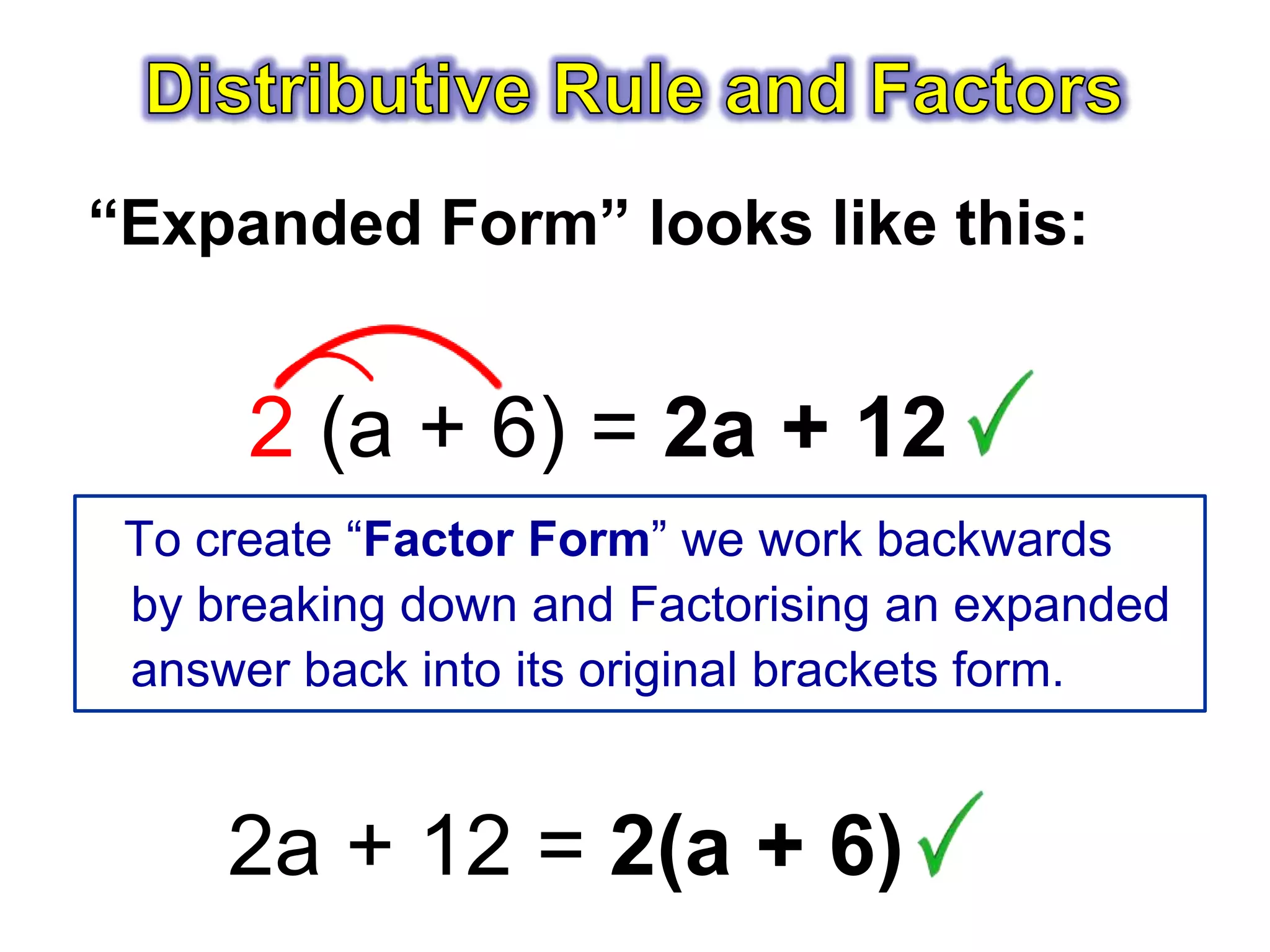
2 (a + 6) = 2a + 12
To create “Factor Form” we work backwards
by breaking down and Factorising an expanded
answer back into its original brackets form.
“Expanded Form” looks like this:
2a + 12 = 2(a + 6)
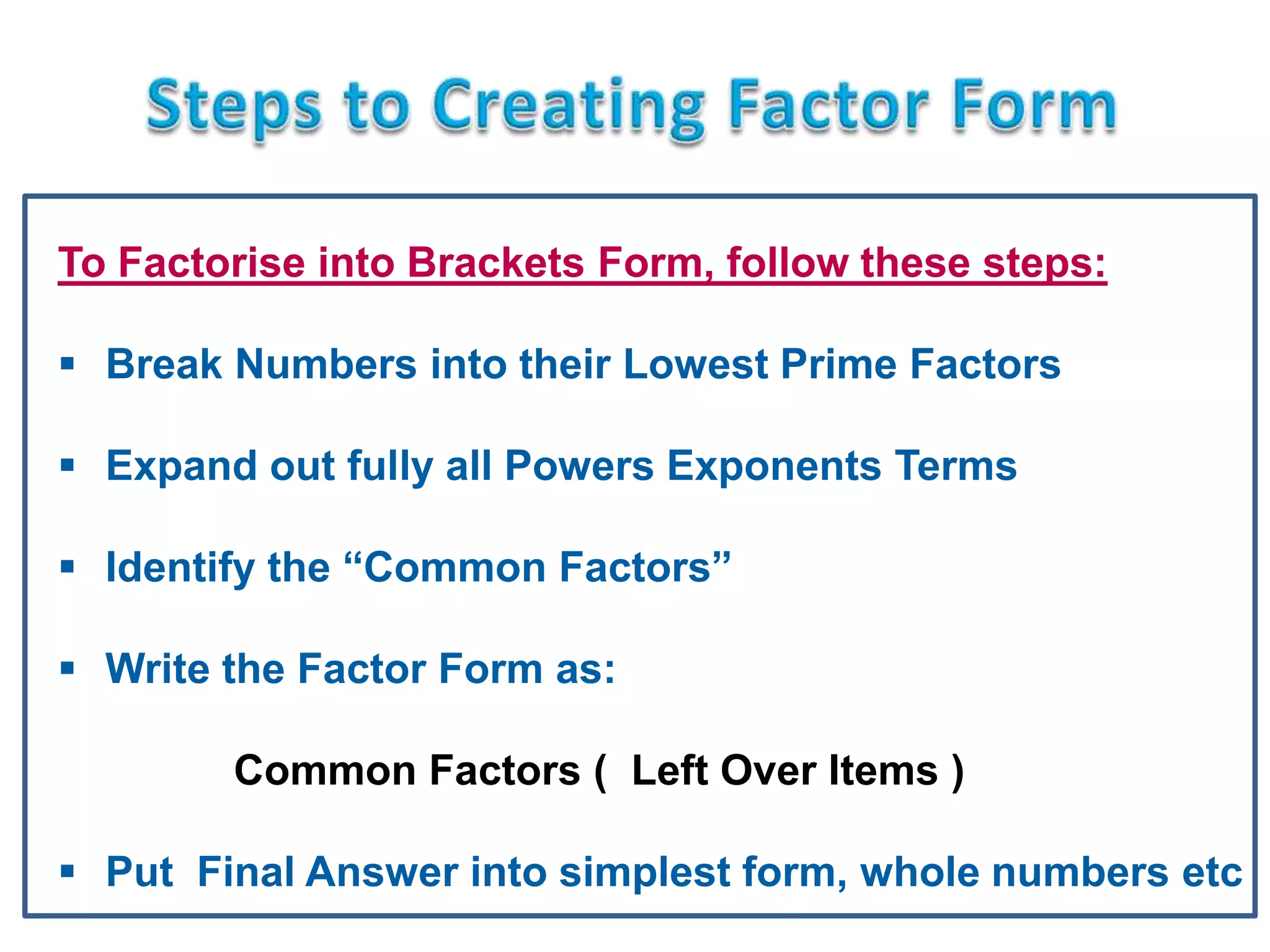
To Factorise into Brackets Form, follow these steps:
 Break Numbers into their Lowest Prime Factors
 Expand out fully all Powers Exponents Terms
 Identify the “Common Factors”
 Write the Factor Form as:
Common Factors ( Left Over Items )
 Put Final Answer into simplest form, whole numbers etc
6
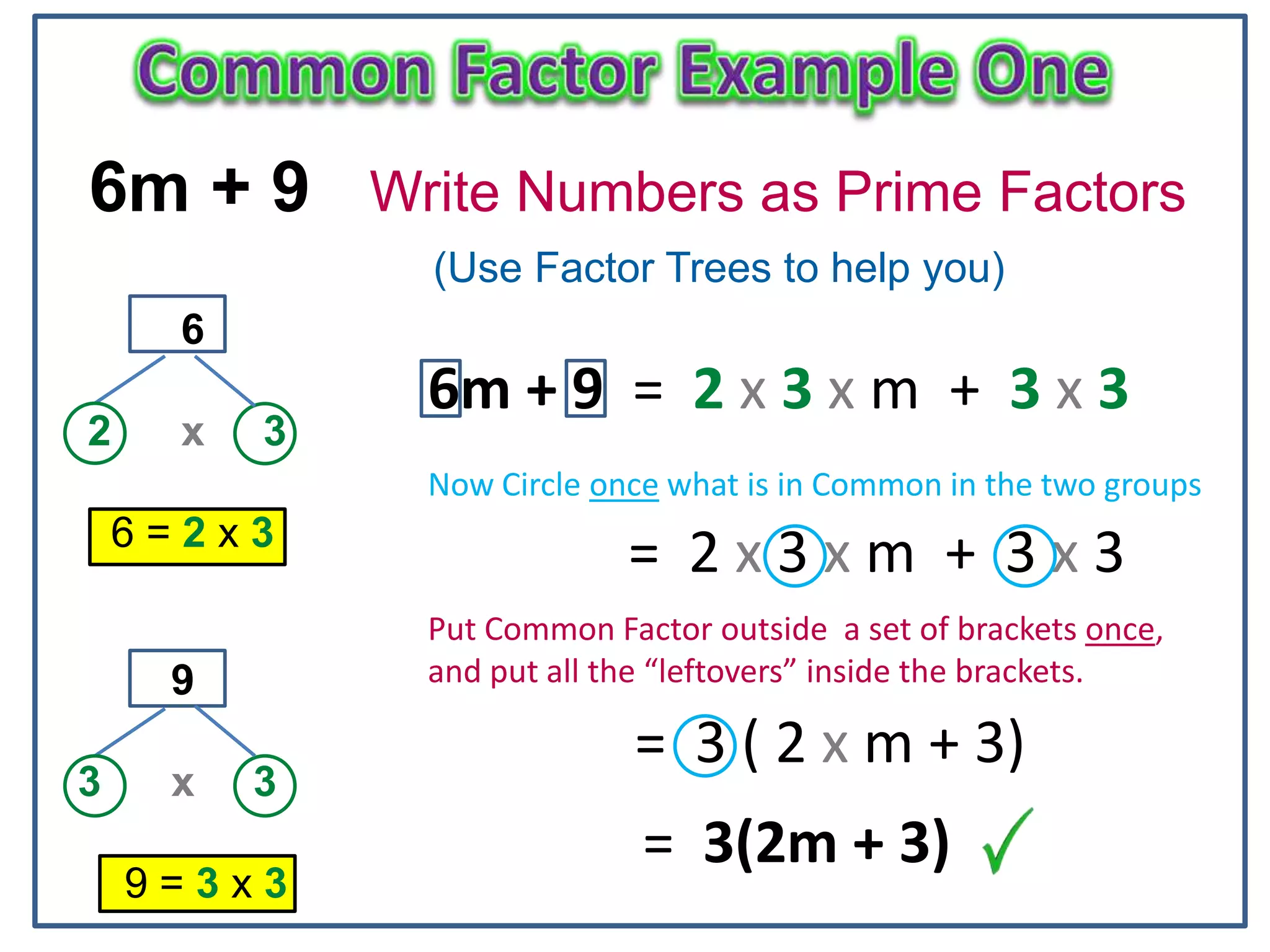
6m + 9 Write Numbers as Prime Factors
(Use Factor Trees to help you)
6
2 x 3
6 = 2 x 3
9
3 x 3
9 = 3 x 3
6m + 9 = 2 x 3 x m + 3 x 3
= 2 x 3 x m + 3 x 3
Now Circle once what is in Common in the two groups
Put Common Factor outside a set of brackets once,
and put all the “leftovers” inside the brackets.
= 3 ( 2 x m + 3)
= 3(2m + 3)
6
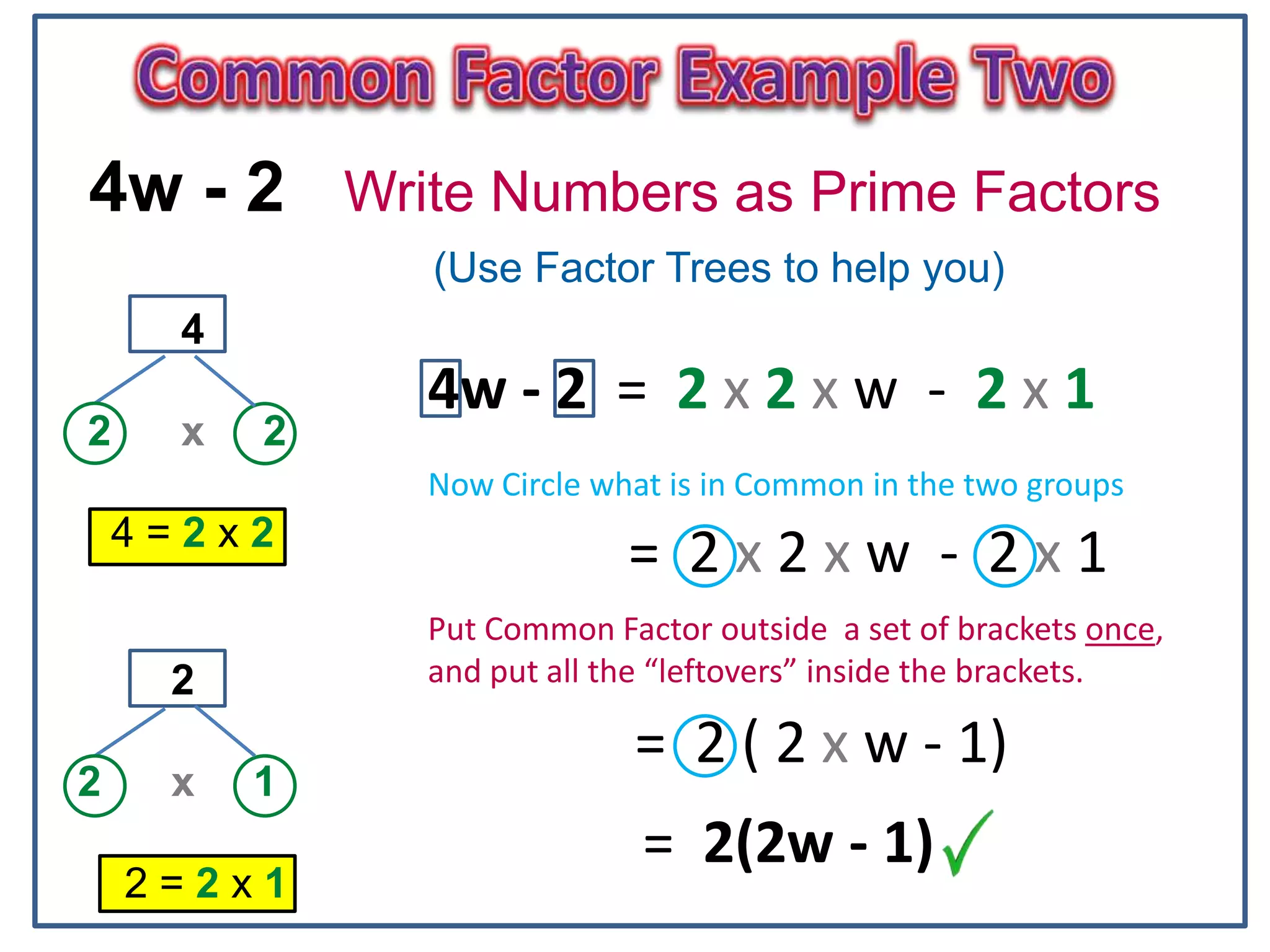
4w - 2 Write Numbers as Prime Factors
(Use Factor Trees to help you)
4
2 x 2
4 = 2 x 2
2
2 x 1
2 = 2 x 1
4w - 2 = 2 x 2 x w - 2 x 1
= 2 x 2 x w - 2 x 1
Now Circle what is in Common in the two groups
Put Common Factor outside a set of brackets once,
and put all the “leftovers” inside the brackets.
= 2 ( 2 x w - 1)
= 2(2w - 1)
N
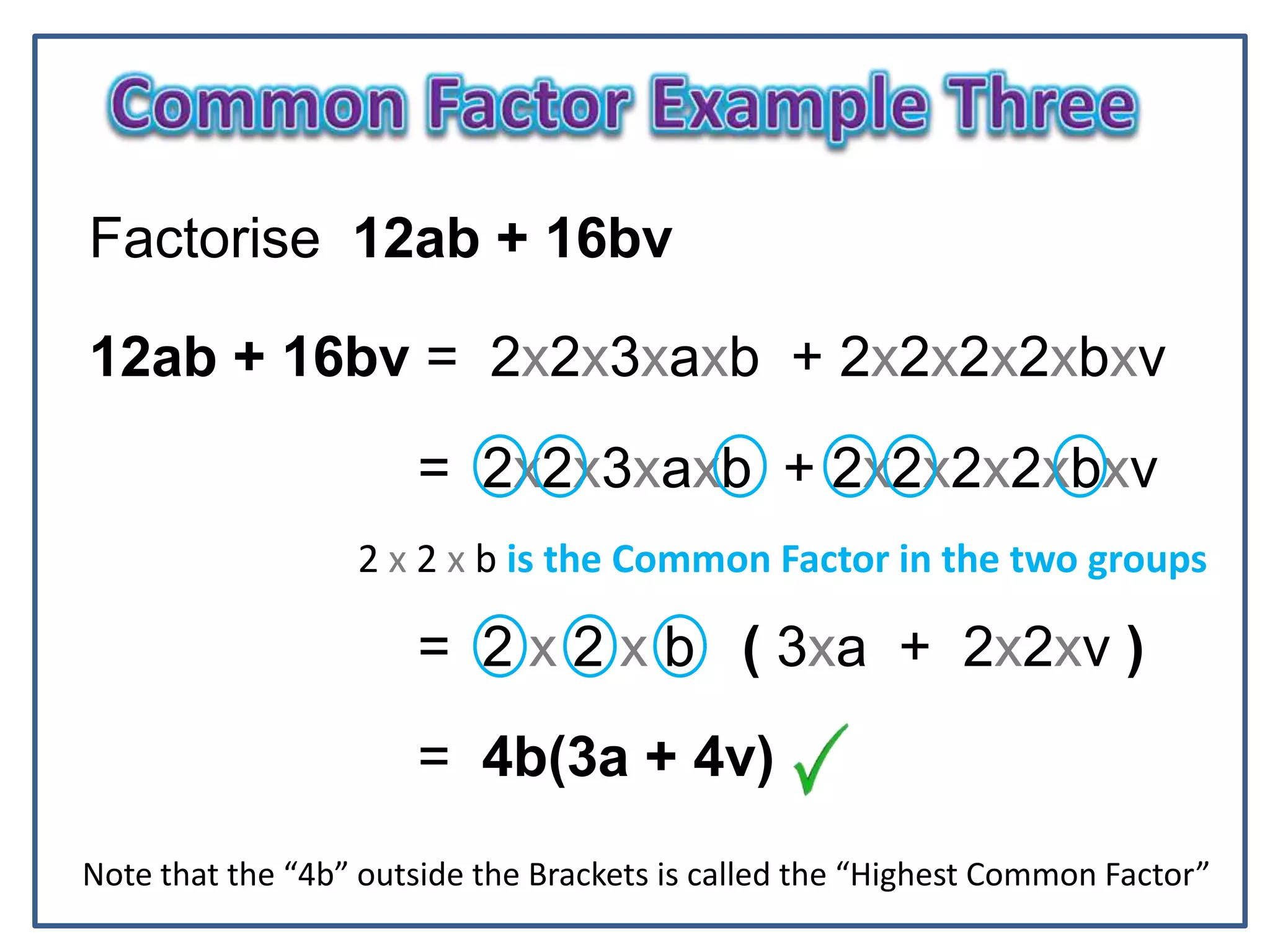
Factorise 12ab + 16bv
12ab + 16bv = 2x2x3xaxb + 2x2x2x2xbxv
= 2x2x3xaxb + 2x2x2x2xbxv
2 x 2 x b is the Common Factor in the two groups
= 2 x 2 x b ( 3xa + 2x2xv )
= 4b(3a + 4v)
Note that the “4b” outside the Brackets is called the “Highest Common Factor”
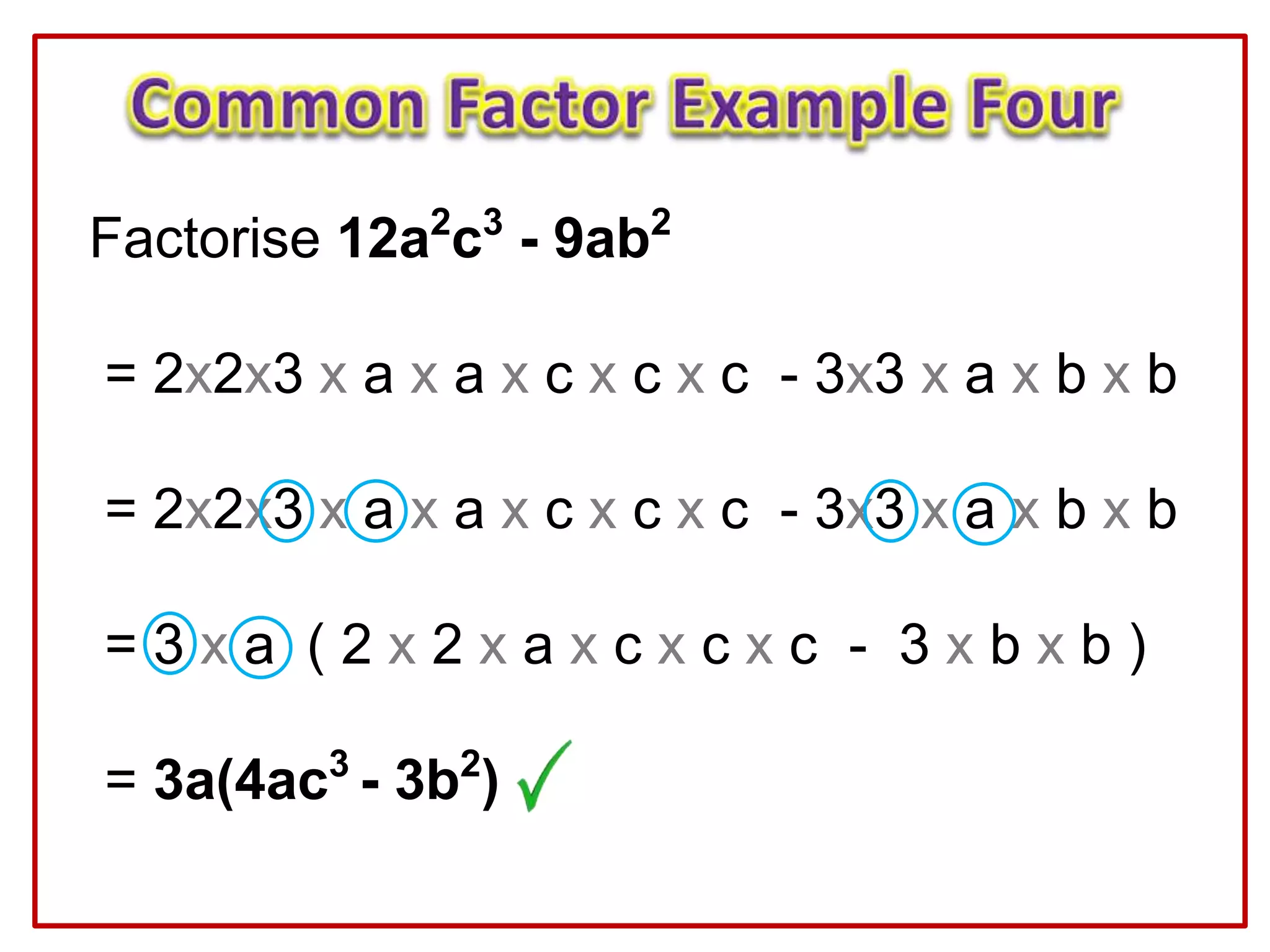
Factorise 12a2
c3
- 9ab2
= 2x2x3 x a x a x c x c x c - 3x3 x a x b x b
= 3 x a ( 2 x 2 x a x c x c x c - 3 x b x b )
= 3a(4ac3
- 3b2
)
6
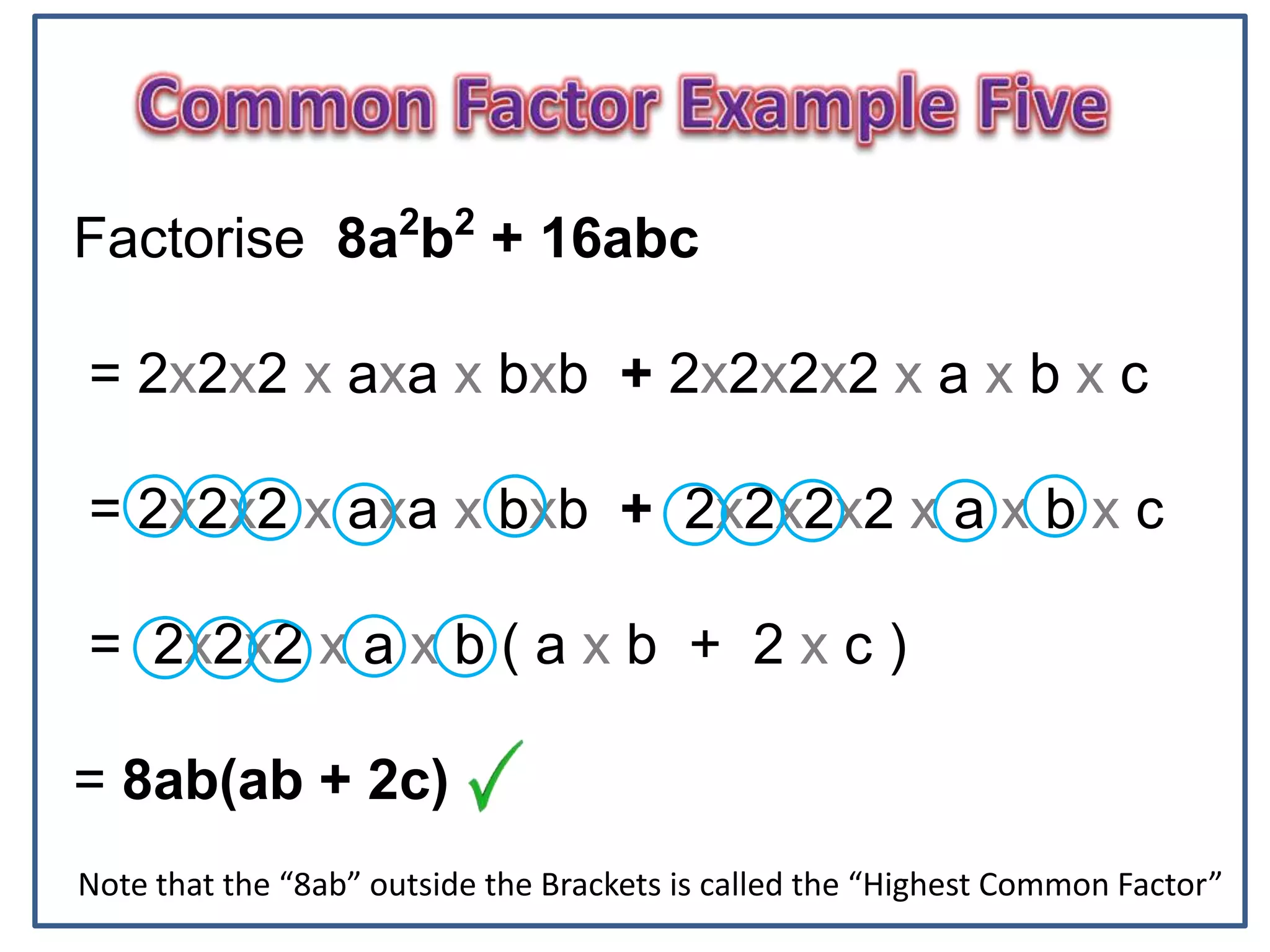
Factorise 8a2
b2
+ 16abc
= 2x2x2 x axa x bxb + 2x2x2x2 x a x b x c
= 2x2x2 x a x b ( a x b + 2 x c )
= 8ab(ab + 2c)
Note that the “8ab” outside the Brackets is called the “Highest Common Factor”
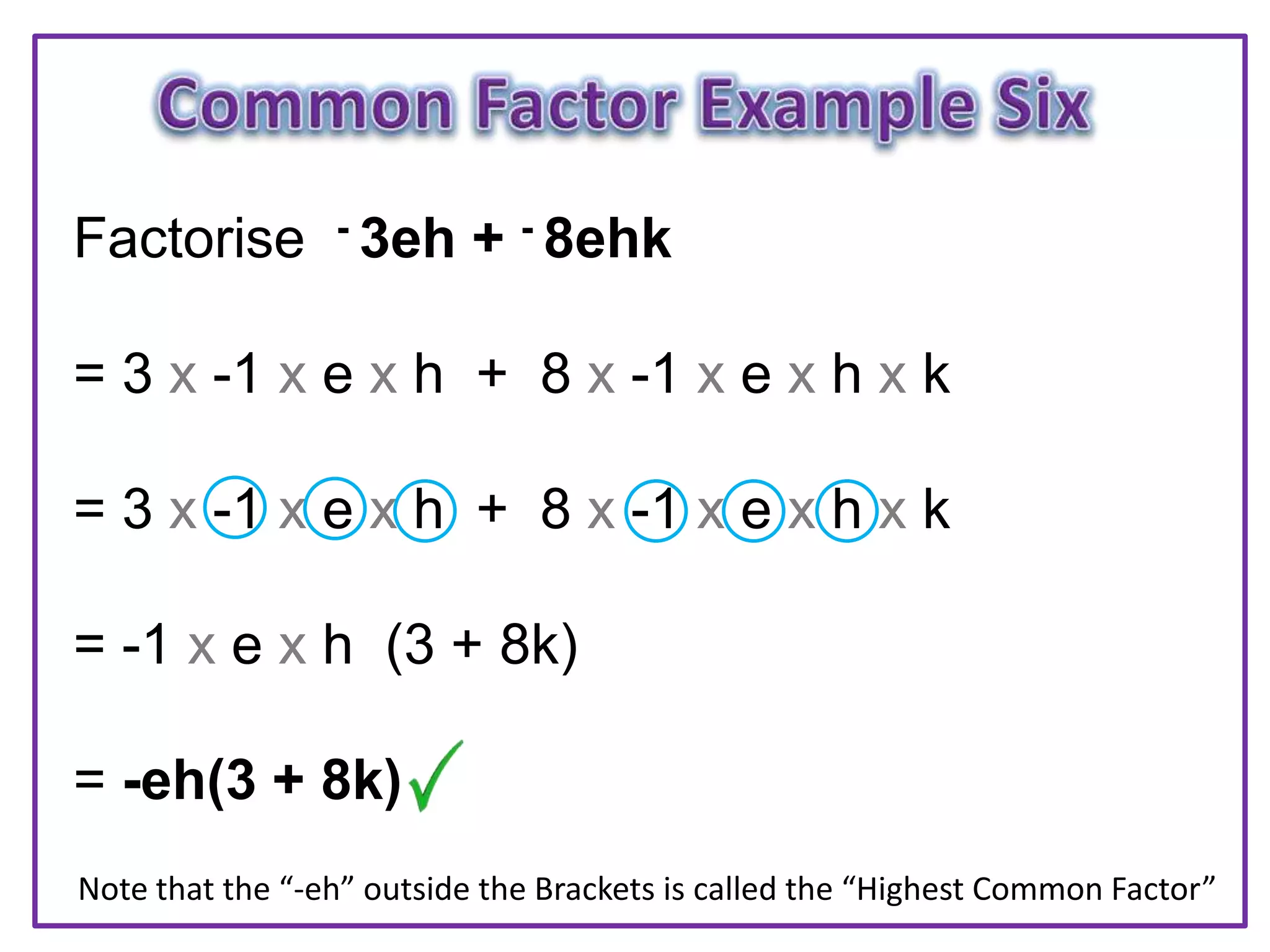
Factorise - 3eh + - 8ehk
= 3 x -1 x e x h + 8 x -1 x e x h x k
= -1 x e x h (3 + 8k)
= -eh(3 + 8k)
Note that the “-eh” outside the Brackets is called the “Highest Common Factor”
http://passyworldofmathematics.com
Visit our Site for Free Mathematics PowerPoints

Factorising Common Factors

  • 1.
    What do theseTwo Groups have in Common ?
  • 2.
    Passy is inboth Groups ! To find the “Common Factor” we need to break down the group into its smallest possible components, and then see which of these components is the same, or “common” to both groups. For mathematical numbers and Algebra Terms, we find the “Common Factor” by breaking down the number part into a set of “Prime Numbers”, and seeing which of these Prime Numbers is “common” to both of our starting items.
  • 3.
    We first needto look at how to break numbers down into their lowest “Prime Factors” (eg. 2, 3, 5, 7, 11, 13, etc) The easiest way to do this is to make a “Factor Tree”, where the prime number factors end up as the outer leaves of our tree. 12 2 x 6 2 x 3 12 = 2 x 2 x 3 The upside down “Tree” is not complete until all of its outer leaves are Prime Numbers
  • 4.
    16 9 2 x8 3 x 3 2 x 4 9 = 3 x 3 2 x 2 16 = 2 x 2 x 2 x 2 6 2 x 3 6 = 2 x 3 We will be using Prime Factors for Reducing down Numbers present in our Expressions.
  • 5.
    2 (a +6) = 2a + 12 To create “Factor Form” we work backwards by breaking down and Factorising an expanded answer back into its original brackets form. “Expanded Form” looks like this: 2a + 12 = 2(a + 6)
  • 6.
    To Factorise intoBrackets Form, follow these steps:  Break Numbers into their Lowest Prime Factors  Expand out fully all Powers Exponents Terms  Identify the “Common Factors”  Write the Factor Form as: Common Factors ( Left Over Items )  Put Final Answer into simplest form, whole numbers etc
  • 7.
    6 6m + 9Write Numbers as Prime Factors (Use Factor Trees to help you) 6 2 x 3 6 = 2 x 3 9 3 x 3 9 = 3 x 3 6m + 9 = 2 x 3 x m + 3 x 3 = 2 x 3 x m + 3 x 3 Now Circle once what is in Common in the two groups Put Common Factor outside a set of brackets once, and put all the “leftovers” inside the brackets. = 3 ( 2 x m + 3) = 3(2m + 3)
  • 8.
    6 4w - 2Write Numbers as Prime Factors (Use Factor Trees to help you) 4 2 x 2 4 = 2 x 2 2 2 x 1 2 = 2 x 1 4w - 2 = 2 x 2 x w - 2 x 1 = 2 x 2 x w - 2 x 1 Now Circle what is in Common in the two groups Put Common Factor outside a set of brackets once, and put all the “leftovers” inside the brackets. = 2 ( 2 x w - 1) = 2(2w - 1)
  • 9.
    N Factorise 12ab +16bv 12ab + 16bv = 2x2x3xaxb + 2x2x2x2xbxv = 2x2x3xaxb + 2x2x2x2xbxv 2 x 2 x b is the Common Factor in the two groups = 2 x 2 x b ( 3xa + 2x2xv ) = 4b(3a + 4v) Note that the “4b” outside the Brackets is called the “Highest Common Factor”
  • 10.
    Factorise 12a2 c3 - 9ab2 =2x2x3 x a x a x c x c x c - 3x3 x a x b x b = 2x2x3 x a x a x c x c x c - 3x3 x a x b x b = 3 x a ( 2 x 2 x a x c x c x c - 3 x b x b ) = 3a(4ac3 - 3b2 )
  • 11.
    6 Factorise 8a2 b2 + 16abc =2x2x2 x axa x bxb + 2x2x2x2 x a x b x c = 2x2x2 x axa x bxb + 2x2x2x2 x a x b x c = 2x2x2 x a x b ( a x b + 2 x c ) = 8ab(ab + 2c) Note that the “8ab” outside the Brackets is called the “Highest Common Factor”
  • 12.
    Factorise - 3eh+ - 8ehk = 3 x -1 x e x h + 8 x -1 x e x h x k = 3 x -1 x e x h + 8 x -1 x e x h x k = -1 x e x h (3 + 8k) = -eh(3 + 8k) Note that the “-eh” outside the Brackets is called the “Highest Common Factor”
  • 13.
    http://passyworldofmathematics.com Visit our Sitefor Free Mathematics PowerPoints