Performance
Task
MATHEMATICS
STUDENT: NERIS,MITZ NOREJEN Z
TEACHER: NELSON R. TUMALA
STE - IX NEWTON
PRAYER
Mathematics (from Ancient
Greek μάθημα; máthēma:
'knowledge, study, learning') is
an area of knowledge that
includes such topics as numbers
(arithmetic and number theory),
[2] formulas and related
structures (algebra),[3] shapes
and the spaces in which they
are contained (geometry),[2]
and quantities and their
changes (calculus and analysis).
FUN FACTS OF MATHEMATICS
Adding the names picture.
Just add the names of illustration and state the answer.
Exercise I : WORD PROBLEM
+
ANSWER
THE ANSWER IS :
FACTORING.
EXPLANATION: FACTORY + RING =
FACTORING
Rise and Shine
Students!
Today,I'll be
discussing an
interesting math
lesson.
MATHEMATICS
MATHEMATICS
Definition of Quadratic Function
Quadratic Equation
Quadratic equations are second-degree
algebraic expressions and are of the
form ax2 + bx + c = 0. The word
"Quadratic" is derived from the word
"Quad" which means square. In other
words, a quadratic equation is an
“equation of degree 2.”
What is factorising quadratics?
Factorising, or factoring quadratic
equations is the opposite of
expanding brackets and is used to
solve quadratic equations.
The Formula of Factorizing Quadratic Equation.
Factoring Quadratic
Equations using Algebraic
Identities
a2 + 2ab + b2 = (a + b)2 =
(a + b)(a + b) a2 – 2ab + b2
= (a – b)2 = (a – b)(a – b)
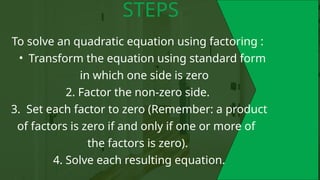
To solve an quadratic equation using factoring :
• Transform the equation using standard form
in which one side is zero
2. Factor the non-zero side.
3. Set each factor to zero (Remember: a product
of factors is zero if and only if one or more of
the factors is zero).
4. Solve each resulting equation.
STEPS
These are the examples of
factorization of quadratic
equation,so that you can
easily understand the
lesson well.
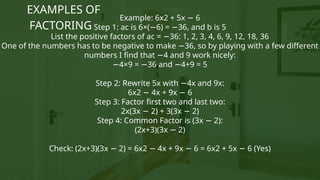
Example: 6x2 + 5x 6
−
Step 1: ac is 6×( 6) = 36, and b is 5
− −
List the positive factors of ac = 36: 1, 2, 3, 4, 6, 9, 12, 18, 36
−
One of the numbers has to be negative to make 36, so by playing with a few different
−
numbers I find that 4 and 9 work nicely:
−
−4×9 = 36 and 4+9 = 5
− −
Step 2: Rewrite 5x with 4x and 9x:
−
6x2 4x + 9x 6
− −
Step 3: Factor first two and last two:
2x(3x 2) + 3(3x 2)
− −
Step 4: Common Factor is (3x 2):
−
(2x+3)(3x 2)
−
Check: (2x+3)(3x 2) = 6x2 4x + 9x 6 = 6x2 + 5x 6 (Yes)
− − − −
EXAMPLES OF
FACTORING
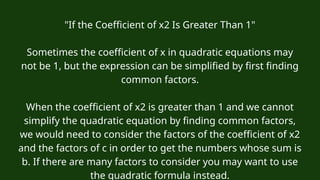
"If the Coefficient of x2 Is Greater Than 1"
Sometimes the coefficient of x in quadratic equations may
not be 1, but the expression can be simplified by first finding
common factors.
When the coefficient of x2 is greater than 1 and we cannot
simplify the quadratic equation by finding common factors,
we would need to consider the factors of the coefficient of x2
and the factors of c in order to get the numbers whose sum is
b. If there are many factors to consider you may want to use
the quadratic formula instead.
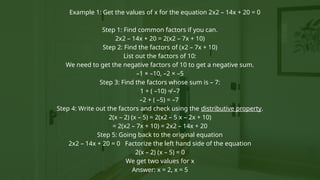
Example 1: Get the values of x for the equation 2x2 – 14x + 20 = 0
Step 1: Find common factors if you can.
2x2 – 14x + 20 = 2(x2 – 7x + 10)
Step 2: Find the factors of (x2 – 7x + 10)
List out the factors of 10:
We need to get the negative factors of 10 to get a negative sum.
–1 × –10, –2 × –5
Step 3: Find the factors whose sum is – 7:
1 + ( –10) ≠ –7
–2 + ( –5) = –7
Step 4: Write out the factors and check using the distributive property.
2(x – 2) (x – 5) = 2(x2 – 5 x – 2x + 10)
= 2(x2 – 7x + 10) = 2x2 – 14x + 20
Step 5: Going back to the original equation
2x2 – 14x + 20 = 0 Factorize the left hand side of the equation
2(x – 2) (x – 5) = 0
We get two values for x
Answer: x = 2, x = 5
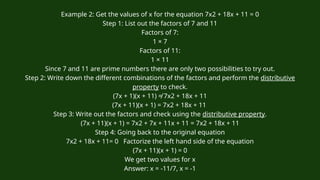
Example 2: Get the values of x for the equation 7x2 + 18x + 11 = 0
Step 1: List out the factors of 7 and 11
Factors of 7:
1 × 7
Factors of 11:
1 × 11
Since 7 and 11 are prime numbers there are only two possibilities to try out.
Step 2: Write down the different combinations of the factors and perform the distributive
property to check.
(7x + 1)(x + 11) ≠ 7x2 + 18x + 11
(7x + 11)(x + 1) = 7x2 + 18x + 11
Step 3: Write out the factors and check using the distributive property.
(7x + 11)(x + 1) = 7x2 + 7x + 11x + 11 = 7x2 + 18x + 11
Step 4: Going back to the original equation
7x2 + 18x + 11= 0 Factorize the left hand side of the equation
(7x + 11)(x + 1) = 0
We get two values for x
Answer: x = -11/7, x = -1
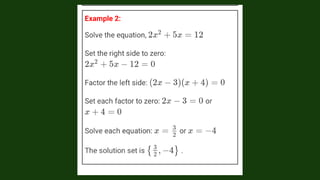
Question: Factorize x2 + 4x – 21 = 0 using quadratic formula.
Solution:
Given,
x2 + 4x – 21 = 0
Here, a = 1, b = 4, c = -21
b2 – 4ac = (4)2 – 4(1)(-21) = 16 + 84 = 100
Substituting these values in the quadratic formula, we get;
x = [-4 ± 100]/ 2(1)
√
= (-4 ± 10)/2
x = (-4 + 10)/2, x = (-4 – 10)/2
x = 6/2, x = -14/2
x = 3, x = -7
Therefore, the factors of the given quadratic equation are (x –
3) and (x + 7).
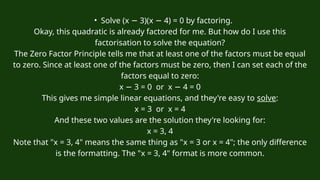
• Solve (x 3)(
− x 4) = 0 by factoring.
−
Okay, this quadratic is already factored for me. But how do I use this
factorisation to solve the equation?
The Zero Factor Principle tells me that at least one of the factors must be equal
to zero. Since at least one of the factors must be zero, then I can set each of the
factors equal to zero:
x 3 = 0 or
− x 4 = 0
−
This gives me simple linear equations, and they're easy to solve:
x = 3 or x = 4
And these two values are the solution they're looking for:
x = 3, 4
Note that "x = 3, 4" means the same thing as "x = 3 or x = 4"; the only difference
is the formatting. The "x = 3, 4" format is more common.
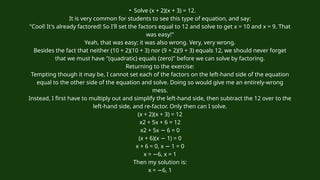
• Solve (x + 2)(x + 3) = 12.
It is very common for students to see this type of equation, and say:
"Cool! It's already factored! So I'll set the factors equal to 12 and solve to get x = 10 and x = 9. That
was easy!"
Yeah, that was easy; it was also wrong. Very, very wrong.
Besides the fact that neither (10 + 2)(10 + 3) nor (9 + 2)(9 + 3) equals 12, we should never forget
that we must have "(quadratic) equals (zero)" before we can solve by factoring.
Returning to the exercise:
Tempting though it may be, I cannot set each of the factors on the left-hand side of the equation
equal to the other side of the equation and solve. Doing so would give me an entirely-wrong
mess.
Instead, I first have to multiply out and simplify the left-hand side, then subtract the 12 over to the
left-hand side, and re-factor. Only then can I solve.
(x + 2)(x + 3) = 12
x2 + 5x + 6 = 12
x2 + 5x 6 = 0
−
(x + 6)(x 1) = 0
−
x + 6 = 0, x 1 = 0
−
x = 6, x = 1
−
Then my solution is:
x = 6, 1
−
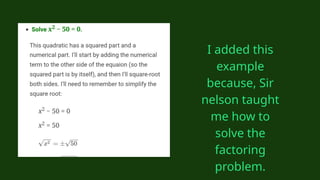
I added this
example
because, Sir
nelson taught
me how to
solve the
factoring
problem.
"The more
examples you
know,the more,
Appreciation Qoute.
THE CLIMAX .
Way of testing your knowledge of what you've
learned in this lesson.
We're going to the exiting part which is the
ASSESSMENT.
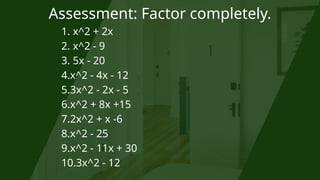
Assessment: Factor completely.
1. x^2 + 2x
2. x^2 - 9
3. 5x - 20
4.x^2 - 4x - 12
5.3x^2 - 2x - 5
6.x^2 + 8x +15
7.2x^2 + x -6
8.x^2 - 25
9.x^2 - 11x + 30
10.3x^2 - 12
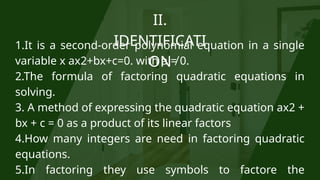
II.
IDENTIFICATI
ON
1.It is a second-order polynomial equation in a single
variable x ax2+bx+c=0. with a ≠ 0.
2.The formula of factoring quadratic equations in
solving.
3. A method of expressing the quadratic equation ax2 +
bx + c = 0 as a product of its linear factors
4.How many integers are need in factoring quadratic
equations.
5.In factoring they use symbols to factore the
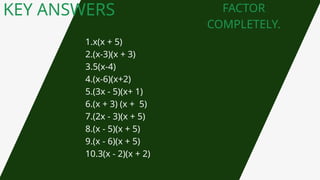
KEY ANSWERS FACTOR
COMPLETELY.
1.x(x + 5)
2.(x-3)(x + 3)
3.5(x-4)
4.(x-6)(x+2)
5.(3x - 5)(x+ 1)
6.(x + 3) (x + 5)
7.(2x - 3)(x + 5)
8.(x - 5)(x + 5)
9.(x - 6)(x + 5)
10.3(x - 2)(x + 2)
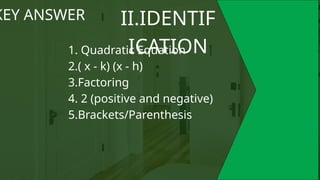
II.IDENTIF
ICATION
KEY ANSWER
1. Quadratic Equation
2.( x - k) (x - h)
3.Factoring
4. 2 (positive and negative)
5.Brackets/Parenthesis
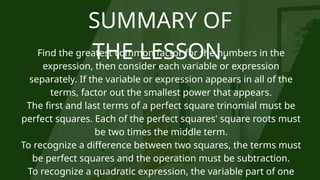
Find the greatest common factor for the numbers in the
expression, then consider each variable or expression
separately. If the variable or expression appears in all of the
terms, factor out the smallest power that appears.
The first and last terms of a perfect square trinomial must be
perfect squares. Each of the perfect squares' square roots must
be two times the middle term.
To recognize a difference between two squares, the terms must
be perfect squares and the operation must be subtraction.
To recognize a quadratic expression, the variable part of one
SUMMARY OF
THE LESSON.
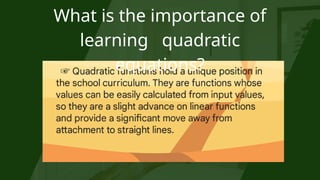
What is the importance of
learning quadratic
equations?
THANK
YOU
For viewing my powerpoint.
SCHOOL
+123-456-7890
www.reallygreatsite.com
P-2 Litapan Ozamiz City

performance in mathematics 9 title .pptx

  • 1.
    Performance Task MATHEMATICS STUDENT: NERIS,MITZ NOREJENZ TEACHER: NELSON R. TUMALA STE - IX NEWTON
  • 2.
  • 3.
    Mathematics (from Ancient Greekμάθημα; máthēma: 'knowledge, study, learning') is an area of knowledge that includes such topics as numbers (arithmetic and number theory), [2] formulas and related structures (algebra),[3] shapes and the spaces in which they are contained (geometry),[2] and quantities and their changes (calculus and analysis). FUN FACTS OF MATHEMATICS
  • 4.
    Adding the namespicture. Just add the names of illustration and state the answer. Exercise I : WORD PROBLEM +
  • 5.
    ANSWER THE ANSWER IS: FACTORING. EXPLANATION: FACTORY + RING = FACTORING
  • 6.
    Rise and Shine Students! Today,I'llbe discussing an interesting math lesson. MATHEMATICS
  • 7.
    MATHEMATICS Definition of QuadraticFunction Quadratic Equation Quadratic equations are second-degree algebraic expressions and are of the form ax2 + bx + c = 0. The word "Quadratic" is derived from the word "Quad" which means square. In other words, a quadratic equation is an “equation of degree 2.”
  • 8.
    What is factorisingquadratics? Factorising, or factoring quadratic equations is the opposite of expanding brackets and is used to solve quadratic equations.
  • 9.
    The Formula ofFactorizing Quadratic Equation. Factoring Quadratic Equations using Algebraic Identities a2 + 2ab + b2 = (a + b)2 = (a + b)(a + b) a2 – 2ab + b2 = (a – b)2 = (a – b)(a – b)
  • 10.
    To solve anquadratic equation using factoring : • Transform the equation using standard form in which one side is zero 2. Factor the non-zero side. 3. Set each factor to zero (Remember: a product of factors is zero if and only if one or more of the factors is zero). 4. Solve each resulting equation. STEPS
  • 11.
    These are theexamples of factorization of quadratic equation,so that you can easily understand the lesson well.
  • 12.
    Example: 6x2 +5x 6 − Step 1: ac is 6×( 6) = 36, and b is 5 − − List the positive factors of ac = 36: 1, 2, 3, 4, 6, 9, 12, 18, 36 − One of the numbers has to be negative to make 36, so by playing with a few different − numbers I find that 4 and 9 work nicely: − −4×9 = 36 and 4+9 = 5 − − Step 2: Rewrite 5x with 4x and 9x: − 6x2 4x + 9x 6 − − Step 3: Factor first two and last two: 2x(3x 2) + 3(3x 2) − − Step 4: Common Factor is (3x 2): − (2x+3)(3x 2) − Check: (2x+3)(3x 2) = 6x2 4x + 9x 6 = 6x2 + 5x 6 (Yes) − − − − EXAMPLES OF FACTORING
  • 15.
    "If the Coefficientof x2 Is Greater Than 1" Sometimes the coefficient of x in quadratic equations may not be 1, but the expression can be simplified by first finding common factors. When the coefficient of x2 is greater than 1 and we cannot simplify the quadratic equation by finding common factors, we would need to consider the factors of the coefficient of x2 and the factors of c in order to get the numbers whose sum is b. If there are many factors to consider you may want to use the quadratic formula instead.
  • 16.
    Example 1: Getthe values of x for the equation 2x2 – 14x + 20 = 0 Step 1: Find common factors if you can. 2x2 – 14x + 20 = 2(x2 – 7x + 10) Step 2: Find the factors of (x2 – 7x + 10) List out the factors of 10: We need to get the negative factors of 10 to get a negative sum. –1 × –10, –2 × –5 Step 3: Find the factors whose sum is – 7: 1 + ( –10) ≠ –7 –2 + ( –5) = –7 Step 4: Write out the factors and check using the distributive property. 2(x – 2) (x – 5) = 2(x2 – 5 x – 2x + 10) = 2(x2 – 7x + 10) = 2x2 – 14x + 20 Step 5: Going back to the original equation 2x2 – 14x + 20 = 0 Factorize the left hand side of the equation 2(x – 2) (x – 5) = 0 We get two values for x Answer: x = 2, x = 5
  • 17.
    Example 2: Getthe values of x for the equation 7x2 + 18x + 11 = 0 Step 1: List out the factors of 7 and 11 Factors of 7: 1 × 7 Factors of 11: 1 × 11 Since 7 and 11 are prime numbers there are only two possibilities to try out. Step 2: Write down the different combinations of the factors and perform the distributive property to check. (7x + 1)(x + 11) ≠ 7x2 + 18x + 11 (7x + 11)(x + 1) = 7x2 + 18x + 11 Step 3: Write out the factors and check using the distributive property. (7x + 11)(x + 1) = 7x2 + 7x + 11x + 11 = 7x2 + 18x + 11 Step 4: Going back to the original equation 7x2 + 18x + 11= 0 Factorize the left hand side of the equation (7x + 11)(x + 1) = 0 We get two values for x Answer: x = -11/7, x = -1
  • 18.
    Question: Factorize x2+ 4x – 21 = 0 using quadratic formula. Solution: Given, x2 + 4x – 21 = 0 Here, a = 1, b = 4, c = -21 b2 – 4ac = (4)2 – 4(1)(-21) = 16 + 84 = 100 Substituting these values in the quadratic formula, we get; x = [-4 ± 100]/ 2(1) √ = (-4 ± 10)/2 x = (-4 + 10)/2, x = (-4 – 10)/2 x = 6/2, x = -14/2 x = 3, x = -7 Therefore, the factors of the given quadratic equation are (x – 3) and (x + 7).
  • 19.
    • Solve (x3)( − x 4) = 0 by factoring. − Okay, this quadratic is already factored for me. But how do I use this factorisation to solve the equation? The Zero Factor Principle tells me that at least one of the factors must be equal to zero. Since at least one of the factors must be zero, then I can set each of the factors equal to zero: x 3 = 0 or − x 4 = 0 − This gives me simple linear equations, and they're easy to solve: x = 3 or x = 4 And these two values are the solution they're looking for: x = 3, 4 Note that "x = 3, 4" means the same thing as "x = 3 or x = 4"; the only difference is the formatting. The "x = 3, 4" format is more common.
  • 20.
    • Solve (x+ 2)(x + 3) = 12. It is very common for students to see this type of equation, and say: "Cool! It's already factored! So I'll set the factors equal to 12 and solve to get x = 10 and x = 9. That was easy!" Yeah, that was easy; it was also wrong. Very, very wrong. Besides the fact that neither (10 + 2)(10 + 3) nor (9 + 2)(9 + 3) equals 12, we should never forget that we must have "(quadratic) equals (zero)" before we can solve by factoring. Returning to the exercise: Tempting though it may be, I cannot set each of the factors on the left-hand side of the equation equal to the other side of the equation and solve. Doing so would give me an entirely-wrong mess. Instead, I first have to multiply out and simplify the left-hand side, then subtract the 12 over to the left-hand side, and re-factor. Only then can I solve. (x + 2)(x + 3) = 12 x2 + 5x + 6 = 12 x2 + 5x 6 = 0 − (x + 6)(x 1) = 0 − x + 6 = 0, x 1 = 0 − x = 6, x = 1 − Then my solution is: x = 6, 1 −
  • 21.
    I added this example because,Sir nelson taught me how to solve the factoring problem.
  • 22.
    "The more examples you know,themore, Appreciation Qoute.
  • 23.
    THE CLIMAX . Wayof testing your knowledge of what you've learned in this lesson. We're going to the exiting part which is the ASSESSMENT.
  • 24.
    Assessment: Factor completely. 1.x^2 + 2x 2. x^2 - 9 3. 5x - 20 4.x^2 - 4x - 12 5.3x^2 - 2x - 5 6.x^2 + 8x +15 7.2x^2 + x -6 8.x^2 - 25 9.x^2 - 11x + 30 10.3x^2 - 12
  • 25.
    II. IDENTIFICATI ON 1.It is asecond-order polynomial equation in a single variable x ax2+bx+c=0. with a ≠ 0. 2.The formula of factoring quadratic equations in solving. 3. A method of expressing the quadratic equation ax2 + bx + c = 0 as a product of its linear factors 4.How many integers are need in factoring quadratic equations. 5.In factoring they use symbols to factore the
  • 26.
    KEY ANSWERS FACTOR COMPLETELY. 1.x(x+ 5) 2.(x-3)(x + 3) 3.5(x-4) 4.(x-6)(x+2) 5.(3x - 5)(x+ 1) 6.(x + 3) (x + 5) 7.(2x - 3)(x + 5) 8.(x - 5)(x + 5) 9.(x - 6)(x + 5) 10.3(x - 2)(x + 2)
  • 27.
    II.IDENTIF ICATION KEY ANSWER 1. QuadraticEquation 2.( x - k) (x - h) 3.Factoring 4. 2 (positive and negative) 5.Brackets/Parenthesis
  • 28.
    Find the greatestcommon factor for the numbers in the expression, then consider each variable or expression separately. If the variable or expression appears in all of the terms, factor out the smallest power that appears. The first and last terms of a perfect square trinomial must be perfect squares. Each of the perfect squares' square roots must be two times the middle term. To recognize a difference between two squares, the terms must be perfect squares and the operation must be subtraction. To recognize a quadratic expression, the variable part of one SUMMARY OF THE LESSON.
  • 29.
    What is theimportance of learning quadratic equations?
  • 30.
    THANK YOU For viewing mypowerpoint. SCHOOL +123-456-7890 www.reallygreatsite.com P-2 Litapan Ozamiz City