October 4, 2012

Brackets and factors


  2. Factorising


                                 Next
Explanation               October 4, 2012

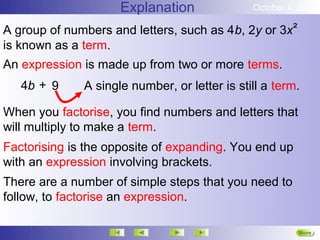
A group of numbers and letters, such as 4b, 2y or 3x²
is known as a term.
An expression is made up from two or more terms.
   4b + 9     A single number, or letter is still a term.

When you factorise, you find numbers and letters that
will multiply to make a term.
Factorising is the opposite of expanding. You end up
with an expression involving brackets.
There are a number of simple steps that you need to
follow, to factorise an expression.

                                                         More
                                                         Next
Example                October 4, 2012

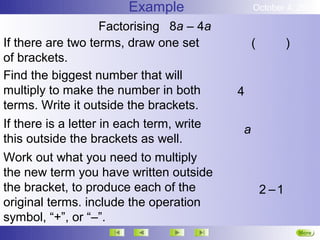
                     Factorising 8a – 4a
If there are two terms, draw one set           (          )
of brackets.
Find the biggest number that will
multiply to make the number in both        4
terms. Write it outside the brackets.
If there is a letter in each term, write   a
this outside the brackets as well.
Work out what you need to multiply
the new term you have written outside
the bracket, to produce each of the                2 –1
original terms. include the operation
symbol, “+”, or “–”.
                                                              More
                                                              Next
Example               October 4, 2012

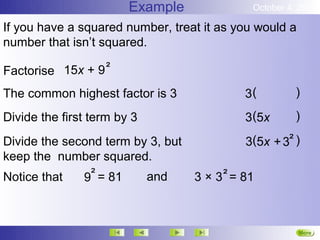
If you have a squared number, treat it as you would a
number that isn’t squared.

Factorise 15x + 9 ²
The common highest factor is 3               3(         )

Divide the first term by 3                   3(5x       )

Divide the second term by 3, but             3(5x + 3² )
keep the number squared.
Notice that   9² = 81    and       3 × 3 ² = 81


                                                        More
                                                        Next
Practise   October 4, 2012

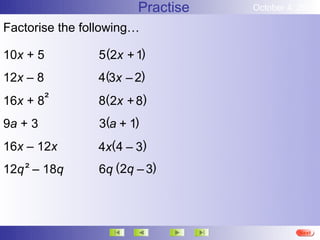
Factorise the following…

10x + 5         5 (2x + 1)
12x – 8         4(3x – 2)
16x + 8²        8(2x + 8)
9a + 3          3(a + 1)
16x – 12x       4x(4 – 3)
12q ² – 18q     6q (2q – 3)


                                             More
                                             Next
                                             End

Factorising

  • 1.
    October 4, 2012 Bracketsand factors 2. Factorising Next
  • 2.
    Explanation October 4, 2012 A group of numbers and letters, such as 4b, 2y or 3x² is known as a term. An expression is made up from two or more terms. 4b + 9 A single number, or letter is still a term. When you factorise, you find numbers and letters that will multiply to make a term. Factorising is the opposite of expanding. You end up with an expression involving brackets. There are a number of simple steps that you need to follow, to factorise an expression. More Next
  • 3.
    Example October 4, 2012 Factorising 8a – 4a If there are two terms, draw one set ( ) of brackets. Find the biggest number that will multiply to make the number in both 4 terms. Write it outside the brackets. If there is a letter in each term, write a this outside the brackets as well. Work out what you need to multiply the new term you have written outside the bracket, to produce each of the 2 –1 original terms. include the operation symbol, “+”, or “–”. More Next
  • 4.
    Example October 4, 2012 If you have a squared number, treat it as you would a number that isn’t squared. Factorise 15x + 9 ² The common highest factor is 3 3( ) Divide the first term by 3 3(5x ) Divide the second term by 3, but 3(5x + 3² ) keep the number squared. Notice that 9² = 81 and 3 × 3 ² = 81 More Next
  • 5.
    Practise October 4, 2012 Factorise the following… 10x + 5 5 (2x + 1) 12x – 8 4(3x – 2) 16x + 8² 8(2x + 8) 9a + 3 3(a + 1) 16x – 12x 4x(4 – 3) 12q ² – 18q 6q (2q – 3) More Next End