DEPARTMENT OF EDUCATION
Solving Word
Problems with
the Bar Model
Method
http://news.bbcimg.co.uk/media/images/
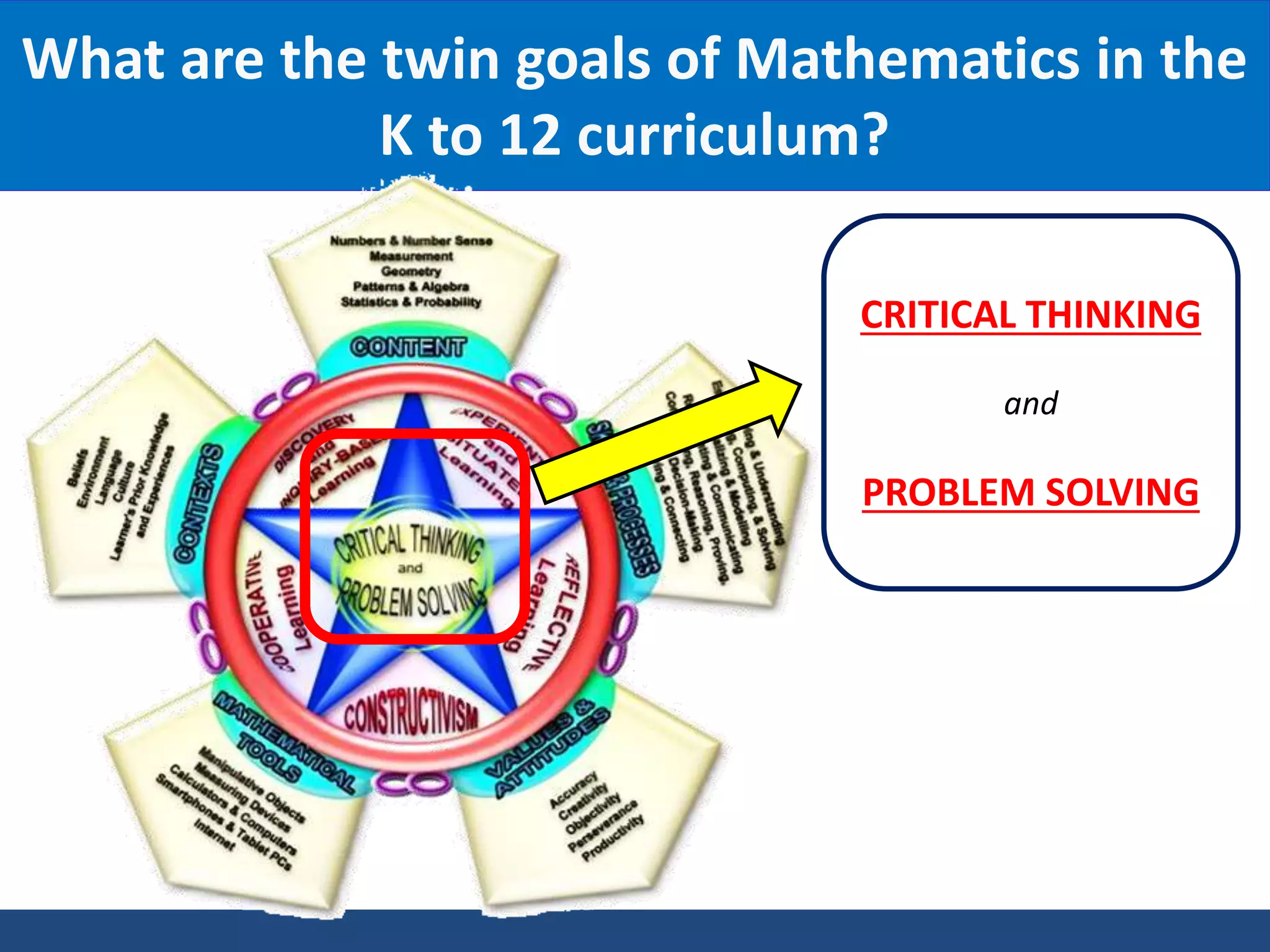
What are the twin goals of Mathematics in the
K to 12 curriculum?
CRITICAL THINKING
and
PROBLEM SOLVING
DEPARTMENT OF EDUCATION
Objectives
At the end of this session, you should be
able to:
 describe and elaborate the features
of the bar model method;
 explain the two main types of bar
models and their usage;
DEPARTMENT OF EDUCATION
Objectives
At the end of this session, you should be
able to:
 draw part-whole and comparison
models to represent quantities and
relationships given in word problems;
 apply bar modeling to solve word
problems involving whole numbers,
fractions, ratios and percent ;
DEPARTMENT OF EDUCATION
Activity 1: Let’s Try
Task :
•For 5 – 10 minutes, read and analyze each
problem assigned to your group. Solve each
one using bar models. Show your complete
and neat solution (manila paper).
•Present your output (maximum of 5 minutes
only).
DEPARTMENT OF EDUCATION
Assigned Word Problems
• Group 1 – No. 1 and No.2
• Group 2 – No. 2 and No. 3
• Group 3 – No. 3 and No. 4
• Group 4 – No. 4 and No. 5
• Group 5 – No. 5 and No. 6
• Group 6 – No. 7 and No. 8
DEPARTMENT OF EDUCATION
Activity 1: Let’s Try
1. At a mall, Laura spent ₱988. This is 4
times as much money Michelle spent at
the same mall. How much did they spend
altogether?
DEPARTMENT OF EDUCATION
Activity 1: Let’s Try
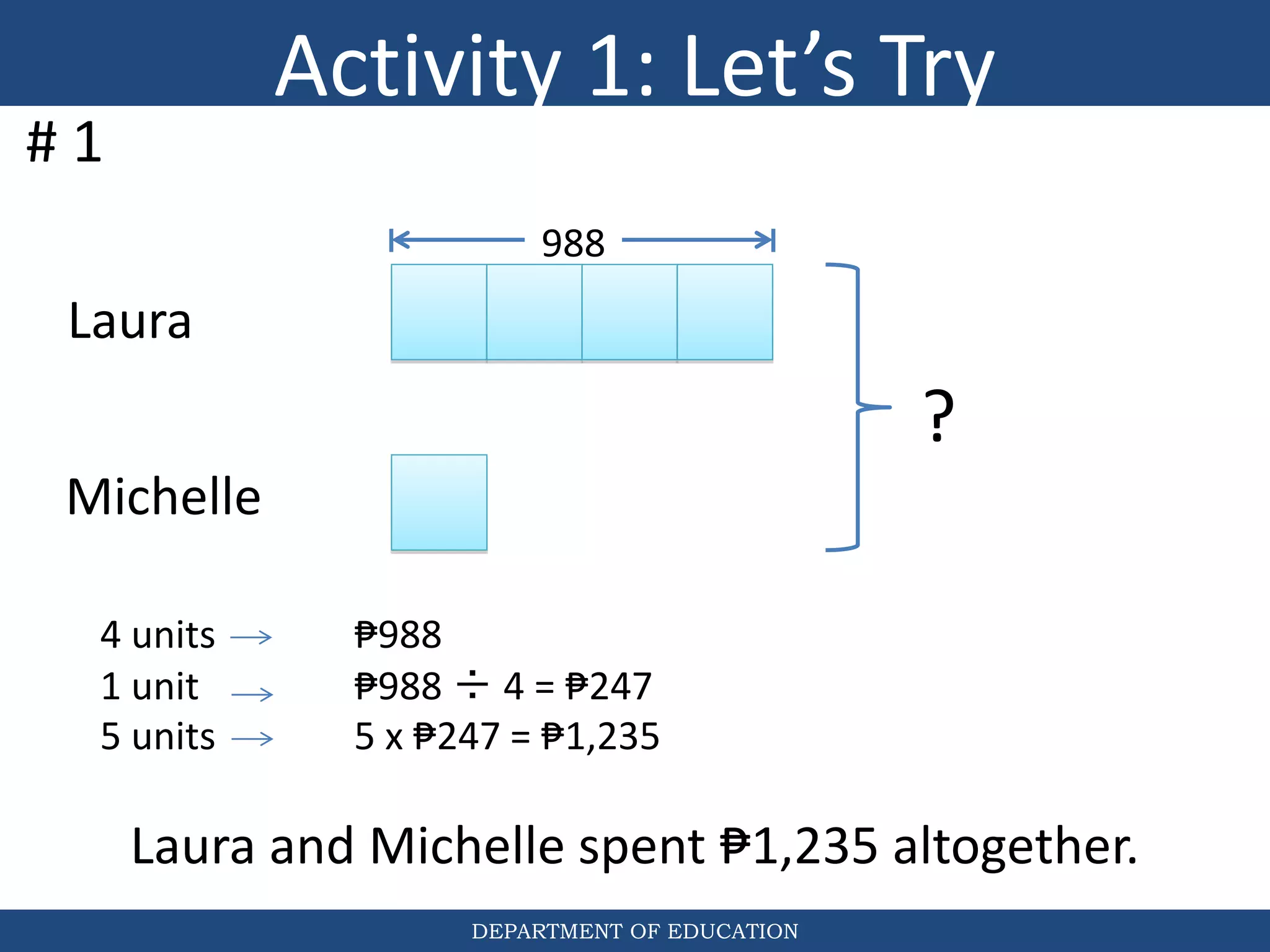
# 1
Laura
Michelle
988
?
Laura and Michelle spent ₱1,235 altogether.
4 units ₱988
1 unit ₱988 ÷ 4 = ₱247
5 units 5 x ₱247 = ₱1,235
DEPARTMENT OF EDUCATION
Activity 1: Let’s Try
2. Ian started saving some money on
Monday. Each day he saved ₱20 more
than the day before. By Friday of the same
week Ian had saved ₱350. Find the
amount Ian saved on Wednesday.
DEPARTMENT OF EDUCATION
# 2
Monday
₱350
Tuesday
Wednesday
Thursday
Friday
Php
20
Ian saved ₱70 on Wednesday.
Php
20
Php
20
Php
20
Php
20
Php
20
Php
20
Php
20
Php
20
Php
20
10 x ₱20 = ₱200
₱350 – ₱200 = ₱150
5 units ₱150
1 unit ₱150 ÷ 5 = ₱30
Wednesday:
₱30 + ₱20 + ₱20 = ₱70
DEPARTMENT OF EDUCATION
Activity 1: Let’s Try
3. Three-fifths of a group of children
were girls. If there were 24 girls, how
many children were there in the
group?
DEPARTMENT OF EDUCATION
Activity 1: Let’s Try
?
24 girls
There were 40 children in the group.
3 units 24
1 unit 24 ÷ 3 = 8
5 units 5 x 8 = 40
DEPARTMENT OF EDUCATION
Activity 1: Let’s Try
DEPARTMENT OF EDUCATION
Activity 1: Let’s Try
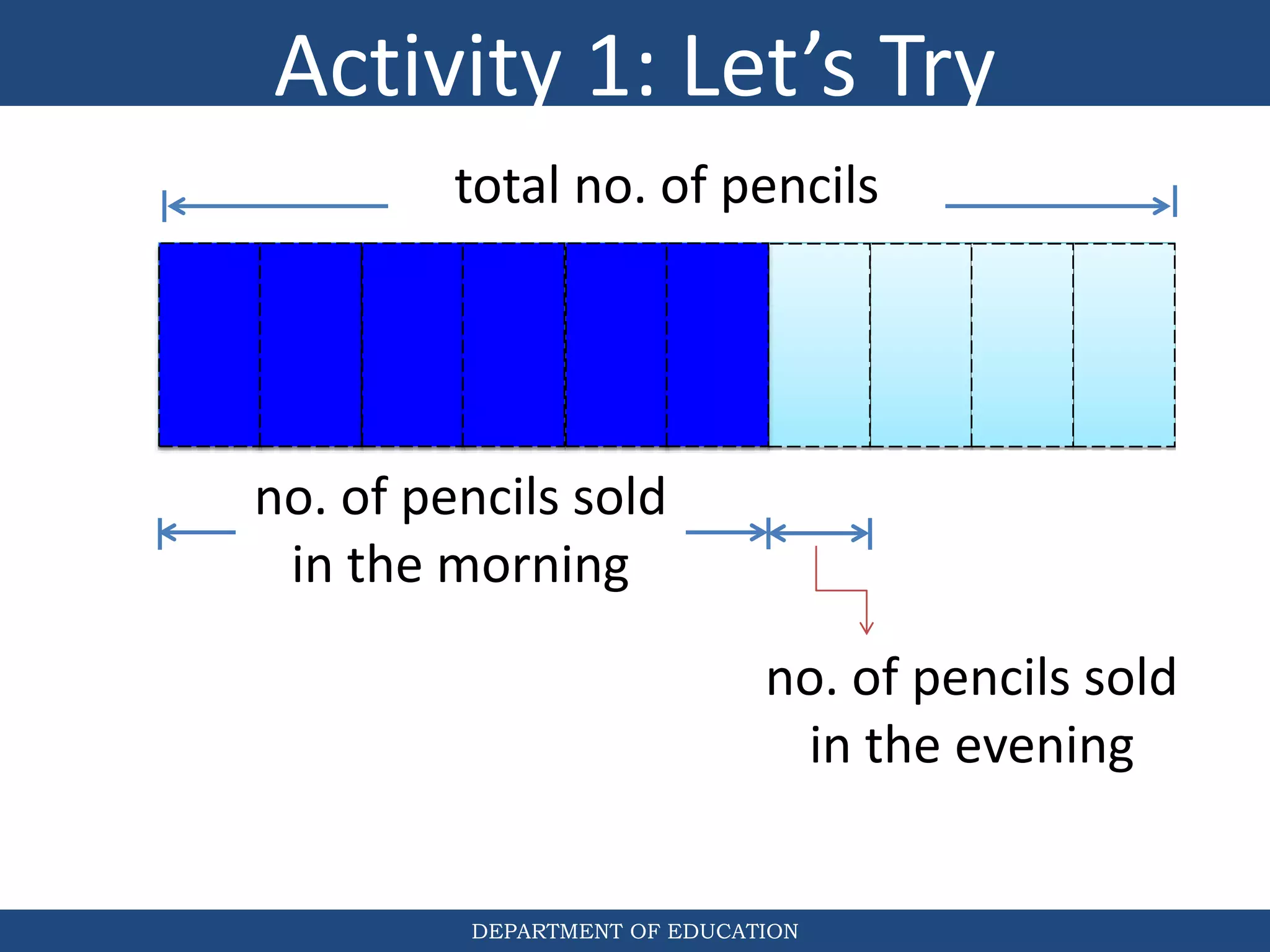
total no. of pencils
no. of pencils sold
in the morning
no. of pencils sold
in the evening
DEPARTMENT OF EDUCATION
Activity 1: Let’s Try
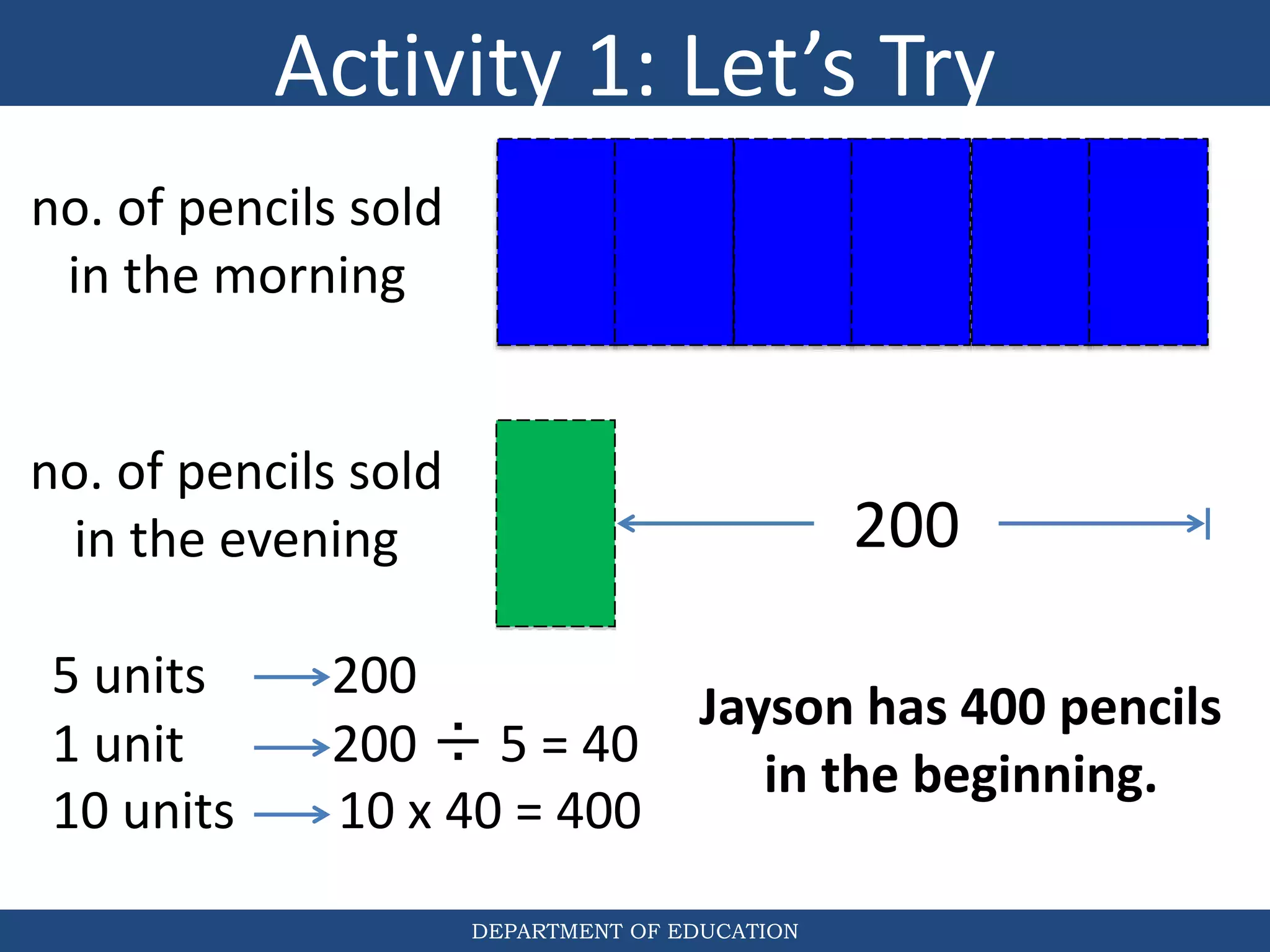
200
no. of pencils sold
in the morning
no. of pencils sold
in the evening
Jayson has 400 pencils
in the beginning.
5 units 200
1 unit 200 ÷ 5 = 40
10 units 10 x 40 = 400
DEPARTMENT OF EDUCATION
Activity 1: Let’s Try
5. On Monday, the ratio of the number
of beads Anna had to the number of
beads Wilma had was 4:7. On
Tuesday, after Wilma gave 36 beads to
Anna, they both had the same
number of beads. How many beads
did Anna have on Monday?
DEPARTMENT OF EDUCATION
Activity 1: Let’s Try
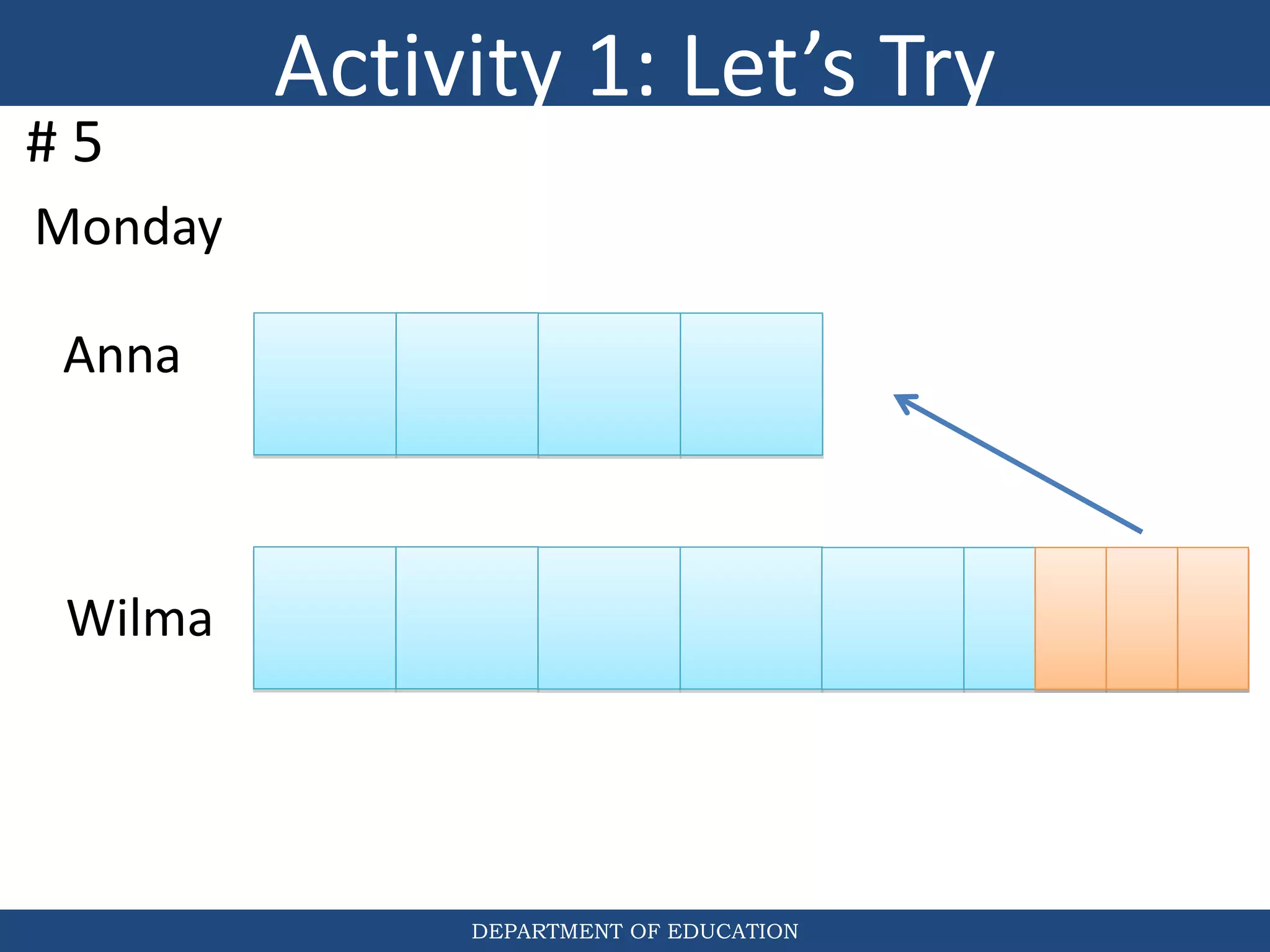
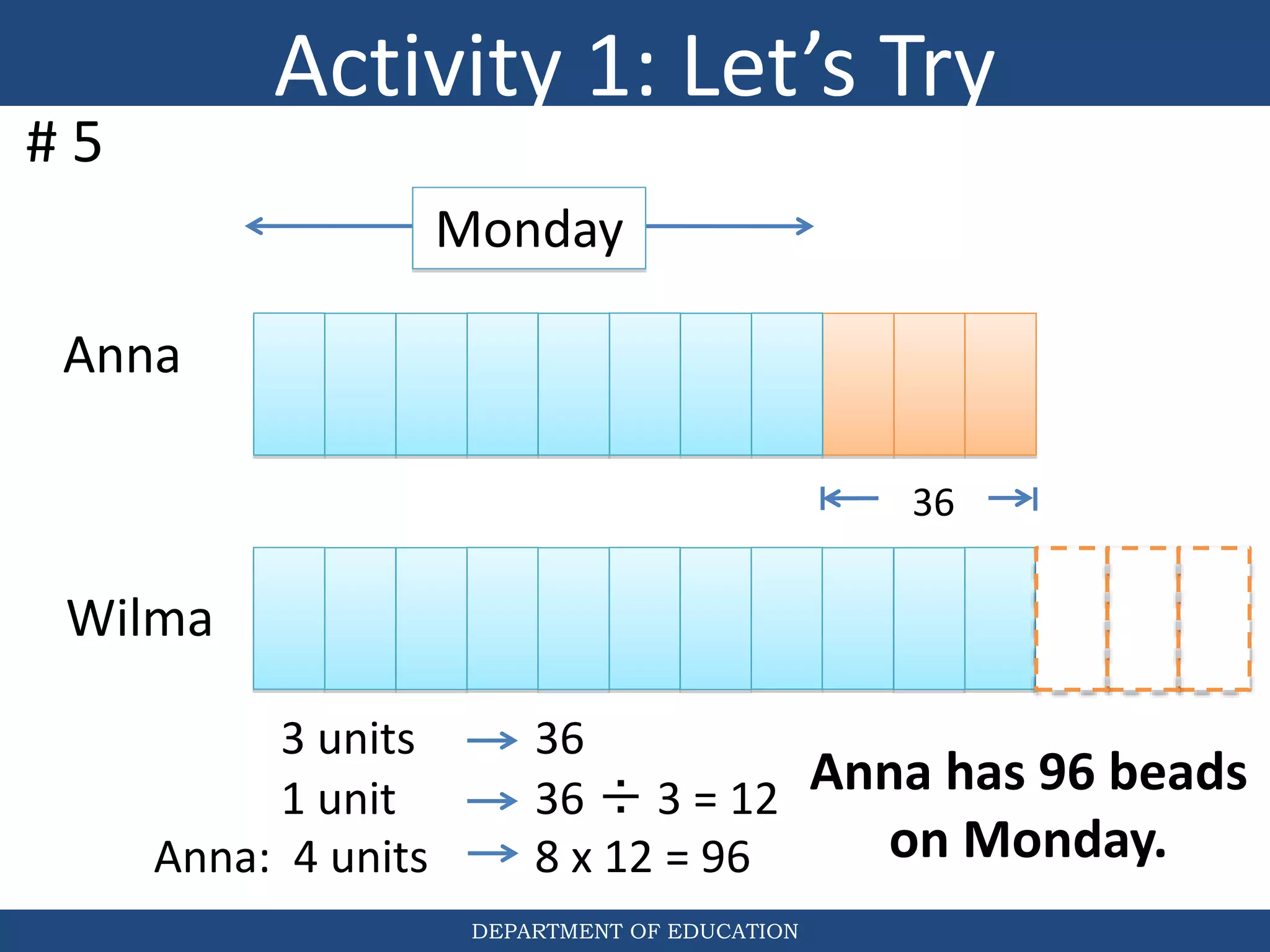
# 5
Monday
Anna
Wilma
DEPARTMENT OF EDUCATION
Activity 1: Let’s Try
# 5
Monday
Anna
Wilma
DEPARTMENT OF EDUCATION
Activity 1: Let’s Try
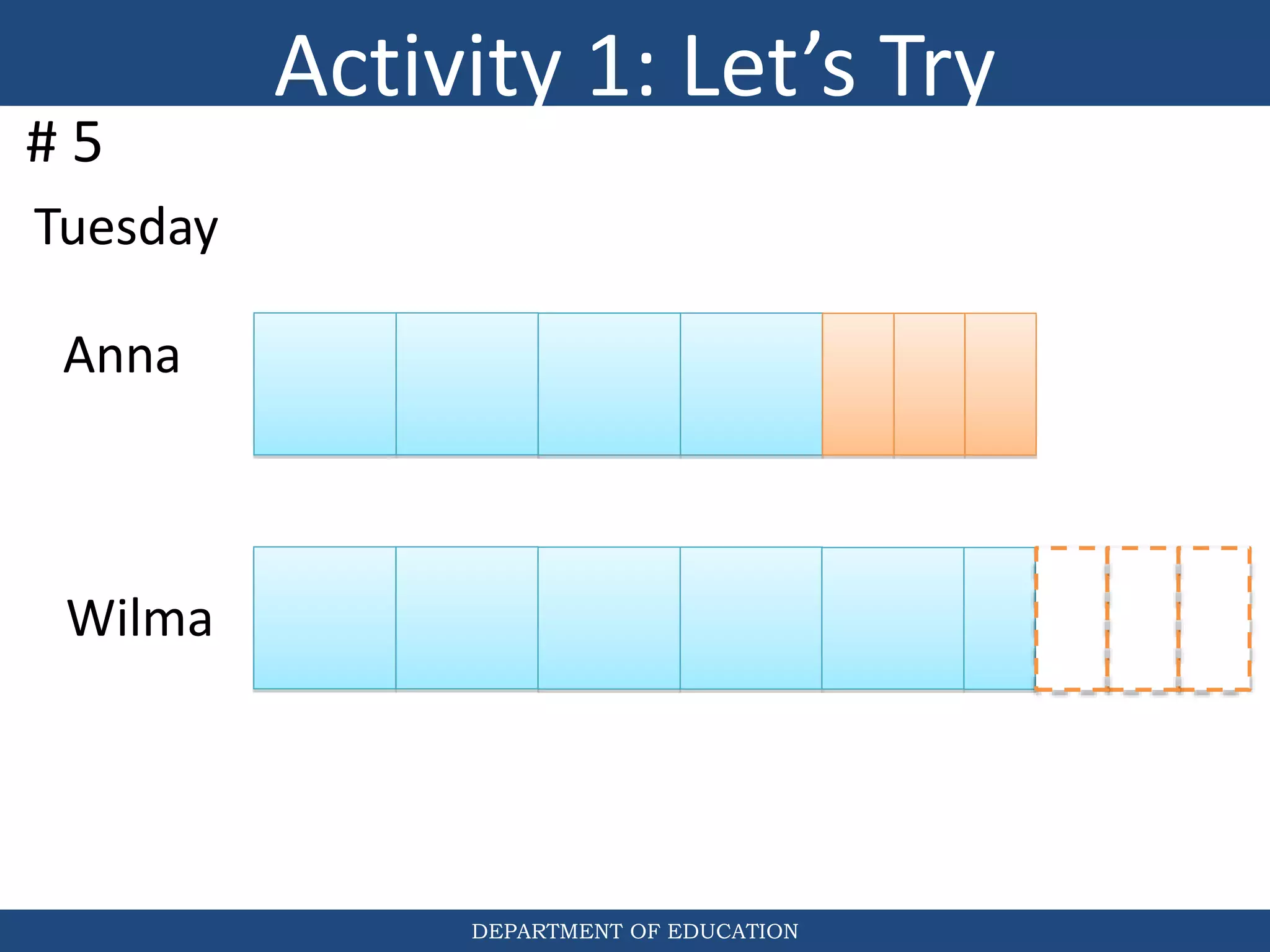
# 5
Tuesday
Anna
Wilma
DEPARTMENT OF EDUCATION
Activity 1: Let’s Try
# 5
Anna
Wilma
36
Anna has 96 beads
on Monday.
Monday
3 units 36
1 unit 36 ÷ 3 = 12
Anna: 4 units 8 x 12 = 96
DEPARTMENT OF EDUCATION
Activity 1: Let’s Try
6. A profit of ₱4 500 is to be divided
among three friends, A, B and C, in
the ratio of 3:4:5. Find the share of
each friend.
DEPARTMENT OF EDUCATION
Activity 1: Let’s Try
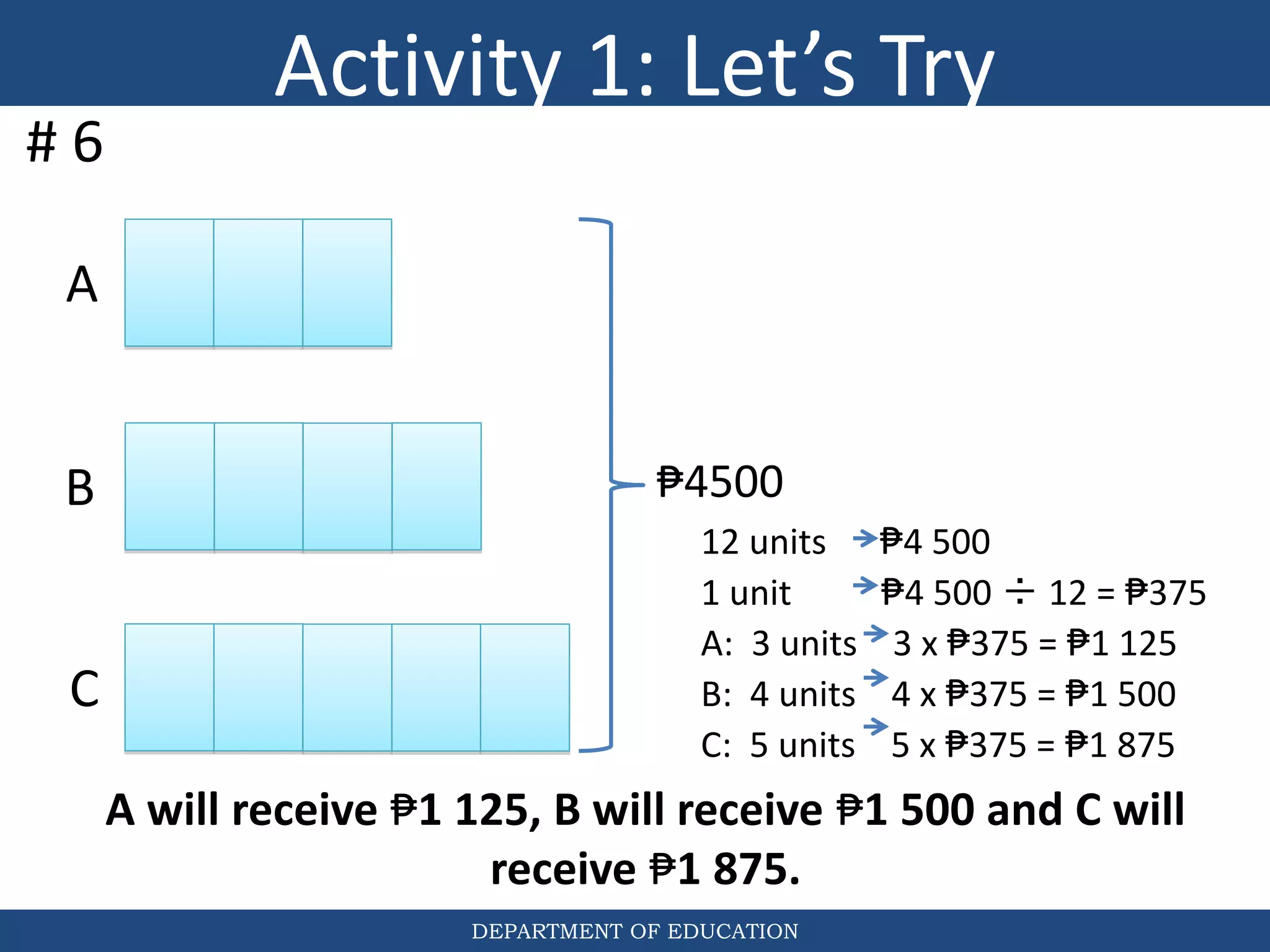
# 6
A
C
B ₱4500
12 units ₱4 500
1 unit ₱4 500 ÷ 12 = ₱375
A: 3 units 3 x ₱375 = ₱1 125
B: 4 units 4 x ₱375 = ₱1 500
C: 5 units 5 x ₱375 = ₱1 875
A will receive ₱1 125, B will receive ₱1 500 and C will
receive ₱1 875.
DEPARTMENT OF EDUCATION
Activity 1: Let’s Try
7.Mr. Palattao bought a guitar for
₱6,400. After using it several
months, he sold it for 25% less than
the amount he paid for it. How
much did Mr. Palattao receive for his
guitar?
DEPARTMENT OF EDUCATION
Activity 1: Let’s Try
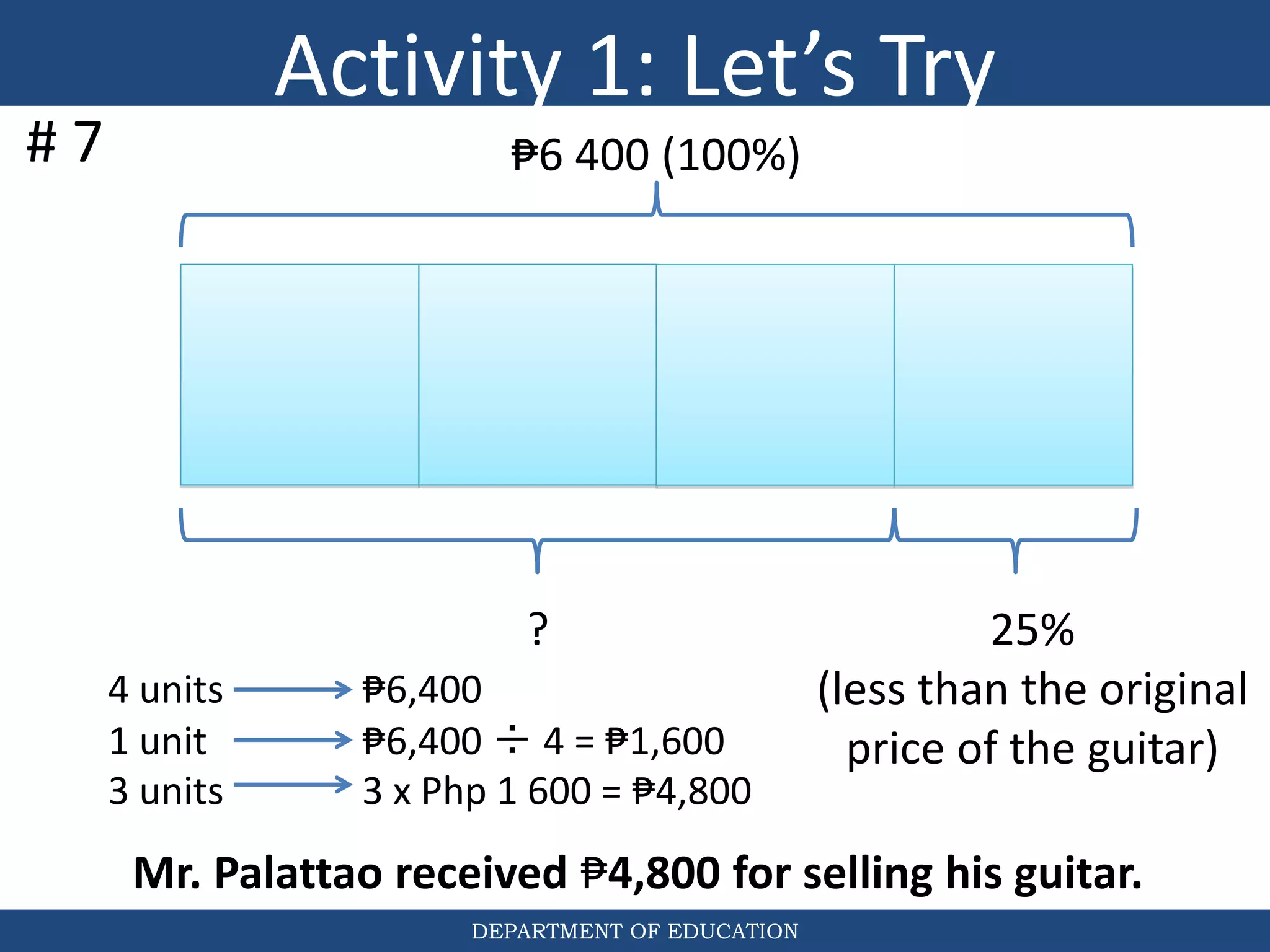
# 7 ₱6 400 (100%)
? 25%
(less than the original
price of the guitar)
4 units ₱6,400
1 unit ₱6,400 ÷ 4 = ₱1,600
3 units 3 x Php 1 600 = ₱4,800
Mr. Palattao received ₱4,800 for selling his guitar.
DEPARTMENT OF EDUCATION
Activity 1: Let’s Try
8. Michelle had 65 more yellow ribbons
than red ribbons. After giving away 30
ribbons of each color, the number of
red ribbons became 50% of the
number of yellow ribbons. Find the
total number of ribbons Michelle had
left.
DEPARTMENT OF EDUCATION
Activity 1: Let’s Try
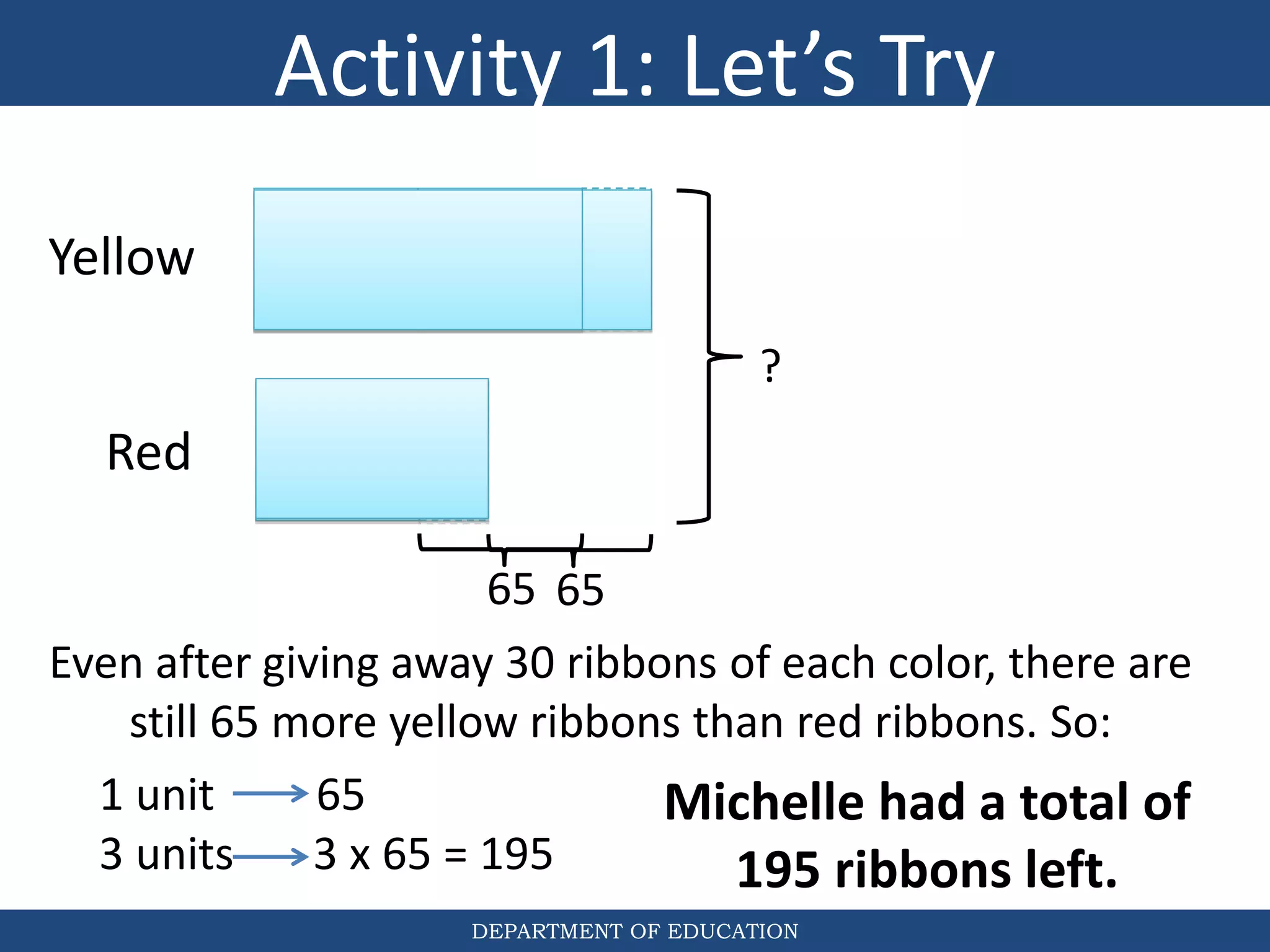
Yellow
Red
30
65
Even after giving away 30 ribbons of each color, there are
still 65 more yellow ribbons than red ribbons. So:
1 unit 65
3 units 3 x 65 = 195
30
65
?
Michelle had a total of
195 ribbons left.
DEPARTMENT OF EDUCATION
1. Who among you are already familiar with bar
models prior to this session? Any first-timers?
2. What were your thoughts while doing the
activity?
3. Did you attempt to use other strategies to solve
the problems? Why?
4. Which of the questions did you find easy to
answer? Which ones were not? Why?
5. Did you notice any similarities and/or differences
in your solutions?
DEPARTMENT OF EDUCATION
Bar Model Method
A problem-solving heuristic
that enables pupils to
understand, visualize and
represent mathematical word
problems and their solution
The Model Method
Part-Whole Model
Comparison Model
Examples
DEPARTMENT OF EDUCATION
Bar Model Method
•was introduced in Singapore
in the 1980’s
•to address low achievement
in basic numeracy skills and
difficulties in solving word
problems
The Model Method
Part-Whole Model
Comparison Model
Examples
DEPARTMENT OF EDUCATION
Learners use rectangular bars
to illustrate how the known
and unknown quantities in a
word problem are related.
The Model Method
Part-Whole Model
Comparison Model
Examples
Bar Model Method
DEPARTMENT OF EDUCATION
Bar Model Method
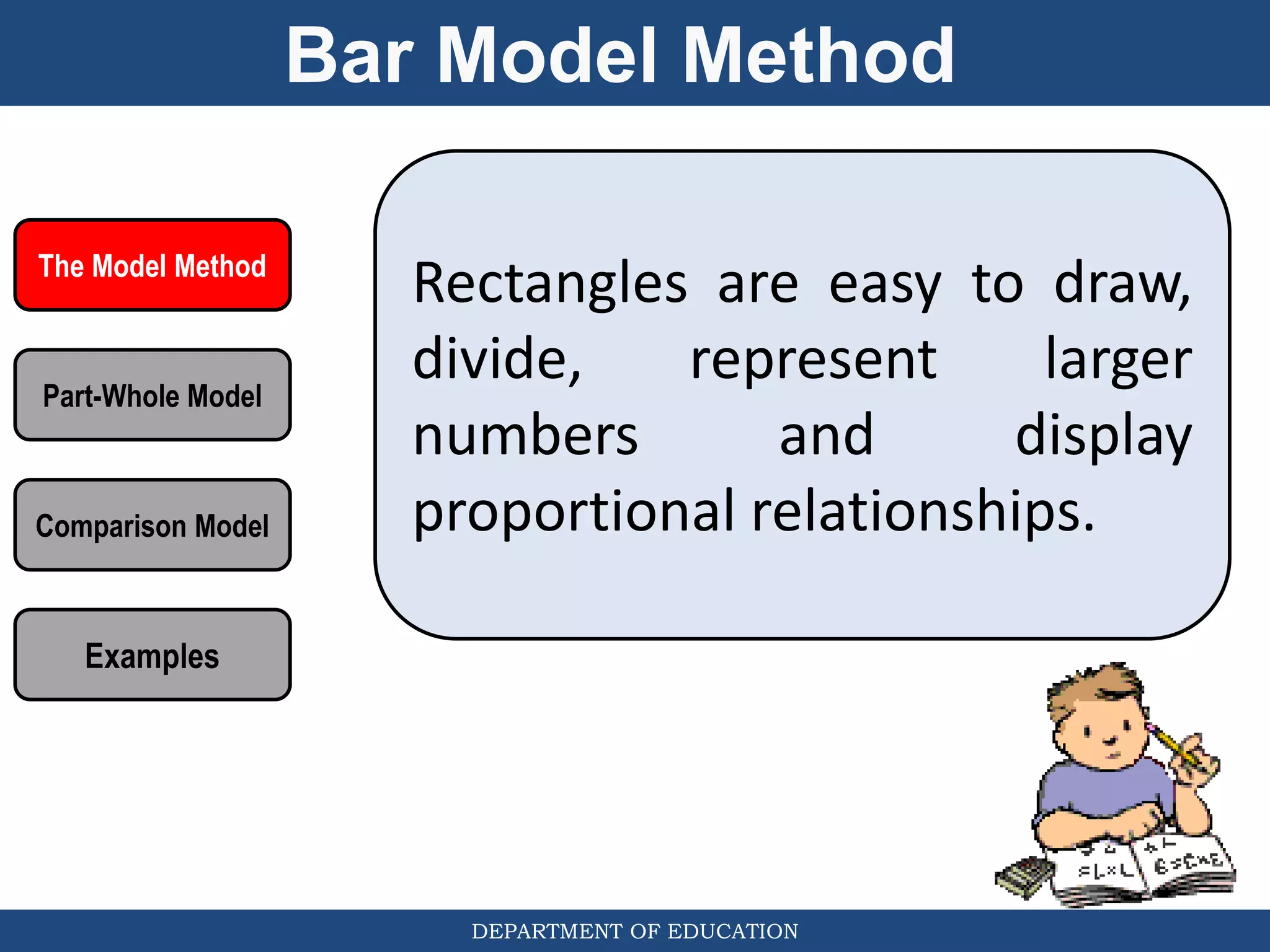
Rectangles are easy to draw,
divide, represent larger
numbers and display
proportional relationships.
The Model Method
Part-Whole Model
Comparison Model
Examples
DEPARTMENT OF EDUCATION
Bar Model Method
 CPA teaching approach
Concrete – Pictorial – Abstract
The Model Method
Part-Whole Model
Comparison Model
Examples
 Aligned with Bruner’s enactive,
iconic and symbolic modes of
representing ideas
DEPARTMENT OF EDUCATION
Part – Whole Model
The Model Method
Part-Whole Model
Comparison Model
Examples
Shows a quantitative relationship
between a whole and the other
parts
DEPARTMENT OF EDUCATION
Part - Whole Model
The Model Method
Part-Whole Model
Comparison Model
Examples
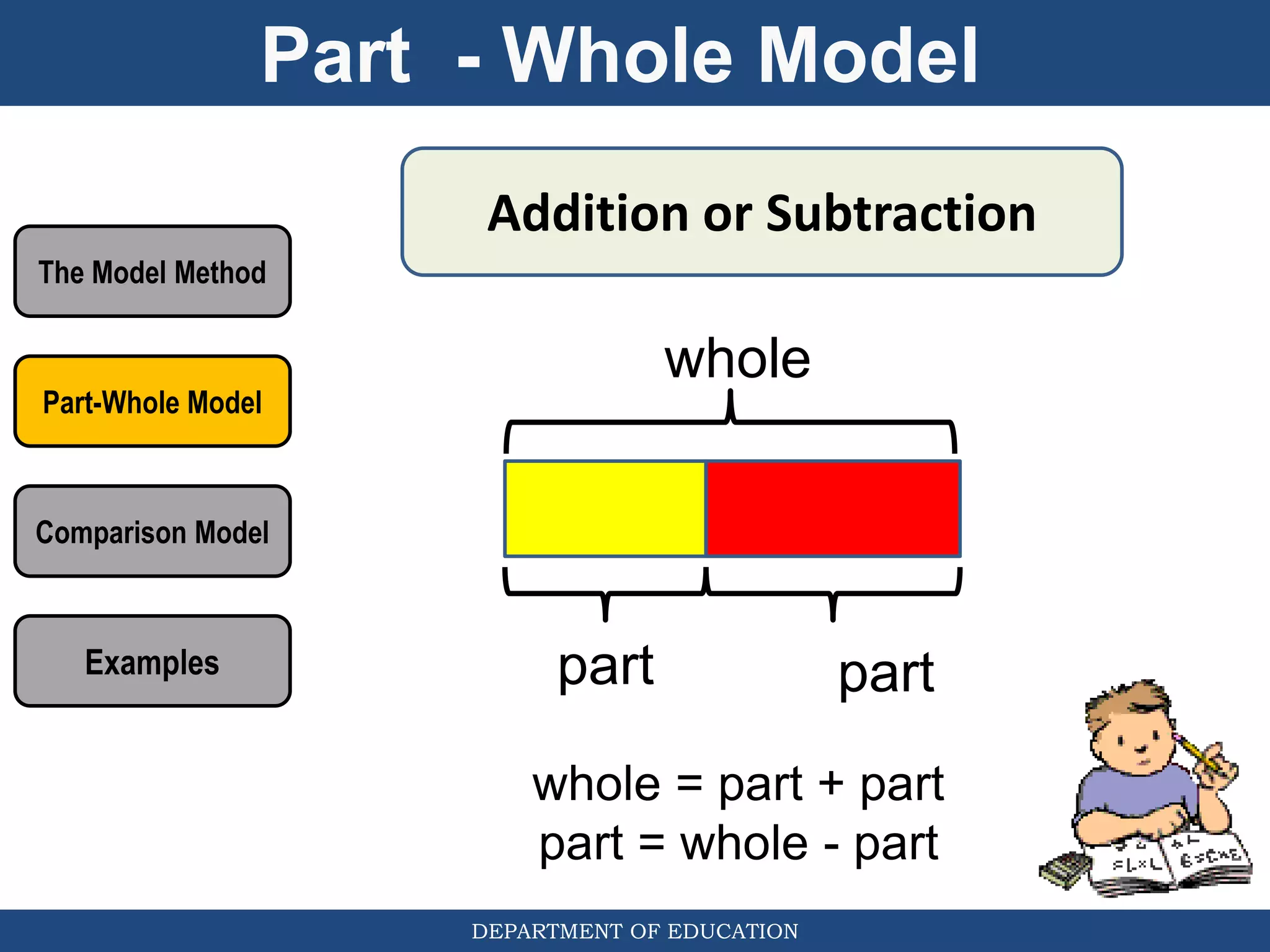
Addition or Subtraction
part part
whole
whole = part + part
part = whole - part
DEPARTMENT OF EDUCATION
Part - Whole Model
The Model Method
Part-Whole Model
Comparison Model
Examples
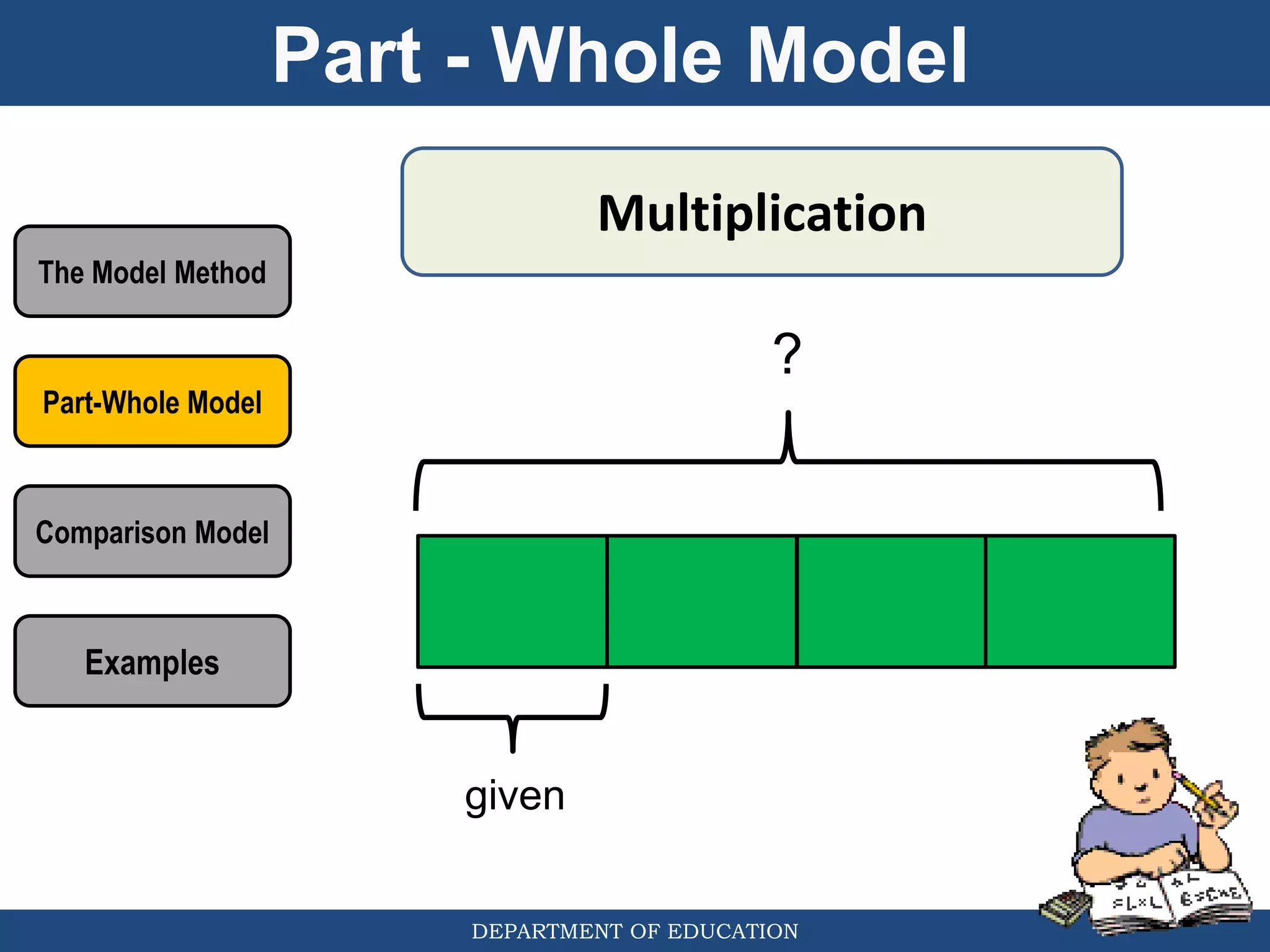
?
given
Multiplication
DEPARTMENT OF EDUCATION
Part - Whole Model
The Model Method
Part-Whole Model
Comparison Model
Examples
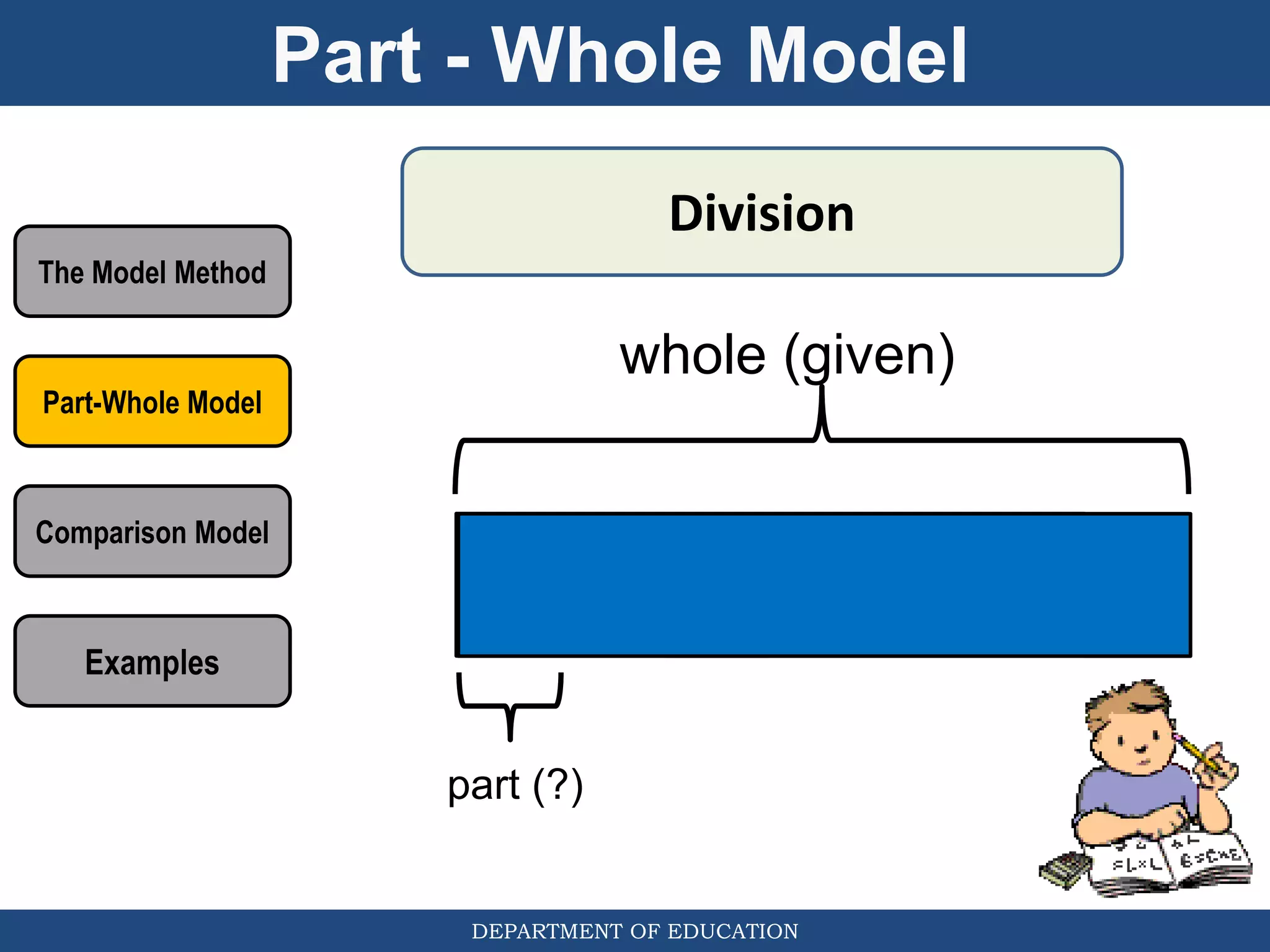
whole (given)
part (?)
Division
DEPARTMENT OF EDUCATION
Part - Whole Model
The Model Method
Part-Whole Model
Comparison Model
Examples
Three-fifths of a group of children
were girls. If there were 24 girls,
how many children were there in
the group?
DEPARTMENT OF EDUCATION
Part - Whole Model
The Model Method
Part-Whole Model
Comparison Model
Examples
Mr. Palattao bought a guitar for
₱6400. After using it several
months, he sold it for 25% less than
the amount he paid for it. How
much did Mr. Palattao receive for
his guitar?
DEPARTMENT OF EDUCATION
Comparison Model
The Model Method
Part-Whole Model
Comparison Model
Examples
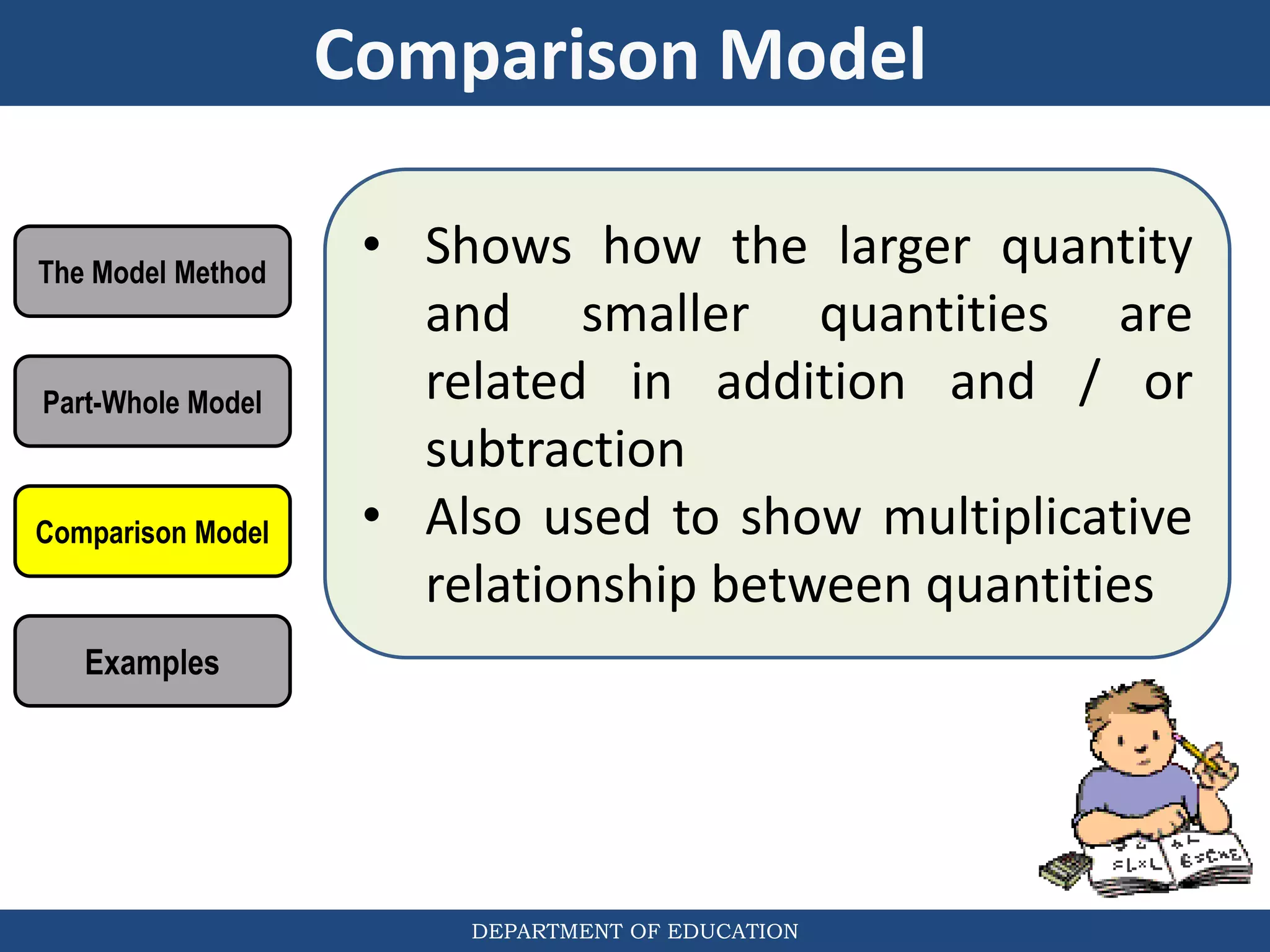
• Shows how the larger quantity
and smaller quantities are
related in addition and / or
subtraction
• Also used to show multiplicative
relationship between quantities
DEPARTMENT OF EDUCATION
Comparison Model
The Model Method
Part-Whole Model
Comparison Model
Examples
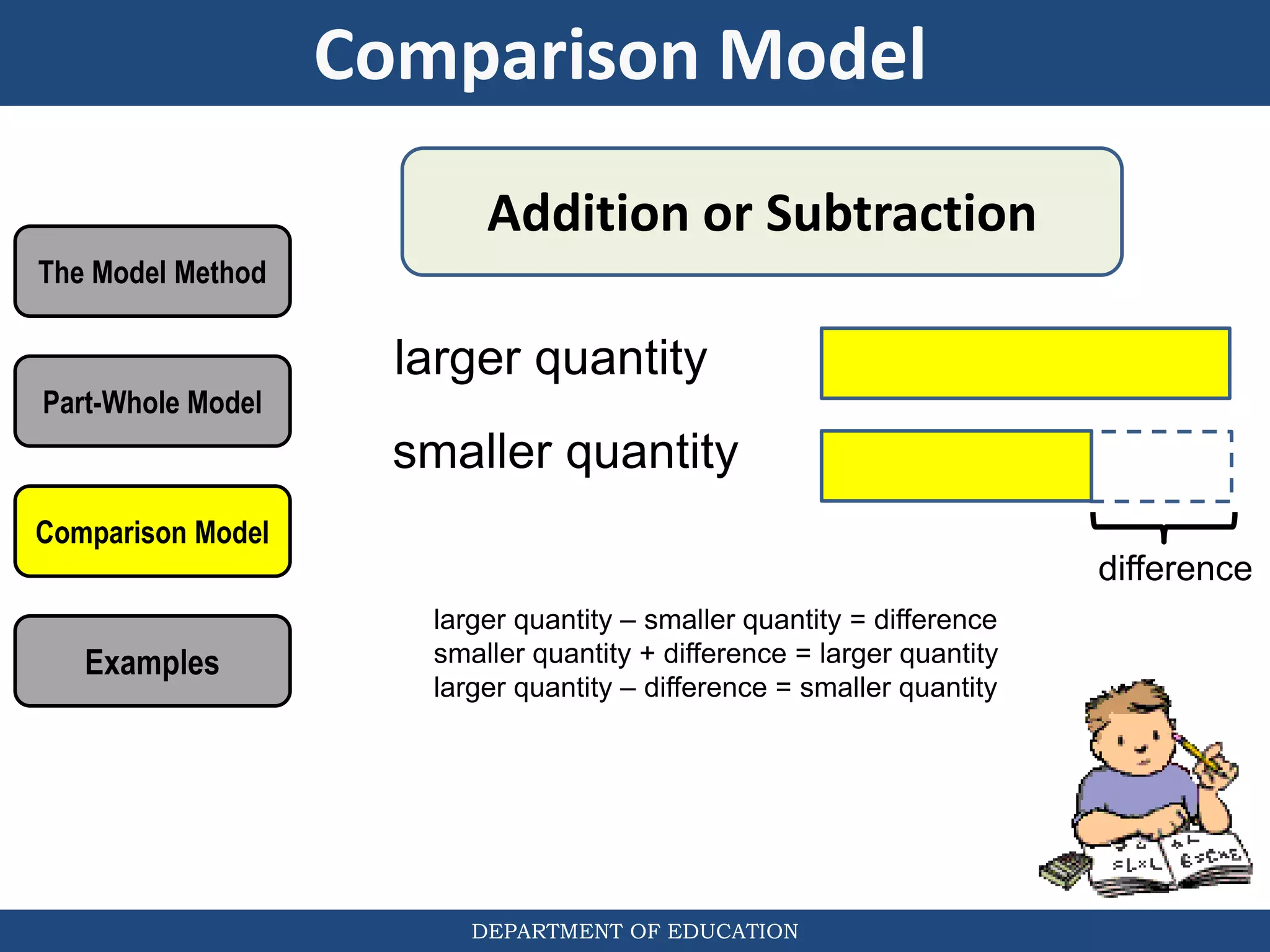
larger quantity
smaller quantity
difference
larger quantity – smaller quantity = difference
smaller quantity + difference = larger quantity
larger quantity – difference = smaller quantity
Addition or Subtraction
DEPARTMENT OF EDUCATION
Comparison Model
The Model Method
Part-Whole Model
Comparison Model
Examples
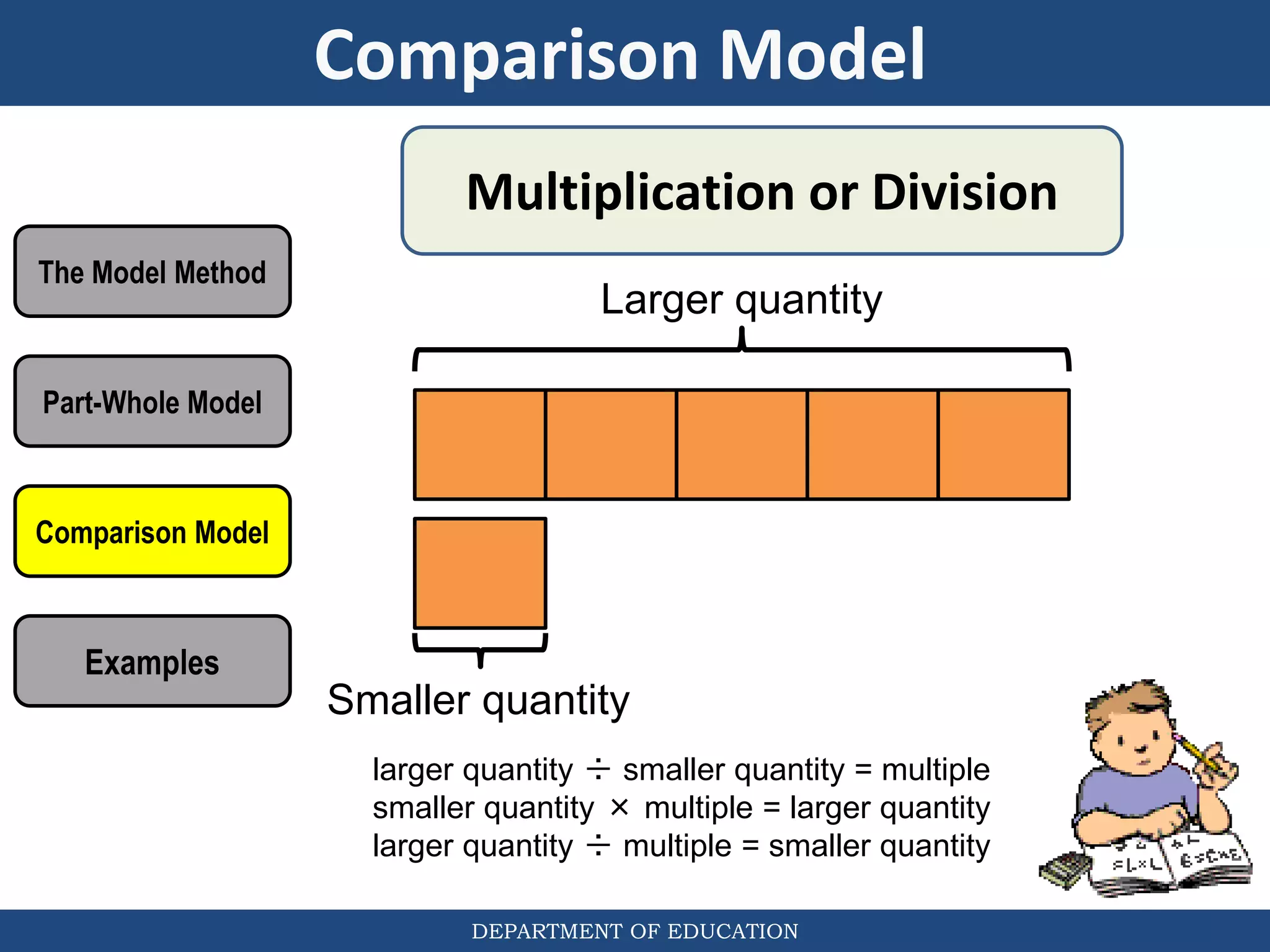
larger quantity ÷ smaller quantity = multiple
smaller quantity × multiple = larger quantity
larger quantity ÷ multiple = smaller quantity
Larger quantity
Smaller quantity
Multiplication or Division
DEPARTMENT OF EDUCATION
Comparison Model
The Model Method
Part-Whole Model
Comparison Model
Examples
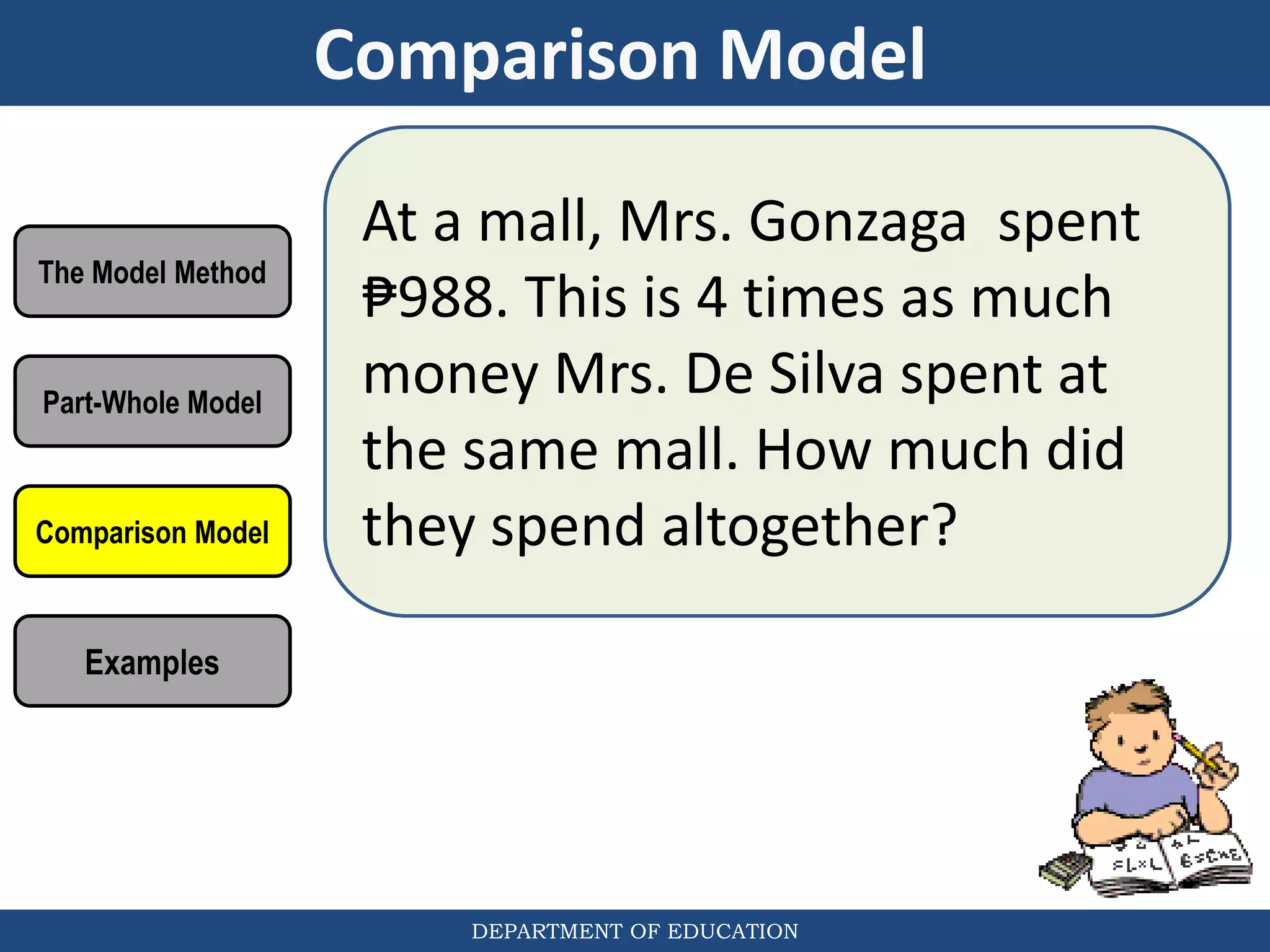
At a mall, Mrs. Gonzaga spent
₱988. This is 4 times as much
money Mrs. De Silva spent at
the same mall. How much did
they spend altogether?
DEPARTMENT OF EDUCATION
Comparison Model
The Model Method
Part-Whole Model
Comparison Model
Examples
Ian started saving some money on
Monday. Each day he saved ₱20
more than the day before. By Friday
of the same week Ian had saved
₱350. Find the amount Chris saved
on Wednesday.
DEPARTMENT OF EDUCATION
Comparison Model
The Model Method
Part-Whole Model
Comparison Model
Examples
Jayson is selling pencils. He sold of
them in the morning and of the
remainder in the afternoon. If
Jayson sold 200 more pencils in the
morning than in the afternoon, how
many pencils did Jayson have in the
beginning?
DEPARTMENT OF EDUCATION
Comparison Model
The Model Method
Part-Whole Model
Comparison Model
Examples
A profit of ₱4,500 is to be divided
among 3 persons, A, B, and C in the
ratio of 3:4:5. Find the share of each
person.
DEPARTMENT OF EDUCATION
Comparison Model
The Model Method
Part-Whole Model
Comparison Model
Examples
On Monday, the ratio of the
number of beads Anna had to the
number of beads Wilma had was
4:7. On Tuesday, after Wilma gave
36 beads to Anna, they both had
the same number of beads. How
many beads did Anna have on
Monday?
DEPARTMENT OF EDUCATION
Comparison Model
The Model Method
Part-Whole Model
Comparison Model
Examples
Michelle had 65 more yellow
ribbons than red ribbons. After
giving away 30 ribbons of each
color, the number of red ribbons
became 50% of the number of
yellow ribbons. Find the total
number of ribbons Michelle had
left.
DEPARTMENT OF EDUCATION
Examples
The Model Method
Part-Whole Model
Comparison Model
Examples
Sam and Jane have stamps in the
ratio of 7: 8. Jane gives Sam 200 of
his stamps, so that the new ratio of
Sam to Jane is now 11: 4. How many
stamps are there together?
DEPARTMENT OF EDUCATION
Examples
The Model Method
Part-Whole Model
Comparison Model
Examples
A, B, C and D earned the same
amount of money every month. A
spent three times as much as B. D
spent twice as much as C. B saved
twice as much as A. C saved three
times as much as D. Find the ratio of
B's savings to D's savings.
DEPARTMENT OF EDUCATION
Activity 2: Let’s Apply
Task :
• For 10 - 15 minutes, read and analyze each
problem assigned to your group. Solve
each one using bar models. Show your
complete and neat solution (manila
paper).
• Present your output (maximum of 5
minutes only).
DEPARTMENT OF EDUCATION
Activity 2: Let’s Apply
Whole numbers - #1 and #3
Fractions - #1 and #5
Ratio and Proportion - #2 and #4
Percents - #2 and #4
DEPARTMENT OF EDUCATION
Activity 2: Let’s Apply
1. Two numbers have a sum of
64. One of the numbers is 12
less than the other number.
Find the two numbers.
DEPARTMENT OF EDUCATION
# 1
First Number
Second Number
64 + 12 = 76
2 units 76
1 units 76 ÷ 2 = 38
First number: 38
Second number: 38 – 12 = 26
64
12
The first number
is 38, while the
second is 26.
Activity 2: Let’s Apply
DEPARTMENT OF EDUCATION
# 1
First Number
Second Number
64 - 12 = 52
2 units 52
1 units 52 ÷ 2 = 26
First number: 26 + 12 = 38
Second number: 26
64
12
The first number
is 38, while the
second is 26.
Activity 2: Let’s Apply
DEPARTMENT OF EDUCATION
Activity 2: Let’s Apply
2. The total of five consecutive
odd numbers is 795. What
becomes of the middle number
if it is decreased by 25?
DEPARTMENT OF EDUCATION
# 2
1st Odd Number
Php 795
2
When decreased by
25, the middle
number will be 134.
10 x 2 = 20
795 – 20 = 775
5 units 775
1 unit 775 ÷ 5 = 155
3rd Number / Middle Number:
155 + 4 = 159
When decreased by 25:
159 – 25 = 134
2nd Odd Number
3rd Odd Number
4th Odd Number
5th Odd Number
2 2
2 2 2
2 2 2 2
DEPARTMENT OF EDUCATION
Activity 2: Let’s apply
DEPARTMENT OF EDUCATION
Activity 2: Let’s Apply
60 pupils
boys
There were 24 boys.
5 units 60
1 unit 60 ÷ 5 = 12
2 units 2 x 12 = 24
DEPARTMENT OF EDUCATION
Activity 2: Let’s Apply
DEPARTMENT OF EDUCATION
Activity 2: Let’s Apply
Sports Plus Target ₱400
4 units ₱400
1 unit ₱400 ÷ 4 = ₱100
9 units 9 x ₱100 = ₱900
David had ₱900 at first.
DEPARTMENT OF EDUCATION
Activity 2: Let’s Apply
2. Two numbers are in the
ratio 3:5. If the difference
between the numbers is 36,
find the two numbers.
DEPARTMENT OF EDUCATION
Activity 2: Let’s Apply
First Number
Second Number
36 (difference)
2 units 36
1 unit 36 ÷ 2 = 18
First number: 3 units 3 x 18 = 54
Second number:5 units 5 x 18 = 90
The first
number is 54,
while the
second
number is 90.
DEPARTMENT OF EDUCATION
Activity 2: Let’s Apply
4. In a swimming club, the ratio of
the number of boys to the
number of girls is 5:9. If there
are 104 more girls than boys in
the club, how many children
are there altogether?
DEPARTMENT OF EDUCATION
Activity 2: Let’s Apply
Boys
Girls
104
There are 364
children altogether.
?
4 units 104
1 unit 104 ÷ 4 = 26
14 units 14 x 26 = 364
DEPARTMENT OF EDUCATION
Activity 2: Let’s Apply
2. Of the Grade Six pupils in a school,
27 usually walk to school. This
represents 30% of the total
number of Grade Six pupils in the
school. How many Grade Six pupils
are there?
DEPARTMENT OF EDUCATION
Activity 2: Let’s Apply
?
27 children walk
to school
There are 90
Grade Six pupils in
the school.
3 units 27
1 unit 27 ÷ 3 = 9
10 units 10 x 9 = 90
10% 10% 10%
DEPARTMENT OF EDUCATION
Activity 2: Let’s Apply
4. Separate 360 into 2
numbers such that one is
125% of the other. What
are the numbers?
DEPARTMENT OF EDUCATION
Activity 2: Let’s Apply
Smaller number
The two
numbers are
160 and 200.
360
9 units 360
1 unit 360 ÷ 9 = 40
Smaller number: 4 × 40 = 160
Larger Number: 5 × 40 = 200
25%
Larger number 25%
100%
DEPARTMENT OF EDUCATION

7_Solving Word Problems Using The Bar Model Method copy.ppt

  • 1.
    DEPARTMENT OF EDUCATION SolvingWord Problems with the Bar Model Method http://news.bbcimg.co.uk/media/images/
  • 2.
    What are thetwin goals of Mathematics in the K to 12 curriculum? CRITICAL THINKING and PROBLEM SOLVING
  • 3.
    DEPARTMENT OF EDUCATION Objectives Atthe end of this session, you should be able to:  describe and elaborate the features of the bar model method;  explain the two main types of bar models and their usage;
  • 4.
    DEPARTMENT OF EDUCATION Objectives Atthe end of this session, you should be able to:  draw part-whole and comparison models to represent quantities and relationships given in word problems;  apply bar modeling to solve word problems involving whole numbers, fractions, ratios and percent ;
  • 5.
    DEPARTMENT OF EDUCATION Activity1: Let’s Try Task : •For 5 – 10 minutes, read and analyze each problem assigned to your group. Solve each one using bar models. Show your complete and neat solution (manila paper). •Present your output (maximum of 5 minutes only).
  • 6.
    DEPARTMENT OF EDUCATION AssignedWord Problems • Group 1 – No. 1 and No.2 • Group 2 – No. 2 and No. 3 • Group 3 – No. 3 and No. 4 • Group 4 – No. 4 and No. 5 • Group 5 – No. 5 and No. 6 • Group 6 – No. 7 and No. 8
  • 7.
  • 8.
  • 9.
    DEPARTMENT OF EDUCATION Activity1: Let’s Try 1. At a mall, Laura spent ₱988. This is 4 times as much money Michelle spent at the same mall. How much did they spend altogether?
  • 10.
    DEPARTMENT OF EDUCATION Activity1: Let’s Try # 1 Laura Michelle 988 ? Laura and Michelle spent ₱1,235 altogether. 4 units ₱988 1 unit ₱988 ÷ 4 = ₱247 5 units 5 x ₱247 = ₱1,235
  • 11.
    DEPARTMENT OF EDUCATION Activity1: Let’s Try 2. Ian started saving some money on Monday. Each day he saved ₱20 more than the day before. By Friday of the same week Ian had saved ₱350. Find the amount Ian saved on Wednesday.
  • 12.
    DEPARTMENT OF EDUCATION #2 Monday ₱350 Tuesday Wednesday Thursday Friday Php 20 Ian saved ₱70 on Wednesday. Php 20 Php 20 Php 20 Php 20 Php 20 Php 20 Php 20 Php 20 Php 20 10 x ₱20 = ₱200 ₱350 – ₱200 = ₱150 5 units ₱150 1 unit ₱150 ÷ 5 = ₱30 Wednesday: ₱30 + ₱20 + ₱20 = ₱70
  • 13.
    DEPARTMENT OF EDUCATION Activity1: Let’s Try 3. Three-fifths of a group of children were girls. If there were 24 girls, how many children were there in the group?
  • 14.
    DEPARTMENT OF EDUCATION Activity1: Let’s Try ? 24 girls There were 40 children in the group. 3 units 24 1 unit 24 ÷ 3 = 8 5 units 5 x 8 = 40
  • 15.
  • 16.
    DEPARTMENT OF EDUCATION Activity1: Let’s Try total no. of pencils no. of pencils sold in the morning no. of pencils sold in the evening
  • 17.
    DEPARTMENT OF EDUCATION Activity1: Let’s Try 200 no. of pencils sold in the morning no. of pencils sold in the evening Jayson has 400 pencils in the beginning. 5 units 200 1 unit 200 ÷ 5 = 40 10 units 10 x 40 = 400
  • 18.
    DEPARTMENT OF EDUCATION Activity1: Let’s Try 5. On Monday, the ratio of the number of beads Anna had to the number of beads Wilma had was 4:7. On Tuesday, after Wilma gave 36 beads to Anna, they both had the same number of beads. How many beads did Anna have on Monday?
  • 19.
    DEPARTMENT OF EDUCATION Activity1: Let’s Try # 5 Monday Anna Wilma
  • 20.
    DEPARTMENT OF EDUCATION Activity1: Let’s Try # 5 Monday Anna Wilma
  • 21.
    DEPARTMENT OF EDUCATION Activity1: Let’s Try # 5 Tuesday Anna Wilma
  • 22.
    DEPARTMENT OF EDUCATION Activity1: Let’s Try # 5 Anna Wilma 36 Anna has 96 beads on Monday. Monday 3 units 36 1 unit 36 ÷ 3 = 12 Anna: 4 units 8 x 12 = 96
  • 23.
    DEPARTMENT OF EDUCATION Activity1: Let’s Try 6. A profit of ₱4 500 is to be divided among three friends, A, B and C, in the ratio of 3:4:5. Find the share of each friend.
  • 24.
    DEPARTMENT OF EDUCATION Activity1: Let’s Try # 6 A C B ₱4500 12 units ₱4 500 1 unit ₱4 500 ÷ 12 = ₱375 A: 3 units 3 x ₱375 = ₱1 125 B: 4 units 4 x ₱375 = ₱1 500 C: 5 units 5 x ₱375 = ₱1 875 A will receive ₱1 125, B will receive ₱1 500 and C will receive ₱1 875.
  • 25.
    DEPARTMENT OF EDUCATION Activity1: Let’s Try 7.Mr. Palattao bought a guitar for ₱6,400. After using it several months, he sold it for 25% less than the amount he paid for it. How much did Mr. Palattao receive for his guitar?
  • 26.
    DEPARTMENT OF EDUCATION Activity1: Let’s Try # 7 ₱6 400 (100%) ? 25% (less than the original price of the guitar) 4 units ₱6,400 1 unit ₱6,400 ÷ 4 = ₱1,600 3 units 3 x Php 1 600 = ₱4,800 Mr. Palattao received ₱4,800 for selling his guitar.
  • 27.
    DEPARTMENT OF EDUCATION Activity1: Let’s Try 8. Michelle had 65 more yellow ribbons than red ribbons. After giving away 30 ribbons of each color, the number of red ribbons became 50% of the number of yellow ribbons. Find the total number of ribbons Michelle had left.
  • 28.
    DEPARTMENT OF EDUCATION Activity1: Let’s Try Yellow Red 30 65 Even after giving away 30 ribbons of each color, there are still 65 more yellow ribbons than red ribbons. So: 1 unit 65 3 units 3 x 65 = 195 30 65 ? Michelle had a total of 195 ribbons left.
  • 29.
    DEPARTMENT OF EDUCATION 1.Who among you are already familiar with bar models prior to this session? Any first-timers? 2. What were your thoughts while doing the activity? 3. Did you attempt to use other strategies to solve the problems? Why? 4. Which of the questions did you find easy to answer? Which ones were not? Why? 5. Did you notice any similarities and/or differences in your solutions?
  • 30.
  • 31.
    DEPARTMENT OF EDUCATION BarModel Method A problem-solving heuristic that enables pupils to understand, visualize and represent mathematical word problems and their solution The Model Method Part-Whole Model Comparison Model Examples
  • 32.
    DEPARTMENT OF EDUCATION BarModel Method •was introduced in Singapore in the 1980’s •to address low achievement in basic numeracy skills and difficulties in solving word problems The Model Method Part-Whole Model Comparison Model Examples
  • 33.
    DEPARTMENT OF EDUCATION Learnersuse rectangular bars to illustrate how the known and unknown quantities in a word problem are related. The Model Method Part-Whole Model Comparison Model Examples Bar Model Method
  • 34.
  • 35.
    DEPARTMENT OF EDUCATION BarModel Method Rectangles are easy to draw, divide, represent larger numbers and display proportional relationships. The Model Method Part-Whole Model Comparison Model Examples
  • 36.
  • 37.
    DEPARTMENT OF EDUCATION BarModel Method  CPA teaching approach Concrete – Pictorial – Abstract The Model Method Part-Whole Model Comparison Model Examples  Aligned with Bruner’s enactive, iconic and symbolic modes of representing ideas
  • 38.
  • 39.
    DEPARTMENT OF EDUCATION Part– Whole Model The Model Method Part-Whole Model Comparison Model Examples Shows a quantitative relationship between a whole and the other parts
  • 40.
    DEPARTMENT OF EDUCATION Part- Whole Model The Model Method Part-Whole Model Comparison Model Examples Addition or Subtraction part part whole whole = part + part part = whole - part
  • 41.
    DEPARTMENT OF EDUCATION Part- Whole Model The Model Method Part-Whole Model Comparison Model Examples ? given Multiplication
  • 42.
    DEPARTMENT OF EDUCATION Part- Whole Model The Model Method Part-Whole Model Comparison Model Examples whole (given) part (?) Division
  • 43.
    DEPARTMENT OF EDUCATION Part- Whole Model The Model Method Part-Whole Model Comparison Model Examples Three-fifths of a group of children were girls. If there were 24 girls, how many children were there in the group?
  • 44.
    DEPARTMENT OF EDUCATION Part- Whole Model The Model Method Part-Whole Model Comparison Model Examples Mr. Palattao bought a guitar for ₱6400. After using it several months, he sold it for 25% less than the amount he paid for it. How much did Mr. Palattao receive for his guitar?
  • 45.
    DEPARTMENT OF EDUCATION ComparisonModel The Model Method Part-Whole Model Comparison Model Examples • Shows how the larger quantity and smaller quantities are related in addition and / or subtraction • Also used to show multiplicative relationship between quantities
  • 46.
    DEPARTMENT OF EDUCATION ComparisonModel The Model Method Part-Whole Model Comparison Model Examples larger quantity smaller quantity difference larger quantity – smaller quantity = difference smaller quantity + difference = larger quantity larger quantity – difference = smaller quantity Addition or Subtraction
  • 47.
    DEPARTMENT OF EDUCATION ComparisonModel The Model Method Part-Whole Model Comparison Model Examples larger quantity ÷ smaller quantity = multiple smaller quantity × multiple = larger quantity larger quantity ÷ multiple = smaller quantity Larger quantity Smaller quantity Multiplication or Division
  • 48.
    DEPARTMENT OF EDUCATION ComparisonModel The Model Method Part-Whole Model Comparison Model Examples At a mall, Mrs. Gonzaga spent ₱988. This is 4 times as much money Mrs. De Silva spent at the same mall. How much did they spend altogether?
  • 49.
    DEPARTMENT OF EDUCATION ComparisonModel The Model Method Part-Whole Model Comparison Model Examples Ian started saving some money on Monday. Each day he saved ₱20 more than the day before. By Friday of the same week Ian had saved ₱350. Find the amount Chris saved on Wednesday.
  • 50.
    DEPARTMENT OF EDUCATION ComparisonModel The Model Method Part-Whole Model Comparison Model Examples Jayson is selling pencils. He sold of them in the morning and of the remainder in the afternoon. If Jayson sold 200 more pencils in the morning than in the afternoon, how many pencils did Jayson have in the beginning?
  • 51.
    DEPARTMENT OF EDUCATION ComparisonModel The Model Method Part-Whole Model Comparison Model Examples A profit of ₱4,500 is to be divided among 3 persons, A, B, and C in the ratio of 3:4:5. Find the share of each person.
  • 52.
    DEPARTMENT OF EDUCATION ComparisonModel The Model Method Part-Whole Model Comparison Model Examples On Monday, the ratio of the number of beads Anna had to the number of beads Wilma had was 4:7. On Tuesday, after Wilma gave 36 beads to Anna, they both had the same number of beads. How many beads did Anna have on Monday?
  • 53.
    DEPARTMENT OF EDUCATION ComparisonModel The Model Method Part-Whole Model Comparison Model Examples Michelle had 65 more yellow ribbons than red ribbons. After giving away 30 ribbons of each color, the number of red ribbons became 50% of the number of yellow ribbons. Find the total number of ribbons Michelle had left.
  • 54.
    DEPARTMENT OF EDUCATION Examples TheModel Method Part-Whole Model Comparison Model Examples Sam and Jane have stamps in the ratio of 7: 8. Jane gives Sam 200 of his stamps, so that the new ratio of Sam to Jane is now 11: 4. How many stamps are there together?
  • 55.
    DEPARTMENT OF EDUCATION Examples TheModel Method Part-Whole Model Comparison Model Examples A, B, C and D earned the same amount of money every month. A spent three times as much as B. D spent twice as much as C. B saved twice as much as A. C saved three times as much as D. Find the ratio of B's savings to D's savings.
  • 56.
    DEPARTMENT OF EDUCATION Activity2: Let’s Apply Task : • For 10 - 15 minutes, read and analyze each problem assigned to your group. Solve each one using bar models. Show your complete and neat solution (manila paper). • Present your output (maximum of 5 minutes only).
  • 57.
    DEPARTMENT OF EDUCATION Activity2: Let’s Apply Whole numbers - #1 and #3 Fractions - #1 and #5 Ratio and Proportion - #2 and #4 Percents - #2 and #4
  • 58.
  • 59.
  • 60.
    DEPARTMENT OF EDUCATION Activity2: Let’s Apply 1. Two numbers have a sum of 64. One of the numbers is 12 less than the other number. Find the two numbers.
  • 61.
    DEPARTMENT OF EDUCATION #1 First Number Second Number 64 + 12 = 76 2 units 76 1 units 76 ÷ 2 = 38 First number: 38 Second number: 38 – 12 = 26 64 12 The first number is 38, while the second is 26. Activity 2: Let’s Apply
  • 62.
    DEPARTMENT OF EDUCATION #1 First Number Second Number 64 - 12 = 52 2 units 52 1 units 52 ÷ 2 = 26 First number: 26 + 12 = 38 Second number: 26 64 12 The first number is 38, while the second is 26. Activity 2: Let’s Apply
  • 63.
    DEPARTMENT OF EDUCATION Activity2: Let’s Apply 2. The total of five consecutive odd numbers is 795. What becomes of the middle number if it is decreased by 25?
  • 64.
    DEPARTMENT OF EDUCATION #2 1st Odd Number Php 795 2 When decreased by 25, the middle number will be 134. 10 x 2 = 20 795 – 20 = 775 5 units 775 1 unit 775 ÷ 5 = 155 3rd Number / Middle Number: 155 + 4 = 159 When decreased by 25: 159 – 25 = 134 2nd Odd Number 3rd Odd Number 4th Odd Number 5th Odd Number 2 2 2 2 2 2 2 2 2
  • 65.
  • 66.
    DEPARTMENT OF EDUCATION Activity2: Let’s Apply 60 pupils boys There were 24 boys. 5 units 60 1 unit 60 ÷ 5 = 12 2 units 2 x 12 = 24
  • 67.
  • 68.
    DEPARTMENT OF EDUCATION Activity2: Let’s Apply Sports Plus Target ₱400 4 units ₱400 1 unit ₱400 ÷ 4 = ₱100 9 units 9 x ₱100 = ₱900 David had ₱900 at first.
  • 69.
    DEPARTMENT OF EDUCATION Activity2: Let’s Apply 2. Two numbers are in the ratio 3:5. If the difference between the numbers is 36, find the two numbers.
  • 70.
    DEPARTMENT OF EDUCATION Activity2: Let’s Apply First Number Second Number 36 (difference) 2 units 36 1 unit 36 ÷ 2 = 18 First number: 3 units 3 x 18 = 54 Second number:5 units 5 x 18 = 90 The first number is 54, while the second number is 90.
  • 71.
    DEPARTMENT OF EDUCATION Activity2: Let’s Apply 4. In a swimming club, the ratio of the number of boys to the number of girls is 5:9. If there are 104 more girls than boys in the club, how many children are there altogether?
  • 72.
    DEPARTMENT OF EDUCATION Activity2: Let’s Apply Boys Girls 104 There are 364 children altogether. ? 4 units 104 1 unit 104 ÷ 4 = 26 14 units 14 x 26 = 364
  • 73.
    DEPARTMENT OF EDUCATION Activity2: Let’s Apply 2. Of the Grade Six pupils in a school, 27 usually walk to school. This represents 30% of the total number of Grade Six pupils in the school. How many Grade Six pupils are there?
  • 74.
    DEPARTMENT OF EDUCATION Activity2: Let’s Apply ? 27 children walk to school There are 90 Grade Six pupils in the school. 3 units 27 1 unit 27 ÷ 3 = 9 10 units 10 x 9 = 90 10% 10% 10%
  • 75.
    DEPARTMENT OF EDUCATION Activity2: Let’s Apply 4. Separate 360 into 2 numbers such that one is 125% of the other. What are the numbers?
  • 76.
    DEPARTMENT OF EDUCATION Activity2: Let’s Apply Smaller number The two numbers are 160 and 200. 360 9 units 360 1 unit 360 ÷ 9 = 40 Smaller number: 4 × 40 = 160 Larger Number: 5 × 40 = 200 25% Larger number 25% 100%
  • 77.
  • 78.

Editor's Notes

  • #33 Since then, it has become a distinctive characteristic of mathematics taught in their primary schools Emphasize timeline
  • #34 Helping students analyse such relationships before constructing a logical plan to solve the problem
  • #36 Since then, it has become a distinctive characteristic of mathematics taught in their primary schools
  • #38 In CPA approach, Grade 6 is the transition level for higher Mathematics hence visualizing word problems must be developed by our learners. It acts a bridge for pupils moving fro the concrete to visualizing the abstract and presenting the abstract as mathematical equations.