FACTORING
POLYNOMIALS
Quarter 1
After going through this lesson, you are expected to:
- determine the appropriate factoring methods and be
able to factor out the given polynomials completely;
- factor the given polynomials with utmost accuracy using
a variety of techniques and strategies; and
- solve problems involving factors of polynomials.
Objectives
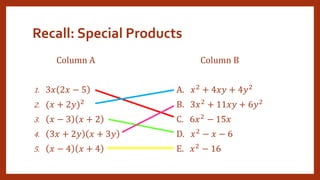
Recall: Special Products
Column A Column B
1. 3𝑥 2𝑥 − 5 A. 𝑥2 + 4𝑥𝑦 + 4𝑦2
2. (𝑥 + 2𝑦)2 B. 3𝑥2 + 11𝑥𝑦 + 6𝑦2
3. 𝑥 − 3 𝑥 + 2 C. 6𝑥2 − 15𝑥
4. 3𝑥 + 2𝑦 𝑥 + 3𝑦 D. 𝑥2
− 𝑥 − 6
5. 𝑥 − 4 𝑥 + 4 E. 𝑥2 − 16
Fix the term/s
corresponding to the given
definitions by rearranging
the jumbled letters.
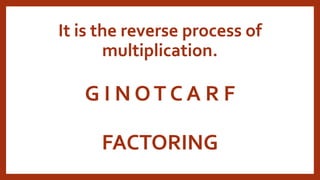
G I N OT C A R F
FACTORING
It is the reverse process of
multiplication.
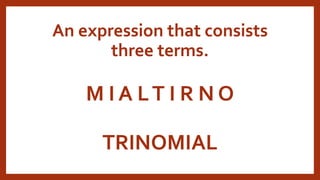
M I A LT I R N O
TRINOMIAL
An expression that consists
three terms.
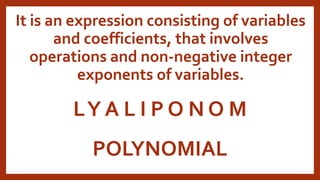
LY A L I P O N O M
POLYNOMIAL
It is an expression consisting of variables
and coefficients, that involves
operations and non-negative integer
exponents of variables.
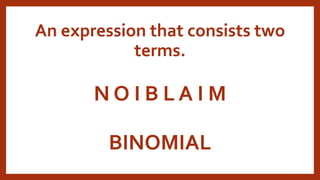
N O I B L A I M
BINOMIAL
An expression that consists two
terms.
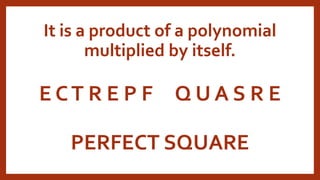
E CT R E P F Q U A S R E
PERFECT SQUARE
It is a product of a polynomial
multiplied by itself.
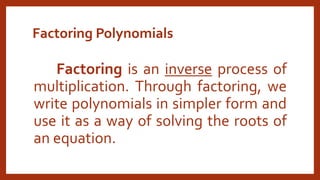
Factoring Polynomials
Factoring is an inverse process of
multiplication. Through factoring, we
write polynomials in simpler form and
use it as a way of solving the roots of
an equation.
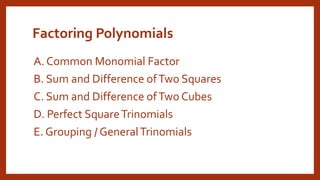
Factoring Polynomials
A. Common Monomial Factor
B. Sum and Difference ofTwo Squares
C. Sum and Difference ofTwo Cubes
D. Perfect SquareTrinomials
E. Grouping / GeneralTrinomials
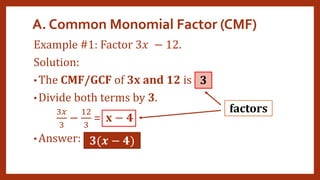
A. Common Monomial Factor (CMF)
Example #1: Factor 3𝑥 − 12.
Solution:
• The CMF/GCF of 3x and 12 is
• Divide both terms by 3.
3𝑥
3
−
12
3
= x − 4
• Answer: 3(𝒙 − 𝟒)
3
factors
A. Common Monomial Factor (CMF)
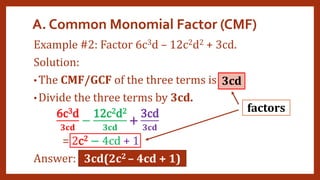
Example #2: Factor 6c3d – 12c2d2 + 3cd.
Solution:
• The CMF/GCF of the three terms is
• Divide the three terms by 3cd.
6c3d
𝟑𝐜𝐝
−
12c2d2
𝟑𝐜𝐝
+
3cd
𝟑𝐜𝐝
= 2c2 − 4cd + 1
Answer: 3cd(2c2 – 4cd + 1)
3cd
factors
A. Common Monomial Factor (CMF)
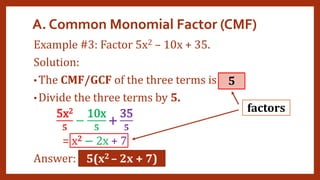
Example #3: Factor 5x2 – 10x + 35.
Solution:
• The CMF/GCF of the three terms is
• Divide the three terms by 5.
5x2
𝟓
−
10x
𝟓
+
35
𝟓
= x2 − 2x + 7
Answer: 5(x2 – 2x + 7)
5
factors
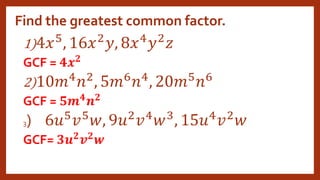
Find the greatest common factor.
1)4𝑥5
, 16𝑥2
𝑦, 8𝑥4
𝑦2
𝑧
GCF = 𝟒𝒙𝟐
2)10𝑚4
𝑛2
, 5𝑚6
𝑛4
, 20𝑚5
𝑛6
GCF = 𝟓𝒎𝟒
𝒏𝟐
3) 6𝑢5
𝑣5
𝑤, 9𝑢2
𝑣4
𝑤3
, 15𝑢4
𝑣2
𝑤
GCF= 𝟑𝒖𝟐
𝒗𝟐
𝒘
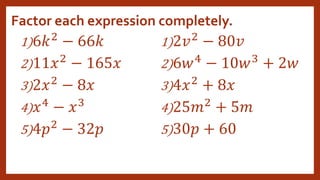
Factor each expression completely.
1)6𝑘2 − 66𝑘
2)11𝑥2
− 165𝑥
3)2𝑥2
− 8𝑥
4)𝑥4 − 𝑥3
5)4𝑝2
− 32𝑝
1)2𝑣2 − 80𝑣
2)6𝑤4
− 10𝑤3
+ 2𝑤
3)4𝑥2
+ 8𝑥
4)25𝑚2 + 5𝑚
5)30𝑝 + 60
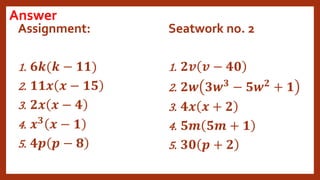
Answer
Assignment:
1. 𝟔𝒌(𝒌 − 𝟏𝟏)
2. 𝟏𝟏𝒙 𝒙 − 𝟏𝟓
3. 𝟐𝒙 𝒙 − 𝟒
4. 𝒙𝟑
𝒙 − 𝟏
5. 𝟒𝒑 𝒑 − 𝟖
Seatwork no. 2
1. 𝟐𝒗 𝒗 − 𝟒𝟎
2. 𝟐𝒘 𝟑𝒘𝟑
− 𝟓𝒘𝟐
+ 𝟏
3. 𝟒𝒙 𝒙 + 𝟐
4. 𝟓𝒎 𝟓𝒎 + 𝟏
5. 𝟑𝟎 𝒑 + 𝟐
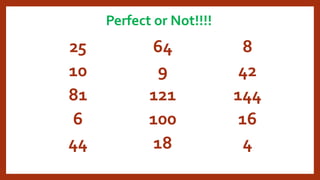
Perfect or Not!!!!
25
10
81
6
44
64
9
121
100
18
8
42
144
16
4
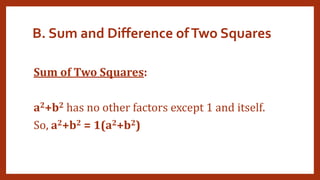
B. Sum and Difference ofTwo Squares
Sum of Two Squares:
a2+b2 has no other factors except 1 and itself.
So, a2+b2 = 1(a2+b2)
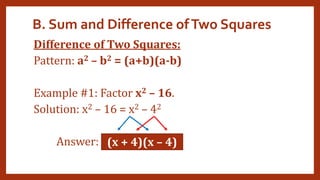
B. Sum and Difference ofTwo Squares
Difference of Two Squares:
Pattern: a2 – b2 = (a+b)(a-b)
Example #1: Factor x2 – 16.
Solution: x2 – 16 = x2 – 42
Answer: (x + 4)(x – 4)
B. Sum and Difference ofTwo Squares
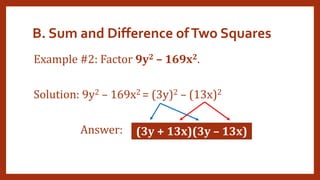
Example #2: Factor 9y2 – 169x2.
Solution: 9y2 – 169x2 = (3y)2 – (13x)2
Answer: (3y + 13x)(3y – 13x)
B. Sum and Difference ofTwo Squares
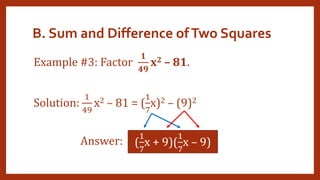
Example #3: Factor
𝟏
𝟒𝟗
x2 – 81.
Solution:
1
49
x2 – 81 = (
1
7
x)2 – (9)2
Answer: (
1
7
x + 9)(
1
7
x – 9)
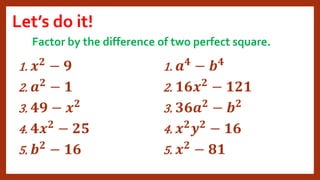
Let’s do it!
1. 𝒙𝟐 − 𝟗
2. 𝒂𝟐 − 𝟏
3. 𝟒𝟗 − 𝒙𝟐
4. 𝟒𝒙𝟐 − 𝟐𝟓
5. 𝒃𝟐 − 𝟏𝟔
1. 𝒂𝟒 − 𝒃𝟒
2. 𝟏𝟔𝒙𝟐
− 𝟏𝟐𝟏
3. 𝟑𝟔𝒂𝟐 − 𝒃𝟐
4. 𝒙𝟐𝒚𝟐 − 𝟏𝟔
5. 𝒙𝟐 − 𝟖𝟏
Factor by the difference of two perfect square.
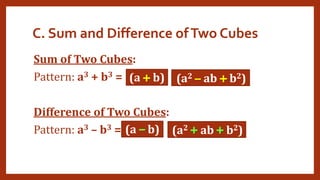
C. Sum and Difference ofTwo Cubes
Sum of Two Cubes:
Pattern: a3 + b3 =
Difference of Two Cubes:
Pattern: a3 – b3 =
(a2 – ab + b2)
(a + b)
+ +
–
(a2 + ab + b2)
(a – b)
– +
+
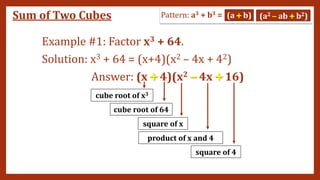
Example #1: Factor x3 + 64.
Solution: x3 + 64 = (x+4)(x2 – 4x + 42)
Answer: (x + 4)(x2 – 4x + 16)
cube root of x3
cube root of 64
square of x
square of 4
product of x and 4
+ +
–
Sum of Two Cubes
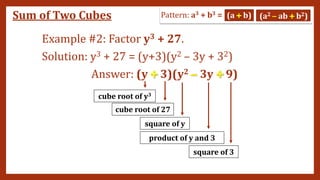
Example #2: Factor y3 + 27.
Solution: y3 + 27 = (y+3)(y2 – 3y + 32)
Answer: (y + 3)(y2 – 3y + 9)
Sum of Two Cubes
cube root of 27
square of y
square of 3
product of y and 3
cube root of y3
+ +
–
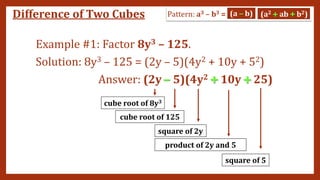
Example #1: Factor 8y3 – 125.
Solution: 8y3 – 125 = (2y – 5)(4y2 + 10y + 52)
Answer: (2y – 5)(4y2 + 10y + 25)
cube root of 8y3
cube root of 125
square of 2y
square of 5
product of 2y and 5
– +
+
Difference of Two Cubes
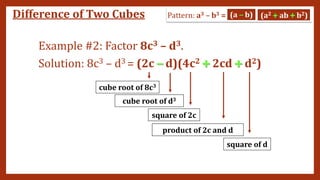
Example #2: Factor 8c3 – d3.
Solution: 8c3 – d3 = (2c – d)(4c2 + 2cd + d2)
cube root of 8c3
cube root of d3
square of 2c
square of d
product of 2c and d
– +
+
– +
+
Difference of Two Cubes
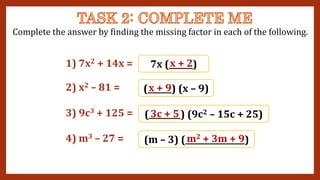
Complete the answer by finding the missing factor in each of the following.
1) 7x2 + 14x = 7x (______)
(______) (x – 9)
2) x2 – 81 =
(________) (9c2 – 15c + 25)
3) 9c3 + 125 =
(m – 3) (_______________)
4) m3 – 27 =
x + 2
x + 9
3c + 5
m2 + 3m + 9
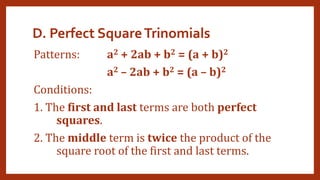
D. Perfect SquareTrinomials
Patterns: a2 + 2ab + b2 = (a + b)2
a2 – 2ab + b2 = (a – b)2
Conditions:
1. The first and last terms are both perfect
squares.
2. The middle term is twice the product of the
square root of the first and last terms.
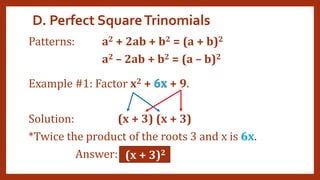
D. Perfect SquareTrinomials
Patterns: a2 + 2ab + b2 = (a + b)2
a2 – 2ab + b2 = (a – b)2
Example #1: Factor x2 + 6x + 9.
Solution: (x + 3) (x + 3)
*Twice the product of the roots 3 and x is 6x.
Answer: (x + 3)2
6x
6x
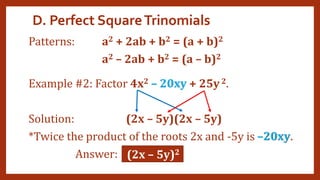
D. Perfect SquareTrinomials
Patterns: a2 + 2ab + b2 = (a + b)2
a2 – 2ab + b2 = (a – b)2
Example #2: Factor 4x2 – 20xy + 25y2.
Solution: (2x – 5y)(2x – 5y)
*Twice the product of the roots 2x and -5y is –20xy.
Answer: (2x – 5y)2
– 20xy
–20xy
D. Perfect SquareTrinomials
Patterns: a2 + 2ab + b2 = (a + b)2
a2 – 2ab + b2 = (a – b)2
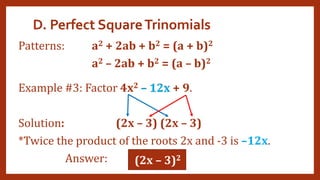
Example #3: Factor 4x2 – 12x + 9.
Solution: (2x – 3) (2x – 3)
*Twice the product of the roots 2x and -3 is –12x.
Answer: (2x – 3)2
– 12x
–12x
E. GeneralTrinomials
*To find the factors, you can use reverse foil method or
trial and error.
Case 1: a = 1
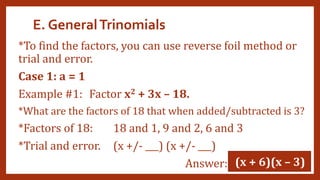
Example #1: Factor x2 + 3x – 18.
*What are the factors of 18 that when added/subtracted is 3?
*Factors of 18: 18 and 1, 9 and 2, 6 and 3
*Trial and error. (x +/- ___) (x +/- ___)
Answer: (x + 6)(x – 3)
E. GeneralTrinomials
Case 1: a = 1
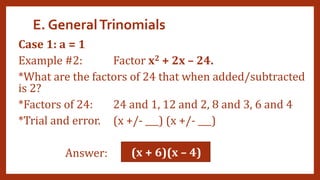
Example #2: Factor x2 + 2x – 24.
*What are the factors of 24 that when added/subtracted
is 2?
*Factors of 24: 24 and 1, 12 and 2, 8 and 3, 6 and 4
*Trial and error. (x +/- ___) (x +/- ___)
Answer: (x + 6)(x – 4)
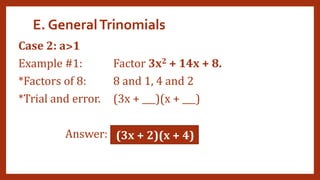
E. GeneralTrinomials
Case 2: a˃1
Example #1: Factor 3x2 + 14x + 8.
*Factors of 8: 8 and 1, 4 and 2
*Trial and error. (3x + ___)(x + ___)
Answer: (3x + 2)(x + 4)
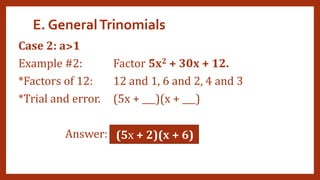
E. GeneralTrinomials
Case 2: a˃1
Example #2: Factor 5x2 + 30x + 12.
*Factors of 12: 12 and 1, 6 and 2, 4 and 3
*Trial and error. (5x + ___)(x + ___)
Answer: (5x + 2)(x + 6)
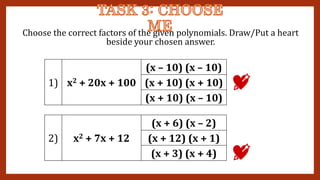
Choose the correct factors of the given polynomials. Draw/Put a heart
beside your chosen answer.
1) x2 + 20x + 100
(x – 10) (x – 10)
(x + 10) (x + 10)
(x + 10) (x – 10)
2) x2 + 7x + 12
(x + 6) (x – 2)
(x + 12) (x + 1)
(x + 3) (x + 4)
Word Problems Involving
Factoring Polynomials
Quarter 1 – MELC 2
Word Problem
Find two consecutive integers whose product is 72.
Representation: Let n represent one integer, then n + 1
represents the next integer.
Solution: n(n + 1) = 72
n2 + n = 72
n2 + n – 72 = 0
(n + 9)(n – 8) = 0
n = -9 n = 8
If n = -9, then n + 1 = -9 + 1 = -8.
If n = 8, then n + 1 = 9.
Thus, the consecutive integers are
-9 and -8 or 8 and 9.
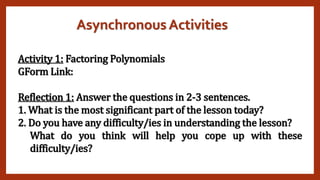
Asynchronous Activities
Activity 1: Factoring Polynomials
GForm Link:
Reflection 1: Answer the questions in 2-3 sentences.
1. What is the most significant part of the lesson today?
2. Do you have any difficulty/ies in understanding the lesson?
What do you think will help you cope up with these
difficulty/ies?

Q1-W1-Factoring Polynomials.pptx

  • 2.
  • 3.
    After going throughthis lesson, you are expected to: - determine the appropriate factoring methods and be able to factor out the given polynomials completely; - factor the given polynomials with utmost accuracy using a variety of techniques and strategies; and - solve problems involving factors of polynomials. Objectives
  • 4.
    Recall: Special Products ColumnA Column B 1. 3𝑥 2𝑥 − 5 A. 𝑥2 + 4𝑥𝑦 + 4𝑦2 2. (𝑥 + 2𝑦)2 B. 3𝑥2 + 11𝑥𝑦 + 6𝑦2 3. 𝑥 − 3 𝑥 + 2 C. 6𝑥2 − 15𝑥 4. 3𝑥 + 2𝑦 𝑥 + 3𝑦 D. 𝑥2 − 𝑥 − 6 5. 𝑥 − 4 𝑥 + 4 E. 𝑥2 − 16
  • 5.
    Fix the term/s correspondingto the given definitions by rearranging the jumbled letters.
  • 6.
    G I NOT C A R F FACTORING It is the reverse process of multiplication.
  • 7.
    M I ALT I R N O TRINOMIAL An expression that consists three terms.
  • 8.
    LY A LI P O N O M POLYNOMIAL It is an expression consisting of variables and coefficients, that involves operations and non-negative integer exponents of variables.
  • 9.
    N O IB L A I M BINOMIAL An expression that consists two terms.
  • 10.
    E CT RE P F Q U A S R E PERFECT SQUARE It is a product of a polynomial multiplied by itself.
  • 11.
    Factoring Polynomials Factoring isan inverse process of multiplication. Through factoring, we write polynomials in simpler form and use it as a way of solving the roots of an equation.
  • 12.
    Factoring Polynomials A. CommonMonomial Factor B. Sum and Difference ofTwo Squares C. Sum and Difference ofTwo Cubes D. Perfect SquareTrinomials E. Grouping / GeneralTrinomials
  • 13.
    A. Common MonomialFactor (CMF) Example #1: Factor 3𝑥 − 12. Solution: • The CMF/GCF of 3x and 12 is • Divide both terms by 3. 3𝑥 3 − 12 3 = x − 4 • Answer: 3(𝒙 − 𝟒) 3 factors
  • 14.
    A. Common MonomialFactor (CMF) Example #2: Factor 6c3d – 12c2d2 + 3cd. Solution: • The CMF/GCF of the three terms is • Divide the three terms by 3cd. 6c3d 𝟑𝐜𝐝 − 12c2d2 𝟑𝐜𝐝 + 3cd 𝟑𝐜𝐝 = 2c2 − 4cd + 1 Answer: 3cd(2c2 – 4cd + 1) 3cd factors
  • 15.
    A. Common MonomialFactor (CMF) Example #3: Factor 5x2 – 10x + 35. Solution: • The CMF/GCF of the three terms is • Divide the three terms by 5. 5x2 𝟓 − 10x 𝟓 + 35 𝟓 = x2 − 2x + 7 Answer: 5(x2 – 2x + 7) 5 factors
  • 16.
    Find the greatestcommon factor. 1)4𝑥5 , 16𝑥2 𝑦, 8𝑥4 𝑦2 𝑧 GCF = 𝟒𝒙𝟐 2)10𝑚4 𝑛2 , 5𝑚6 𝑛4 , 20𝑚5 𝑛6 GCF = 𝟓𝒎𝟒 𝒏𝟐 3) 6𝑢5 𝑣5 𝑤, 9𝑢2 𝑣4 𝑤3 , 15𝑢4 𝑣2 𝑤 GCF= 𝟑𝒖𝟐 𝒗𝟐 𝒘
  • 17.
    Factor each expressioncompletely. 1)6𝑘2 − 66𝑘 2)11𝑥2 − 165𝑥 3)2𝑥2 − 8𝑥 4)𝑥4 − 𝑥3 5)4𝑝2 − 32𝑝 1)2𝑣2 − 80𝑣 2)6𝑤4 − 10𝑤3 + 2𝑤 3)4𝑥2 + 8𝑥 4)25𝑚2 + 5𝑚 5)30𝑝 + 60
  • 18.
    Answer Assignment: 1. 𝟔𝒌(𝒌 −𝟏𝟏) 2. 𝟏𝟏𝒙 𝒙 − 𝟏𝟓 3. 𝟐𝒙 𝒙 − 𝟒 4. 𝒙𝟑 𝒙 − 𝟏 5. 𝟒𝒑 𝒑 − 𝟖 Seatwork no. 2 1. 𝟐𝒗 𝒗 − 𝟒𝟎 2. 𝟐𝒘 𝟑𝒘𝟑 − 𝟓𝒘𝟐 + 𝟏 3. 𝟒𝒙 𝒙 + 𝟐 4. 𝟓𝒎 𝟓𝒎 + 𝟏 5. 𝟑𝟎 𝒑 + 𝟐
  • 19.
  • 20.
    B. Sum andDifference ofTwo Squares Sum of Two Squares: a2+b2 has no other factors except 1 and itself. So, a2+b2 = 1(a2+b2)
  • 21.
    B. Sum andDifference ofTwo Squares Difference of Two Squares: Pattern: a2 – b2 = (a+b)(a-b) Example #1: Factor x2 – 16. Solution: x2 – 16 = x2 – 42 Answer: (x + 4)(x – 4)
  • 22.
    B. Sum andDifference ofTwo Squares Example #2: Factor 9y2 – 169x2. Solution: 9y2 – 169x2 = (3y)2 – (13x)2 Answer: (3y + 13x)(3y – 13x)
  • 23.
    B. Sum andDifference ofTwo Squares Example #3: Factor 𝟏 𝟒𝟗 x2 – 81. Solution: 1 49 x2 – 81 = ( 1 7 x)2 – (9)2 Answer: ( 1 7 x + 9)( 1 7 x – 9)
  • 24.
    Let’s do it! 1.𝒙𝟐 − 𝟗 2. 𝒂𝟐 − 𝟏 3. 𝟒𝟗 − 𝒙𝟐 4. 𝟒𝒙𝟐 − 𝟐𝟓 5. 𝒃𝟐 − 𝟏𝟔 1. 𝒂𝟒 − 𝒃𝟒 2. 𝟏𝟔𝒙𝟐 − 𝟏𝟐𝟏 3. 𝟑𝟔𝒂𝟐 − 𝒃𝟐 4. 𝒙𝟐𝒚𝟐 − 𝟏𝟔 5. 𝒙𝟐 − 𝟖𝟏 Factor by the difference of two perfect square.
  • 25.
    C. Sum andDifference ofTwo Cubes Sum of Two Cubes: Pattern: a3 + b3 = Difference of Two Cubes: Pattern: a3 – b3 = (a2 – ab + b2) (a + b) + + – (a2 + ab + b2) (a – b) – + +
  • 26.
    Example #1: Factorx3 + 64. Solution: x3 + 64 = (x+4)(x2 – 4x + 42) Answer: (x + 4)(x2 – 4x + 16) cube root of x3 cube root of 64 square of x square of 4 product of x and 4 + + – Sum of Two Cubes
  • 27.
    Example #2: Factory3 + 27. Solution: y3 + 27 = (y+3)(y2 – 3y + 32) Answer: (y + 3)(y2 – 3y + 9) Sum of Two Cubes cube root of 27 square of y square of 3 product of y and 3 cube root of y3 + + –
  • 28.
    Example #1: Factor8y3 – 125. Solution: 8y3 – 125 = (2y – 5)(4y2 + 10y + 52) Answer: (2y – 5)(4y2 + 10y + 25) cube root of 8y3 cube root of 125 square of 2y square of 5 product of 2y and 5 – + + Difference of Two Cubes
  • 29.
    Example #2: Factor8c3 – d3. Solution: 8c3 – d3 = (2c – d)(4c2 + 2cd + d2) cube root of 8c3 cube root of d3 square of 2c square of d product of 2c and d – + + – + + Difference of Two Cubes
  • 30.
    Complete the answerby finding the missing factor in each of the following. 1) 7x2 + 14x = 7x (______) (______) (x – 9) 2) x2 – 81 = (________) (9c2 – 15c + 25) 3) 9c3 + 125 = (m – 3) (_______________) 4) m3 – 27 = x + 2 x + 9 3c + 5 m2 + 3m + 9
  • 31.
    D. Perfect SquareTrinomials Patterns:a2 + 2ab + b2 = (a + b)2 a2 – 2ab + b2 = (a – b)2 Conditions: 1. The first and last terms are both perfect squares. 2. The middle term is twice the product of the square root of the first and last terms.
  • 32.
    D. Perfect SquareTrinomials Patterns:a2 + 2ab + b2 = (a + b)2 a2 – 2ab + b2 = (a – b)2 Example #1: Factor x2 + 6x + 9. Solution: (x + 3) (x + 3) *Twice the product of the roots 3 and x is 6x. Answer: (x + 3)2 6x 6x
  • 33.
    D. Perfect SquareTrinomials Patterns:a2 + 2ab + b2 = (a + b)2 a2 – 2ab + b2 = (a – b)2 Example #2: Factor 4x2 – 20xy + 25y2. Solution: (2x – 5y)(2x – 5y) *Twice the product of the roots 2x and -5y is –20xy. Answer: (2x – 5y)2 – 20xy –20xy
  • 34.
    D. Perfect SquareTrinomials Patterns:a2 + 2ab + b2 = (a + b)2 a2 – 2ab + b2 = (a – b)2 Example #3: Factor 4x2 – 12x + 9. Solution: (2x – 3) (2x – 3) *Twice the product of the roots 2x and -3 is –12x. Answer: (2x – 3)2 – 12x –12x
  • 35.
    E. GeneralTrinomials *To findthe factors, you can use reverse foil method or trial and error. Case 1: a = 1 Example #1: Factor x2 + 3x – 18. *What are the factors of 18 that when added/subtracted is 3? *Factors of 18: 18 and 1, 9 and 2, 6 and 3 *Trial and error. (x +/- ___) (x +/- ___) Answer: (x + 6)(x – 3)
  • 36.
    E. GeneralTrinomials Case 1:a = 1 Example #2: Factor x2 + 2x – 24. *What are the factors of 24 that when added/subtracted is 2? *Factors of 24: 24 and 1, 12 and 2, 8 and 3, 6 and 4 *Trial and error. (x +/- ___) (x +/- ___) Answer: (x + 6)(x – 4)
  • 37.
    E. GeneralTrinomials Case 2:a˃1 Example #1: Factor 3x2 + 14x + 8. *Factors of 8: 8 and 1, 4 and 2 *Trial and error. (3x + ___)(x + ___) Answer: (3x + 2)(x + 4)
  • 38.
    E. GeneralTrinomials Case 2:a˃1 Example #2: Factor 5x2 + 30x + 12. *Factors of 12: 12 and 1, 6 and 2, 4 and 3 *Trial and error. (5x + ___)(x + ___) Answer: (5x + 2)(x + 6)
  • 39.
    Choose the correctfactors of the given polynomials. Draw/Put a heart beside your chosen answer. 1) x2 + 20x + 100 (x – 10) (x – 10) (x + 10) (x + 10) (x + 10) (x – 10) 2) x2 + 7x + 12 (x + 6) (x – 2) (x + 12) (x + 1) (x + 3) (x + 4)
  • 40.
    Word Problems Involving FactoringPolynomials Quarter 1 – MELC 2
  • 41.
    Word Problem Find twoconsecutive integers whose product is 72. Representation: Let n represent one integer, then n + 1 represents the next integer. Solution: n(n + 1) = 72 n2 + n = 72 n2 + n – 72 = 0 (n + 9)(n – 8) = 0 n = -9 n = 8 If n = -9, then n + 1 = -9 + 1 = -8. If n = 8, then n + 1 = 9. Thus, the consecutive integers are -9 and -8 or 8 and 9.
  • 42.
    Asynchronous Activities Activity 1:Factoring Polynomials GForm Link: Reflection 1: Answer the questions in 2-3 sentences. 1. What is the most significant part of the lesson today? 2. Do you have any difficulty/ies in understanding the lesson? What do you think will help you cope up with these difficulty/ies?