Copyright © 2012 Pearson Education,
Inc.
Trinomials of
the
Type
ax2 + bx + c
■ Factoring Trinomials of the Type
ax2 + bx + c
■ Equations and Functions
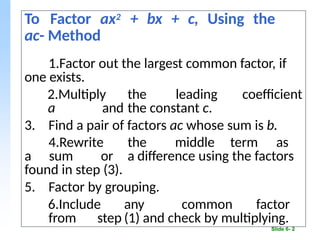
To Factor ax2 + bx + c, Using the
ac- Method
1.Factor out the largest common factor, if
one exists.
2.Multiply the leading coefficient
a and the constant c.
3. Find a pair of factors ac whose sum is b.
4.Rewrite the middle term as
a sum or a difference using the factors
found in step (3).
5. Factor by grouping.
6.Include any common factor
from step (1) and check by multiplying.
Slide 6- 2
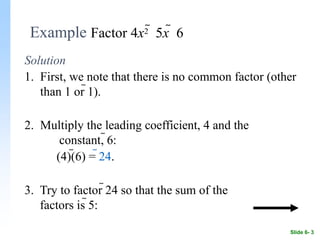
Example Factor 4x2  5x  6
Solution
1. First, we note that there is no common factor (other
than 1 or 1).
2. Multiply the leading coefficient, 4 and the
constant, 6:
(4)(6) = 24.
3. Try to factor 24 so that the sum of the
factors is 5:
Slide 6- 3
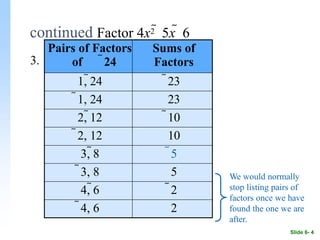
Pairs of Factors
of 24
Sums of
Factors
1, 24 23
1, 24 23
2, 12 10
2, 12 10
3, 8 5
3, 8 5
4, 6 2
4, 6 2
continued Factor 4x2  5x  6
3.
We would normally
stop listing pairs of
factors once we have
found the one we are
after.
Slide 6- 4
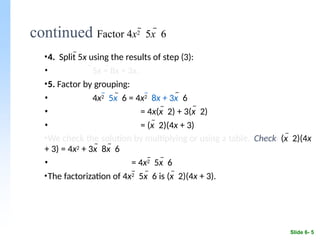
•4. Split 5x using the results of step (3):
• 5x = 8x + 3x.
•5. Factor by grouping:
Slide 6- 5
•
•
•
4x2  5x  6 = 4x2  8x + 3x  6
= 4x(x  2) + 3(x  2)
= (x  2)(4x + 3)
•We check the solution by multiplying or using a table. Check: (x  2)(4x
+ 3) = 4x2 + 3x  8x  6
• = 4x2  5x  6
•The factorization of 4x2  5x  6 is (x  2)(4x + 3).
continued Factor 4x2  5x  6
Example Factor 8x3 + 10x2  12x
Solution
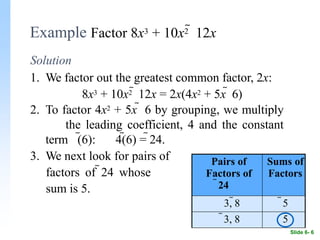
1. We factor out the greatest common factor, 2x:
8x3 + 10x2  12x = 2x(4x2 + 5x  6)
2. To factor 4x2 + 5x  6 by grouping, we multiply
the leading coefficient, 4 and the constant
term (6): 4(6) = 24.
3. We next look for pairs of
factors of 24 whose
sum is 5.
Pairs of
Factors of
24
Sums of
Factors
3, 8 5
3, 8 5
Slide 6- 6
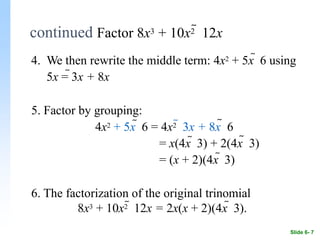
4. We then rewrite the middle term: 4x2 + 5x  6 using
5x = 3x + 8x
5. Factor by grouping:
4x2 + 5x  6 = 4x2  3x + 8x  6
= x(4x  3) + 2(4x  3)
= (x + 2)(4x  3)
6. The factorization of the original trinomial
8x3 + 10x2  12x = 2x(x + 2)(4x  3).
Slide 6- 7
continued Factor 8x3 + 10x2  12x
Equations and
Functions
Slide 6- 8
•We now use our new factoring skills to solve a polynomial equation.
We factor a polynomial expression and use the principle of zero
products to solve the equation.
Example
Slide 6- 9
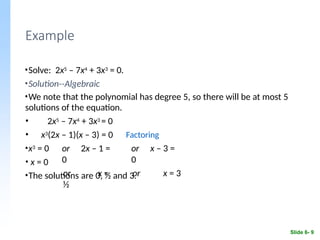
•Solve: 2x5 – 7x4 + 3x3 = 0.
•Solution--Algebraic
•We note that the polynomial has degree 5, so there will be at most 5
solutions of the equation.
• 2x5 – 7x4 + 3x3 = 0
• x3(2x – 1)(x – 3) = 0 Factoring
•x3 = 0
• x = 0
or 2x – 1 =
0
or x =
½
or x – 3 =
0
or x = 3
•The solutions are 0, ½ and 3.
Example
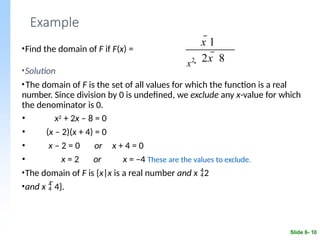
•Find the domain of F if F(x) =
•Solution
•The domain of F is the set of all values for which the function is a real
number. Since division by 0 is undefined, we exclude any x-value for which
the denominator is 0.
• x2 + 2x – 8 = 0
• (x – 2)(x + 4) = 0
•
•
x – 2 = 0
x = 2
or x + 4 = 0
or x = –4 These are the values to exclude.
•The domain of F is {x|x is a real number and x 2
•and x  4}.
x2
Slide 6- 10
x 1
 2x  8

Math 9hghfyftftyftydytdtrd-Lesson 2.pptx

  • 1.
    Copyright © 2012Pearson Education, Inc. Trinomials of the Type ax2 + bx + c ■ Factoring Trinomials of the Type ax2 + bx + c ■ Equations and Functions
  • 2.
    To Factor ax2+ bx + c, Using the ac- Method 1.Factor out the largest common factor, if one exists. 2.Multiply the leading coefficient a and the constant c. 3. Find a pair of factors ac whose sum is b. 4.Rewrite the middle term as a sum or a difference using the factors found in step (3). 5. Factor by grouping. 6.Include any common factor from step (1) and check by multiplying. Slide 6- 2
  • 3.
    Example Factor 4x2 5x  6 Solution 1. First, we note that there is no common factor (other than 1 or 1). 2. Multiply the leading coefficient, 4 and the constant, 6: (4)(6) = 24. 3. Try to factor 24 so that the sum of the factors is 5: Slide 6- 3
  • 4.
    Pairs of Factors of24 Sums of Factors 1, 24 23 1, 24 23 2, 12 10 2, 12 10 3, 8 5 3, 8 5 4, 6 2 4, 6 2 continued Factor 4x2  5x  6 3. We would normally stop listing pairs of factors once we have found the one we are after. Slide 6- 4
  • 5.
    •4. Split 5xusing the results of step (3): • 5x = 8x + 3x. •5. Factor by grouping: Slide 6- 5 • • • 4x2  5x  6 = 4x2  8x + 3x  6 = 4x(x  2) + 3(x  2) = (x  2)(4x + 3) •We check the solution by multiplying or using a table. Check: (x  2)(4x + 3) = 4x2 + 3x  8x  6 • = 4x2  5x  6 •The factorization of 4x2  5x  6 is (x  2)(4x + 3). continued Factor 4x2  5x  6
  • 6.
    Example Factor 8x3+ 10x2  12x Solution 1. We factor out the greatest common factor, 2x: 8x3 + 10x2  12x = 2x(4x2 + 5x  6) 2. To factor 4x2 + 5x  6 by grouping, we multiply the leading coefficient, 4 and the constant term (6): 4(6) = 24. 3. We next look for pairs of factors of 24 whose sum is 5. Pairs of Factors of 24 Sums of Factors 3, 8 5 3, 8 5 Slide 6- 6
  • 7.
    4. We thenrewrite the middle term: 4x2 + 5x  6 using 5x = 3x + 8x 5. Factor by grouping: 4x2 + 5x  6 = 4x2  3x + 8x  6 = x(4x  3) + 2(4x  3) = (x + 2)(4x  3) 6. The factorization of the original trinomial 8x3 + 10x2  12x = 2x(x + 2)(4x  3). Slide 6- 7 continued Factor 8x3 + 10x2  12x
  • 8.
    Equations and Functions Slide 6-8 •We now use our new factoring skills to solve a polynomial equation. We factor a polynomial expression and use the principle of zero products to solve the equation.
  • 9.
    Example Slide 6- 9 •Solve:2x5 – 7x4 + 3x3 = 0. •Solution--Algebraic •We note that the polynomial has degree 5, so there will be at most 5 solutions of the equation. • 2x5 – 7x4 + 3x3 = 0 • x3(2x – 1)(x – 3) = 0 Factoring •x3 = 0 • x = 0 or 2x – 1 = 0 or x = ½ or x – 3 = 0 or x = 3 •The solutions are 0, ½ and 3.
  • 10.
    Example •Find the domainof F if F(x) = •Solution •The domain of F is the set of all values for which the function is a real number. Since division by 0 is undefined, we exclude any x-value for which the denominator is 0. • x2 + 2x – 8 = 0 • (x – 2)(x + 4) = 0 • • x – 2 = 0 x = 2 or x + 4 = 0 or x = –4 These are the values to exclude. •The domain of F is {x|x is a real number and x 2 •and x  4}. x2 Slide 6- 10 x 1  2x  8