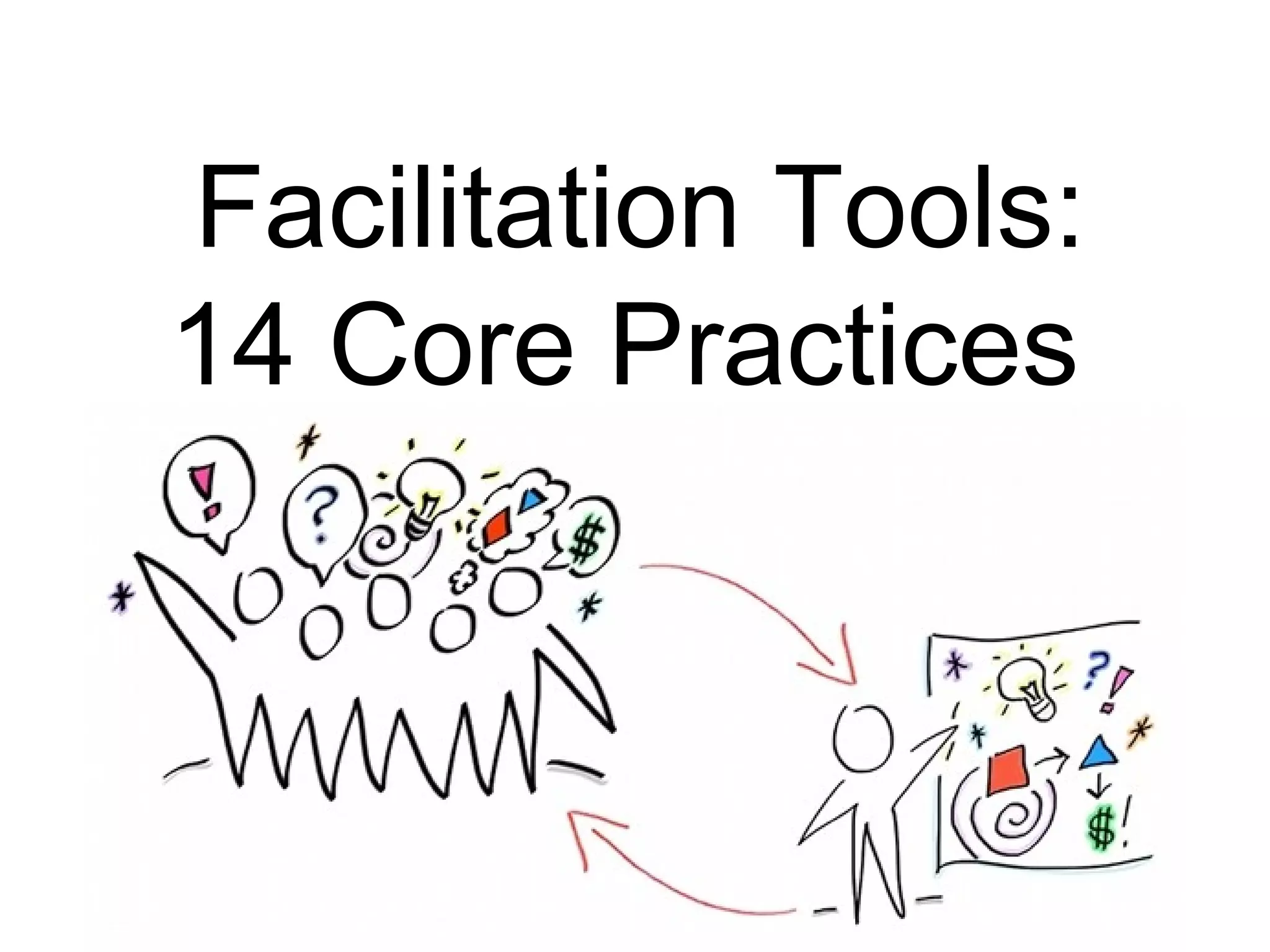
Facilitation Tools:
14 Core Practices
Stay neutral on content
– Your job is to focus on the process role and
avoid the temptation of offering opinions about
the topic under discussion.
– You should use questions and suggestions to
offer ideas that spring to mind, but never
impose opinions on the group.
Listen actively
– Look people in the eye
– Use attentive body language
– Paraphrase what people say
– Summarize key ideas
Use eye contact
– While people are speaking
– When paraphrasing what they have just said
– When summarizing their key ideas
– Let people know they can speak next
– Prompt the quiet ones in the crowd to
participate
Ask questions
– This is the most important tool you possess
– Questions test assumptions, invite
participation, gather information and probe for
hidden points.
– Effective questioning allows you to delve past
the symptoms and get at the “root cause”.
Paraphrase to clarify
– This involves repeating what people say to:
• make sure they know they are being heard
• let others hear their points a second time
• clarify key ideas
– “Are you saying…?”
– “Am I understanding you to mean…?”
Synthesize ideas
– Don’t just record individual ideas of
participants.
– Instead, get people to comment and build on
each other’s thoughts to ensure that the ideas
recorded represent collective thinking.
– This builds consensus and commitment.
– “Alice, what would you add to Jeff’s
comments?”
Stay on track
– Set time guidelines for each discussion
– Appoint a time keeper inside the group to call
out milestones.
– Point out the digression if discussion has
veered off topic.
– “Park” all off-topic comments and
suggestions on a separate
“Parking Lot” sheet posted
on a nearby wall to be dealt
with later.
Give and receive feedback
– Periodically “hold up a mirror” to help the group “see”
it6self so it can make corrections.
• “Only two people are involved in this discussion,
while others are sitting silently. How can we
shift the leadership so everyone will contribute?”
– Ask for and accept feedback about the
facilitation.
• “Are we making progress?”
• “How’s the pace?”
• “What can I do to be more effective?”
Test assumptions
– You need to bring the assumptions people are
operating under out into the open and clarify
them, so that they are clearly understood by
everyone.
– These assumptions may even need to be
challenged before a group can explore new
ground.
• “John, on what basis are you making the
comment that Sarah’s idea is too narrow
to be considered an option?”
Collect ideas
– Keep track of both emerging ideas and final
decisions.
– Make clear and accurate summaries on a
flipchart, writing board, or electric board so
everyone can see the notes.
– Notes should be brief and concise.
– They must always reflect what the
participants said, rather than your
interpretation of what they said.
Summarize clearly
– A great facilitator listens attentively to
everything that is said, and then offers concise
and timely summaries.
– Summarize when you want to revive a
discussion that has ground to a halt
or to end a discussion when things
seem to be wrapping up.
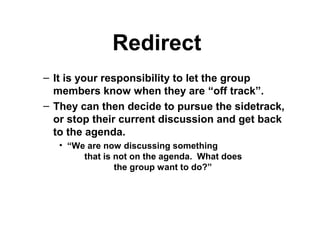
Redirect
– It is your responsibility to let the group
members know when they are “off track”.
– They can then decide to pursue the sidetrack,
or stop their current discussion and get back
to the agenda.
• “We are now discussing something
that is not on the agenda. What does
the group want to do?”
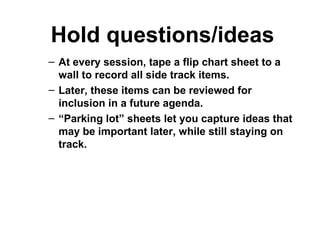
Hold questions/ideas
– At every session, tape a flip chart sheet to a
wall to record all side track items.
– Later, these items can be reviewed for
inclusion in a future agenda.
– “Parking lot” sheets let you capture ideas that
may be important later, while still staying on
track.
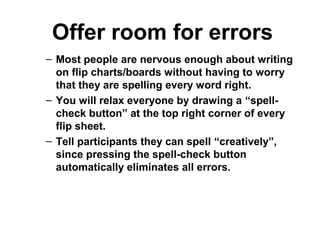
Offer room for errors
– Most people are nervous enough about writing
on flip charts/boards without having to worry
that they are spelling every word right.
– You will relax everyone by drawing a “spell-
check button” at the top right corner of every
flip sheet.
– Tell participants they can spell “creatively”,
since pressing the spell-check button
automatically eliminates all errors.

Facilitation Tools - 14 Core Practices

  • 1.
  • 2.
    Stay neutral oncontent – Your job is to focus on the process role and avoid the temptation of offering opinions about the topic under discussion. – You should use questions and suggestions to offer ideas that spring to mind, but never impose opinions on the group.
  • 3.
    Listen actively – Lookpeople in the eye – Use attentive body language – Paraphrase what people say – Summarize key ideas
  • 4.
    Use eye contact –While people are speaking – When paraphrasing what they have just said – When summarizing their key ideas – Let people know they can speak next – Prompt the quiet ones in the crowd to participate
  • 5.
    Ask questions – Thisis the most important tool you possess – Questions test assumptions, invite participation, gather information and probe for hidden points. – Effective questioning allows you to delve past the symptoms and get at the “root cause”.
  • 6.
    Paraphrase to clarify –This involves repeating what people say to: • make sure they know they are being heard • let others hear their points a second time • clarify key ideas – “Are you saying…?” – “Am I understanding you to mean…?”
  • 7.
    Synthesize ideas – Don’tjust record individual ideas of participants. – Instead, get people to comment and build on each other’s thoughts to ensure that the ideas recorded represent collective thinking. – This builds consensus and commitment. – “Alice, what would you add to Jeff’s comments?”
  • 8.
    Stay on track –Set time guidelines for each discussion – Appoint a time keeper inside the group to call out milestones. – Point out the digression if discussion has veered off topic. – “Park” all off-topic comments and suggestions on a separate “Parking Lot” sheet posted on a nearby wall to be dealt with later.
  • 9.
    Give and receivefeedback – Periodically “hold up a mirror” to help the group “see” it6self so it can make corrections. • “Only two people are involved in this discussion, while others are sitting silently. How can we shift the leadership so everyone will contribute?” – Ask for and accept feedback about the facilitation. • “Are we making progress?” • “How’s the pace?” • “What can I do to be more effective?”
  • 10.
    Test assumptions – Youneed to bring the assumptions people are operating under out into the open and clarify them, so that they are clearly understood by everyone. – These assumptions may even need to be challenged before a group can explore new ground. • “John, on what basis are you making the comment that Sarah’s idea is too narrow to be considered an option?”
  • 11.
    Collect ideas – Keeptrack of both emerging ideas and final decisions. – Make clear and accurate summaries on a flipchart, writing board, or electric board so everyone can see the notes. – Notes should be brief and concise. – They must always reflect what the participants said, rather than your interpretation of what they said.
  • 12.
    Summarize clearly – Agreat facilitator listens attentively to everything that is said, and then offers concise and timely summaries. – Summarize when you want to revive a discussion that has ground to a halt or to end a discussion when things seem to be wrapping up.
  • 13.
    Redirect – It isyour responsibility to let the group members know when they are “off track”. – They can then decide to pursue the sidetrack, or stop their current discussion and get back to the agenda. • “We are now discussing something that is not on the agenda. What does the group want to do?”
  • 14.
    Hold questions/ideas – Atevery session, tape a flip chart sheet to a wall to record all side track items. – Later, these items can be reviewed for inclusion in a future agenda. – “Parking lot” sheets let you capture ideas that may be important later, while still staying on track.
  • 15.
    Offer room forerrors – Most people are nervous enough about writing on flip charts/boards without having to worry that they are spelling every word right. – You will relax everyone by drawing a “spell- check button” at the top right corner of every flip sheet. – Tell participants they can spell “creatively”, since pressing the spell-check button automatically eliminates all errors.

Editor's Notes

  • #2 ReferenceBens, I. (2012). Facilitating With Ease!, 3rd Edition. San Francisco, CA: Jossey-Bass, Inc.
  • #3 ReferenceBens, I. (2012). Facilitating With Ease!, 3rd Edition. San Francisco, CA: Jossey-Bass, Inc.
  • #5 ReferenceBens, I. (2012). Facilitating With Ease!, 3rd Edition. San Francisco, CA: Jossey-Bass, Inc.
  • #6 ReferenceBens, I. (2012). Facilitating With Ease!, 3rd Edition. San Francisco, CA: Jossey-Bass, Inc.
  • #7 ReferenceBens, I. (2012). Facilitating With Ease!, 3rd Edition. San Francisco, CA: Jossey-Bass, Inc.
  • #8 ReferenceBens, I. (2012). Facilitating With Ease!, 3rd Edition. San Francisco, CA: Jossey-Bass, Inc.
  • #9 ReferenceBens, I. (2012). Facilitating With Ease!, 3rd Edition. San Francisco, CA: Jossey-Bass, Inc.
  • #10 ReferenceBens, I. (2012). Facilitating With Ease!, 3rd Edition. San Francisco, CA: Jossey-Bass, Inc.
  • #11 ReferenceBens, I. (2012). Facilitating With Ease!, 3rd Edition. San Francisco, CA: Jossey-Bass, Inc.
  • #13 ReferenceBens, I. (2012). Facilitating With Ease!, 3rd Edition. San Francisco, CA: Jossey-Bass, Inc.
  • #14 ReferenceBens, I. (2012). Facilitating With Ease!, 3rd Edition. San Francisco, CA: Jossey-Bass, Inc.
  • #15 ReferenceBens, I. (2012). Facilitating With Ease!, 3rd Edition. San Francisco, CA: Jossey-Bass, Inc.
  • #16 ReferenceBens, I. (2012). Facilitating With Ease!, 3rd Edition. San Francisco, CA: Jossey-Bass, Inc.