Welcome to: E.F.F.E.C.T.I.V.E. Meeting Facilitation
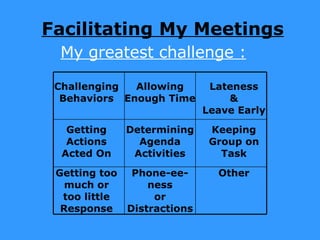
Facilitating My Meetings My greatest challenge :
Session Outcome Understand the best practices for effective meeting facilitation
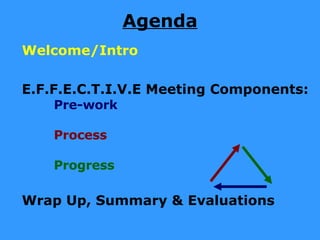
Agenda Welcome/Intro E.F.F.E.C.T.I.V.E Meeting Components: Pre-work Process Progress Wrap Up, Summary & Evaluations
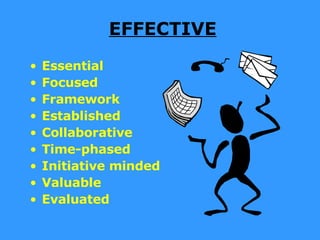
EFFECTIVE Essential Focused Framework Established Collaborative Time-phased Initiative minded Valuable Evaluated
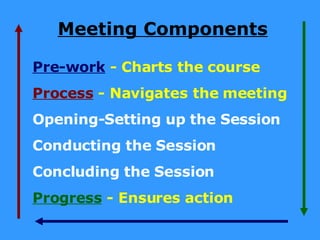
Meeting Components Pre-work  - Charts the course Process   - Navigates the meeting Opening-Setting up the Session Conducting the Session Concluding the Session Progress  - Ensures action
Facilitator Focus is on ensuring that application of necessary activities, assignments and learning will occur
Facilitator     Guides the team throughout project life      Establishes the working ground rules with the project team      Navigates back to the issue(s) at hand       Hosts the team and diplomatically acts as a referee or works through issues
Facilitator Designs problem-solving activities Frames the medium used for the process Maintains a neutral perception throughout the facilitation process
Educator Focus is on content mastery and understanding
Educator Instructs the projects team as needed Provides content though self or others Determines the learning needs throughout the life of the project Tutors team members when appropriate
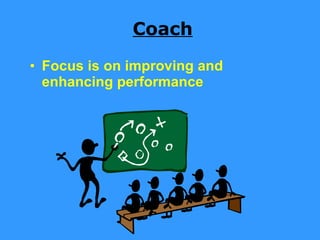
Coach Focus is on improving and enhancing performance
Coach Strategizes-assigns positions, tasks  Understands the players’ abilities Provides feedback to redirect, reinforce or extend performance Asks, encourages and offers help when needed
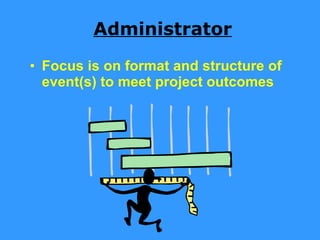
Administrator Focus is on format and structure of event(s) to meet project outcomes
Administrator Organizes team meetings  (pre and post meeting logistics) Acts as the liaison between team, stakeholders and sponsor  Reports project status
Administrator Manages and revises plan Procures resources Navigates through additional changes that might occur Documents project activities, outcomes, products
Communicator Focus is on ensuring that information is flowing productively
Communicator Manages communication within the group such as meeting summaries, project updates, etc. Serves as the bridge to all  Translates content and concepts by effectively using various mediums to communicate, such as presentations, written documents, conferencing, etc. Connects the right people and resources
Communicator Negotiates issues as they arise in order to complete the project Promotes the product(s) resulting from the project Informs the sponsor to ensure ongoing support during the project life Contacts stakeholders as necessary throughout the life of the project
Motivator Focus is to foster a motivating environment
Motivator Encourages Congratulates Recognizes Affirms Reinforces Rewards All involved with the project   CHEER!
Miscellaneous  Time-keeper Scribe Spokesperson
Characteristics of Facilitation Protects participants self-esteem Understands and senses group energy and productivity and acts accordingly to keep ideas flowing and energy up Monitors the pace and quality Helps summarize and prioritize content Moves group to consensus & to define and assign next steps
Characteristics of Facilitation Creates a participatory environment with active listening, dialogue creativity Directs group to focus and achieve desired outcomes Suggests helpful processes to meet outcomes Remains neutral on content
Neutrality Difficult when we have multiple roles When possible, facilitate parts of the meeting where you are more apt to be neutral Ask another group member to facilitate topics that you have more content input needs
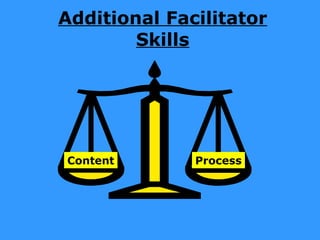
Additional Facilitator Skills Content Process
Facilitation Competencies Providing a Motivating Environment Demonstrating Leadership Excellence Providing Feedback Managing Discussions & Activities Effective Communication-clear & timely, using various tools  (Written & Oral)
Delivery Do’s & Don’ts “ Professional Presence” Appropriate Body Language Appropriate Language Inclusive Certain Asking Questions Open  Closed Polling
Group Dynamics Collective experience adds more than individual experience Building on the ideas and experiences of many increases synergy and creativity Productivity, quality and efficiency improve or are enhanced Improved communication skills through the group interactions
Functional Behaviors Contributing Suggest ideas Offer facts, speculations and solutions Provide information relevant to the issue Clarifying Paraphrase, explain, ask clarifying questions, seek additional ideas & connect one idea to another Supporting Praise, encouragement, agreement, open communication Mediating Seek to understand other’s point of view Attempt to reconcile differences, “referee”
Challenging Behaviors The Over-Participator Self-Appointed Spokesperson Doting on Displeasure Readily Repetitive I’m Important
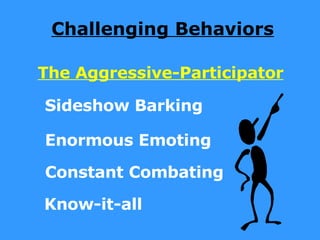
Challenging Behaviors The Aggressive-Participator Sideshow Barking Enormous Emoting Constant Combating Know-it-all
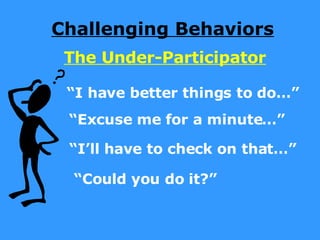
Challenging Behaviors The Under-Participator “ I have better things to do…” “ Excuse me for a minute…” “ I’ll have to check on that…” “ Could you do it?”
What’s Up? What possible resistance could there be? Why? What else might need consideration? What potential concerns are there? What else might I need to know?
General Rules of Thumb Stay Calm Relaxed & Open (non-verbal) Reinforce Acceptable Behavior Refer to Ground Rules/Roles Allow Group to Discourage  Refocus to D.O./Topic Activity Make a Direct Statement Time Out!
ACT B.I.G. Describe the  B EHAVIOR  as you’ve  seen and heard it Describe the  I MPACT  of the behavior—what it’s done to you, others, or what resulted from the act Explain the  G ROWTH  needed to get a positive outcome
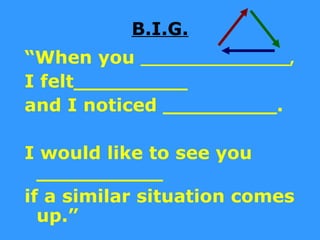
B.I.G. “ When you  _______________,   I felt_________  and I noticed _________.  I would like to see you __________  if a similar situation comes up.”
Planning for Your Audience Types of behavior: Over Aggressive Under Strategies to try
Communication Considerations Are there issues where information is not communicated clearly? Actions Goals Progress
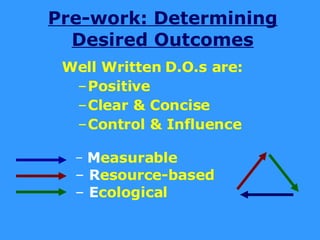
Pre-work: Determining Desired Outcomes Well Written D.O.s are: Positive Clear & Concise Control & Influence M easurable R esource-based E cological
My Desired Outcome This meeting is to decide on a mandatory class to teach all staff on how to act professionally.
My Desired Outcome The desired outcome of this meeting is to decide on a training program that promotes a harassment free workplace.
More Desired Outcomes This meeting is to stop wasting too much money. To reduce the number of people who show up late each day. To find ways to change the sagging morale in our department because there is too much tension and we’re not as productive as we should be. To have a team meeting .
Reasons to Meet 1.  To identify problems To solve identified problems 3.  Generate ideas, Brainstorming 4.  Establish Goals or Plans 5.  Training or Education
Reasons NOT to Meet 1. Conversation, phone, or e-mail Not prepared, you and/or others 3. Decision makers are not available Desired Outcome is not clear  (or written) 5.  A decision has already been made
Desired Outcomes  Considerations: Purpose/Charge/Mission of Group Communication Needs Actions Goals Progress Decision-Making Protocol Guidelines
Pre-work: Creating the Agenda AGENDA :  a  written  document with critical information to get the  right  people together at the same  time  to  accomplish  a common  Desired   Outcome(s).
Pre-work: Creating the Agenda What is the critical information? This is the stuff you need to do  at the meeting  in order to accomplish your Desired Outcome(s). Presentations Activities, etc.
Pre-work: Creating the Agenda Contents :  Desired Outcome(s) Start/End times Location(s)/Accommodations Meeting and Pre-work Assignments Topics/Items with times allocated
Pre-work: Creating the Agenda Who are the  right  people? Can this person help reach the Desired Outcome(s)?
Pre-work: Creating the Agenda Whenever possible, publish the Agenda at  48-72  hours prior to the meeting . Assign a start and end time to the meeting Assign a timeframe for each topic
Pre-work: Creating the Agenda When and where should we meet? If you have access to schedules-set it up in the calendar system Ask participants to accept or decline
Managing Expectations Designed to Build Trust Typically used: Ritual or Regular Meetings Training Sessions Problem Solving Sessions Group Facilitations
Managing Expectations: Ground Rules Identify Potential Hazards What are some of the things you’ve seen go wrong in a meeting? Minimize the Impact of Hazards What steps can be taken to keep the meeting as productive as possible?
Basic Ground Rules Start & end on time Cell phones & pagers silent/off Stick to the agenda/participate Avoid side-bar conversations Maintain respect for all views Professional language Maintain confidentiality
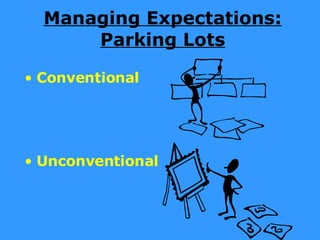
Managing Expectations: Parking Lots Conventional Unconventional
Brainstorming Generate New Ideas Spur Creativity Encourage Idea Association Stimulate Competition Among Teams
Brainstorming Administrate to keep it:  On Target Lively Productive Creative
Problem Solving What is the problem? What are all of the possible causes? What are all of the possible  solutions? What is the best solution & why?
Decision-Making Does the group have established guidelines? What are they? How are they defined?
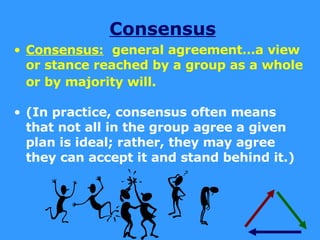
Consensus Consensus:   general agreement…a view or stance reached by a group as a whole or by majority will.   (In practice, consensus often means that not all in the group agree a given plan is ideal; rather, they may agree they can accept it and stand behind it.)
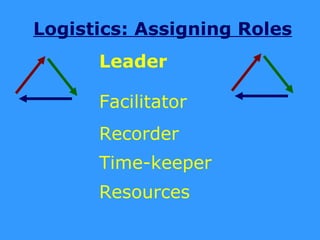
Logistics: Assigning Roles Leader Facilitator Recorder Time-keeper Resources
Meeting Roles Leader Establishes Direction Works to Decision Ensures Action Ensures Accountability Facilitator Keeps on Track Ensures Participation Keeps it Positive Establishes Trust Sticks to Agenda
Logistics: Room Set Up U shape Classroom Conference Style Table Groups
Logistics: Charts & Whiteboards 2-3 Bold Colors Use Their Words Color for Consistency Touch & Turn Technique Parking Lot(s)
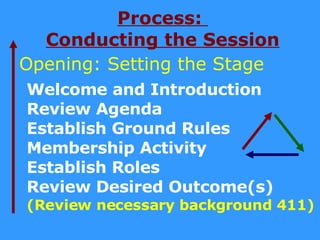
Process:  Conducting the Session Welcome and Introduction Review Agenda Establish Ground Rules Membership Activity Establish Roles Review Desired Outcome(s) (Review necessary background 411) Opening: Setting the Stage
Process:  Conducting the Session Content & Communication  Remain Positive Cover Activities to the D.O.
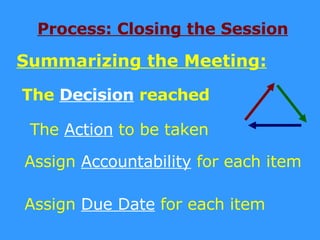
Process: Closing the Session The  Decision  reached The  Action   to be taken Assign  Due Date  for each item Assign  Accountability  for each item Summarizing the Meeting:
Process: Closing the Session Helps members commit to action Reinforces key decisions/learning points Provide support and encouragement Stimulates personal commitment Assign/Review Action Items Evaluate the Meeting
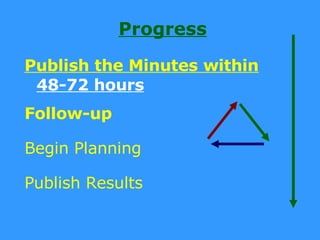
Progress Follow-up Begin Planning Publish Results Publish the Minutes within  48-72 hours
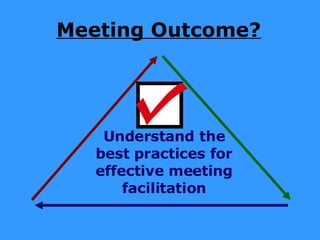
Meeting Outcome? Understand the best practices for effective meeting facilitation
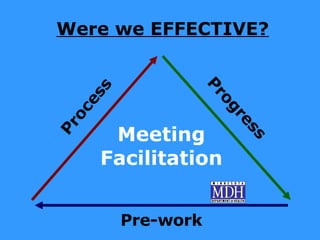
Were we EFFECTIVE? Meeting Facilitation Process Progress Pre-work

Facilitation

  • 1.
    Welcome to: E.F.F.E.C.T.I.V.E.Meeting Facilitation
  • 2.
    Facilitating My MeetingsMy greatest challenge :
  • 3.
    Session Outcome Understandthe best practices for effective meeting facilitation
  • 4.
    Agenda Welcome/Intro E.F.F.E.C.T.I.V.EMeeting Components: Pre-work Process Progress Wrap Up, Summary & Evaluations
  • 5.
    EFFECTIVE Essential FocusedFramework Established Collaborative Time-phased Initiative minded Valuable Evaluated
  • 6.
    Meeting Components Pre-work - Charts the course Process - Navigates the meeting Opening-Setting up the Session Conducting the Session Concluding the Session Progress - Ensures action
  • 7.
    Facilitator Focus ison ensuring that application of necessary activities, assignments and learning will occur
  • 8.
    Facilitator    Guides the team throughout project life      Establishes the working ground rules with the project team      Navigates back to the issue(s) at hand       Hosts the team and diplomatically acts as a referee or works through issues
  • 9.
    Facilitator Designs problem-solvingactivities Frames the medium used for the process Maintains a neutral perception throughout the facilitation process
  • 10.
    Educator Focus ison content mastery and understanding
  • 11.
    Educator Instructs theprojects team as needed Provides content though self or others Determines the learning needs throughout the life of the project Tutors team members when appropriate
  • 12.
    Coach Focus ison improving and enhancing performance
  • 13.
    Coach Strategizes-assigns positions,tasks Understands the players’ abilities Provides feedback to redirect, reinforce or extend performance Asks, encourages and offers help when needed
  • 14.
    Administrator Focus ison format and structure of event(s) to meet project outcomes
  • 15.
    Administrator Organizes teammeetings (pre and post meeting logistics) Acts as the liaison between team, stakeholders and sponsor Reports project status
  • 16.
    Administrator Manages andrevises plan Procures resources Navigates through additional changes that might occur Documents project activities, outcomes, products
  • 17.
    Communicator Focus ison ensuring that information is flowing productively
  • 18.
    Communicator Manages communicationwithin the group such as meeting summaries, project updates, etc. Serves as the bridge to all Translates content and concepts by effectively using various mediums to communicate, such as presentations, written documents, conferencing, etc. Connects the right people and resources
  • 19.
    Communicator Negotiates issuesas they arise in order to complete the project Promotes the product(s) resulting from the project Informs the sponsor to ensure ongoing support during the project life Contacts stakeholders as necessary throughout the life of the project
  • 20.
    Motivator Focus isto foster a motivating environment
  • 21.
    Motivator Encourages CongratulatesRecognizes Affirms Reinforces Rewards All involved with the project CHEER!
  • 22.
    Miscellaneous Time-keeperScribe Spokesperson
  • 23.
    Characteristics of FacilitationProtects participants self-esteem Understands and senses group energy and productivity and acts accordingly to keep ideas flowing and energy up Monitors the pace and quality Helps summarize and prioritize content Moves group to consensus & to define and assign next steps
  • 24.
    Characteristics of FacilitationCreates a participatory environment with active listening, dialogue creativity Directs group to focus and achieve desired outcomes Suggests helpful processes to meet outcomes Remains neutral on content
  • 25.
    Neutrality Difficult whenwe have multiple roles When possible, facilitate parts of the meeting where you are more apt to be neutral Ask another group member to facilitate topics that you have more content input needs
  • 26.
  • 27.
    Facilitation Competencies Providinga Motivating Environment Demonstrating Leadership Excellence Providing Feedback Managing Discussions & Activities Effective Communication-clear & timely, using various tools (Written & Oral)
  • 28.
    Delivery Do’s &Don’ts “ Professional Presence” Appropriate Body Language Appropriate Language Inclusive Certain Asking Questions Open Closed Polling
  • 29.
    Group Dynamics Collectiveexperience adds more than individual experience Building on the ideas and experiences of many increases synergy and creativity Productivity, quality and efficiency improve or are enhanced Improved communication skills through the group interactions
  • 30.
    Functional Behaviors ContributingSuggest ideas Offer facts, speculations and solutions Provide information relevant to the issue Clarifying Paraphrase, explain, ask clarifying questions, seek additional ideas & connect one idea to another Supporting Praise, encouragement, agreement, open communication Mediating Seek to understand other’s point of view Attempt to reconcile differences, “referee”
  • 31.
    Challenging Behaviors TheOver-Participator Self-Appointed Spokesperson Doting on Displeasure Readily Repetitive I’m Important
  • 32.
    Challenging Behaviors TheAggressive-Participator Sideshow Barking Enormous Emoting Constant Combating Know-it-all
  • 33.
    Challenging Behaviors TheUnder-Participator “ I have better things to do…” “ Excuse me for a minute…” “ I’ll have to check on that…” “ Could you do it?”
  • 34.
    What’s Up? Whatpossible resistance could there be? Why? What else might need consideration? What potential concerns are there? What else might I need to know?
  • 35.
    General Rules ofThumb Stay Calm Relaxed & Open (non-verbal) Reinforce Acceptable Behavior Refer to Ground Rules/Roles Allow Group to Discourage Refocus to D.O./Topic Activity Make a Direct Statement Time Out!
  • 36.
    ACT B.I.G. Describethe B EHAVIOR as you’ve seen and heard it Describe the I MPACT of the behavior—what it’s done to you, others, or what resulted from the act Explain the G ROWTH needed to get a positive outcome
  • 37.
    B.I.G. “ Whenyou _______________, I felt_________ and I noticed _________. I would like to see you __________ if a similar situation comes up.”
  • 38.
    Planning for YourAudience Types of behavior: Over Aggressive Under Strategies to try
  • 39.
    Communication Considerations Arethere issues where information is not communicated clearly? Actions Goals Progress
  • 40.
    Pre-work: Determining DesiredOutcomes Well Written D.O.s are: Positive Clear & Concise Control & Influence M easurable R esource-based E cological
  • 41.
    My Desired OutcomeThis meeting is to decide on a mandatory class to teach all staff on how to act professionally.
  • 42.
    My Desired OutcomeThe desired outcome of this meeting is to decide on a training program that promotes a harassment free workplace.
  • 43.
    More Desired OutcomesThis meeting is to stop wasting too much money. To reduce the number of people who show up late each day. To find ways to change the sagging morale in our department because there is too much tension and we’re not as productive as we should be. To have a team meeting .
  • 44.
    Reasons to Meet1. To identify problems To solve identified problems 3. Generate ideas, Brainstorming 4. Establish Goals or Plans 5. Training or Education
  • 45.
    Reasons NOT toMeet 1. Conversation, phone, or e-mail Not prepared, you and/or others 3. Decision makers are not available Desired Outcome is not clear (or written) 5. A decision has already been made
  • 46.
    Desired Outcomes Considerations: Purpose/Charge/Mission of Group Communication Needs Actions Goals Progress Decision-Making Protocol Guidelines
  • 47.
    Pre-work: Creating theAgenda AGENDA : a written document with critical information to get the right people together at the same time to accomplish a common Desired Outcome(s).
  • 48.
    Pre-work: Creating theAgenda What is the critical information? This is the stuff you need to do at the meeting in order to accomplish your Desired Outcome(s). Presentations Activities, etc.
  • 49.
    Pre-work: Creating theAgenda Contents : Desired Outcome(s) Start/End times Location(s)/Accommodations Meeting and Pre-work Assignments Topics/Items with times allocated
  • 50.
    Pre-work: Creating theAgenda Who are the right people? Can this person help reach the Desired Outcome(s)?
  • 51.
    Pre-work: Creating theAgenda Whenever possible, publish the Agenda at 48-72 hours prior to the meeting . Assign a start and end time to the meeting Assign a timeframe for each topic
  • 52.
    Pre-work: Creating theAgenda When and where should we meet? If you have access to schedules-set it up in the calendar system Ask participants to accept or decline
  • 53.
    Managing Expectations Designedto Build Trust Typically used: Ritual or Regular Meetings Training Sessions Problem Solving Sessions Group Facilitations
  • 54.
    Managing Expectations: GroundRules Identify Potential Hazards What are some of the things you’ve seen go wrong in a meeting? Minimize the Impact of Hazards What steps can be taken to keep the meeting as productive as possible?
  • 55.
    Basic Ground RulesStart & end on time Cell phones & pagers silent/off Stick to the agenda/participate Avoid side-bar conversations Maintain respect for all views Professional language Maintain confidentiality
  • 56.
    Managing Expectations: ParkingLots Conventional Unconventional
  • 57.
    Brainstorming Generate NewIdeas Spur Creativity Encourage Idea Association Stimulate Competition Among Teams
  • 58.
    Brainstorming Administrate tokeep it: On Target Lively Productive Creative
  • 59.
    Problem Solving Whatis the problem? What are all of the possible causes? What are all of the possible solutions? What is the best solution & why?
  • 60.
    Decision-Making Does thegroup have established guidelines? What are they? How are they defined?
  • 61.
    Consensus Consensus: general agreement…a view or stance reached by a group as a whole or by majority will. (In practice, consensus often means that not all in the group agree a given plan is ideal; rather, they may agree they can accept it and stand behind it.)
  • 62.
    Logistics: Assigning RolesLeader Facilitator Recorder Time-keeper Resources
  • 63.
    Meeting Roles LeaderEstablishes Direction Works to Decision Ensures Action Ensures Accountability Facilitator Keeps on Track Ensures Participation Keeps it Positive Establishes Trust Sticks to Agenda
  • 64.
    Logistics: Room SetUp U shape Classroom Conference Style Table Groups
  • 65.
    Logistics: Charts &Whiteboards 2-3 Bold Colors Use Their Words Color for Consistency Touch & Turn Technique Parking Lot(s)
  • 66.
    Process: Conductingthe Session Welcome and Introduction Review Agenda Establish Ground Rules Membership Activity Establish Roles Review Desired Outcome(s) (Review necessary background 411) Opening: Setting the Stage
  • 67.
    Process: Conductingthe Session Content & Communication Remain Positive Cover Activities to the D.O.
  • 68.
    Process: Closing theSession The Decision reached The Action to be taken Assign Due Date for each item Assign Accountability for each item Summarizing the Meeting:
  • 69.
    Process: Closing theSession Helps members commit to action Reinforces key decisions/learning points Provide support and encouragement Stimulates personal commitment Assign/Review Action Items Evaluate the Meeting
  • 70.
    Progress Follow-up BeginPlanning Publish Results Publish the Minutes within 48-72 hours
  • 71.
    Meeting Outcome? Understandthe best practices for effective meeting facilitation
  • 72.
    Were we EFFECTIVE?Meeting Facilitation Process Progress Pre-work

Editor's Notes

  • #2 (8:30) PG 1 Welcome to today’s EFFECTIVE meeting facilitation workshop. I’m pleased to be here today to work with you in improving our skills of meeting facilitation. No matter how long we’ve been doing it, we can always get better! In fact, we may be using many or all of the meeting best practices and still lead ineffective meetings! Whenever we facilitate a meeting, we are engaged in a growth experience in many competency or job skill areas. Most notably, interpersonal savvy, time management and drive for success and achievement.