Facilitation and
Facilitative Leadership
Some tricks of the trade for
New Jersey VISTA Leaders
small
agreements
Facilitation is the art of
What Facilitators Do…
➤ manage the process of dialogue, learning, or
decision making (involving a group)
➤ encourage participation and set a tone
➤ maintain focus on the task
➤ help build small agreements
➤ educational session; working meeting; conflict
resolution
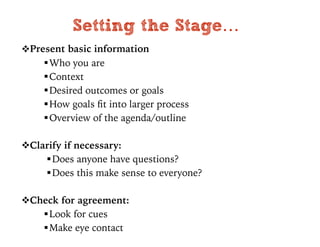
Setting the Stage…
!Present basic information
"Who you are
"Context
"Desired outcomes or goals
"How goals fit into larger process
"Overview of the agenda/outline
!Clarify if necessary:
"Does anyone have questions?
"Does this make sense to everyone?
!Check for agreement:
"Look for cues
"Make eye contact
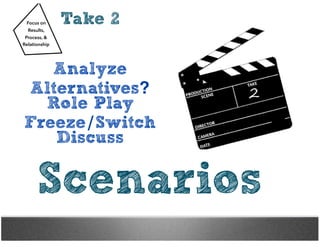
Take 2Focus on
Results,
Process, &
Relationship
Scenarios
Analyze
Alternatives?
Role Play
Freeze/Switch
Discuss
The Flow…
You are navigating a conversation or problem-solving attempt:
! First you might set out the question or issue (like defining an
outcome) in the context of a conversation, such as “What kind of
ice cream do we want for dessert? We can only have two kinds.”
! And you might open it up or guide it with a few constraints
or details, “Look they have 50 kinds of ice cream; might we go
around and hear preferences”
! Then, you might focus in a bit, “We will only have time to do
two strategies fully; we need to decide what is most important.”
! Then, the process comes to a close or transition of some
kind, “The surveys show that the partners brought in more than
half the recruits and the others were tapped by alumni; we
believe that strategy should take first priority.”
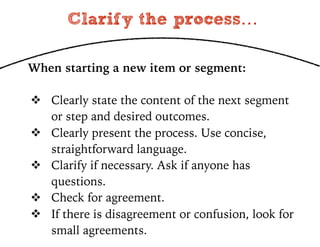
Clarify the process…
When starting a new item or segment:
! Clearly state the content of the next segment
or step and desired outcomes.
! Clearly present the process. Use concise,
straightforward language.
! Clarify if necessary. Ask if anyone has
questions.
! Check for agreement.
! If there is disagreement or confusion, look for
small agreements.
Open
Open consideration of a topic through open-ended
activities (brainstorm, questions, etc.
Narrow
Use a process to narrow the
information and considerations.
Close.
Reach closure
or transition
(e.g. next steps
for process).
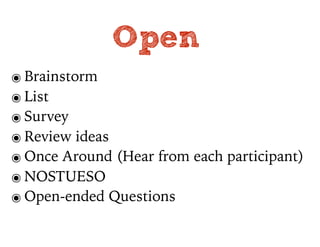
Open
๏ Brainstorm
๏ List
๏ Survey
๏ Review ideas
๏ Once Around (Hear from each participant)
๏ NOSTUESO
๏ Open-ended Questions
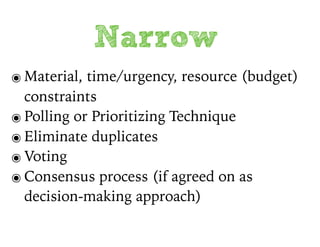
Narrow
๏ Material, time/urgency, resource (budget)
constraints
๏ Polling or Prioritizing Technique
๏ Eliminate duplicates
๏ Voting
๏ Consensus process (if agreed on as
decision-making approach)
Close
๏ Negative poll
๏ Decision - Prioritizing Technique or Voting
๏ Combine and build agreements until goal
is reached
๏ Define next steps for decision (e.g. “Okay
we have three possibilities to research –
let’s come back next week with the
information and we’ll decide based on
that”)
Take 2Focus on
Results,
Process, &
Relationship
Scenarios
Analyze
Alternatives?
Role Play
Freeze/Switch
Discuss
Bag of Tricks
Plus/Delta
fist of five
once around
the funnel
most interesting thing
Take 2Focus on
Results,
Process, &
Relationship
Scenarios
Analyze
Alternatives?
Role Play
Freeze/Switch
Discuss
Back on Track
boomerang
grounding in the ground rules
where are we
affirm then defer
whats going on
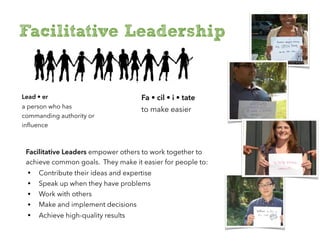
Facilitative Leadership
Lead • er
a person who has
commanding authority or
influence
Fa • cil • i • tate
to make easier
Facilitative Leaders empower others to work together to
achieve common goals. They make it easier for people to:
• Contribute their ideas and expertise
• Speak up when they have problems
• Work with others
• Make and implement decisions
• Achieve high-quality results
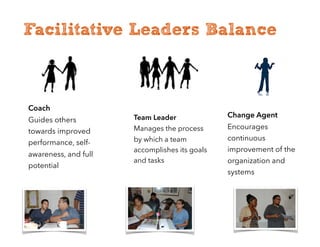
Facilitative Leaders Balance
Coach
Guides others
towards improved
performance, self-
awareness, and full
potential
Team Leader
Manages the process
by which a team
accomplishes its goals
and tasks
Change Agent
Encourages
continuous
improvement of the
organization and
systems
Eight Practices
Celebrate
Accomplishment
Team
Leader
Share an Inspiring
Vision
Focus on
Results,
Process, &
Relationship
Seek
Maximum
Appropriate
Involvement
Model Actions
that Facilitate
Collaboration
Design
Pathways
to
Action
Bring
Out the
Best in
Others
Build
the
Clock
Change Agent
Coach
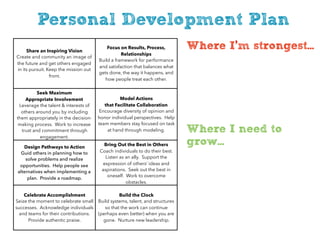
Share an Inspiring Vision
Create and community an image of
the future and get others engaged
in its pursuit. Keep the mission out
front.
Focus on Results, Process,
Relationships
Build a framework for performance
and satisfaction that balances what
gets done, the way it happens, and
how people treat each other.
Seek Maximum
Appropriate Involvement
Leverage the talent & interests of
others around you by including
them appropriately in the decision-
making process. Work to increase
trust and commitment through
engagement.
Model Actions
that Facilitate Collaboration
Encourage diversity of opinion and
honor individual perspectives. Help
team members stay focused on task
at hand through modeling.
Design Pathways to Action
Guid others in planning how to
solve problems and realize
opportunities. Help people see
alternatives when implementing a
plan. Provide a roadmap.
Bring Out the Best in Others
Coach individuals to do their best.
Listen as an ally. Support the
expression of others’ ideas and
aspirations. Seek out the best in
oneself. Work to overcome
obstacles.
Celebrate Accomplishment
Seize the moment to celebrate small
successes. Acknowledge individuals
and teams for their contributions.
Provide authentic praise.
Build the Clock
Build systems, talent, and structures
so that the work can continue
(perhaps even better) when you are
gone. Nurture new leadership.
Personal Development Plan
Where I’m strongest...
Where I need to
grow...
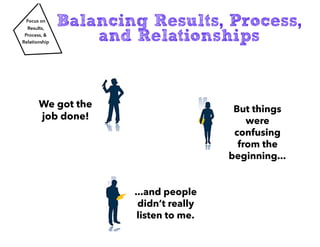
Balancing Results, Process,
and Relationships
We got the
job done!
Focus on
Results,
Process, &
Relationship
But things
were
confusing
from the
beginning...
...and people
didn’t really
listen to me.
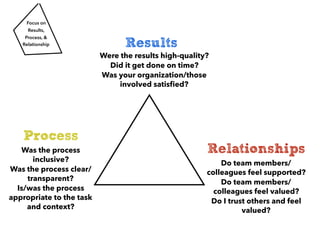
Results
Focus on
Results,
Process, &
Relationship
Relationships
Do team members/
colleagues feel supported?
Do team members/
colleagues feel valued?
Do I trust others and feel
valued?
Process
Was the process
inclusive?
Was the process clear/
transparent?
Is/was the process
appropriate to the task
and context?
Were the results high-quality?
Did it get done on time?
Was your organization/those
involved satisfied?
Facilitation
Outcomes/Goals
Relationships
/Dynamics
The facilitator has to be
aware of and observant
about the individuals’ and
group’s behavior and
participation, attempting
to reaffirm and trust
participants’ contributions
Process/
How
The facilitator is
concerned about how to
get to the aim, paying
attention to the quality
of the process, its flow,
and its efficiency.
The facilitator is attempting to get
to a particular outcome or end.
This is usually a goal or aim.
Take 2: Seek Maximum
Appropriate Involvement
Level of
involvement
Seek
Maximum
Appropriate
Involvement
Time and Other Constraints
Decide &
announce
Gather input from
individuals & decide
Gather input from
team & decide
Use
Consensus
Delegate decision
with constraints
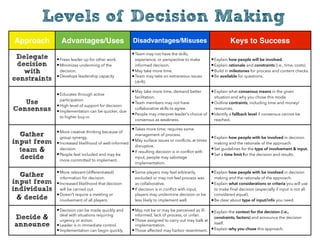
Approach Advantages/Uses Disadvantages/Misuses Keys to Success
Delegate
decision
with
constraints
•Frees leader up for other work.
•Minimizes underming of the
decision.
•Develops leadership capacity
•Team may not have the skills,
experience, or perspective to make
informed decision.
•May take more time.
•Team may take on extraneous issues
(drift).
•Explain how people will be involved.
•Explain rationale and constraints (i.e., time, costs).
•Build in milestones for process and content checks.
•Be available for questions.
Use
Consensus
•Educates through active
participation.
•High level of support for decision.
•Implementation can be quicker, due
to higher buy-in.
•May take more time, demand better
facilitation.
•Team members may not have
collaborative skills to agree.
•People may interpret leader’s choice of
consensus as weakness.
•Explain what consensus means in the given
situation and why you chose this mode.
•Outline contraints, including time and money/
resources.
•Identify a fallback level if consensus cannot be
reached.
Gather
input from
team &
decide
•More creative thinking because of
group synergy.
•Increased likelihood of well-informed
decision.
•People feel included and may be
more committed to implement.
•Takes more time; requires some
management of process.
•May surface issues or conflicts, at times
disruptive.
•If resulting decision is in conflict with
input, people may sabotage
implementation.
•Explain how people with be involved in decision
making and the rationale of the approach.
•Set guidelines for the type of involvement & input.
•Set a time limit for the decision and results.
Gather
input from
individuals
& decide
•More relevant (differentiated)
information for decision.
•Increased likelihood that decision
will be carried out.
•Doesn’t require a meeting or
involvement of all players.
•Some players may feel arbitrarily
excluded or may not feel process was
as collaborative.
•If decision is in conflict with input,
players may undermine decision or be
less likely to implement well.
•Explain how people with be involved in decision
making and the rationale of the approach.
•Explain what considerations or criteria you will use
to make final decision (especially if input is not all
considered equal).
•Be clear about type of input/info you need.
Decide &
announce
•Decision can be made quickly and
deal with situations requiring
urgency or action.
•Leader is in immediate control.
•Implementation can begin quickly.
•May not be or may be perceived as ill-
informed, lack of process, or unfair.
•Those assigned to carry out may balk at
implementation.
•Those affected may harbor resentment.
•Explain the context for the decision (i.e.,
constraints, factors) and announce the decision
itself.
•Explain why you chose this approach.
Levels of Decision Making
Take 2Focus on
Results,
Process, &
Relationship
Scenarios
Analyze
Alternatives?
Role Play
Freeze/Switch
Discuss

Facilitation and Facilitative Leadership

  • 1.
    Facilitation and Facilitative Leadership Sometricks of the trade for New Jersey VISTA Leaders
  • 2.
  • 3.
    What Facilitators Do… ➤manage the process of dialogue, learning, or decision making (involving a group) ➤ encourage participation and set a tone ➤ maintain focus on the task ➤ help build small agreements ➤ educational session; working meeting; conflict resolution
  • 4.
    Setting the Stage… !Presentbasic information "Who you are "Context "Desired outcomes or goals "How goals fit into larger process "Overview of the agenda/outline !Clarify if necessary: "Does anyone have questions? "Does this make sense to everyone? !Check for agreement: "Look for cues "Make eye contact
  • 5.
    Take 2Focus on Results, Process,& Relationship Scenarios Analyze Alternatives? Role Play Freeze/Switch Discuss
  • 6.
    The Flow… You arenavigating a conversation or problem-solving attempt: ! First you might set out the question or issue (like defining an outcome) in the context of a conversation, such as “What kind of ice cream do we want for dessert? We can only have two kinds.” ! And you might open it up or guide it with a few constraints or details, “Look they have 50 kinds of ice cream; might we go around and hear preferences” ! Then, you might focus in a bit, “We will only have time to do two strategies fully; we need to decide what is most important.” ! Then, the process comes to a close or transition of some kind, “The surveys show that the partners brought in more than half the recruits and the others were tapped by alumni; we believe that strategy should take first priority.”
  • 7.
    Clarify the process… Whenstarting a new item or segment: ! Clearly state the content of the next segment or step and desired outcomes. ! Clearly present the process. Use concise, straightforward language. ! Clarify if necessary. Ask if anyone has questions. ! Check for agreement. ! If there is disagreement or confusion, look for small agreements.
  • 8.
    Open Open consideration ofa topic through open-ended activities (brainstorm, questions, etc. Narrow Use a process to narrow the information and considerations. Close. Reach closure or transition (e.g. next steps for process).
  • 9.
    Open ๏ Brainstorm ๏ List ๏Survey ๏ Review ideas ๏ Once Around (Hear from each participant) ๏ NOSTUESO ๏ Open-ended Questions
  • 10.
    Narrow ๏ Material, time/urgency,resource (budget) constraints ๏ Polling or Prioritizing Technique ๏ Eliminate duplicates ๏ Voting ๏ Consensus process (if agreed on as decision-making approach)
  • 11.
    Close ๏ Negative poll ๏Decision - Prioritizing Technique or Voting ๏ Combine and build agreements until goal is reached ๏ Define next steps for decision (e.g. “Okay we have three possibilities to research – let’s come back next week with the information and we’ll decide based on that”)
  • 12.
    Take 2Focus on Results, Process,& Relationship Scenarios Analyze Alternatives? Role Play Freeze/Switch Discuss
  • 13.
    Bag of Tricks Plus/Delta fistof five once around the funnel most interesting thing
  • 14.
    Take 2Focus on Results, Process,& Relationship Scenarios Analyze Alternatives? Role Play Freeze/Switch Discuss
  • 15.
    Back on Track boomerang groundingin the ground rules where are we affirm then defer whats going on
  • 16.
    Facilitative Leadership Lead •er a person who has commanding authority or influence Fa • cil • i • tate to make easier Facilitative Leaders empower others to work together to achieve common goals. They make it easier for people to: • Contribute their ideas and expertise • Speak up when they have problems • Work with others • Make and implement decisions • Achieve high-quality results
  • 17.
    Facilitative Leaders Balance Coach Guidesothers towards improved performance, self- awareness, and full potential Team Leader Manages the process by which a team accomplishes its goals and tasks Change Agent Encourages continuous improvement of the organization and systems
  • 18.
    Eight Practices Celebrate Accomplishment Team Leader Share anInspiring Vision Focus on Results, Process, & Relationship Seek Maximum Appropriate Involvement Model Actions that Facilitate Collaboration Design Pathways to Action Bring Out the Best in Others Build the Clock Change Agent Coach
  • 19.
    Share an InspiringVision Create and community an image of the future and get others engaged in its pursuit. Keep the mission out front. Focus on Results, Process, Relationships Build a framework for performance and satisfaction that balances what gets done, the way it happens, and how people treat each other. Seek Maximum Appropriate Involvement Leverage the talent & interests of others around you by including them appropriately in the decision- making process. Work to increase trust and commitment through engagement. Model Actions that Facilitate Collaboration Encourage diversity of opinion and honor individual perspectives. Help team members stay focused on task at hand through modeling. Design Pathways to Action Guid others in planning how to solve problems and realize opportunities. Help people see alternatives when implementing a plan. Provide a roadmap. Bring Out the Best in Others Coach individuals to do their best. Listen as an ally. Support the expression of others’ ideas and aspirations. Seek out the best in oneself. Work to overcome obstacles. Celebrate Accomplishment Seize the moment to celebrate small successes. Acknowledge individuals and teams for their contributions. Provide authentic praise. Build the Clock Build systems, talent, and structures so that the work can continue (perhaps even better) when you are gone. Nurture new leadership. Personal Development Plan Where I’m strongest... Where I need to grow...
  • 20.
    Balancing Results, Process, andRelationships We got the job done! Focus on Results, Process, & Relationship But things were confusing from the beginning... ...and people didn’t really listen to me.
  • 21.
    Results Focus on Results, Process, & Relationship Relationships Doteam members/ colleagues feel supported? Do team members/ colleagues feel valued? Do I trust others and feel valued? Process Was the process inclusive? Was the process clear/ transparent? Is/was the process appropriate to the task and context? Were the results high-quality? Did it get done on time? Was your organization/those involved satisfied?
  • 22.
    Facilitation Outcomes/Goals Relationships /Dynamics The facilitator hasto be aware of and observant about the individuals’ and group’s behavior and participation, attempting to reaffirm and trust participants’ contributions Process/ How The facilitator is concerned about how to get to the aim, paying attention to the quality of the process, its flow, and its efficiency. The facilitator is attempting to get to a particular outcome or end. This is usually a goal or aim.
  • 23.
    Take 2: SeekMaximum Appropriate Involvement Level of involvement Seek Maximum Appropriate Involvement Time and Other Constraints Decide & announce Gather input from individuals & decide Gather input from team & decide Use Consensus Delegate decision with constraints
  • 24.
    Approach Advantages/Uses Disadvantages/MisusesKeys to Success Delegate decision with constraints •Frees leader up for other work. •Minimizes underming of the decision. •Develops leadership capacity •Team may not have the skills, experience, or perspective to make informed decision. •May take more time. •Team may take on extraneous issues (drift). •Explain how people will be involved. •Explain rationale and constraints (i.e., time, costs). •Build in milestones for process and content checks. •Be available for questions. Use Consensus •Educates through active participation. •High level of support for decision. •Implementation can be quicker, due to higher buy-in. •May take more time, demand better facilitation. •Team members may not have collaborative skills to agree. •People may interpret leader’s choice of consensus as weakness. •Explain what consensus means in the given situation and why you chose this mode. •Outline contraints, including time and money/ resources. •Identify a fallback level if consensus cannot be reached. Gather input from team & decide •More creative thinking because of group synergy. •Increased likelihood of well-informed decision. •People feel included and may be more committed to implement. •Takes more time; requires some management of process. •May surface issues or conflicts, at times disruptive. •If resulting decision is in conflict with input, people may sabotage implementation. •Explain how people with be involved in decision making and the rationale of the approach. •Set guidelines for the type of involvement & input. •Set a time limit for the decision and results. Gather input from individuals & decide •More relevant (differentiated) information for decision. •Increased likelihood that decision will be carried out. •Doesn’t require a meeting or involvement of all players. •Some players may feel arbitrarily excluded or may not feel process was as collaborative. •If decision is in conflict with input, players may undermine decision or be less likely to implement well. •Explain how people with be involved in decision making and the rationale of the approach. •Explain what considerations or criteria you will use to make final decision (especially if input is not all considered equal). •Be clear about type of input/info you need. Decide & announce •Decision can be made quickly and deal with situations requiring urgency or action. •Leader is in immediate control. •Implementation can begin quickly. •May not be or may be perceived as ill- informed, lack of process, or unfair. •Those assigned to carry out may balk at implementation. •Those affected may harbor resentment. •Explain the context for the decision (i.e., constraints, factors) and announce the decision itself. •Explain why you chose this approach. Levels of Decision Making
  • 25.
    Take 2Focus on Results, Process,& Relationship Scenarios Analyze Alternatives? Role Play Freeze/Switch Discuss