Facilitation Skills
Learning Objectives . To understand the roles of facilitators .To understand the facilitator’s basic responsibilities  .To understand the structure of facilitation map   .To understand the basic facilitation skills
Program Outline and Timelines 1.Getting Started  – 30 minutes 2.Basic Responsibilities of a Facilitator  –  120  minutes 3.Basic Facilitation Map – 60 Minutes 4.The Facilitation Techniques – 180   minutes 5.Conclusion – 30 minutes
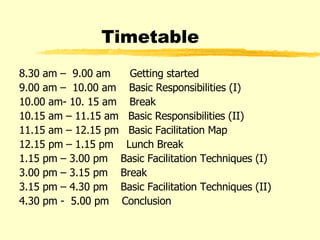
Timetable 8.30 am –  9.00 am  Getting started 9.00 am –  10.00 am  Basic Responsibilities (I) 10.00 am- 10. 15 am  Break 10.15 am – 11.15 am  Basic Responsibilities (II) 11.15 am – 12.15 pm  Basic Facilitation Map 12.15 pm – 1.15 pm  Lunch Break 1.15 pm – 3.00 pm  Basic Facilitation Techniques (I) 3.00 pm – 3.15 pm  Break 3.15 pm – 4.30 pm  Basic Facilitation Techniques (II) 4.30 pm -  5.00 pm  Conclusion
Module 1 Getting Started Getting Started
Warm Up Name Your Team
Module 1 Getting Started 1. What do you think a facilitator is?
Module 1 Getting Started What do you think a facilitator is? Facilitator is the individual responsible    for guiding a team through a process in   order to accomplish a specific task or   achieve a specific goals or outcomes
2. The Business Environment and the role of Facilitator (read notes) What’s today’s business situation?  Volatile or Stable? Fast product cycle or slow cycle? Module 1 Getting Started
2. The Business Environment and the role of Facilitator (read notes) Fast !! Do it first. Task Behaviors Module 1 Getting Started
Task behaviors Doing Work Independently Making logic-based decisions Acting Moving things along Focusing on details Directing Bringing things to closure (making decisions) Controlling Telling Focusing on the job at hand Resistance to change
3. The importance of facilitation to enhance process behaviors Success though planning and discussion Module 1 Getting Started
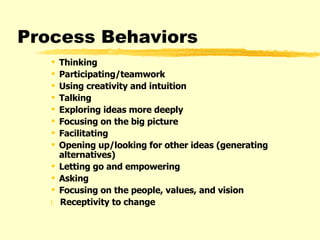
Process Behaviors Thinking Participating/teamwork Using creativity and intuition Talking Exploring ideas more deeply Focusing on the big picture Facilitating Opening up/looking for other ideas (generating alternatives) Letting go and empowering Asking Focusing on the people, values, and vision Receptivity to change
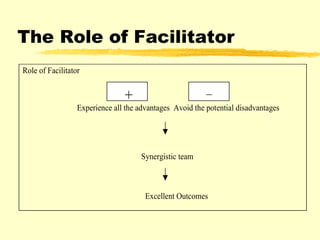
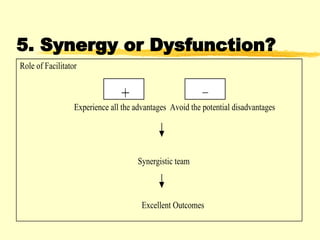
4. The Role of Facilitator The facilitator’s task is to ensure that a team   a.  avoids the potential disadvantages and   b.  experiences all of the advantages   and so performs as a synergistic team creating excellent outcomes
The definition of facilitation Komag’s SDWT Context Facilitator is the individual who designs and manages of structures and processes that help a group do its work and minimize the common problems  Komag’s Definition
The Role of Facilitator
5. Working In a Team Advantages  Disadvantages
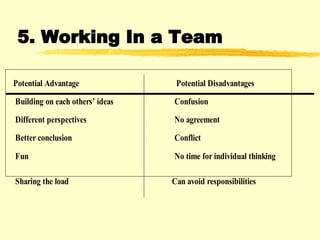
5. Working In a Team
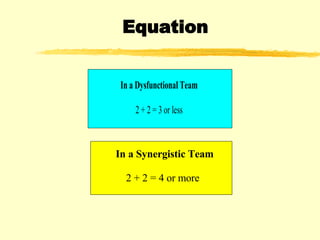
In a Synergistic Team 2 + 2 = 4 or more Equation
5. Synergy or Dysfunction?
synergy ,  synergism noun [U]  SPECIALIZED  the combined power of a group of things when they are working together which is greater than the total power achieved by each working separately  (from  Cambridge International Dictionary of English )   Definition of Word
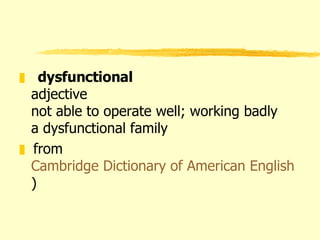
dysfunctional adjective  not able to operate well; working badly  a dysfunctional family from  Cambridge Dictionary of American English )
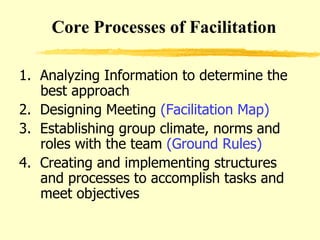
1.  Analyzing Information to determine the best approach 2.  Designing Meeting  (Facilitation Map) 3.  Establishing group climate, norms and roles with the team  (Ground Rules) 4.  Creating and implementing structures and processes to accomplish tasks and meet objectives Core Processes of Facilitation
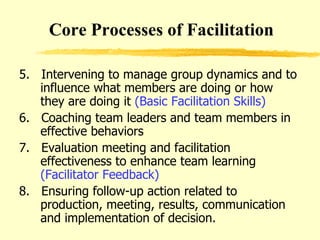
5.  Intervening to manage group dynamics and to influence what members are doing or how they are doing it  (Basic Facilitation Skills) 6.  Coaching team leaders and team members in effective behaviors 7.  Evaluation meeting and facilitation effectiveness to enhance team learning  (Facilitator Feedback) 8.  Ensuring follow-up action related to production, meeting, results, communication and implementation of decision. Core Processes of Facilitation
Facilitator is  essential for today’s business in two aspects: a. It helps the team to focus on  process   behaviors , that is planning, thinking and discussion b. It helps  the team to  bring out the best part  of team to be more synergistic.   Conclusion
Module 2 Introduction to the Basic Responsibilities of a  Facilitator
Module 2 What are the essential responsibilities of facilitator?
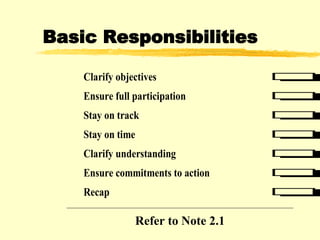
Basic Responsibilities Refer to Note 2.1
Clarify Objectives Explain what  the topic is What do we want to achieve? Why are we having this meeting?
Clarify Objectives For example: Background :the team is calling for quarter end outing .  Objectives Department Outing   What do we want to achieve? Identify venue and select organizing  committee
Clarify Objectives For example: Background: The team discuss the issue of labeling and displaying goods   Objectives Housekeeping   What do we want to achieve? Identify issues faced by HIT leaders
Ensure Full Participation Everyone must have an equal opportunity to participate and that all participants contribute to the process
Ensure Full Participation How do you handle such situation? Quiet person? Talkative person?
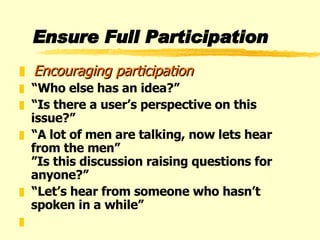
Ensure Full Participation Encouraging participation “ Who else has an idea?” “ Is there a user’s perspective on this issue?” “ A lot of men are talking, now lets hear from the men” ”Is this discussion raising questions for anyone?” “ Let’s hear from someone who hasn’t spoken in a while”  
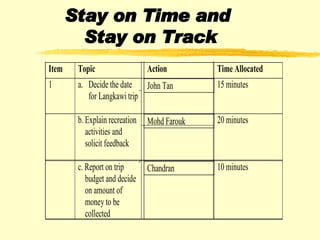
Stay on Time and  Stay on Track
Stay on Time and  Stay on Track What happen when the team does not stay on track? What would you do?
Stay on Time and  Stay on Track What happen when the team does not stay on time? What would you do?
Clarify Understanding Ask for examples, pictures, diagrams, data Ask if other participants understand what was being said
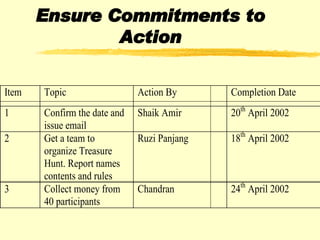
Ensure Commitments to Action identifying who is to do what and when
Ensure Commitments to Action
Recap Recap what has been decided “ Today we have decided to adopt 5S as the way to improve our housekeeping system. Anyone has anymore concerns?”
Recap Recap who has agreed to do what and by when “ John has agreed to lead the Housekeeping Improvement Team. He will submit a plan for training, discussion and implementation by 18 th  of April. We will discuss the plan in next meeting. John do you have anything to add?”
Preparation for Workout – Feedback Guideline
Giving Feedback You are not looking for what you “like” or “don’t like” about a person’s facilitation style. Select feedback that can benefit the practice facilitator. No personal attack.
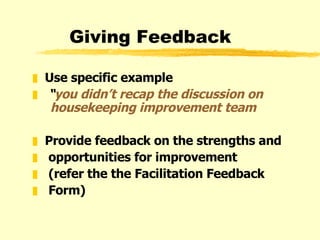
Giving Feedback Use specific example “ you didn’t recap the discussion on   housekeeping improvement team Provide feedback on the strengths and  opportunities for improvement (refer the the Facilitation Feedback Form)
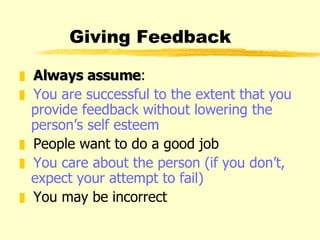
Giving Feedback Always assume : You are successful to the extent that you provide feedback without lowering the person’s self esteem People want to do a good job You care about the person (if you don’t, expect your attempt to fail) You may be incorrect
Receiving Feedback People often uncomfortable receiving feedback But they take risk to tell you.
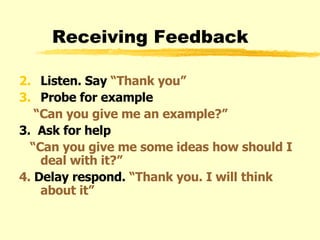
Receiving Feedback Listen. Say  “Thank you” Probe for example  “ Can you give me an example?” 3.  Ask for help “ Can you give me some ideas how should I deal with it?” 4.  Delay respond.  “Thank you. I will think about it”
Example of FON, FF Facilitation Observation Notes Refer to Note 2.2 and  Note 2.3
Team Workout Identifying Facilitation Challenges Refer to Note 2.4
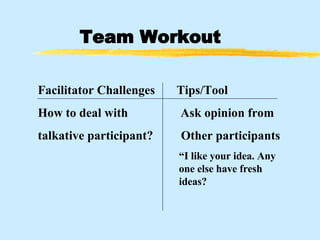
Team Workout Facilitator Challenges  Tips/Tool How to deal with  Ask opinion from talkative participant?  Other participants “ I like your idea. Any   one else have fresh    ideas?
Team Workout Practice facilitator Time Keeper Note Keeper Facilitation Observer
Team Workout Time Allocation 5 minutes of preparation 25 minutes Workout 10 minutes feedback
Team Workout: Feedback What has the person done well? How can the improve ?
Team Workout Key Learning Points
Module 3 Road Map for facilitation Success
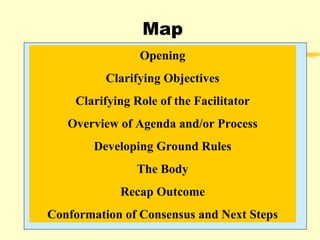
Map Opening Clarifying Objectives Clarifying Role of the Facilitator Overview of Agenda and/or Process Developing Ground Rules The Body Recap Outcome Conformation of Consensus and Next Steps
Notes Example Refer to Note 3.1 Explanation Refer to Note 3.2
Opening First few words Set the tone – positive Get their attention  Tell them the purpose of the meeting
Clarifying Objectives What do we want to achieve? Why do we meet today? Present a brief statement of objectives (written form) – reminder “ are we on track?”
Clarifying the Role of Facilitator Tell them what you do –  as process expert,  not content expert  Tell them how you will intervene  - off track: “ I will pull you back” - dominant conversation: “I will gate keep the conversation”
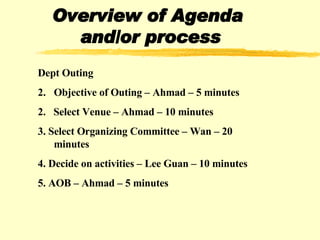
Overview of Agenda  and/or process Dept Outing Objective of Outing – Ahmad – 5 minutes 2.  Select Venue – Ahmad – 10 minutes 3. Select Organizing Committee – Wan – 20 minutes 4. Decide on activities – Lee Guan – 10 minutes 5. AOB – Ahmad – 5 minutes
Developing Ground Rules Powerful tool to shape culture. The team empower you to lead the team How the team behave and work together Write in a flipchart. Put it up for the first five meetings to remind them
Ground Rules 1.  We are prompt and regular in attendance 2.        We listen attentively 3.        We only allow one person talk at a time 4.        We complete assigned work within stipulated time 5.        We appreciate the other person’s point of view 6.        We provide constructive feedback and receive it    willingly 7.        We keep confidences and assume others will 8.        We stick to the agenda and schedule unless we    agree to change them 9.        We are here to find solutions, not to fight and win  
The Body The part the team tackle the issues You apply most tools
The Body Fact finding Brainstorming Action Plan Problem Solving Decision Making Brainstorming Communicating
Recap Outcomes Recap outcome briefly to ensure understanding Recap what has been decided Recap who has agreed to do what and by when
Confirmation of Consensus and Next Steps Confirm of the actions agreed to be taken or decisions have been made Decide on next meeting or things to do next
Team Workout Using The Facilitation Map as a Planning Tool Refer to Note 3.3
Team Workout Practice facilitator Time Keeper Note Keeper Facilitation Observer
Team Workout The practice Facilitator identifies a meeting/team process that he or she is likely to facilitate in the near future. Use that as the background of this Workout
Team Workout The team must use the Facilitation Map to facilitate the meeting but ONLY for the first five steps.
Team Workout Time Allocation 5 minutes of preparation 15 minutes Workout 5 minutes feedback
Team Workout: Feedback What has the person done well? How can the improve ?
Team Workout Key Learning Points
Module 4 Basic Facilitation Skills
Focus on Basic Skills There are many facilitation skills such as decision making, problem solving etc.  We focus on the fundamental. You will learn 26 skills altogether.
Background You will see facilitation skills used in marketing and shipping department
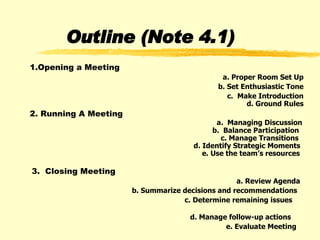
Outline (Note 4.1) 1.Opening a Meeting  a. Proper Room Set Up b. Set Enthusiastic Tone c.  Make Introduction   d. Ground Rules 2. Running A Meeting   a.  Managing Discussion   b.  Balance Participation   c. Manage Transitions   d. Identify Strategic Moments   e. Use the team’s resources 3.  Closing Meeting a. Review Agenda b. Summarize decisions and recommendations  c. Determine remaining issues  d. Manage follow-up actions  e. Evaluate Meeting
View Video Watch video for familiarization.   It takes only 15 minutes
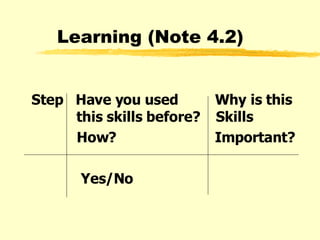
Learning (Note 4.2) Step  Have you used  Why is this   this skills before?  Skills  How?  Important? Yes/No
Stretch Your Mind View Tape   Answer Questions   Share with the group   Refer to Note 4.1
Opening A Meeting Proper Room Set Up Chair/ Table/ Light/ Refreshment/ Flipchart/AV…
Opening A Meeting Set Enthusiastic Tone Positive/ High Energy/ Your mood affect them/ Positive Body Language…
Opening A Meeting Make Introduction Get to know them/  Come early/ Be positive/ Everyone is important…
Opening A Meeting Ground Rules Rules/ Form culture/ Let the team generate/ …
Manage Discussion Ask Clarifying Questions 5W1H/ Ask if the team understand…
Manage Discussion Build Team Memory Use flipchart/ Paste it/ Unsure common understanding…
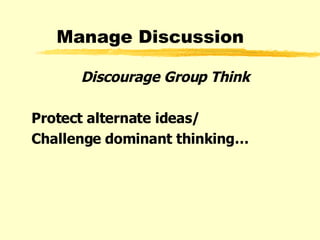
Manage Discussion Discourage Group Think Protect alternate ideas/ Challenge dominant thinking…
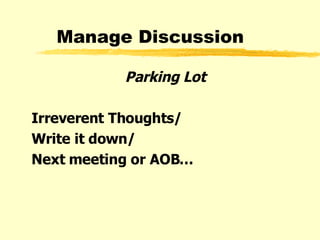
Manage Discussion Parking Lot Irreverent Thoughts/ Write it down/ Next meeting or AOB…
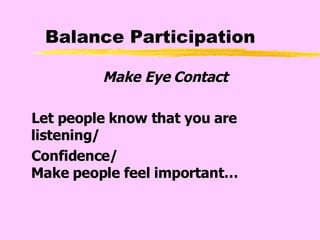
Balance Participation Make Eye Contact Let people know that you are listening/ Confidence/ Make people feel important…
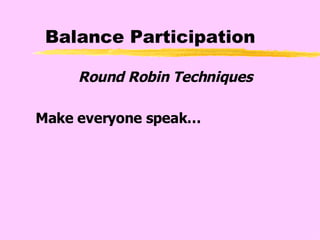
Balance Participation Round Robin Techniques Make everyone speak…
Balance Participation Include Everyone
Balance Participation Ask Low Participants For Help
Manage Transitions Summarize the Topics
Manage Transitions Use Clear Segues
Manage Transitions Agenda As Road Map
Identify Strategic Moments Note Moments of team Agreement
Identify Strategic Moments Summarize Key Points
Use The Team’s Resources Use Open-Ended Questions 5W1H…
Use The Team’s Resources Tolerate Silence 20 seconds/ Create pressure…
Use The Team’s Resources Mobilize Team Knowledge
Use The team’s Resources Use their Words
Closing A Meeting Review Agenda
Closing A Meeting Summarize Decisions and Recommendations
Closing A Meeting Determine Remaining Issues
Closing A Meeting Manage Follow-Up Actions
Closing A Meeting Evaluate Meeting
Team Workout Running A Meeting – Pros and Cons Refer to Note 4.3
Team Workout Practice facilitator Time Keeper Note Keeper Facilitation Observer
Team Workout The Practice Facilitator select a topic form the list. Explore the pros and cons  of the issue. Use Facilitation Map and Basic Facilitation Skills.
Team Workout Topics 1.  Should we allow Internet access to every employee?   2.  Can we hold our Family day in Langkawi? Employees are   allowed to bring spouse.   3. Should we build a multi-storey car park?   4. Should we work without uniform?   5. Should the company provide us free breakfast? 6.  Should we assign a person to oversee the sustainability of   housekeeping at Common area?  
Team Workout The rest of the team members should agree among themselves who will  be argue in favor and who will be argue against the presented idea.
Team Workout The selected team will do the workout before the class. The class would be their observer. Half of the class evaluates the  Responsibilities of Facilitator  and the other half evaluates  Basic Facilitation Skills
Team Workout Time Allocation 5 minutes of preparation 20 minutes Workout 10 minutes feedback
Team Workout: Feedback What has the person done well? How can the improve ?
Team Workout Key Learning Points
Conclusion Open Book Quiz Refer to Note 5.1
Questions The role of facilitator The responsibilities of Facilitator The Facilitation Map Basic facilitation skills
Sharing 1.      Share three things you have picked up from this training 1`. 2. 3.   

Facilitation Training for Team Members

  • 1.
  • 2.
    Learning Objectives .To understand the roles of facilitators .To understand the facilitator’s basic responsibilities .To understand the structure of facilitation map .To understand the basic facilitation skills
  • 3.
    Program Outline andTimelines 1.Getting Started – 30 minutes 2.Basic Responsibilities of a Facilitator – 120 minutes 3.Basic Facilitation Map – 60 Minutes 4.The Facilitation Techniques – 180 minutes 5.Conclusion – 30 minutes
  • 4.
    Timetable 8.30 am– 9.00 am Getting started 9.00 am – 10.00 am Basic Responsibilities (I) 10.00 am- 10. 15 am Break 10.15 am – 11.15 am Basic Responsibilities (II) 11.15 am – 12.15 pm Basic Facilitation Map 12.15 pm – 1.15 pm Lunch Break 1.15 pm – 3.00 pm Basic Facilitation Techniques (I) 3.00 pm – 3.15 pm Break 3.15 pm – 4.30 pm Basic Facilitation Techniques (II) 4.30 pm - 5.00 pm Conclusion
  • 5.
    Module 1 GettingStarted Getting Started
  • 6.
    Warm Up NameYour Team
  • 7.
    Module 1 GettingStarted 1. What do you think a facilitator is?
  • 8.
    Module 1 GettingStarted What do you think a facilitator is? Facilitator is the individual responsible for guiding a team through a process in order to accomplish a specific task or achieve a specific goals or outcomes
  • 9.
    2. The BusinessEnvironment and the role of Facilitator (read notes) What’s today’s business situation? Volatile or Stable? Fast product cycle or slow cycle? Module 1 Getting Started
  • 10.
    2. The BusinessEnvironment and the role of Facilitator (read notes) Fast !! Do it first. Task Behaviors Module 1 Getting Started
  • 11.
    Task behaviors DoingWork Independently Making logic-based decisions Acting Moving things along Focusing on details Directing Bringing things to closure (making decisions) Controlling Telling Focusing on the job at hand Resistance to change
  • 12.
    3. The importanceof facilitation to enhance process behaviors Success though planning and discussion Module 1 Getting Started
  • 13.
    Process Behaviors ThinkingParticipating/teamwork Using creativity and intuition Talking Exploring ideas more deeply Focusing on the big picture Facilitating Opening up/looking for other ideas (generating alternatives) Letting go and empowering Asking Focusing on the people, values, and vision Receptivity to change
  • 14.
    4. The Roleof Facilitator The facilitator’s task is to ensure that a team a. avoids the potential disadvantages and b. experiences all of the advantages and so performs as a synergistic team creating excellent outcomes
  • 15.
    The definition offacilitation Komag’s SDWT Context Facilitator is the individual who designs and manages of structures and processes that help a group do its work and minimize the common problems Komag’s Definition
  • 16.
    The Role ofFacilitator
  • 17.
    5. Working Ina Team Advantages Disadvantages
  • 18.
  • 19.
    In a SynergisticTeam 2 + 2 = 4 or more Equation
  • 20.
    5. Synergy orDysfunction?
  • 21.
    synergy , synergism noun [U] SPECIALIZED the combined power of a group of things when they are working together which is greater than the total power achieved by each working separately (from Cambridge International Dictionary of English ) Definition of Word
  • 22.
    dysfunctional adjective not able to operate well; working badly a dysfunctional family from Cambridge Dictionary of American English )
  • 23.
    1. AnalyzingInformation to determine the best approach 2. Designing Meeting (Facilitation Map) 3. Establishing group climate, norms and roles with the team (Ground Rules) 4. Creating and implementing structures and processes to accomplish tasks and meet objectives Core Processes of Facilitation
  • 24.
    5. Interveningto manage group dynamics and to influence what members are doing or how they are doing it (Basic Facilitation Skills) 6. Coaching team leaders and team members in effective behaviors 7. Evaluation meeting and facilitation effectiveness to enhance team learning (Facilitator Feedback) 8. Ensuring follow-up action related to production, meeting, results, communication and implementation of decision. Core Processes of Facilitation
  • 25.
    Facilitator is essential for today’s business in two aspects: a. It helps the team to focus on process behaviors , that is planning, thinking and discussion b. It helps the team to bring out the best part of team to be more synergistic. Conclusion
  • 26.
    Module 2 Introductionto the Basic Responsibilities of a Facilitator
  • 27.
    Module 2 Whatare the essential responsibilities of facilitator?
  • 28.
  • 29.
    Clarify Objectives Explainwhat the topic is What do we want to achieve? Why are we having this meeting?
  • 30.
    Clarify Objectives Forexample: Background :the team is calling for quarter end outing . Objectives Department Outing What do we want to achieve? Identify venue and select organizing committee
  • 31.
    Clarify Objectives Forexample: Background: The team discuss the issue of labeling and displaying goods Objectives Housekeeping What do we want to achieve? Identify issues faced by HIT leaders
  • 32.
    Ensure Full ParticipationEveryone must have an equal opportunity to participate and that all participants contribute to the process
  • 33.
    Ensure Full ParticipationHow do you handle such situation? Quiet person? Talkative person?
  • 34.
    Ensure Full ParticipationEncouraging participation “ Who else has an idea?” “ Is there a user’s perspective on this issue?” “ A lot of men are talking, now lets hear from the men” ”Is this discussion raising questions for anyone?” “ Let’s hear from someone who hasn’t spoken in a while”  
  • 35.
    Stay on Timeand Stay on Track
  • 36.
    Stay on Timeand Stay on Track What happen when the team does not stay on track? What would you do?
  • 37.
    Stay on Timeand Stay on Track What happen when the team does not stay on time? What would you do?
  • 38.
    Clarify Understanding Askfor examples, pictures, diagrams, data Ask if other participants understand what was being said
  • 39.
    Ensure Commitments toAction identifying who is to do what and when
  • 40.
  • 41.
    Recap Recap whathas been decided “ Today we have decided to adopt 5S as the way to improve our housekeeping system. Anyone has anymore concerns?”
  • 42.
    Recap Recap whohas agreed to do what and by when “ John has agreed to lead the Housekeeping Improvement Team. He will submit a plan for training, discussion and implementation by 18 th of April. We will discuss the plan in next meeting. John do you have anything to add?”
  • 43.
    Preparation for Workout– Feedback Guideline
  • 44.
    Giving Feedback Youare not looking for what you “like” or “don’t like” about a person’s facilitation style. Select feedback that can benefit the practice facilitator. No personal attack.
  • 45.
    Giving Feedback Usespecific example “ you didn’t recap the discussion on housekeeping improvement team Provide feedback on the strengths and opportunities for improvement (refer the the Facilitation Feedback Form)
  • 46.
    Giving Feedback Alwaysassume : You are successful to the extent that you provide feedback without lowering the person’s self esteem People want to do a good job You care about the person (if you don’t, expect your attempt to fail) You may be incorrect
  • 47.
    Receiving Feedback Peopleoften uncomfortable receiving feedback But they take risk to tell you.
  • 48.
    Receiving Feedback Listen.Say “Thank you” Probe for example “ Can you give me an example?” 3. Ask for help “ Can you give me some ideas how should I deal with it?” 4. Delay respond. “Thank you. I will think about it”
  • 49.
    Example of FON,FF Facilitation Observation Notes Refer to Note 2.2 and Note 2.3
  • 50.
    Team Workout IdentifyingFacilitation Challenges Refer to Note 2.4
  • 51.
    Team Workout FacilitatorChallenges Tips/Tool How to deal with Ask opinion from talkative participant? Other participants “ I like your idea. Any one else have fresh ideas?
  • 52.
    Team Workout Practicefacilitator Time Keeper Note Keeper Facilitation Observer
  • 53.
    Team Workout TimeAllocation 5 minutes of preparation 25 minutes Workout 10 minutes feedback
  • 54.
    Team Workout: FeedbackWhat has the person done well? How can the improve ?
  • 55.
    Team Workout KeyLearning Points
  • 56.
    Module 3 RoadMap for facilitation Success
  • 57.
    Map Opening ClarifyingObjectives Clarifying Role of the Facilitator Overview of Agenda and/or Process Developing Ground Rules The Body Recap Outcome Conformation of Consensus and Next Steps
  • 58.
    Notes Example Referto Note 3.1 Explanation Refer to Note 3.2
  • 59.
    Opening First fewwords Set the tone – positive Get their attention Tell them the purpose of the meeting
  • 60.
    Clarifying Objectives Whatdo we want to achieve? Why do we meet today? Present a brief statement of objectives (written form) – reminder “ are we on track?”
  • 61.
    Clarifying the Roleof Facilitator Tell them what you do – as process expert, not content expert Tell them how you will intervene - off track: “ I will pull you back” - dominant conversation: “I will gate keep the conversation”
  • 62.
    Overview of Agenda and/or process Dept Outing Objective of Outing – Ahmad – 5 minutes 2. Select Venue – Ahmad – 10 minutes 3. Select Organizing Committee – Wan – 20 minutes 4. Decide on activities – Lee Guan – 10 minutes 5. AOB – Ahmad – 5 minutes
  • 63.
    Overview of Agenda and/or process Dept Outing Objective of Outing – Ahmad – 5 minutes 2. Select Venue – Ahmad – 10 minutes 3. Select Organizing Committee – Wan – 20 minutes 4. Decide on activities – Lee Guan – 10 minutes 5. AOB – Ahmad – 5 minutes
  • 64.
    Developing Ground RulesPowerful tool to shape culture. The team empower you to lead the team How the team behave and work together Write in a flipchart. Put it up for the first five meetings to remind them
  • 65.
    Ground Rules 1. We are prompt and regular in attendance 2.       We listen attentively 3.       We only allow one person talk at a time 4.       We complete assigned work within stipulated time 5.       We appreciate the other person’s point of view 6.       We provide constructive feedback and receive it willingly 7.       We keep confidences and assume others will 8.       We stick to the agenda and schedule unless we agree to change them 9.       We are here to find solutions, not to fight and win  
  • 66.
    The Body Thepart the team tackle the issues You apply most tools
  • 67.
    The Body Factfinding Brainstorming Action Plan Problem Solving Decision Making Brainstorming Communicating
  • 68.
    Recap Outcomes Recapoutcome briefly to ensure understanding Recap what has been decided Recap who has agreed to do what and by when
  • 69.
    Confirmation of Consensusand Next Steps Confirm of the actions agreed to be taken or decisions have been made Decide on next meeting or things to do next
  • 70.
    Team Workout UsingThe Facilitation Map as a Planning Tool Refer to Note 3.3
  • 71.
    Team Workout Practicefacilitator Time Keeper Note Keeper Facilitation Observer
  • 72.
    Team Workout Thepractice Facilitator identifies a meeting/team process that he or she is likely to facilitate in the near future. Use that as the background of this Workout
  • 73.
    Team Workout Theteam must use the Facilitation Map to facilitate the meeting but ONLY for the first five steps.
  • 74.
    Team Workout TimeAllocation 5 minutes of preparation 15 minutes Workout 5 minutes feedback
  • 75.
    Team Workout: FeedbackWhat has the person done well? How can the improve ?
  • 76.
    Team Workout KeyLearning Points
  • 77.
    Module 4 BasicFacilitation Skills
  • 78.
    Focus on BasicSkills There are many facilitation skills such as decision making, problem solving etc. We focus on the fundamental. You will learn 26 skills altogether.
  • 79.
    Background You willsee facilitation skills used in marketing and shipping department
  • 80.
    Outline (Note 4.1)1.Opening a Meeting a. Proper Room Set Up b. Set Enthusiastic Tone c. Make Introduction d. Ground Rules 2. Running A Meeting a. Managing Discussion b. Balance Participation c. Manage Transitions d. Identify Strategic Moments e. Use the team’s resources 3. Closing Meeting a. Review Agenda b. Summarize decisions and recommendations c. Determine remaining issues d. Manage follow-up actions e. Evaluate Meeting
  • 81.
    View Video Watchvideo for familiarization. It takes only 15 minutes
  • 82.
    Learning (Note 4.2)Step Have you used Why is this this skills before? Skills How? Important? Yes/No
  • 83.
    Stretch Your MindView Tape Answer Questions Share with the group Refer to Note 4.1
  • 84.
    Opening A MeetingProper Room Set Up Chair/ Table/ Light/ Refreshment/ Flipchart/AV…
  • 85.
    Opening A MeetingSet Enthusiastic Tone Positive/ High Energy/ Your mood affect them/ Positive Body Language…
  • 86.
    Opening A MeetingMake Introduction Get to know them/ Come early/ Be positive/ Everyone is important…
  • 87.
    Opening A MeetingGround Rules Rules/ Form culture/ Let the team generate/ …
  • 88.
    Manage Discussion AskClarifying Questions 5W1H/ Ask if the team understand…
  • 89.
    Manage Discussion BuildTeam Memory Use flipchart/ Paste it/ Unsure common understanding…
  • 90.
    Manage Discussion DiscourageGroup Think Protect alternate ideas/ Challenge dominant thinking…
  • 91.
    Manage Discussion ParkingLot Irreverent Thoughts/ Write it down/ Next meeting or AOB…
  • 92.
    Balance Participation MakeEye Contact Let people know that you are listening/ Confidence/ Make people feel important…
  • 93.
    Balance Participation RoundRobin Techniques Make everyone speak…
  • 94.
  • 95.
    Balance Participation AskLow Participants For Help
  • 96.
  • 97.
  • 98.
  • 99.
    Identify Strategic MomentsNote Moments of team Agreement
  • 100.
    Identify Strategic MomentsSummarize Key Points
  • 101.
    Use The Team’sResources Use Open-Ended Questions 5W1H…
  • 102.
    Use The Team’sResources Tolerate Silence 20 seconds/ Create pressure…
  • 103.
    Use The Team’sResources Mobilize Team Knowledge
  • 104.
    Use The team’sResources Use their Words
  • 105.
    Closing A MeetingReview Agenda
  • 106.
    Closing A MeetingSummarize Decisions and Recommendations
  • 107.
    Closing A MeetingDetermine Remaining Issues
  • 108.
    Closing A MeetingManage Follow-Up Actions
  • 109.
    Closing A MeetingEvaluate Meeting
  • 110.
    Team Workout RunningA Meeting – Pros and Cons Refer to Note 4.3
  • 111.
    Team Workout Practicefacilitator Time Keeper Note Keeper Facilitation Observer
  • 112.
    Team Workout ThePractice Facilitator select a topic form the list. Explore the pros and cons of the issue. Use Facilitation Map and Basic Facilitation Skills.
  • 113.
    Team Workout Topics1. Should we allow Internet access to every employee?   2.  Can we hold our Family day in Langkawi? Employees are allowed to bring spouse.   3. Should we build a multi-storey car park?   4. Should we work without uniform?   5. Should the company provide us free breakfast? 6.  Should we assign a person to oversee the sustainability of housekeeping at Common area?  
  • 114.
    Team Workout Therest of the team members should agree among themselves who will be argue in favor and who will be argue against the presented idea.
  • 115.
    Team Workout Theselected team will do the workout before the class. The class would be their observer. Half of the class evaluates the Responsibilities of Facilitator and the other half evaluates Basic Facilitation Skills
  • 116.
    Team Workout TimeAllocation 5 minutes of preparation 20 minutes Workout 10 minutes feedback
  • 117.
    Team Workout: FeedbackWhat has the person done well? How can the improve ?
  • 118.
    Team Workout KeyLearning Points
  • 119.
    Conclusion Open BookQuiz Refer to Note 5.1
  • 120.
    Questions The roleof facilitator The responsibilities of Facilitator The Facilitation Map Basic facilitation skills
  • 121.
    Sharing 1.     Share three things you have picked up from this training 1`. 2. 3.