Basic Facilitation Skills:
Developing Facilitative Leadership
PRESENTED BY
R. MASILAMANI
Objectives
The aims of this three day workshop are to,
 Clarify the roles and responsibilities of the facilitator
 Differentiate the facilitator from his counterparts like

trainer, consultant etc.
 Establish the clear capability requirements of a
facilitator
 Provide the attitudes, tools, techniques and principles for
effective management of facilitation, and
 Highlight some other requisites of great facilitation e.g.
communication skills
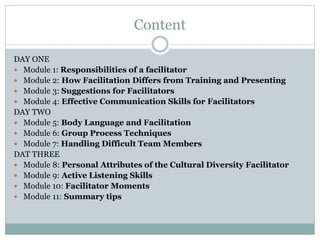
Content
DAY ONE
 Module 1: Responsibilities of a facilitator
 Module 2: How Facilitation Differs from Training and Presenting
 Module 3: Suggestions for Facilitators
 Module 4: Effective Communication Skills for Facilitators
DAY TWO
 Module 5: Body Language and Facilitation
 Module 6: Group Process Techniques
 Module 7: Handling Difficult Team Members
DAT THREE
 Module 8: Personal Attributes of the Cultural Diversity Facilitator
 Module 9: Active Listening Skills
 Module 10: Facilitator Moments
 Module 11: Summary tips
The Facilitator
 The workshop will be facilitated by Mr. R. Masilamani.

He is an active trainer, consultant and corporate
manager. He has been exposed to Kepner Tregoe, Mc
Kenzie, Dale Carnegie and many other prominent
learning technologies. He himself has designed and
developed many programs. He worked for 25 years in
PETRONAS, including as internal trainer/consultant.
He has been the General Manager, COO and Financial
Controller of other institutions like METEOR, Open
University Malaysia and BATC. He has had formal
training and certifications in learning, training and
consulting technologies. He continues to train and
consult in management and leadership.
References
 Dale Hunter, ‘the art of facilitation- the essentials for leading great







meetings and creating group synergy’, Jossey Bass,2007
Bens, Ingrid, ‘Facilitating with Ease! A Step-by-Step Guidebook
with Customizable Worksheets on CD-ROM’, Jossey Bass, January
2000.
Kaner, Sam, ‘Facilitator’s Guide to Participatory Decision Making’,
New Society Pub, July 1996.
Hackett, Donald, and Charles L. Martin, ‘Facilitation Skills for Team
Leaders’, Crisp Publications, Menlo Park, CA, 1993.
Rees, Fran, ‘How to Lead Work Teams: Facilitation Skills’, 2nd ed.,
John Wiley & Sons, May 2001.
Schwarz, Roger M., ‘The Skilled Facilitator: A Comprehensive
Resource for Consultants, Facilitators, Managers, Trainers, and
Coaches’, Jossey-Bass, 2002’
Ice breaker activities
- FIRST IMPRESSIONS
 I love "feel good" types of ice breaker activities.
 Here is a wonderful one for new teams and/or small or large

training classes.
 Use this ice breaker activity to start your meeting,
presentation or training. You might consider ending the day
with another one of my other favourite ice breaker/team
builder activities - "Say Something Positive!"
 Purpose: To start a meeting, training or presentation on a
positive note and to quickly break the ice.

When: This ice breaker activity can be used with groups of six
to one hundred or more. It is especially effective with groups or
teams that don't know each other.
Materials: Provide large index cards (or card stock), pen and
pieces of masking tape to each participant.
The Ice Breaker Activity- Things to Do
 How:

 Provide a large index card (or piece of card stock), pen and piece of masking tape to







each participant.
Have participants tape the index card to each others backs with masking tape and
make sure it is secure.
Have participants find someone and introduce themselves and mingle for a few
minutes. When done ask them to write on each others back their first impression of
that person in one or two words max. Instruct the group that only positive
impressions can be written. After the pairs have written on each others backs have
them move onto someone else.
Once participants have written on each others backs (depending on the size of the
group and how long you want the activity to go) ask them to remove the index cards
and provide them a few silent minutes to review what others have written.
Once participants have had time to read the responses on their index cards ask them
what they are thinking? Ask how they might feel if they always thought others first
impressions of them were so positive? Ask what they might be able to learn from
this ice breaker activity? Responses might include the need for us to form good first
impressions of others, the need to share the good we see in others and the way we
feel when others say positive things about us.
Things to Note
Module 1:
Responsibilities of a
Facilitator
Some of the key responsibilities of a
facilitation
The facilitator
Some Basic Premises of Facilitation:
1. The facilitator leads
2. The facilitator is knowledgeable enough
3. The facilitator is not an answer provider, but
rather a tour guide
4. The facilitator promotes the concept of “safe
space”. Opinions
5. It is vital that you have some “probing questions”
ready
Facilitation requires an understanding of
the following:

Community

Balance

Observation

Affirmation

Flexibility

Silence

Imagination

Challenge

Patience

Connections
Module 2:
How Facilitation Differs from
Training and Presenting
Training
Presenting
Facilitation
How Facilitation Differs from Training
and Presenting
Training

Presenting

Facilitation

Participants are present to
learn.

Audience is present to
receive prepared remarks.

Participants are members
of teams whose mission is
to recommend new ideas or
improvements.

Objectives are based upon
learning.

Objectives are based on
what is to be
communicated, i.e., sell,
inform, motivate, describe.

Objectives are based on
process improvements.

Lesson plans are prepared to
enhance learning structure.

Presenter’s outline
structures a logical
presentation.

An agenda is used to
structure the meeting for
effectiveness.
How Facilitation Differs from Training
and Presenting
Training

Presenting

Facilitation

Instructor is a catalyst for
learning.

Presenter primarily answers
rather than asks questions.

Questions are used to
develop individual
involvement in the group.

Instructor asks questions to
evaluate learning.

Visual aids are used to
present data (charts, graphs,
tables).

Flip chart is used to record
team member's inputs and
ideas.

Visual and training aids
(tapes, films, cases, role
plays) are used to illustrate
learning points.

Data, charts, graphs are
used to support messages or
recommendations.

Facilitator teaches members
to use tools for team
problem solving.
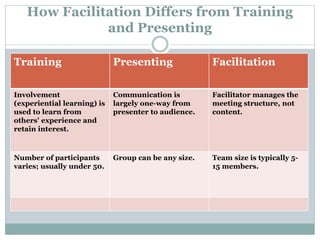
How Facilitation Differs from Training
and Presenting
Training

Presenting

Facilitation

Involvement
(experiential learning) is
used to learn from
others' experience and
retain interest.

Communication is
largely one-way from
presenter to audience.

Facilitator manages the
meeting structure, not
content.

Number of participants
varies; usually under 50.

Group can be any size.

Team size is typically 515 members.
Module3:
Suggestion for Facilitators
suggestions and tips for facilitators
 Be aware of the physical environment and how it








can influence group behaviour.
Orient group to the timeframe and task at the
beginning of each session.
Explain the product that is expected.
Develop group ground rules, or norms for
operating, and use them.
If you don’t have a co-facilitator, select someone
to write key points on the flipchart.
If group is large, use name tents to remember
everyone’s name.
suggestions and tips for facilitators Additional
Considerations
 Be certain in advance that your sponsor (client, representative) agrees









with the purpose and is comfortable with the process.
Stay focused in the present but know where the group has been and
where it needs to be.
Choose a decision making method BEFORE you need it. Suggest some
options that the group could use to get them thinking.
Remember that people properly disagree. It's probably naive to think
that there won't be moments of conflict in your group.
Call a "pulse check" and check in with the group as to how people are
feeling or what they are thinking about at that time. This is good to do
when the group seems generally blocked or confused.
If you have a lead facilitation role, close each session with recognition of
the group for a "job well done."
Role modlelling of desirable behaviour is important with the recorder,
other staff, and the group.
Your own self-development can make a difference.
Module 4:
Effective Communication Skills for
Facilitators
skill points for communicating
 Active Listening
 Modelling
 Summarising
 Focusing attention and Pacing
 Recognising Progress
 Waiting or silence
 Scanning/Observing

 Inclusion
Module 5:
Body Language and Facilitation
The nonverbal cues
 the role of nonverbal cues or body language is also

critical to facilitative leadership.
 constantly flowing from team member to facilitator
and vice versa.
 be careful not to send out nonverbal cues or body
language
 be keenly aware of the nonverbal cues given off by
team members
Module 6:
Group Process Techniques
work with groups
 Brainstorming
 Response rounds
 Sub Groups
 Force field Analysis
 Questioning technique
 Others
Brainstorming
 Procedure: Clarify the question or topic to be









brainstormed. Set a time limit. Review the rules
(post them?).
Quantity, not quality, is the goal
Defer all judgment until the process is over
You are encouraged to further other people's ideas
All ideas are recorded
This is a good all-purpose technique for generating a
variety of options or alternatives.
Response rounds
 Procedure: Give the group members a







task/question to work on individually.
Ask members to respond one at a time.
People are allowed to pass.
Record responses
Repeat until people run out of responses
Summarize each round of responses if it seems
appropriate.
Subgroups
 Procedure: When facilitating a large group (e.g., 20 +







people), to enable more of the members to talk, it helps to
break the group into subgroups of 2-5 people.
Give them a clear question or task (e.g., “How can a program
avoid volunteer burnout?”).
Set a time limit and ask subgroups to self-assign a
spokesperson and recorder.
Plan time for each group to report to the whole group using a
spokesperson.
Post the subgroups' work or records when the whole group
reconvenes.
The whole group can do such things as pick out
commonalities, pick out uncommon items, or circle its
favourite one (two, etc.).
Force field analysis (or "helps and
hindrances")
 Procedure: Group members begin by brainstorming or








making lists of factors or forces that help or hinder their
stated goal.
This technique allows for the group to see what factors
could support them and those that need to be hurdled in
reaching their goal.
Supporting forces are meant to be reinforced.
Restraining forces are meant to be reduced, dealt with,
or eliminated.
Groups may choose to focus their energy on supporting
forces, restraining forces, or both, as a way to move
toward their goal.
Force field analysis-cont.
 Force field analysis is a technique originally developed by









Kurt Lewin.
It involves identifying the forces or factors that either help or
hinder accomplishment of goals.
Goal or Problem Statement:
__________________________________________
Restraining Forces
Supporting Forces
1._________________
1._________________
2._________________
2._________________
3._________________
3._________________
n._________________
n._________________
Module 7:
Handling Difficult Team Members
WHEN to Handle a Difficult Team
Member
HOW to Handle a Troublesome Team
Member
 Should never verbally scold or embarrass the

individual in front of the group or even privately.
 Your first opportunity to correct troublesome
behaviour should be during the meeting
 A second option is to talk with the person candidly
about the behaviour in private.
 A third option is to use the team's informal
leaders−those members most respected for their
knowledge and experience.
Four Common Types of Troublesome
Team Members
 1. The Mummy :This person will not freely participate in

discussions. The motivation might be indifference, an
inferiority complex, confusion about the issues or process, or
a feeling of superiority.
 2. The Windbag: This individual comments too frequently
and tends to dominate discussions. He or she also tends to be
the first to speak on each issue.
 3. The Rambler: This individual will often get off track in
his remarks, misses the point, or uses far-fetched examples to
make a point.
 4. The Homesteader: A person who takes an initial
position and is highly reluctant to budge or consider other
viable alternatives.
Reluctant Team Members
 An often-asked question is what to do about

employees who do not want to be on a team.
 We advise that you not force involvement, but rather
allow the dynamics of the team process and the
excitement of other team members to arouse their
interest and motivate them to fully participate in the
team concept.
Module 8:
Personal Attributes of the
Cultural Diversity Facilitator
Personal Attributes of the Cultural Diversity
Facilitator













Tolerance of ambiguity:
Cognitive and behavioural flexibility:
Personal self-awareness:
Cultural self-awareness:
Patience:
Enthusiasm and commitment:
Interpersonal sensitivity and relations:
Tolerance of differences.
Openness to new experiences and peoples:
Empathy:
Sense of humility:
Sense of humour:
Module 9:
Active Listening Skills
 Maintain good eye contact
 Face the person or group head on
 Keep an open posture−don't cross arms
 Stay relaxed in your overall manner
 Be aware of body language and nonverbal behaviour
 Listen for feeling as well as content
 Don't confuse content and delivery

 Listen for the main thought or idea, rather than

trying to memorize every word
Active Listening Skills
 Cultivate empathy−try to put yourself in his or









her place
Refrain from evaluating what is being said
Don't jump in the conversation too soon
Pause a few seconds before giving feedback or
answering a question
Give the person time to correct an obvious
mistake
Show encouragement.
Show support.
Don't let the person ramble
Active Listening Skills
 Don't turn an implication you've picked up in the







conversation into a conclusion
Paraphrase or summarize what the person has said, and
get agreement that you've understood completely
Ask questions beginning with the words "what" and
"how" (open-ended questions).
Avoid questions that can be answered with a yes or no
Don't "jump ahead" to complete the person's sentence
Be aware of your own emotional response to what you
are hearing
Focus your energy and attention on what is being said to
you
Module 10:
Facilitator Moments in Listening
Facilitator Moments:
Put on your facilitator's hat, then try to finish as many of these

sentences as you can.
When one group member seems to do most of the talking, I might…
When an individual is silent for a long period of time, I could…
When someone in the team "puts down" another member, I might…
When a group seems to want to reach a decision, but appears unable to,
I might…
When someone comes late, I might…
When group members are excessively polite and unwilling to confront
each other’s ideas, I might…
Public Speaking vs Fear of Death
•If you are going to a funeral you are better off in the
casket than doing the eulogy
•Studies show public speaking is a bigger fear than
death in the casket than doing the eulogy
•Becoming a competent, rather than just confident,
speaker requires a lot of practice
•The best start is simply to make a better
presentation
-Jerry Seinfeld
Module11:
Summary Tips
18 Tips to Sharpen Presentation Skills
1. 10-20-30 Rule –
2. Be Entertaining
3. Slow Down
4. Eye Contact
5. 15 Word Summary
6. 20-20 Rule
7. Don’t Read.
8. Speeches are About Stories
9. Project Your Voice
18 Tips to Sharpen Presentation Skills
10. Don’t Plan Gestures
11.“That’s a Good Question”
12. Breathe In Not Out
13. Come Early, Really Early
14. Get Practice
15. Don’t Apologize
16. Do Apologize if You’re Wrong
17. Put Yourself in the Audience
18. Have Fun
-Jerry Seinfeld
Basic Facilitation Skills

Basic Facilitation Skills

  • 1.
    Basic Facilitation Skills: DevelopingFacilitative Leadership PRESENTED BY R. MASILAMANI
  • 2.
    Objectives The aims ofthis three day workshop are to,  Clarify the roles and responsibilities of the facilitator  Differentiate the facilitator from his counterparts like trainer, consultant etc.  Establish the clear capability requirements of a facilitator  Provide the attitudes, tools, techniques and principles for effective management of facilitation, and  Highlight some other requisites of great facilitation e.g. communication skills
  • 3.
    Content DAY ONE  Module1: Responsibilities of a facilitator  Module 2: How Facilitation Differs from Training and Presenting  Module 3: Suggestions for Facilitators  Module 4: Effective Communication Skills for Facilitators DAY TWO  Module 5: Body Language and Facilitation  Module 6: Group Process Techniques  Module 7: Handling Difficult Team Members DAT THREE  Module 8: Personal Attributes of the Cultural Diversity Facilitator  Module 9: Active Listening Skills  Module 10: Facilitator Moments  Module 11: Summary tips
  • 4.
    The Facilitator  Theworkshop will be facilitated by Mr. R. Masilamani. He is an active trainer, consultant and corporate manager. He has been exposed to Kepner Tregoe, Mc Kenzie, Dale Carnegie and many other prominent learning technologies. He himself has designed and developed many programs. He worked for 25 years in PETRONAS, including as internal trainer/consultant. He has been the General Manager, COO and Financial Controller of other institutions like METEOR, Open University Malaysia and BATC. He has had formal training and certifications in learning, training and consulting technologies. He continues to train and consult in management and leadership.
  • 5.
    References  Dale Hunter,‘the art of facilitation- the essentials for leading great      meetings and creating group synergy’, Jossey Bass,2007 Bens, Ingrid, ‘Facilitating with Ease! A Step-by-Step Guidebook with Customizable Worksheets on CD-ROM’, Jossey Bass, January 2000. Kaner, Sam, ‘Facilitator’s Guide to Participatory Decision Making’, New Society Pub, July 1996. Hackett, Donald, and Charles L. Martin, ‘Facilitation Skills for Team Leaders’, Crisp Publications, Menlo Park, CA, 1993. Rees, Fran, ‘How to Lead Work Teams: Facilitation Skills’, 2nd ed., John Wiley & Sons, May 2001. Schwarz, Roger M., ‘The Skilled Facilitator: A Comprehensive Resource for Consultants, Facilitators, Managers, Trainers, and Coaches’, Jossey-Bass, 2002’
  • 6.
    Ice breaker activities -FIRST IMPRESSIONS  I love "feel good" types of ice breaker activities.  Here is a wonderful one for new teams and/or small or large training classes.  Use this ice breaker activity to start your meeting, presentation or training. You might consider ending the day with another one of my other favourite ice breaker/team builder activities - "Say Something Positive!"  Purpose: To start a meeting, training or presentation on a positive note and to quickly break the ice. When: This ice breaker activity can be used with groups of six to one hundred or more. It is especially effective with groups or teams that don't know each other. Materials: Provide large index cards (or card stock), pen and pieces of masking tape to each participant.
  • 7.
    The Ice BreakerActivity- Things to Do  How:  Provide a large index card (or piece of card stock), pen and piece of masking tape to     each participant. Have participants tape the index card to each others backs with masking tape and make sure it is secure. Have participants find someone and introduce themselves and mingle for a few minutes. When done ask them to write on each others back their first impression of that person in one or two words max. Instruct the group that only positive impressions can be written. After the pairs have written on each others backs have them move onto someone else. Once participants have written on each others backs (depending on the size of the group and how long you want the activity to go) ask them to remove the index cards and provide them a few silent minutes to review what others have written. Once participants have had time to read the responses on their index cards ask them what they are thinking? Ask how they might feel if they always thought others first impressions of them were so positive? Ask what they might be able to learn from this ice breaker activity? Responses might include the need for us to form good first impressions of others, the need to share the good we see in others and the way we feel when others say positive things about us.
  • 8.
  • 9.
    Module 1: Responsibilities ofa Facilitator Some of the key responsibilities of a facilitation The facilitator
  • 10.
    Some Basic Premisesof Facilitation: 1. The facilitator leads 2. The facilitator is knowledgeable enough 3. The facilitator is not an answer provider, but rather a tour guide 4. The facilitator promotes the concept of “safe space”. Opinions 5. It is vital that you have some “probing questions” ready
  • 11.
    Facilitation requires anunderstanding of the following: Community Balance Observation Affirmation Flexibility Silence Imagination Challenge Patience Connections
  • 12.
    Module 2: How FacilitationDiffers from Training and Presenting Training Presenting Facilitation
  • 13.
    How Facilitation Differsfrom Training and Presenting Training Presenting Facilitation Participants are present to learn. Audience is present to receive prepared remarks. Participants are members of teams whose mission is to recommend new ideas or improvements. Objectives are based upon learning. Objectives are based on what is to be communicated, i.e., sell, inform, motivate, describe. Objectives are based on process improvements. Lesson plans are prepared to enhance learning structure. Presenter’s outline structures a logical presentation. An agenda is used to structure the meeting for effectiveness.
  • 14.
    How Facilitation Differsfrom Training and Presenting Training Presenting Facilitation Instructor is a catalyst for learning. Presenter primarily answers rather than asks questions. Questions are used to develop individual involvement in the group. Instructor asks questions to evaluate learning. Visual aids are used to present data (charts, graphs, tables). Flip chart is used to record team member's inputs and ideas. Visual and training aids (tapes, films, cases, role plays) are used to illustrate learning points. Data, charts, graphs are used to support messages or recommendations. Facilitator teaches members to use tools for team problem solving.
  • 15.
    How Facilitation Differsfrom Training and Presenting Training Presenting Facilitation Involvement (experiential learning) is used to learn from others' experience and retain interest. Communication is largely one-way from presenter to audience. Facilitator manages the meeting structure, not content. Number of participants varies; usually under 50. Group can be any size. Team size is typically 515 members.
  • 16.
  • 17.
    suggestions and tipsfor facilitators  Be aware of the physical environment and how it      can influence group behaviour. Orient group to the timeframe and task at the beginning of each session. Explain the product that is expected. Develop group ground rules, or norms for operating, and use them. If you don’t have a co-facilitator, select someone to write key points on the flipchart. If group is large, use name tents to remember everyone’s name.
  • 18.
    suggestions and tipsfor facilitators Additional Considerations  Be certain in advance that your sponsor (client, representative) agrees        with the purpose and is comfortable with the process. Stay focused in the present but know where the group has been and where it needs to be. Choose a decision making method BEFORE you need it. Suggest some options that the group could use to get them thinking. Remember that people properly disagree. It's probably naive to think that there won't be moments of conflict in your group. Call a "pulse check" and check in with the group as to how people are feeling or what they are thinking about at that time. This is good to do when the group seems generally blocked or confused. If you have a lead facilitation role, close each session with recognition of the group for a "job well done." Role modlelling of desirable behaviour is important with the recorder, other staff, and the group. Your own self-development can make a difference.
  • 19.
    Module 4: Effective CommunicationSkills for Facilitators
  • 21.
    skill points forcommunicating  Active Listening  Modelling  Summarising  Focusing attention and Pacing  Recognising Progress  Waiting or silence  Scanning/Observing  Inclusion
  • 22.
    Module 5: Body Languageand Facilitation
  • 23.
    The nonverbal cues the role of nonverbal cues or body language is also critical to facilitative leadership.  constantly flowing from team member to facilitator and vice versa.  be careful not to send out nonverbal cues or body language  be keenly aware of the nonverbal cues given off by team members
  • 24.
  • 25.
    work with groups Brainstorming  Response rounds  Sub Groups  Force field Analysis  Questioning technique  Others
  • 26.
    Brainstorming  Procedure: Clarifythe question or topic to be      brainstormed. Set a time limit. Review the rules (post them?). Quantity, not quality, is the goal Defer all judgment until the process is over You are encouraged to further other people's ideas All ideas are recorded This is a good all-purpose technique for generating a variety of options or alternatives.
  • 27.
    Response rounds  Procedure:Give the group members a      task/question to work on individually. Ask members to respond one at a time. People are allowed to pass. Record responses Repeat until people run out of responses Summarize each round of responses if it seems appropriate.
  • 28.
    Subgroups  Procedure: Whenfacilitating a large group (e.g., 20 +      people), to enable more of the members to talk, it helps to break the group into subgroups of 2-5 people. Give them a clear question or task (e.g., “How can a program avoid volunteer burnout?”). Set a time limit and ask subgroups to self-assign a spokesperson and recorder. Plan time for each group to report to the whole group using a spokesperson. Post the subgroups' work or records when the whole group reconvenes. The whole group can do such things as pick out commonalities, pick out uncommon items, or circle its favourite one (two, etc.).
  • 29.
    Force field analysis(or "helps and hindrances")  Procedure: Group members begin by brainstorming or     making lists of factors or forces that help or hinder their stated goal. This technique allows for the group to see what factors could support them and those that need to be hurdled in reaching their goal. Supporting forces are meant to be reinforced. Restraining forces are meant to be reduced, dealt with, or eliminated. Groups may choose to focus their energy on supporting forces, restraining forces, or both, as a way to move toward their goal.
  • 30.
    Force field analysis-cont. Force field analysis is a technique originally developed by       Kurt Lewin. It involves identifying the forces or factors that either help or hinder accomplishment of goals. Goal or Problem Statement: __________________________________________ Restraining Forces Supporting Forces 1._________________ 1._________________ 2._________________ 2._________________ 3._________________ 3._________________ n._________________ n._________________
  • 31.
  • 32.
    WHEN to Handlea Difficult Team Member
  • 33.
    HOW to Handlea Troublesome Team Member  Should never verbally scold or embarrass the individual in front of the group or even privately.  Your first opportunity to correct troublesome behaviour should be during the meeting  A second option is to talk with the person candidly about the behaviour in private.  A third option is to use the team's informal leaders−those members most respected for their knowledge and experience.
  • 34.
    Four Common Typesof Troublesome Team Members  1. The Mummy :This person will not freely participate in discussions. The motivation might be indifference, an inferiority complex, confusion about the issues or process, or a feeling of superiority.  2. The Windbag: This individual comments too frequently and tends to dominate discussions. He or she also tends to be the first to speak on each issue.  3. The Rambler: This individual will often get off track in his remarks, misses the point, or uses far-fetched examples to make a point.  4. The Homesteader: A person who takes an initial position and is highly reluctant to budge or consider other viable alternatives.
  • 35.
    Reluctant Team Members An often-asked question is what to do about employees who do not want to be on a team.  We advise that you not force involvement, but rather allow the dynamics of the team process and the excitement of other team members to arouse their interest and motivate them to fully participate in the team concept.
  • 36.
    Module 8: Personal Attributesof the Cultural Diversity Facilitator
  • 37.
    Personal Attributes ofthe Cultural Diversity Facilitator             Tolerance of ambiguity: Cognitive and behavioural flexibility: Personal self-awareness: Cultural self-awareness: Patience: Enthusiasm and commitment: Interpersonal sensitivity and relations: Tolerance of differences. Openness to new experiences and peoples: Empathy: Sense of humility: Sense of humour:
  • 38.
  • 39.
    Active Listening Skills Maintain good eye contact  Face the person or group head on  Keep an open posture−don't cross arms  Stay relaxed in your overall manner  Be aware of body language and nonverbal behaviour  Listen for feeling as well as content  Don't confuse content and delivery  Listen for the main thought or idea, rather than trying to memorize every word
  • 40.
    Active Listening Skills Cultivate empathy−try to put yourself in his or        her place Refrain from evaluating what is being said Don't jump in the conversation too soon Pause a few seconds before giving feedback or answering a question Give the person time to correct an obvious mistake Show encouragement. Show support. Don't let the person ramble
  • 41.
    Active Listening Skills Don't turn an implication you've picked up in the       conversation into a conclusion Paraphrase or summarize what the person has said, and get agreement that you've understood completely Ask questions beginning with the words "what" and "how" (open-ended questions). Avoid questions that can be answered with a yes or no Don't "jump ahead" to complete the person's sentence Be aware of your own emotional response to what you are hearing Focus your energy and attention on what is being said to you
  • 42.
  • 43.
    Facilitator Moments: Put onyour facilitator's hat, then try to finish as many of these sentences as you can. When one group member seems to do most of the talking, I might… When an individual is silent for a long period of time, I could… When someone in the team "puts down" another member, I might… When a group seems to want to reach a decision, but appears unable to, I might… When someone comes late, I might… When group members are excessively polite and unwilling to confront each other’s ideas, I might…
  • 44.
    Public Speaking vsFear of Death •If you are going to a funeral you are better off in the casket than doing the eulogy •Studies show public speaking is a bigger fear than death in the casket than doing the eulogy •Becoming a competent, rather than just confident, speaker requires a lot of practice •The best start is simply to make a better presentation -Jerry Seinfeld
  • 45.
  • 46.
    18 Tips toSharpen Presentation Skills 1. 10-20-30 Rule – 2. Be Entertaining 3. Slow Down 4. Eye Contact 5. 15 Word Summary 6. 20-20 Rule 7. Don’t Read. 8. Speeches are About Stories 9. Project Your Voice
  • 47.
    18 Tips toSharpen Presentation Skills 10. Don’t Plan Gestures 11.“That’s a Good Question” 12. Breathe In Not Out 13. Come Early, Really Early 14. Get Practice 15. Don’t Apologize 16. Do Apologize if You’re Wrong 17. Put Yourself in the Audience 18. Have Fun -Jerry Seinfeld