Facilitation 101Presented By: Robert McGeachy, PMPKintyre Consulting IncorporatedJune 6, 2009
AgendaThe role of the facilitatorPreparing for a facilitated sessionCapture Best PracticesDealing with challenging behaviourTools
What is the role of the facilitator?Work with team to plan the sessionMake sure all participants know the reason for the discussion and the intended outcomeTake a diverse group of people (working styles, individual personalities, perspectives) and develop a common direction, solution or outcomeManage time in order to achieve objectivesGuide the group’s discussionAssist the group in developing a common language or terminologyEnsure that points are understood by all membersEnsure content is applicable and of high qualityManage the participation, energy, and group dynamics in the roomActively listenCapture information in a comprehensive and organized manner, or coordinate with a recorder to capture informationProvide subject matter expertise
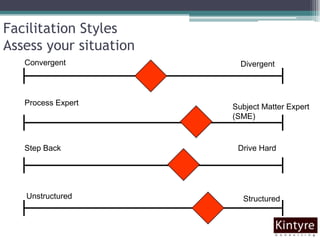
Facilitation Styles Assess your situationConvergentDivergentProcess ExpertSubject Matter Expert(SME)Step BackDrive HardUnstructuredStructured
AgendaThe role of the facilitatorPreparing for a facilitated sessionCapture Best PracticesDealing with challenging behaviourTools
Planning the Session (the PAD)Purpose: Why is the session being held?Agenda/Approach: Logical and sequential roadmap to achieve the objectiveDeliverable: The end result of each objective
Facilitation Preparation BasicsCreate a PAD (Purpose/Agenda/Deliverable) Take care of meeting logisticsAttendeesMeeting request with the proposed PAD Attendees and their rolesFacilitiesRoom arrangement and setup Aids required : projector, laptop etc HandoutsFood and Beverage  Know the groupPrepare/leverage any materials necessaryPopulate white boards (PAD, mark space for issues, next steps)Plan output with the note takerCreate a ‘strawhorse’ solution where makes sense
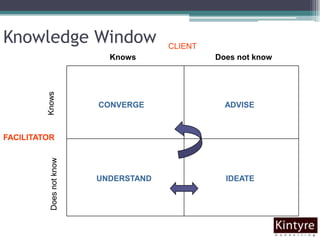
Knowledge WindowCLIENTDoes not knowKnowsKnowsCONVERGEADVISEFACILITATORIDEATEUNDERSTANDDoes not know
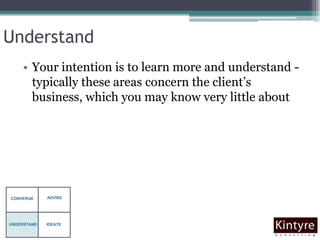
UnderstandYour intention is to learn more and understand - typically these areas concern the client’s business, which you may know very little aboutADVISECONVERGEIDEATEUNDERSTAND
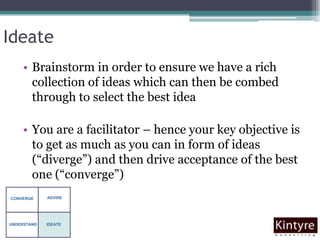
IdeateBrainstorm in order to ensure we have a rich collection of ideas which can then be combed through to select the best ideaYou are a facilitator – hence your key objective is to get as much as you can in form of ideas (“diverge”) and then drive acceptance of the best one (“converge”)ADVISECONVERGEUNDERSTANDIDEATE
AdviseYou are a consultant who needs to provide advice as to what is in the client’s best interest.You need to use your knowledge of the technology or industry to help the client make intelligent decisionsADVISECONVERGEUNDERSTANDIDEATE
ConvergeThis is normally the theme after a lot of work has been done and you want to drive closureThe key idea is to demonstrate the direct linkage of the plan/proposal to the client’s drivers and help the client see the road to successADVISECONVERGEUNDERSTANDIDEATE
Facilitation TechniquesAsk questionsReinforce agreementsMake a proposalDeferGive positive reinforcementEncourage divergent views“Boomerang” – send the question backSummarize
Extract Content – Asking QuestionsOpeningTo generate participation and open the floor for different examples, experiences, ideas or points of view LeadingTo focus the discussion on a particular topic or question. ClosingTo move the group forward or end the session
AgendaThe role of the facilitatorPreparing for a facilitated sessionCapture Best PracticesDealing with challenging behaviourTools
Capturing Content: Best PracticesCapture as much as is possible and is relevantHow do you decide what is relevant?“Creative license”Don’t, unless you are very confident that you are writing exactly what the client intendedPlay it backContextEnough context so it can be easily determined what the point wasIssues should be phrased as questionsConsequenceHow will this information be used?Issues/To Do’s should have an owner, due date
AgendaThe role of the facilitatorPreparing for a facilitated sessionCapture Best PracticesDealing with challenging behaviourTools
Managing PeopleValidate and legitimize client ideasGive access, encourage dialogueEncourage the quiet folksSupport the underdogHelp develop consensusDefuse uncomfortable momentsWatch the groupBody languageDynamicsLevel of interestManage challenging behaviorsWhat else?
Dealing with IssuesDeal effectively with issues or unrelated contentPlay back - Parrot back the statement without agreeing or disagreeingLegitimize - Acknowledge and empathize with the statementDeal with or Defer - Decide if you can deal with the statement in the moment or if you want to defer the statement to a later time
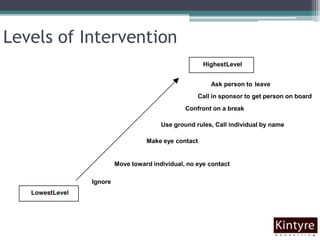
Levels of InterventionHighest LevelAsk person toleaveCall in sponsor to get person on boardConfront on a breakUse ground rules, Call individual by nameMake eye contactMove toward individual, no eye contactIgnoreLowestLevel
Managing Challenging BehaviorHow will you deal with these challenging behaviors ?Late comerSide conversationBeating a dead horseQuiet memberDominating memberThe SkepticAny other challenging behaviors you have faced ?
AgendaThe role of the facilitatorPreparing for a facilitated sessionCapture Best PracticesDealing with challenging behaviourTools
Tools for Generating IdeasBrainstormingWhat : A structured process that allows for a large quantity of ideas in a group settingWhen to use : List possible solutions or alternativesTo imagine the impact of a decisionTo look at all aspects of a problemT-chartWhat : Organizes material into 2 columns with distinct headingsWhen to use : To compare and contrast informationTo show relationships between information (pros and cons, strengths and weaknesses)To show changes over time (how things are now/how you want them to be)
Tools for Organizing InformationAffinity GroupingWhat : Incorporates brainstorming and allows for information to be regrouped or arranged until relationships and categories are found When to use : Lot of information to be categorizedUseful when thoughts, ideas, and opinions are all over the map and need to be recorded in an organized way.FlowchartWhat : Highlights steps in a procedure or project to show how the project proceeds through time and illustrates how the tasks relate to one another When to use : Use to plan the steps within a process To improve a process by altering an existing flow
Tools for Ranking / EvaluatingMulti VotingWhat : Multi-voting allows a group to select the most important or preferred items from a list with minimum discussion.When to use : Used after a brainstorming session or to narrow down a long list Ranking and prioritizingWhat : Is a way of narrowing down many options to a few that the group believes merit further consideration. When to use : Use when you want people to select, prioritize, and discuss top choices only
Tools for Ranking / EvaluatingQuadrant DiagramWhat : Method to determine and graphically portray which solution best meets two goals at onceWhen to use : To compare potential solutions to one another in relation to key factors (e.g., cost/benefit, impact/level of effort, cost/time to implement, and achievable/effective)Decision MatrixWhat : A matrix used to evaluate possible solutions against a predetermined set of criteriaWhen to use : There are many criteria or standards that a solution must meetMultiple solutions are available
Questions?
Facilitation 101

Facilitation 101

  • 1.
    Facilitation 101Presented By:Robert McGeachy, PMPKintyre Consulting IncorporatedJune 6, 2009
  • 2.
    AgendaThe role ofthe facilitatorPreparing for a facilitated sessionCapture Best PracticesDealing with challenging behaviourTools
  • 3.
    AgendaThe role ofthe facilitatorPreparing for a facilitated sessionCapture Best PracticesDealing with challenging behaviourTools
  • 4.
    What is therole of the facilitator?Work with team to plan the sessionMake sure all participants know the reason for the discussion and the intended outcomeTake a diverse group of people (working styles, individual personalities, perspectives) and develop a common direction, solution or outcomeManage time in order to achieve objectivesGuide the group’s discussionAssist the group in developing a common language or terminologyEnsure that points are understood by all membersEnsure content is applicable and of high qualityManage the participation, energy, and group dynamics in the roomActively listenCapture information in a comprehensive and organized manner, or coordinate with a recorder to capture informationProvide subject matter expertise
  • 5.
    Facilitation Styles Assessyour situationConvergentDivergentProcess ExpertSubject Matter Expert(SME)Step BackDrive HardUnstructuredStructured
  • 6.
    AgendaThe role ofthe facilitatorPreparing for a facilitated sessionCapture Best PracticesDealing with challenging behaviourTools
  • 7.
    Planning the Session(the PAD)Purpose: Why is the session being held?Agenda/Approach: Logical and sequential roadmap to achieve the objectiveDeliverable: The end result of each objective
  • 8.
    Facilitation Preparation BasicsCreatea PAD (Purpose/Agenda/Deliverable) Take care of meeting logisticsAttendeesMeeting request with the proposed PAD Attendees and their rolesFacilitiesRoom arrangement and setup Aids required : projector, laptop etc HandoutsFood and Beverage Know the groupPrepare/leverage any materials necessaryPopulate white boards (PAD, mark space for issues, next steps)Plan output with the note takerCreate a ‘strawhorse’ solution where makes sense
  • 9.
    Knowledge WindowCLIENTDoes notknowKnowsKnowsCONVERGEADVISEFACILITATORIDEATEUNDERSTANDDoes not know
  • 10.
    UnderstandYour intention isto learn more and understand - typically these areas concern the client’s business, which you may know very little aboutADVISECONVERGEIDEATEUNDERSTAND
  • 11.
    IdeateBrainstorm in orderto ensure we have a rich collection of ideas which can then be combed through to select the best ideaYou are a facilitator – hence your key objective is to get as much as you can in form of ideas (“diverge”) and then drive acceptance of the best one (“converge”)ADVISECONVERGEUNDERSTANDIDEATE
  • 12.
    AdviseYou are aconsultant who needs to provide advice as to what is in the client’s best interest.You need to use your knowledge of the technology or industry to help the client make intelligent decisionsADVISECONVERGEUNDERSTANDIDEATE
  • 13.
    ConvergeThis is normallythe theme after a lot of work has been done and you want to drive closureThe key idea is to demonstrate the direct linkage of the plan/proposal to the client’s drivers and help the client see the road to successADVISECONVERGEUNDERSTANDIDEATE
  • 14.
    Facilitation TechniquesAsk questionsReinforceagreementsMake a proposalDeferGive positive reinforcementEncourage divergent views“Boomerang” – send the question backSummarize
  • 15.
    Extract Content –Asking QuestionsOpeningTo generate participation and open the floor for different examples, experiences, ideas or points of view LeadingTo focus the discussion on a particular topic or question. ClosingTo move the group forward or end the session
  • 16.
    AgendaThe role ofthe facilitatorPreparing for a facilitated sessionCapture Best PracticesDealing with challenging behaviourTools
  • 17.
    Capturing Content: BestPracticesCapture as much as is possible and is relevantHow do you decide what is relevant?“Creative license”Don’t, unless you are very confident that you are writing exactly what the client intendedPlay it backContextEnough context so it can be easily determined what the point wasIssues should be phrased as questionsConsequenceHow will this information be used?Issues/To Do’s should have an owner, due date
  • 18.
    AgendaThe role ofthe facilitatorPreparing for a facilitated sessionCapture Best PracticesDealing with challenging behaviourTools
  • 19.
    Managing PeopleValidate andlegitimize client ideasGive access, encourage dialogueEncourage the quiet folksSupport the underdogHelp develop consensusDefuse uncomfortable momentsWatch the groupBody languageDynamicsLevel of interestManage challenging behaviorsWhat else?
  • 20.
    Dealing with IssuesDealeffectively with issues or unrelated contentPlay back - Parrot back the statement without agreeing or disagreeingLegitimize - Acknowledge and empathize with the statementDeal with or Defer - Decide if you can deal with the statement in the moment or if you want to defer the statement to a later time
  • 21.
    Levels of InterventionHighestLevelAsk person toleaveCall in sponsor to get person on boardConfront on a breakUse ground rules, Call individual by nameMake eye contactMove toward individual, no eye contactIgnoreLowestLevel
  • 22.
    Managing Challenging BehaviorHowwill you deal with these challenging behaviors ?Late comerSide conversationBeating a dead horseQuiet memberDominating memberThe SkepticAny other challenging behaviors you have faced ?
  • 23.
    AgendaThe role ofthe facilitatorPreparing for a facilitated sessionCapture Best PracticesDealing with challenging behaviourTools
  • 24.
    Tools for GeneratingIdeasBrainstormingWhat : A structured process that allows for a large quantity of ideas in a group settingWhen to use : List possible solutions or alternativesTo imagine the impact of a decisionTo look at all aspects of a problemT-chartWhat : Organizes material into 2 columns with distinct headingsWhen to use : To compare and contrast informationTo show relationships between information (pros and cons, strengths and weaknesses)To show changes over time (how things are now/how you want them to be)
  • 25.
    Tools for OrganizingInformationAffinity GroupingWhat : Incorporates brainstorming and allows for information to be regrouped or arranged until relationships and categories are found When to use : Lot of information to be categorizedUseful when thoughts, ideas, and opinions are all over the map and need to be recorded in an organized way.FlowchartWhat : Highlights steps in a procedure or project to show how the project proceeds through time and illustrates how the tasks relate to one another When to use : Use to plan the steps within a process To improve a process by altering an existing flow
  • 26.
    Tools for Ranking/ EvaluatingMulti VotingWhat : Multi-voting allows a group to select the most important or preferred items from a list with minimum discussion.When to use : Used after a brainstorming session or to narrow down a long list Ranking and prioritizingWhat : Is a way of narrowing down many options to a few that the group believes merit further consideration. When to use : Use when you want people to select, prioritize, and discuss top choices only
  • 27.
    Tools for Ranking/ EvaluatingQuadrant DiagramWhat : Method to determine and graphically portray which solution best meets two goals at onceWhen to use : To compare potential solutions to one another in relation to key factors (e.g., cost/benefit, impact/level of effort, cost/time to implement, and achievable/effective)Decision MatrixWhat : A matrix used to evaluate possible solutions against a predetermined set of criteriaWhen to use : There are many criteria or standards that a solution must meetMultiple solutions are available
  • 28.