
Facilitation Skills
Involve and Share
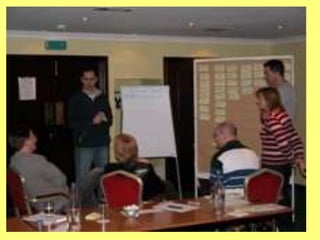
What is a Facilitator?
• Literally means: Making Things Easy
• A person who helps a group to:
–achieve results in interactive events
–by using a range of skills and methods
– to bring the best out in people
–as they work together
• focuses on the process of how
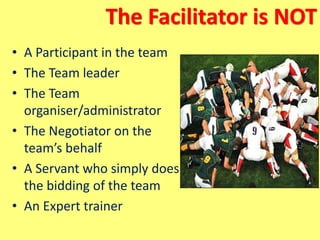
The Facilitator is NOT
• A Participant in the team
• The Team leader
• The Team
organiser/administrator
• The Negotiator on the
team’s behalf
• A Servant who simply does
the bidding of the team
• An Expert trainer
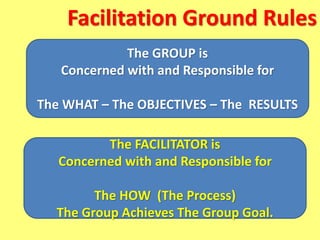
Facilitation Ground Rules
The GROUP is
Concerned with and Responsible for
The WHAT – The OBJECTIVES – The RESULTS
The FACILITATOR is
Concerned with and Responsible for
The HOW (The Process)
The Group Achieves The Group Goal.
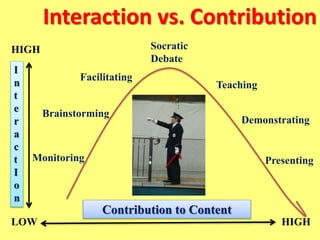
Interaction vs. Contribution
Monitoring
Brainstorming
Facilitating
Socratic
Debate
Teaching
Demonstrating
Presenting
HIGHLOW
HIGH
Contribution to Content
I
n
t
e
r
a
c
t
I
o
n
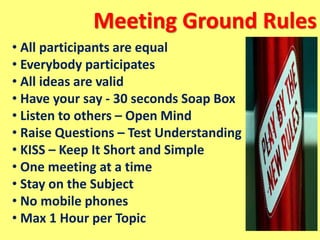
Meeting Ground Rules
• All participants are equal
• Everybody participates
• All ideas are valid
• Have your say - 30 seconds Soap Box
• Listen to others – Open Mind
• Raise Questions – Test Understanding
• KISS – Keep It Short and Simple
• One meeting at a time
• Stay on the Subject
• No mobile phones
• Max 1 Hour per Topic
Facilitation Skills
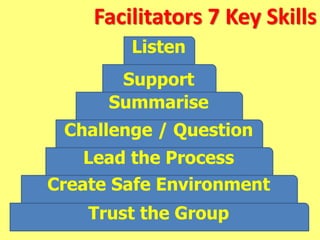
Facilitators 7 Key Skills
Listen
Support
Summarise
Challenge / Question
Lead the Process
Create Safe Environment
Trust the Group
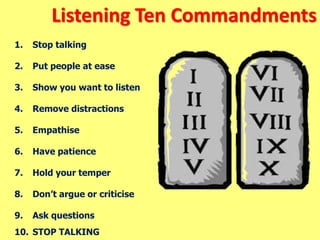
Listening Ten Commandments
1. Stop talking
2. Put people at ease
3. Show you want to listen
4. Remove distractions
5. Empathise
6. Have patience
7. Hold your temper
8. Don’t argue or criticise
9. Ask questions
10. STOP TALKING
Questioning
Use O P E N Questions
to probe
“Who, Why, What, When,
Where, How?”
Use CLOSED Questions
to redirect/ summarise
(yes/no answers)
“Are you saying that…?”
Questioning
Use YOU questions
• How do you see this?
• What are your priorities?
• How important is ... to you?
• Tell me /us more about ...?
• What if....Why....How....?
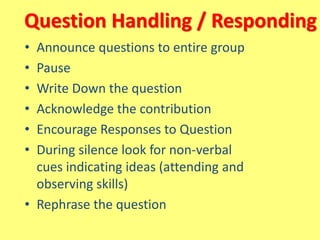
Question Handling / Responding
• Announce questions to entire group
• Pause
• Write Down the question
• Acknowledge the contribution
• Encourage Responses to Question
• During silence look for non-verbal
cues indicating ideas (attending and
observing skills)
• Rephrase the question
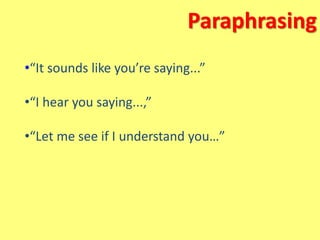
Paraphrasing
•“It sounds like you’re saying...”
•“I hear you saying...,”
•“Let me see if I understand you…”
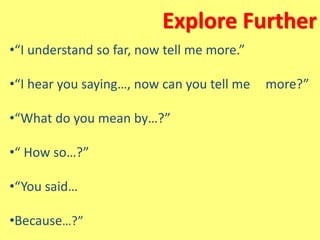
Explore Further
•“I understand so far, now tell me more.”
•“I hear you saying…, now can you tell me more?”
•“What do you mean by…?”
•“ How so…?”
•“You said…
•Because…?”
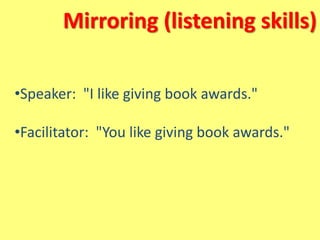
Mirroring (listening skills)
•Speaker: "I like giving book awards."
•Facilitator: "You like giving book awards."
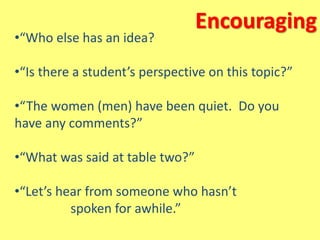
Encouraging
•“Who else has an idea?
•“Is there a student’s perspective on this topic?”
•“The women (men) have been quiet. Do you
have any comments?”
•“What was said at table two?”
•“Let’s hear from someone who hasn’t
spoken for awhile.”
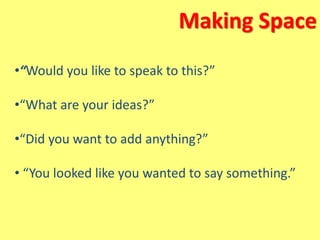
Making Space
•“Would you like to speak to this?”
•“What are your ideas?”
•“Did you want to add anything?”
• “You looked like you wanted to say something.”
Intentional Silence
•……………… (shut up and wait for a reaction)
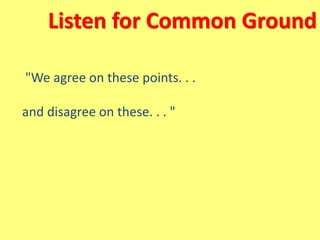
Listen for Common Ground
"We agree on these points. . .
and disagree on these. . . "
What if?
• Someone says something that is way off in left
field???
• Something is said that had seemingly been
addressed or agreed earlier??
Drawing Out
• What did you do well?
• What could you have done
even better?
• What prevented you from
doing even better
• What’s the plan to do even
better in the future?
Managing Conflict
Conflict Has Two
Dimensions
1. Your Personality or
Style
2. Personality or Style
of Participants
What is your style?
• Avoiding
• Accommodating
• Competing
• Collaborating
• Compromising
Avoiding
• Un-cooperative + unassertive
• Your customary manner is to be passive and
withdraw from conflict situations.
• Your attitude is to be accepting and patient,
often suppressing your own feelings to avoid
confrontation.
Accommodating
• Co-operative + unassertive
• You try to satisfy the other person’s concerns
at the expense of your own.
• You strive to understand, listen and put
yourself in the other person’s place.
Competing
• Un-cooperative + assertive
• You use direct tactics and have a strong need
to control the situation and/or people.
• You want to straighten out the other person
and argue about who is right.
• You do whatever it takes to WIN.
Collaborating
• Co-operative + assertive
• You work with the other person to find a
solution that fully satisfies both sides.
• You are ready to defend a stand without being
too pushy.
• You are willing to work toward a mutually
agreeable solution through negotiation.
Compromising
• Intermediate in co-operative + assertiveness
• You work to seek a middle-ground solution for
both parties.
• The solution provides partial satisfaction for
both, but in the interest of time and a lack of
commitment or effort to do better, this will
do.
Personality Types of Participants
• Complainers
• Indecisive
• Super-agreeable
• Negativist
• Experts
• Silent-Unresponsive
• Hostile-Aggressive
Strategies for Complainers
• Listen even though it may be difficult.
• Acknowledge by paraphrasing the complaints.
• DO NOT agree with the complaints.
• Be prepared to interrupt and take control of
the situation (these guys love to ramble).
• Use limiting responses that pin the complainer
to specifics.
Strategies for the Indecisive
• THEY DELAY DECISION MAKING!
• Bring issues out in the open and make it easy
for them to be direct.
• Help them solve problems.
• Watch for signs that the pressure to make a
decision may be overloading them.
• Give them lots of support after they finally
make a decision.
Strategies for Super-Agreeable
• OFTEN DON’T PULL THROUGH
• Don’t allow them to make unrealistic
commitments that they can’t fulfill.
• Make honesty non-threatening. They
sometimes don’t agree, but are afraid to tell
you.
Strategies for Negativist
• OBJECT TO EVERYTHING!
• Avoid getting drawn into their attitude.
• Don’t agree with them.
• Be patient.
• Be prepared to take on the project with
support from others.
Strategies for Experts
• KNOWS EVERYTHING
• Know your subject matter.
• Listen to and acknowledge what they say.
• Avoid being a counter-expert.
• Have documentation to support your
thoughts.
Strategies for Silent-Unresponsive
• ANSWERS ALL QUESTIONS WITH A YES/NO.
Hardest to read.
• Ask open ended questions.
• Pause for long periods, inviting them to fill the
void.
• Discuss one-on-one after the meeting.
• DON’T PLACE THEM IN AN UNCOMFORTABLE
SITUATION.
Hostile-Aggressive
• TRY TO BULLY YOU!
• Stand up for yourself, without being
threatening.
• Give them time to run down.
• Speak from your point of view.
• Stay positive.
Three Steps to Managing Conflict
1. Define the situation
2. Search for alternatives and their implications
3. Make a decision
Key is to have good Observation Skills
Observation Skills
• Help you assess how information is being
received.
• Based on your observations then you can
adjust to the needs you see.
• Observe body language
• Determine Feelings based on Observations
• Take Action based on Inferences
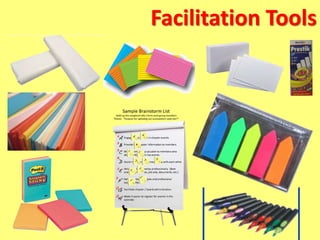
Facilitation Tools
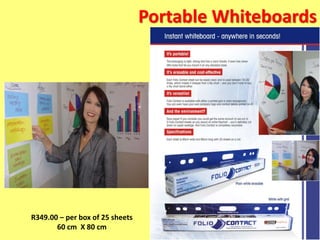
Portable Whiteboards
R349.00 – per box of 25 sheets
60 cm X 80 cm
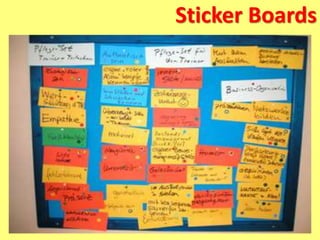
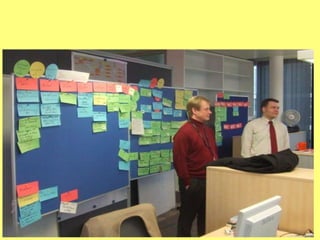
Sticker Boards
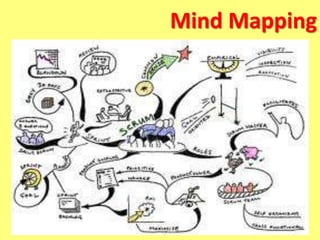
Mind Mapping
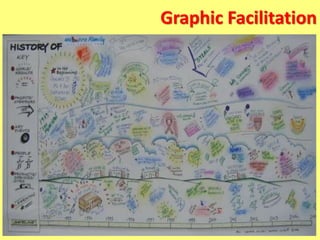
Graphic Facilitation
Sound
• Background Music
– For working sessions
– No words Instrumental only
– Soft background
• Energising Music
• Sound Equipment
– Mike for Facilitator
– Mike For Tables
– Mike for Feedback
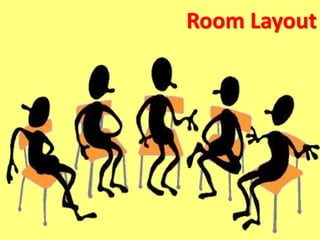
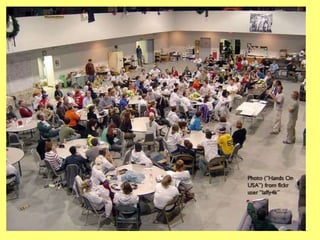
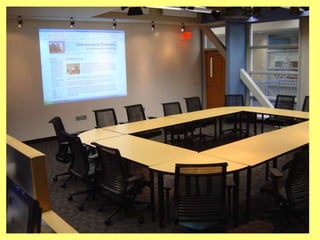
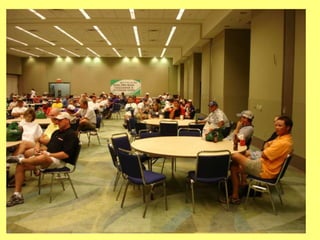
Room Layout
Room Layout
• Based on
– Size of group
– Size of meeting room
• Based on what you want to accomplish
• Planned and arranged beforehand
• Material for delegates
• Domestics
– Temperature
– Drinks
– Snacks
Acknowledgements
• The U N Systems Staff College
• Texas Community Futures Forum
• Gerry Gaffney
Question Time ?
• Web: www.adolph.co.za
• Web: www.adolphevents.co.za
• Web: www.mentorzone.co.za
• Web: www.speakers101.co.za
• e-Mail adolph@adolph.co.za
• Tel: 011- 679 - 3145
• Cell: 082 - 493 - 9093

Facilitation skills

  • 1.
  • 2.
    What is aFacilitator? • Literally means: Making Things Easy • A person who helps a group to: –achieve results in interactive events –by using a range of skills and methods – to bring the best out in people –as they work together • focuses on the process of how
  • 3.
    The Facilitator isNOT • A Participant in the team • The Team leader • The Team organiser/administrator • The Negotiator on the team’s behalf • A Servant who simply does the bidding of the team • An Expert trainer
  • 4.
    Facilitation Ground Rules TheGROUP is Concerned with and Responsible for The WHAT – The OBJECTIVES – The RESULTS The FACILITATOR is Concerned with and Responsible for The HOW (The Process) The Group Achieves The Group Goal.
  • 5.
  • 6.
    Meeting Ground Rules •All participants are equal • Everybody participates • All ideas are valid • Have your say - 30 seconds Soap Box • Listen to others – Open Mind • Raise Questions – Test Understanding • KISS – Keep It Short and Simple • One meeting at a time • Stay on the Subject • No mobile phones • Max 1 Hour per Topic
  • 7.
  • 8.
    Facilitators 7 KeySkills Listen Support Summarise Challenge / Question Lead the Process Create Safe Environment Trust the Group
  • 9.
    Listening Ten Commandments 1.Stop talking 2. Put people at ease 3. Show you want to listen 4. Remove distractions 5. Empathise 6. Have patience 7. Hold your temper 8. Don’t argue or criticise 9. Ask questions 10. STOP TALKING
  • 10.
    Questioning Use O PE N Questions to probe “Who, Why, What, When, Where, How?” Use CLOSED Questions to redirect/ summarise (yes/no answers) “Are you saying that…?”
  • 11.
    Questioning Use YOU questions •How do you see this? • What are your priorities? • How important is ... to you? • Tell me /us more about ...? • What if....Why....How....?
  • 12.
    Question Handling /Responding • Announce questions to entire group • Pause • Write Down the question • Acknowledge the contribution • Encourage Responses to Question • During silence look for non-verbal cues indicating ideas (attending and observing skills) • Rephrase the question
  • 13.
    Paraphrasing •“It sounds likeyou’re saying...” •“I hear you saying...,” •“Let me see if I understand you…”
  • 14.
    Explore Further •“I understandso far, now tell me more.” •“I hear you saying…, now can you tell me more?” •“What do you mean by…?” •“ How so…?” •“You said… •Because…?”
  • 15.
    Mirroring (listening skills) •Speaker:"I like giving book awards." •Facilitator: "You like giving book awards."
  • 16.
    Encouraging •“Who else hasan idea? •“Is there a student’s perspective on this topic?” •“The women (men) have been quiet. Do you have any comments?” •“What was said at table two?” •“Let’s hear from someone who hasn’t spoken for awhile.”
  • 17.
    Making Space •“Would youlike to speak to this?” •“What are your ideas?” •“Did you want to add anything?” • “You looked like you wanted to say something.”
  • 18.
  • 19.
    Listen for CommonGround "We agree on these points. . . and disagree on these. . . "
  • 20.
    What if? • Someonesays something that is way off in left field??? • Something is said that had seemingly been addressed or agreed earlier??
  • 21.
    Drawing Out • Whatdid you do well? • What could you have done even better? • What prevented you from doing even better • What’s the plan to do even better in the future?
  • 22.
    Managing Conflict Conflict HasTwo Dimensions 1. Your Personality or Style 2. Personality or Style of Participants
  • 23.
    What is yourstyle? • Avoiding • Accommodating • Competing • Collaborating • Compromising
  • 24.
    Avoiding • Un-cooperative +unassertive • Your customary manner is to be passive and withdraw from conflict situations. • Your attitude is to be accepting and patient, often suppressing your own feelings to avoid confrontation.
  • 25.
    Accommodating • Co-operative +unassertive • You try to satisfy the other person’s concerns at the expense of your own. • You strive to understand, listen and put yourself in the other person’s place.
  • 26.
    Competing • Un-cooperative +assertive • You use direct tactics and have a strong need to control the situation and/or people. • You want to straighten out the other person and argue about who is right. • You do whatever it takes to WIN.
  • 27.
    Collaborating • Co-operative +assertive • You work with the other person to find a solution that fully satisfies both sides. • You are ready to defend a stand without being too pushy. • You are willing to work toward a mutually agreeable solution through negotiation.
  • 28.
    Compromising • Intermediate inco-operative + assertiveness • You work to seek a middle-ground solution for both parties. • The solution provides partial satisfaction for both, but in the interest of time and a lack of commitment or effort to do better, this will do.
  • 29.
    Personality Types ofParticipants • Complainers • Indecisive • Super-agreeable • Negativist • Experts • Silent-Unresponsive • Hostile-Aggressive
  • 30.
    Strategies for Complainers •Listen even though it may be difficult. • Acknowledge by paraphrasing the complaints. • DO NOT agree with the complaints. • Be prepared to interrupt and take control of the situation (these guys love to ramble). • Use limiting responses that pin the complainer to specifics.
  • 31.
    Strategies for theIndecisive • THEY DELAY DECISION MAKING! • Bring issues out in the open and make it easy for them to be direct. • Help them solve problems. • Watch for signs that the pressure to make a decision may be overloading them. • Give them lots of support after they finally make a decision.
  • 32.
    Strategies for Super-Agreeable •OFTEN DON’T PULL THROUGH • Don’t allow them to make unrealistic commitments that they can’t fulfill. • Make honesty non-threatening. They sometimes don’t agree, but are afraid to tell you.
  • 33.
    Strategies for Negativist •OBJECT TO EVERYTHING! • Avoid getting drawn into their attitude. • Don’t agree with them. • Be patient. • Be prepared to take on the project with support from others.
  • 34.
    Strategies for Experts •KNOWS EVERYTHING • Know your subject matter. • Listen to and acknowledge what they say. • Avoid being a counter-expert. • Have documentation to support your thoughts.
  • 35.
    Strategies for Silent-Unresponsive •ANSWERS ALL QUESTIONS WITH A YES/NO. Hardest to read. • Ask open ended questions. • Pause for long periods, inviting them to fill the void. • Discuss one-on-one after the meeting. • DON’T PLACE THEM IN AN UNCOMFORTABLE SITUATION.
  • 36.
    Hostile-Aggressive • TRY TOBULLY YOU! • Stand up for yourself, without being threatening. • Give them time to run down. • Speak from your point of view. • Stay positive.
  • 37.
    Three Steps toManaging Conflict 1. Define the situation 2. Search for alternatives and their implications 3. Make a decision Key is to have good Observation Skills
  • 38.
    Observation Skills • Helpyou assess how information is being received. • Based on your observations then you can adjust to the needs you see. • Observe body language • Determine Feelings based on Observations • Take Action based on Inferences
  • 39.
  • 40.
    Portable Whiteboards R349.00 –per box of 25 sheets 60 cm X 80 cm
  • 41.
  • 43.
  • 44.
  • 45.
    Sound • Background Music –For working sessions – No words Instrumental only – Soft background • Energising Music • Sound Equipment – Mike for Facilitator – Mike For Tables – Mike for Feedback
  • 46.
  • 47.
    Room Layout • Basedon – Size of group – Size of meeting room • Based on what you want to accomplish • Planned and arranged beforehand • Material for delegates • Domestics – Temperature – Drinks – Snacks
  • 63.
    Acknowledgements • The UN Systems Staff College • Texas Community Futures Forum • Gerry Gaffney
  • 64.
    Question Time ? •Web: www.adolph.co.za • Web: www.adolphevents.co.za • Web: www.mentorzone.co.za • Web: www.speakers101.co.za • e-Mail adolph@adolph.co.za • Tel: 011- 679 - 3145 • Cell: 082 - 493 - 9093