WHAT IS A PROJECT MANAGEMENT OFFICE (PMO)?
(IT 2700-XX V 0.1 DRAFT: FOR DISCUSSION PURPOSES)
PRESENTATION
CAVEAT : THIS PRESENTATION REFLECTS THE OBSERVATIONS, COMMENTS AND STATUSES FROM THE YEAR IT WAS ORIGINALLY
PREPARED (2004) BUT DOES CONTAIN RELEVANCY TO A NUMBER OF SOLUTIONS AND ISSUES OF TODAY FOR A PMO.
as of: Dec 2004
Prepared for:
<Client>
Prepared By:
David Niles; Director
Project Control and Service Management
Wednesday, October 21, 2015ECIO EXECUTIVE WORKBENCH Page: 1
AGENDA
1. Introduction
– Project Management Office (PMO) Definition
– Strategic Assumptions
– Why the PMO is Important
2. PMO Organization and Structure
– PMO Roles and Responsibilities
– PMO Models
3. Key Steps in Establishing a PMO
– Sample PMO Development Methodology and Expected Deliverables
4. Conclusion: Question and Answer Session
Wednesday, October 21, 2015ECIO EXECUTIVE WORKBENCH Page: 2
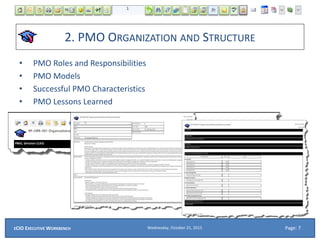
1. INTRODUCTION
• PMO Definition
• Strategic Assumptions
• Why the PMO is Important
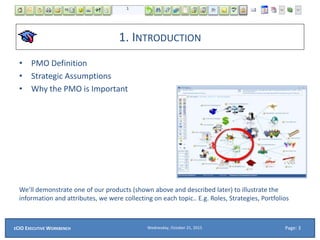
We’ll demonstrate one of our products (shown above and described later) to illustrate the
information and attributes, we were collecting on each topic.. E.g. Roles, Strategies, Portfolios
Wednesday, October 21, 2015ECIO EXECUTIVE WORKBENCH Page: 3
STRATEGIC ASSUMPTIONS
• Project offices will be established in more than 60 percent of IS
organizations by 2003, and will often plan and control project resources
beyond IS
– 0.7 probability
• Through 2004, IS organizations that establish enterprise standards for
project management, including a project office with suitable governance,
will experience half the major project cost overruns, delays and
cancellations of those that do not
– 0.7 probability
Wednesday, October 21, 2015ECIO EXECUTIVE WORKBENCH Page: 4
WHY THE PMO IS IMPORTANT
• Poor Project Management Leads to Significant Levels of Project Failure
– The PMO provides the resources and tools necessary to consistently
improve the success of IT projects.
• Project Management Skills Are Transferable
– The most-critical skills required for effectively managing a development
project fit substantially into the “soft” category (e.g. ability to negotiate
for resources, high motivation, coaching or other skills necessary for good
project management)
– When an individual exhibits such skills, they become a resource that can
be moved between applications or projects coordinated by a PMO.
• Decentralized Development Requires Centralized Support
– Project Management skill sets are not distributed evenly throughout the
organization
– It is crucial to have a support structure in the centralized IT group to
monitor and facilitate best practices transfer, along with infrastructure
issues such as reuse, methodology and measurement.
Wednesday, October 21, 2015ECIO EXECUTIVE WORKBENCH Page: 5
PROJECT MANAGEMENT OFFICE (PMO) DEFINITION
• A Project Management Office (PMO) is a shared competency designed to
integrate project management practices within an organization.
• A PMO can be a key resource in establishing an organizational competency
in project analysis, design, management and review.
• Given the appropriate governance, a PMO accomplishes the following:
– Establishes an enterprise standard for project management.
– Improve communication and the leveraging of resources within the
organization.
– Helps reduce the disastrous effect of failed development projects on
enterprise effectiveness and productivity.
• The PMO is the center of project management best practices within the
organization.
Wednesday, October 21, 2015ECIO EXECUTIVE WORKBENCH Page: 6
2. PMO ORGANIZATION AND STRUCTURE
• PMO Roles and Responsibilities
• PMO Models
• Successful PMO Characteristics
• PMO Lessons Learned
Wednesday, October 21, 2015ECIO EXECUTIVE WORKBENCH Page: 7
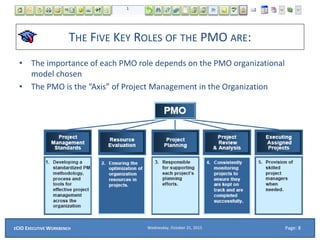
THE FIVE KEY ROLES OF THE PMO ARE:
• The importance of each PMO role depends on the PMO organizational
model chosen
• The PMO is the “Axis” of Project Management in the Organization
Wednesday, October 21, 2015ECIO EXECUTIVE WORKBENCH Page: 8
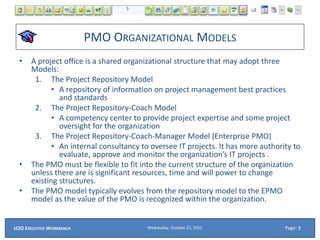
PMO ORGANIZATIONAL MODELS
• A project office is a shared organizational structure that may adopt three
Models:
1. The Project Repository Model
• A repository of information on project management best practices
and standards
2. The Project Repository-Coach Model
• A competency center to provide project expertise and some project
oversight for the organization
3. The Project Repository-Coach-Manager Model (Enterprise PMO)
• An internal consultancy to oversee IT projects. It has more authority to
evaluate, approve and monitor the organization’s IT projects .
• The PMO must be flexible to fit into the current structure of the organization
unless there are is significant resources, time and will power to change
existing structures.
• The PMO model typically evolves from the repository model to the EPMO
model as the value of the PMO is recognized within the organization.
Wednesday, October 21, 2015ECIO EXECUTIVE WORKBENCH Page: 9
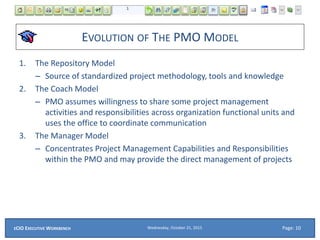
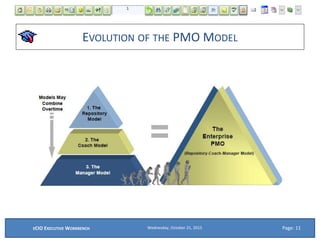
EVOLUTION OF THE PMO MODEL
1. The Repository Model
– Source of standardized project methodology, tools and knowledge
2. The Coach Model
– PMO assumes willingness to share some project management
activities and responsibilities across organization functional units and
uses the office to coordinate communication
3. The Manager Model
– Concentrates Project Management Capabilities and Responsibilities
within the PMO and may provide the direct management of projects
Wednesday, October 21, 2015ECIO EXECUTIVE WORKBENCH Page: 10
EVOLUTION OF THE PMO MODEL
Wednesday, October 21, 2015ECIO EXECUTIVE WORKBENCH Page: 11
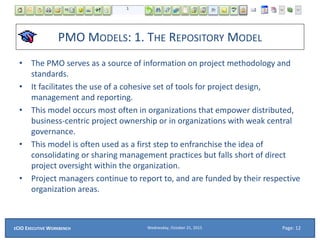
PMO MODELS: 1. THE REPOSITORY MODEL
• The PMO serves as a source of information on project methodology and
standards.
• It facilitates the use of a cohesive set of tools for project design,
management and reporting.
• This model occurs most often in organizations that empower distributed,
business-centric project ownership or in organizations with weak central
governance.
• This model is often used as a first step to enfranchise the idea of
consolidating or sharing management practices but falls short of direct
project oversight within the organization.
• Project managers continue to report to, and are funded by their respective
organization areas.
Wednesday, October 21, 2015ECIO EXECUTIVE WORKBENCH Page: 12
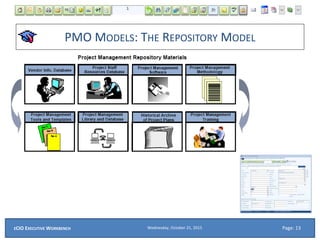
PMO MODELS: THE REPOSITORY MODEL
Wednesday, October 21, 2015ECIO EXECUTIVE WORKBENCH Page: 13
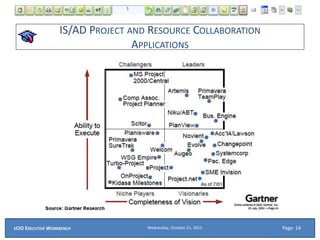
IS/AD PROJECT AND RESOURCE COLLABORATION
APPLICATIONS
Wednesday, October 21, 2015ECIO EXECUTIVE WORKBENCH Page: 14
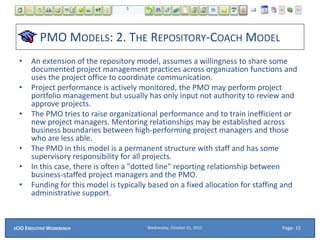
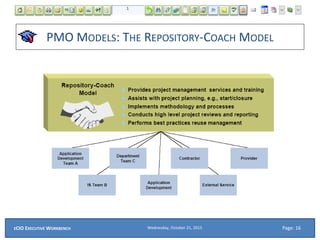
PMO MODELS: 2. THE REPOSITORY-COACH MODEL
• An extension of the repository model, assumes a willingness to share some
documented project management practices across organization functions and
uses the project office to coordinate communication.
• Project performance is actively monitored, the PMO may perform project
portfolio management but usually has only input not authority to review and
approve projects.
• The PMO tries to raise organizational performance and to train inefficient or
new project managers. Mentoring relationships may be established across
business boundaries between high-performing project managers and those
who are less able.
• The PMO in this model is a permanent structure with staff and has some
supervisory responsibility for all projects.
• In this case, there is often a "dotted line" reporting relationship between
business-staffed project managers and the PMO.
• Funding for this model is typically based on a fixed allocation for staffing and
administrative support.
Wednesday, October 21, 2015ECIO EXECUTIVE WORKBENCH Page: 15
PMO MODELS: THE REPOSITORY-COACH MODEL
Wednesday, October 21, 2015ECIO EXECUTIVE WORKBENCH Page: 16
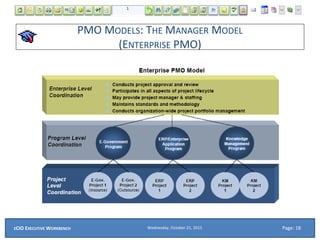
PMO MODELS: 3. THE MANAGER MODEL
(ENTERPRISE PMO)
• The most permanent, consolidated organizational model and concentrates
project management within the PMO.
• This implies direct management or oversight, depending on scope and
duration, of projects wherever they occur within the organization.
• In some cases, all project managers are actually staffed within the shared
service and assigned to projects as needed.
• This model assumes a governance process that involves the PMO in all
projects regardless of size, allowing it to assess scope, allocate resources
and verify time, budget, risk and impact assumptions before the project is
undertaken.
• The PMO is responsible for managing the IT project portfolio.
• Funding is generally a combination of direct, budgeted allocation for
baseline services and a fee-for-service charge for others.
Wednesday, October 21, 2015ECIO EXECUTIVE WORKBENCH Page: 17
PMO MODELS: THE MANAGER MODEL
(ENTERPRISE PMO)
Wednesday, October 21, 2015ECIO EXECUTIVE WORKBENCH Page: 18
PMO MODELS: STAFFING THE PROJECT OFFICE
• The size of the staff, and the skills embedded within the project office, will
vary depending on the role it is designed to play.
• In the repository model, methodology experts or a project librarian may
be sufficient.
• As its role becomes more complex, the PMO will require a manager and,
optionally, relationship managers to develop requirements with the
business unit and manage the staff.
• In the most complex models, project managers and administrative staff
are added.
• Typical project office sizes range from five to 20, although in very large
organizations there may be dozens of project managers linked directly or
indirectly to the project office.
Wednesday, October 21, 2015ECIO EXECUTIVE WORKBENCH Page: 19
SUCCESSFUL PMO CHARACTERISTICS
• A Successful PMO Should
– Add consistency to project
management within the
organization.
– Increase the number of
successful projects.
– Show value both to executive
management and line project
managers and staff.
– Balance its roles of project
control vs. project support.
– Be viewed as neutral and
objective in its dealing
between executive
management and business
unit project managers.
• A Successful PMO Should Not
– Be a policy enforcing body that
polices the execution of projects,
rather it is a facilitator of
management accepted PM
practices that are proven to
provide repeatable project success
across the organization.
– Be a strategy development body
(this lies with the CIO and IT
governing bodies).
• The PMO is a link between strategy
development and strategy
implementation through the proper
execution of IT Projects.
• The PMO can be responsible for the
project portfolio management
process where it is ensured that
projects that are executed are
aligned with the organizations IT
strategies.
Wednesday, October 21, 2015ECIO EXECUTIVE WORKBENCH Page: 20
WIDE WEAKNESS: BENEFITS REALIZATION, DEFINING AND
TRACKING PROJECT SUCCESS
• 41% lack a centrally overseen IT budget
• 46% have poorly documented applications
and infrastructure
• 46% don’t track projects centrally
• 89% don’t use earned value to track
project success
• 57% lack defined criteria for project success
• 68% don’t track project benefits
• 81% don’t consider a project’s option value
“IT Portfolio Management: Challenges and Best Practices,” Kellogg School of Management and
DiamondCluster Survey of 130 Fortune 1000 Companies (respondents reporting to CEO, CFO or
COO), Spring 2003
Wednesday, October 21, 2015ECIO EXECUTIVE WORKBENCH Page: 21
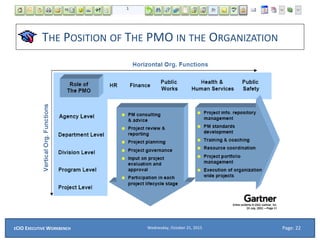
THE POSITION OF THE PMO IN THE ORGANIZATION
Wednesday, October 21, 2015ECIO EXECUTIVE WORKBENCH Page: 22
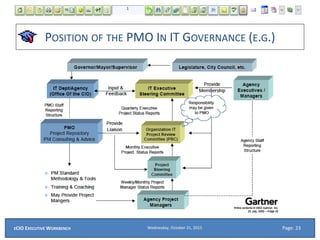
POSITION OF THE PMO IN IT GOVERNANCE (E.G.)
Wednesday, October 21, 2015ECIO EXECUTIVE WORKBENCH Page: 23
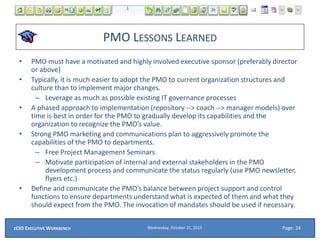
PMO LESSONS LEARNED
• PMO must have a motivated and highly involved executive sponsor (preferably director
or above)
• Typically, it is much easier to adopt the PMO to current organization structures and
culture than to implement major changes.
– Leverage as much as possible existing IT governance processes
• A phased approach to implementation (repository --> coach --> manager models) over
time is best in order for the PMO to gradually develop its capabilities and the
organization to recognize the PMO’s value.
• Strong PMO marketing and communications plan to aggressively promote the
capabilities of the PMO to departments.
– Free Project Management Seminars
– Motivate participation of internal and external stakeholders in the PMO
development process and communicate the status regularly (use PMO newsletter,
flyers etc.)
• Define and communicate the PMO’s balance between project support and control
functions to ensure departments understand what is expected of them and what they
should expect from the PMO. The invocation of mandates should be used if necessary.
Wednesday, October 21, 2015ECIO EXECUTIVE WORKBENCH Page: 24
3. KEY STEPS IN ESTABLISHING A PMO
• Sample PMO Development Methodology and Expected Deliverables
Wednesday, October 21, 2015ECIO EXECUTIVE WORKBENCH Page: 25
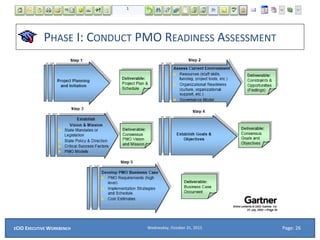
PHASE I: CONDUCT PMO READINESS ASSESSMENT
Wednesday, October 21, 2015ECIO EXECUTIVE WORKBENCH Page: 26
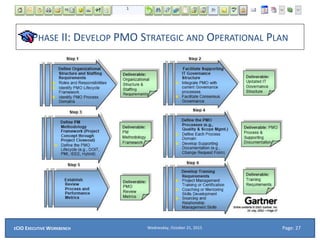
PHASE II: DEVELOP PMO STRATEGIC AND OPERATIONAL PLAN
Wednesday, October 21, 2015ECIO EXECUTIVE WORKBENCH Page: 27
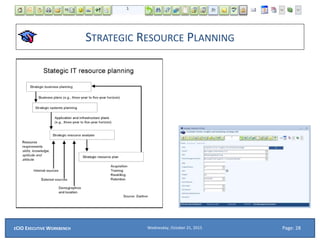
STRATEGIC RESOURCE PLANNING
Wednesday, October 21, 2015ECIO EXECUTIVE WORKBENCH Page: 28
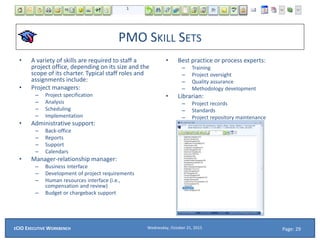
PMO SKILL SETS
• A variety of skills are required to staff a
project office, depending on its size and the
scope of its charter. Typical staff roles and
assignments include:
• Project managers:
– Project specification
– Analysis
– Scheduling
– Implementation
• Administrative support:
– Back-office
– Reports
– Support
– Calendars
• Manager-relationship manager:
– Business interface
– Development of project requirements
– Human resources interface (i.e.,
compensation and review)
– Budget or chargeback support
• Best practice or process experts:
– Training
– Project oversight
– Quality assurance
– Methodology development
• Librarian:
– Project records
– Standards
– Project repository maintenance
Wednesday, October 21, 2015ECIO EXECUTIVE WORKBENCH Page: 29
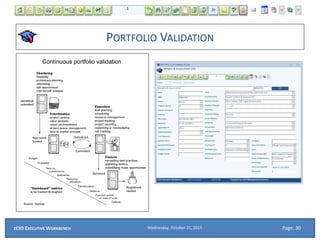
PORTFOLIO VALIDATION
Wednesday, October 21, 2015ECIO EXECUTIVE WORKBENCH Page: 30
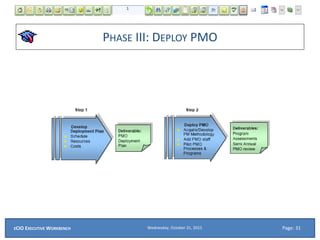
PHASE III: DEPLOY PMO
Wednesday, October 21, 2015ECIO EXECUTIVE WORKBENCH Page: 31
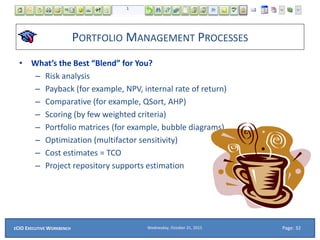
PORTFOLIO MANAGEMENT PROCESSES
• What’s the Best “Blend” for You?
– Risk analysis
– Payback (for example, NPV, internal rate of return)
– Comparative (for example, QSort, AHP)
– Scoring (by few weighted criteria)
– Portfolio matrices (for example, bubble diagrams)
– Optimization (multifactor sensitivity)
– Cost estimates = TCO
– Project repository supports estimation
Wednesday, October 21, 2015ECIO EXECUTIVE WORKBENCH Page: 32
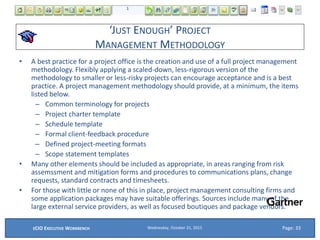
‘JUST ENOUGH’ PROJECT
MANAGEMENT METHODOLOGY
• A best practice for a project office is the creation and use of a full project management
methodology. Flexibly applying a scaled-down, less-rigorous version of the
methodology to smaller or less-risky projects can encourage acceptance and is a best
practice. A project management methodology should provide, at a minimum, the items
listed below.
– Common terminology for projects
– Project charter template
– Schedule template
– Formal client-feedback procedure
– Defined project-meeting formats
– Scope statement templates
• Many other elements should be included as appropriate, in areas ranging from risk
assemssment and mitigation forms and procedures to communications plans, change
requests, standard contracts and timesheets.
• For those with little or none of this in place, project management consulting firms and
some application packages may have suitable offerings. Sources include many of the
large external service providers, as well as focused boutiques and package vendors.
Wednesday, October 21, 2015ECIO EXECUTIVE WORKBENCH Page: 33
SUPPORTING MATERIAL
• Project Management and the Public Sector (July, 2002)
• Matt Light Research Director, Gartner Research
• Irma J. Fabular Vice President, Gartner Consulting
Wednesday, October 21, 2015ECIO EXECUTIVE WORKBENCH Page: 34
PRESENTERS BACKGROUND
• David Niles (djn_bus@msn.com)
– Director, Systems Development
• USA Federal Government Health Care, Washington DC
– Director Enterprise Infrastructure
• Sanmina-SCI Contract Manufacturing, San Jose CA, Huntsville AL
• Largest Oracle ERP instance in the world… HSV Z series, Superdomes
– Director, Project Control And Service Management
• Sanmina-SCI, Chennai India Guadalajara MX
• Mergers and Acquisitions, DRP, SOX, GSC, PMO
– Sr. Director Support Services
• Burlington Coat Factory, Philadelphia PA
• Change Control, GSC, Asset Management, Field Services, Technical Services,
PMO
– Program Director, Day 2 Wipro
– Special advisor, CIO/COO Macmillan Publishing NYC
• Prepared with input by:
Page: 35Wednesday, October 21, 2015ECIO EXECUTIVE WORKBENCH
TOOLKITS USED IN THE ASSISTANCE FOR COLLECTION OF
INFORMATION
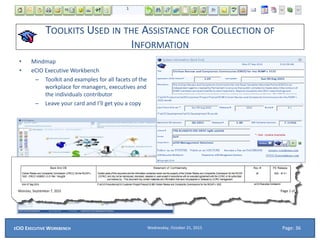
• Mindmap
• eCIO Executive Workbench
– Toolkit and examples for all facets of the
workplace for managers, executives and
the individuals contributor
– Leave your card and I’ll get you a copy
Page: 36Wednesday, October 21, 2015ECIO EXECUTIVE WORKBENCH
END OF PRESENTATION
Page: 37Wednesday, October 21, 2015ECIO EXECUTIVE WORKBENCH

eCIO PPT What is a PMO

  • 1.
    WHAT IS APROJECT MANAGEMENT OFFICE (PMO)? (IT 2700-XX V 0.1 DRAFT: FOR DISCUSSION PURPOSES) PRESENTATION CAVEAT : THIS PRESENTATION REFLECTS THE OBSERVATIONS, COMMENTS AND STATUSES FROM THE YEAR IT WAS ORIGINALLY PREPARED (2004) BUT DOES CONTAIN RELEVANCY TO A NUMBER OF SOLUTIONS AND ISSUES OF TODAY FOR A PMO. as of: Dec 2004 Prepared for: <Client> Prepared By: David Niles; Director Project Control and Service Management Wednesday, October 21, 2015ECIO EXECUTIVE WORKBENCH Page: 1
  • 2.
    AGENDA 1. Introduction – ProjectManagement Office (PMO) Definition – Strategic Assumptions – Why the PMO is Important 2. PMO Organization and Structure – PMO Roles and Responsibilities – PMO Models 3. Key Steps in Establishing a PMO – Sample PMO Development Methodology and Expected Deliverables 4. Conclusion: Question and Answer Session Wednesday, October 21, 2015ECIO EXECUTIVE WORKBENCH Page: 2
  • 3.
    1. INTRODUCTION • PMODefinition • Strategic Assumptions • Why the PMO is Important We’ll demonstrate one of our products (shown above and described later) to illustrate the information and attributes, we were collecting on each topic.. E.g. Roles, Strategies, Portfolios Wednesday, October 21, 2015ECIO EXECUTIVE WORKBENCH Page: 3
  • 4.
    STRATEGIC ASSUMPTIONS • Projectoffices will be established in more than 60 percent of IS organizations by 2003, and will often plan and control project resources beyond IS – 0.7 probability • Through 2004, IS organizations that establish enterprise standards for project management, including a project office with suitable governance, will experience half the major project cost overruns, delays and cancellations of those that do not – 0.7 probability Wednesday, October 21, 2015ECIO EXECUTIVE WORKBENCH Page: 4
  • 5.
    WHY THE PMOIS IMPORTANT • Poor Project Management Leads to Significant Levels of Project Failure – The PMO provides the resources and tools necessary to consistently improve the success of IT projects. • Project Management Skills Are Transferable – The most-critical skills required for effectively managing a development project fit substantially into the “soft” category (e.g. ability to negotiate for resources, high motivation, coaching or other skills necessary for good project management) – When an individual exhibits such skills, they become a resource that can be moved between applications or projects coordinated by a PMO. • Decentralized Development Requires Centralized Support – Project Management skill sets are not distributed evenly throughout the organization – It is crucial to have a support structure in the centralized IT group to monitor and facilitate best practices transfer, along with infrastructure issues such as reuse, methodology and measurement. Wednesday, October 21, 2015ECIO EXECUTIVE WORKBENCH Page: 5
  • 6.
    PROJECT MANAGEMENT OFFICE(PMO) DEFINITION • A Project Management Office (PMO) is a shared competency designed to integrate project management practices within an organization. • A PMO can be a key resource in establishing an organizational competency in project analysis, design, management and review. • Given the appropriate governance, a PMO accomplishes the following: – Establishes an enterprise standard for project management. – Improve communication and the leveraging of resources within the organization. – Helps reduce the disastrous effect of failed development projects on enterprise effectiveness and productivity. • The PMO is the center of project management best practices within the organization. Wednesday, October 21, 2015ECIO EXECUTIVE WORKBENCH Page: 6
  • 7.
    2. PMO ORGANIZATIONAND STRUCTURE • PMO Roles and Responsibilities • PMO Models • Successful PMO Characteristics • PMO Lessons Learned Wednesday, October 21, 2015ECIO EXECUTIVE WORKBENCH Page: 7
  • 8.
    THE FIVE KEYROLES OF THE PMO ARE: • The importance of each PMO role depends on the PMO organizational model chosen • The PMO is the “Axis” of Project Management in the Organization Wednesday, October 21, 2015ECIO EXECUTIVE WORKBENCH Page: 8
  • 9.
    PMO ORGANIZATIONAL MODELS •A project office is a shared organizational structure that may adopt three Models: 1. The Project Repository Model • A repository of information on project management best practices and standards 2. The Project Repository-Coach Model • A competency center to provide project expertise and some project oversight for the organization 3. The Project Repository-Coach-Manager Model (Enterprise PMO) • An internal consultancy to oversee IT projects. It has more authority to evaluate, approve and monitor the organization’s IT projects . • The PMO must be flexible to fit into the current structure of the organization unless there are is significant resources, time and will power to change existing structures. • The PMO model typically evolves from the repository model to the EPMO model as the value of the PMO is recognized within the organization. Wednesday, October 21, 2015ECIO EXECUTIVE WORKBENCH Page: 9
  • 10.
    EVOLUTION OF THEPMO MODEL 1. The Repository Model – Source of standardized project methodology, tools and knowledge 2. The Coach Model – PMO assumes willingness to share some project management activities and responsibilities across organization functional units and uses the office to coordinate communication 3. The Manager Model – Concentrates Project Management Capabilities and Responsibilities within the PMO and may provide the direct management of projects Wednesday, October 21, 2015ECIO EXECUTIVE WORKBENCH Page: 10
  • 11.
    EVOLUTION OF THEPMO MODEL Wednesday, October 21, 2015ECIO EXECUTIVE WORKBENCH Page: 11
  • 12.
    PMO MODELS: 1.THE REPOSITORY MODEL • The PMO serves as a source of information on project methodology and standards. • It facilitates the use of a cohesive set of tools for project design, management and reporting. • This model occurs most often in organizations that empower distributed, business-centric project ownership or in organizations with weak central governance. • This model is often used as a first step to enfranchise the idea of consolidating or sharing management practices but falls short of direct project oversight within the organization. • Project managers continue to report to, and are funded by their respective organization areas. Wednesday, October 21, 2015ECIO EXECUTIVE WORKBENCH Page: 12
  • 13.
    PMO MODELS: THEREPOSITORY MODEL Wednesday, October 21, 2015ECIO EXECUTIVE WORKBENCH Page: 13
  • 14.
    IS/AD PROJECT ANDRESOURCE COLLABORATION APPLICATIONS Wednesday, October 21, 2015ECIO EXECUTIVE WORKBENCH Page: 14
  • 15.
    PMO MODELS: 2.THE REPOSITORY-COACH MODEL • An extension of the repository model, assumes a willingness to share some documented project management practices across organization functions and uses the project office to coordinate communication. • Project performance is actively monitored, the PMO may perform project portfolio management but usually has only input not authority to review and approve projects. • The PMO tries to raise organizational performance and to train inefficient or new project managers. Mentoring relationships may be established across business boundaries between high-performing project managers and those who are less able. • The PMO in this model is a permanent structure with staff and has some supervisory responsibility for all projects. • In this case, there is often a "dotted line" reporting relationship between business-staffed project managers and the PMO. • Funding for this model is typically based on a fixed allocation for staffing and administrative support. Wednesday, October 21, 2015ECIO EXECUTIVE WORKBENCH Page: 15
  • 16.
    PMO MODELS: THEREPOSITORY-COACH MODEL Wednesday, October 21, 2015ECIO EXECUTIVE WORKBENCH Page: 16
  • 17.
    PMO MODELS: 3.THE MANAGER MODEL (ENTERPRISE PMO) • The most permanent, consolidated organizational model and concentrates project management within the PMO. • This implies direct management or oversight, depending on scope and duration, of projects wherever they occur within the organization. • In some cases, all project managers are actually staffed within the shared service and assigned to projects as needed. • This model assumes a governance process that involves the PMO in all projects regardless of size, allowing it to assess scope, allocate resources and verify time, budget, risk and impact assumptions before the project is undertaken. • The PMO is responsible for managing the IT project portfolio. • Funding is generally a combination of direct, budgeted allocation for baseline services and a fee-for-service charge for others. Wednesday, October 21, 2015ECIO EXECUTIVE WORKBENCH Page: 17
  • 18.
    PMO MODELS: THEMANAGER MODEL (ENTERPRISE PMO) Wednesday, October 21, 2015ECIO EXECUTIVE WORKBENCH Page: 18
  • 19.
    PMO MODELS: STAFFINGTHE PROJECT OFFICE • The size of the staff, and the skills embedded within the project office, will vary depending on the role it is designed to play. • In the repository model, methodology experts or a project librarian may be sufficient. • As its role becomes more complex, the PMO will require a manager and, optionally, relationship managers to develop requirements with the business unit and manage the staff. • In the most complex models, project managers and administrative staff are added. • Typical project office sizes range from five to 20, although in very large organizations there may be dozens of project managers linked directly or indirectly to the project office. Wednesday, October 21, 2015ECIO EXECUTIVE WORKBENCH Page: 19
  • 20.
    SUCCESSFUL PMO CHARACTERISTICS •A Successful PMO Should – Add consistency to project management within the organization. – Increase the number of successful projects. – Show value both to executive management and line project managers and staff. – Balance its roles of project control vs. project support. – Be viewed as neutral and objective in its dealing between executive management and business unit project managers. • A Successful PMO Should Not – Be a policy enforcing body that polices the execution of projects, rather it is a facilitator of management accepted PM practices that are proven to provide repeatable project success across the organization. – Be a strategy development body (this lies with the CIO and IT governing bodies). • The PMO is a link between strategy development and strategy implementation through the proper execution of IT Projects. • The PMO can be responsible for the project portfolio management process where it is ensured that projects that are executed are aligned with the organizations IT strategies. Wednesday, October 21, 2015ECIO EXECUTIVE WORKBENCH Page: 20
  • 21.
    WIDE WEAKNESS: BENEFITSREALIZATION, DEFINING AND TRACKING PROJECT SUCCESS • 41% lack a centrally overseen IT budget • 46% have poorly documented applications and infrastructure • 46% don’t track projects centrally • 89% don’t use earned value to track project success • 57% lack defined criteria for project success • 68% don’t track project benefits • 81% don’t consider a project’s option value “IT Portfolio Management: Challenges and Best Practices,” Kellogg School of Management and DiamondCluster Survey of 130 Fortune 1000 Companies (respondents reporting to CEO, CFO or COO), Spring 2003 Wednesday, October 21, 2015ECIO EXECUTIVE WORKBENCH Page: 21
  • 22.
    THE POSITION OFTHE PMO IN THE ORGANIZATION Wednesday, October 21, 2015ECIO EXECUTIVE WORKBENCH Page: 22
  • 23.
    POSITION OF THEPMO IN IT GOVERNANCE (E.G.) Wednesday, October 21, 2015ECIO EXECUTIVE WORKBENCH Page: 23
  • 24.
    PMO LESSONS LEARNED •PMO must have a motivated and highly involved executive sponsor (preferably director or above) • Typically, it is much easier to adopt the PMO to current organization structures and culture than to implement major changes. – Leverage as much as possible existing IT governance processes • A phased approach to implementation (repository --> coach --> manager models) over time is best in order for the PMO to gradually develop its capabilities and the organization to recognize the PMO’s value. • Strong PMO marketing and communications plan to aggressively promote the capabilities of the PMO to departments. – Free Project Management Seminars – Motivate participation of internal and external stakeholders in the PMO development process and communicate the status regularly (use PMO newsletter, flyers etc.) • Define and communicate the PMO’s balance between project support and control functions to ensure departments understand what is expected of them and what they should expect from the PMO. The invocation of mandates should be used if necessary. Wednesday, October 21, 2015ECIO EXECUTIVE WORKBENCH Page: 24
  • 25.
    3. KEY STEPSIN ESTABLISHING A PMO • Sample PMO Development Methodology and Expected Deliverables Wednesday, October 21, 2015ECIO EXECUTIVE WORKBENCH Page: 25
  • 26.
    PHASE I: CONDUCTPMO READINESS ASSESSMENT Wednesday, October 21, 2015ECIO EXECUTIVE WORKBENCH Page: 26
  • 27.
    PHASE II: DEVELOPPMO STRATEGIC AND OPERATIONAL PLAN Wednesday, October 21, 2015ECIO EXECUTIVE WORKBENCH Page: 27
  • 28.
    STRATEGIC RESOURCE PLANNING Wednesday,October 21, 2015ECIO EXECUTIVE WORKBENCH Page: 28
  • 29.
    PMO SKILL SETS •A variety of skills are required to staff a project office, depending on its size and the scope of its charter. Typical staff roles and assignments include: • Project managers: – Project specification – Analysis – Scheduling – Implementation • Administrative support: – Back-office – Reports – Support – Calendars • Manager-relationship manager: – Business interface – Development of project requirements – Human resources interface (i.e., compensation and review) – Budget or chargeback support • Best practice or process experts: – Training – Project oversight – Quality assurance – Methodology development • Librarian: – Project records – Standards – Project repository maintenance Wednesday, October 21, 2015ECIO EXECUTIVE WORKBENCH Page: 29
  • 30.
    PORTFOLIO VALIDATION Wednesday, October21, 2015ECIO EXECUTIVE WORKBENCH Page: 30
  • 31.
    PHASE III: DEPLOYPMO Wednesday, October 21, 2015ECIO EXECUTIVE WORKBENCH Page: 31
  • 32.
    PORTFOLIO MANAGEMENT PROCESSES •What’s the Best “Blend” for You? – Risk analysis – Payback (for example, NPV, internal rate of return) – Comparative (for example, QSort, AHP) – Scoring (by few weighted criteria) – Portfolio matrices (for example, bubble diagrams) – Optimization (multifactor sensitivity) – Cost estimates = TCO – Project repository supports estimation Wednesday, October 21, 2015ECIO EXECUTIVE WORKBENCH Page: 32
  • 33.
    ‘JUST ENOUGH’ PROJECT MANAGEMENTMETHODOLOGY • A best practice for a project office is the creation and use of a full project management methodology. Flexibly applying a scaled-down, less-rigorous version of the methodology to smaller or less-risky projects can encourage acceptance and is a best practice. A project management methodology should provide, at a minimum, the items listed below. – Common terminology for projects – Project charter template – Schedule template – Formal client-feedback procedure – Defined project-meeting formats – Scope statement templates • Many other elements should be included as appropriate, in areas ranging from risk assemssment and mitigation forms and procedures to communications plans, change requests, standard contracts and timesheets. • For those with little or none of this in place, project management consulting firms and some application packages may have suitable offerings. Sources include many of the large external service providers, as well as focused boutiques and package vendors. Wednesday, October 21, 2015ECIO EXECUTIVE WORKBENCH Page: 33
  • 34.
    SUPPORTING MATERIAL • ProjectManagement and the Public Sector (July, 2002) • Matt Light Research Director, Gartner Research • Irma J. Fabular Vice President, Gartner Consulting Wednesday, October 21, 2015ECIO EXECUTIVE WORKBENCH Page: 34
  • 35.
    PRESENTERS BACKGROUND • DavidNiles (djn_bus@msn.com) – Director, Systems Development • USA Federal Government Health Care, Washington DC – Director Enterprise Infrastructure • Sanmina-SCI Contract Manufacturing, San Jose CA, Huntsville AL • Largest Oracle ERP instance in the world… HSV Z series, Superdomes – Director, Project Control And Service Management • Sanmina-SCI, Chennai India Guadalajara MX • Mergers and Acquisitions, DRP, SOX, GSC, PMO – Sr. Director Support Services • Burlington Coat Factory, Philadelphia PA • Change Control, GSC, Asset Management, Field Services, Technical Services, PMO – Program Director, Day 2 Wipro – Special advisor, CIO/COO Macmillan Publishing NYC • Prepared with input by: Page: 35Wednesday, October 21, 2015ECIO EXECUTIVE WORKBENCH
  • 36.
    TOOLKITS USED INTHE ASSISTANCE FOR COLLECTION OF INFORMATION • Mindmap • eCIO Executive Workbench – Toolkit and examples for all facets of the workplace for managers, executives and the individuals contributor – Leave your card and I’ll get you a copy Page: 36Wednesday, October 21, 2015ECIO EXECUTIVE WORKBENCH
  • 37.
    END OF PRESENTATION Page:37Wednesday, October 21, 2015ECIO EXECUTIVE WORKBENCH