Setting up a Project
Management Office (PMO)
The ultimate reference
guide for your organization
by Hussain Bandukwala
Objectives
o What is a PMO?
o Why Would You Need a PMO?
o Components of a PMO
o Functional
o Structural
o Disciplinary
o Characteristics of PMO Maturity
o Where is Your PMO?
o Setup & Evolution of a PMO
o Key Takeaways & Considerations
2© 2016 Parwaaz Consulting Corporation | www.parwaazcc.com | hussain@parwaazcc.com
What is a PMO?
A Project Management Office (PMO) is an entity
within an organization that sets standards, provides
governance, enforces accountability, and establishes
discipline to manage (a collection of) projects in an
objective and consistent manner.
Its mandate typically includes serving as a partner to
other organizational units, and creating a
communication and decision-making platform that
results in organization-wide efficiencies and synergies.
3© 2016 Parwaaz Consulting Corporation | www.parwaazcc.com | hussain@parwaazcc.com
Why Would You Need a PMO?
o Deliver projects with predictable consistency, efficiency and success
o Provide transparent status and financial reporting to executive leadership
o Establish foundation for managing organizational portfolio effectively
o Alignment of investment to organizational strategy
o Improve stakeholder satisfaction
o Improve employee productivity
o Implement standard practices
o Long-term cost savings through improved resource management, limited
project failures and effective execution of high return on investment (ROI)
initiatives
The following are the key benefits of PMOs that their organizations have
experienced:
4© 2016 Parwaaz Consulting Corporation | www.parwaazcc.com | hussain@parwaazcc.com
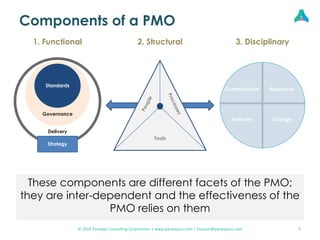
Components of a PMO
Standards
Governance
Strategy
Delivery
Tools
Communicate Resources
Execute Change
1. Functional 2. Structural 3. Disciplinary
These components are different facets of the PMO;
they are inter-dependent and the effectiveness of the
PMO relies on them
5© 2016 Parwaaz Consulting Corporation | www.parwaazcc.com | hussain@parwaazcc.com
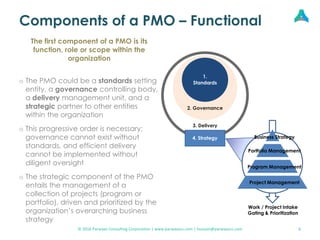
Components of a PMO – Functional
The first component of a PMO is its
function, role or scope within the
organization
o The PMO could be a standards setting
entity, a governance controlling body,
a delivery management unit, and a
strategic partner to other entities
within the organization
o This progressive order is necessary;
governance cannot exist without
standards, and efficient delivery
cannot be implemented without
diligent oversight
o The strategic component of the PMO
entails the management of a
collection of projects (program or
portfolio), driven and prioritized by the
organization’s overarching business
strategy
Business Strategy
Portfolio Management
Program Management
Project Management
1.
Standards
2. Governance
4. Strategy
3. Delivery
Work / Project Intake
Gating & Prioritization
6© 2016 Parwaaz Consulting Corporation | www.parwaazcc.com | hussain@parwaazcc.com
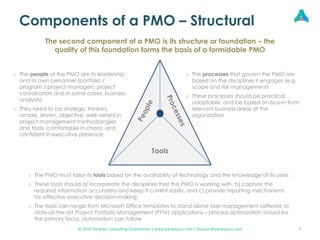
Components of a PMO – Structural
Tools
o The PMO must tailor its tools based on the availability of technology and the knowledge of its users
o These tools should a) incorporate the disciplines that the PMO is working with, b) capture the
required information accurately and keep it current easily, and c) provide reporting mechanisms
for effective executive decision-making
o The tools can range from Microsoft Office templates to stand-alone task-management software to
state-of-the-art Project Portfolio Management (PPM) applications – process optimization should be
the primary focus, automation can follow
o The processes that govern the PMO are
based on the disciplines it engages (e.g.
scope and risk management)
o These processes should be practical,
adaptable, and be based on buy-in from
relevant business areas of the
organization
o The people of the PMO are its leadership
and its own personnel (portfolio /
program / project managers, project
coordinators and in some cases, business
analysts)
o They need to be strategic thinkers,
nimble, driven, objective, well-versed in
project management methodologies
and tools, comfortable in chaos, and
confident in executive presence
The second component of a PMO is its structure or foundation – the
quality of this foundation forms the basis of a formidable PMO
7© 2016 Parwaaz Consulting Corporation | www.parwaazcc.com | hussain@parwaazcc.com
Get the entire guide for FREE
o By visiting our website at:
http://www.parwaazcc.com/ultimate-pmo-guide/
o The remaining parts of the guide are
o Components of a PMO
o Disciplinary
o Characteristics of PMO Maturity
o Where is Your PMO?
o Setup & Evolution of a PMO
o Key Takeaways & Considerations
o Join a tribe of over 50,000 people who have used this Ultimate
PMO Setup Guide to:
o Learn more about PMOs, their value and how they should be setup
o Educate their senior and executive leadership on PMOs
o Bolster their confidence by using tips for PMO success
8© 2016 Parwaaz Consulting Corporation | www.parwaazcc.com | hussain@parwaazcc.com

Setting up a Project Management Office (PMO)

  • 1.
    Setting up aProject Management Office (PMO) The ultimate reference guide for your organization by Hussain Bandukwala
  • 2.
    Objectives o What isa PMO? o Why Would You Need a PMO? o Components of a PMO o Functional o Structural o Disciplinary o Characteristics of PMO Maturity o Where is Your PMO? o Setup & Evolution of a PMO o Key Takeaways & Considerations 2© 2016 Parwaaz Consulting Corporation | www.parwaazcc.com | hussain@parwaazcc.com
  • 3.
    What is aPMO? A Project Management Office (PMO) is an entity within an organization that sets standards, provides governance, enforces accountability, and establishes discipline to manage (a collection of) projects in an objective and consistent manner. Its mandate typically includes serving as a partner to other organizational units, and creating a communication and decision-making platform that results in organization-wide efficiencies and synergies. 3© 2016 Parwaaz Consulting Corporation | www.parwaazcc.com | hussain@parwaazcc.com
  • 4.
    Why Would YouNeed a PMO? o Deliver projects with predictable consistency, efficiency and success o Provide transparent status and financial reporting to executive leadership o Establish foundation for managing organizational portfolio effectively o Alignment of investment to organizational strategy o Improve stakeholder satisfaction o Improve employee productivity o Implement standard practices o Long-term cost savings through improved resource management, limited project failures and effective execution of high return on investment (ROI) initiatives The following are the key benefits of PMOs that their organizations have experienced: 4© 2016 Parwaaz Consulting Corporation | www.parwaazcc.com | hussain@parwaazcc.com
  • 5.
    Components of aPMO Standards Governance Strategy Delivery Tools Communicate Resources Execute Change 1. Functional 2. Structural 3. Disciplinary These components are different facets of the PMO; they are inter-dependent and the effectiveness of the PMO relies on them 5© 2016 Parwaaz Consulting Corporation | www.parwaazcc.com | hussain@parwaazcc.com
  • 6.
    Components of aPMO – Functional The first component of a PMO is its function, role or scope within the organization o The PMO could be a standards setting entity, a governance controlling body, a delivery management unit, and a strategic partner to other entities within the organization o This progressive order is necessary; governance cannot exist without standards, and efficient delivery cannot be implemented without diligent oversight o The strategic component of the PMO entails the management of a collection of projects (program or portfolio), driven and prioritized by the organization’s overarching business strategy Business Strategy Portfolio Management Program Management Project Management 1. Standards 2. Governance 4. Strategy 3. Delivery Work / Project Intake Gating & Prioritization 6© 2016 Parwaaz Consulting Corporation | www.parwaazcc.com | hussain@parwaazcc.com
  • 7.
    Components of aPMO – Structural Tools o The PMO must tailor its tools based on the availability of technology and the knowledge of its users o These tools should a) incorporate the disciplines that the PMO is working with, b) capture the required information accurately and keep it current easily, and c) provide reporting mechanisms for effective executive decision-making o The tools can range from Microsoft Office templates to stand-alone task-management software to state-of-the-art Project Portfolio Management (PPM) applications – process optimization should be the primary focus, automation can follow o The processes that govern the PMO are based on the disciplines it engages (e.g. scope and risk management) o These processes should be practical, adaptable, and be based on buy-in from relevant business areas of the organization o The people of the PMO are its leadership and its own personnel (portfolio / program / project managers, project coordinators and in some cases, business analysts) o They need to be strategic thinkers, nimble, driven, objective, well-versed in project management methodologies and tools, comfortable in chaos, and confident in executive presence The second component of a PMO is its structure or foundation – the quality of this foundation forms the basis of a formidable PMO 7© 2016 Parwaaz Consulting Corporation | www.parwaazcc.com | hussain@parwaazcc.com
  • 8.
    Get the entireguide for FREE o By visiting our website at: http://www.parwaazcc.com/ultimate-pmo-guide/ o The remaining parts of the guide are o Components of a PMO o Disciplinary o Characteristics of PMO Maturity o Where is Your PMO? o Setup & Evolution of a PMO o Key Takeaways & Considerations o Join a tribe of over 50,000 people who have used this Ultimate PMO Setup Guide to: o Learn more about PMOs, their value and how they should be setup o Educate their senior and executive leadership on PMOs o Bolster their confidence by using tips for PMO success 8© 2016 Parwaaz Consulting Corporation | www.parwaazcc.com | hussain@parwaazcc.com