TECHNIQUES
OF
TEACHING
Chapter VII:
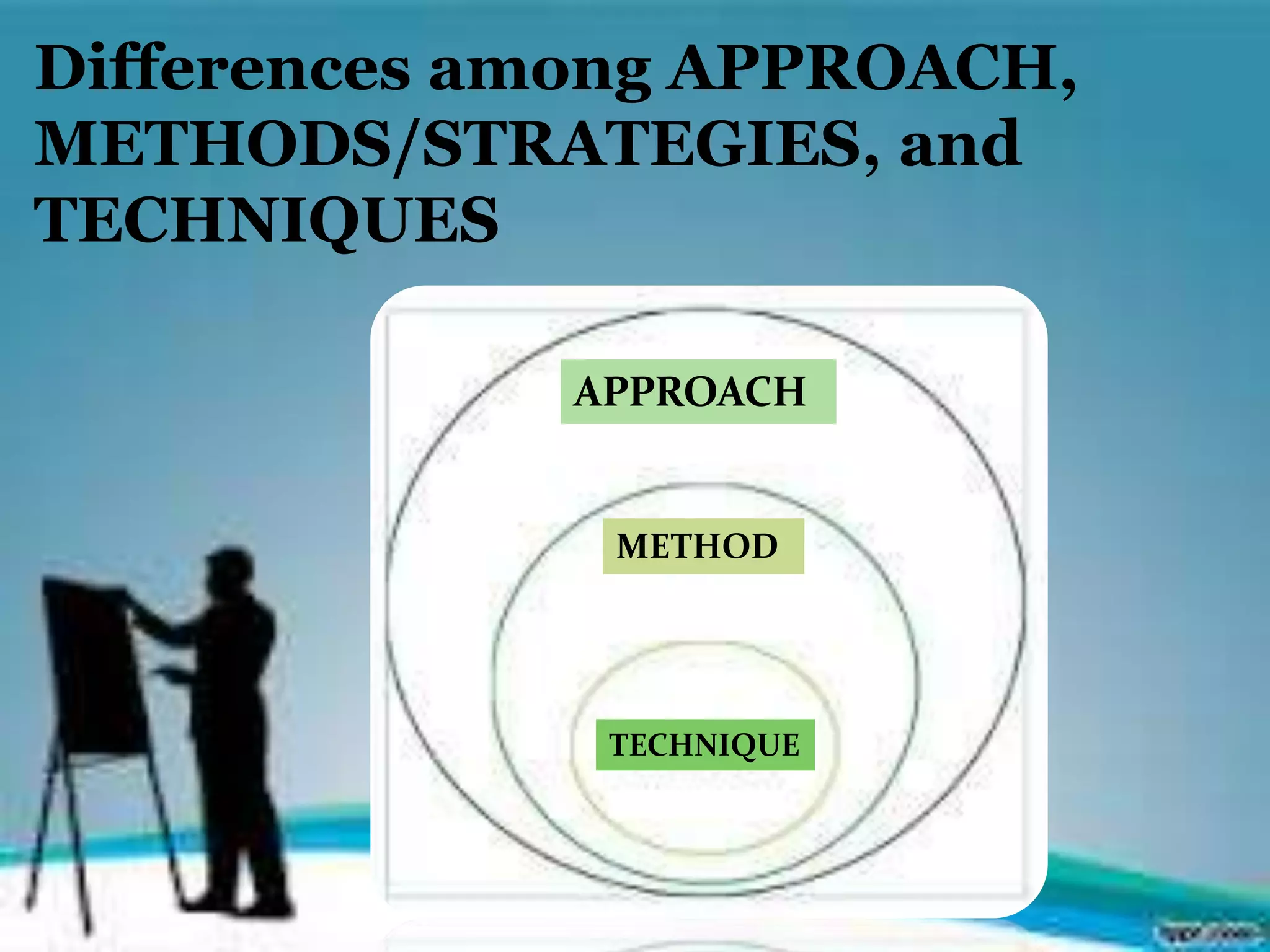
APPROACH
METHOD
TECHNIQUE
Differences among APPROACH,
METHODS/STRATEGIES, and
TECHNIQUES
APPROACH
- an enlightened viewpoint of
teaching.
- provides sound philosophy and
orientation to the whole process
of teaching in which the selection
of an instrumental method is part
and parcel of.
-Embraces the entire spectrum of the process
such that :
a.) it specifies the major goal of teaching;
b.) the given priorities among the three
domains;
c.) the role of teacher;
d.) the expectations from students;
e.) the nature of the teaching-learning process;
and
f.) the kind of evaluative techniques and
suitable teaching methods/strategies to be
employed.
There are two salient points to remember:
1. All approaches of teaching are
viewpoints of teaching, but not all
viewpoint of teaching are considered
approaches of teaching.
2. The selection of an instructional
method is based on a given
approach.
METHODS/STRATEGY
 refers to an organized, orderly,
systematic, well-planned procedure.
 it consist of steps which are logically
arranged aimed at achieving the specific
aims of instruction, at enhancing
greater teaching and maximizing learning
output.
 directs and guide the teacher in all class
activities as well, the organization of
materials to get things done.
Two categories in Organization of
materials:
1.Logical Organization- aims to facilitate the
recall or location and use of facts, ideas, materials,
procedures, etc..
The Logical Organization is achieved by:
a.) association of one’s ideas and arranging known
materials like books, letters, and the like
systematically;
b.) organizing ideas of a similar nature under
appropriate heading;
c.) using suitable headings for the major divisions;
d.) grouping the related sub-points.
2. Psychological Organization- is
designed to facilitate learning of new
things.
The Psychological Organization is
realized through:
a.) understanding how pupils learn things
normally;
b.) selecting those that seem to have a
definite bearing on the given task;
c.) making free and controlled associations
needed in developing the work.
TECHNIQUE
 It is a particular trick, or contrivance,
used to accomplish an immediate
objective.
 It usually consistent with a method,
and therefore, in harmony with an
approach.
 It is also defined as a procedural
variation of a given method. It involves a
highly personalized style of carrying out a
particular step of a given method.
THANK YOU
FOR
LISTENING!!
Reporter:
RHEA B. DULLA

Differences amomg Approach,Methods, and Techniques

  • 1.
  • 2.
  • 3.
    APPROACH - an enlightenedviewpoint of teaching. - provides sound philosophy and orientation to the whole process of teaching in which the selection of an instrumental method is part and parcel of.
  • 4.
    -Embraces the entirespectrum of the process such that : a.) it specifies the major goal of teaching; b.) the given priorities among the three domains; c.) the role of teacher; d.) the expectations from students; e.) the nature of the teaching-learning process; and f.) the kind of evaluative techniques and suitable teaching methods/strategies to be employed.
  • 5.
    There are twosalient points to remember: 1. All approaches of teaching are viewpoints of teaching, but not all viewpoint of teaching are considered approaches of teaching. 2. The selection of an instructional method is based on a given approach.
  • 6.
    METHODS/STRATEGY  refers toan organized, orderly, systematic, well-planned procedure.  it consist of steps which are logically arranged aimed at achieving the specific aims of instruction, at enhancing greater teaching and maximizing learning output.  directs and guide the teacher in all class activities as well, the organization of materials to get things done.
  • 7.
    Two categories inOrganization of materials: 1.Logical Organization- aims to facilitate the recall or location and use of facts, ideas, materials, procedures, etc.. The Logical Organization is achieved by: a.) association of one’s ideas and arranging known materials like books, letters, and the like systematically; b.) organizing ideas of a similar nature under appropriate heading; c.) using suitable headings for the major divisions; d.) grouping the related sub-points.
  • 8.
    2. Psychological Organization-is designed to facilitate learning of new things. The Psychological Organization is realized through: a.) understanding how pupils learn things normally; b.) selecting those that seem to have a definite bearing on the given task; c.) making free and controlled associations needed in developing the work.
  • 9.
    TECHNIQUE  It isa particular trick, or contrivance, used to accomplish an immediate objective.  It usually consistent with a method, and therefore, in harmony with an approach.  It is also defined as a procedural variation of a given method. It involves a highly personalized style of carrying out a particular step of a given method.
  • 10.