Introduction to
Comparative Education
Presented by
Sobia Sultan
• Nicholas Hans, (1958) -
defines comparative education
as a step-by-step study of
different and often
contrasting educational
systems with a view of
understanding their
differences and similarities.
Definition of Comparative Education
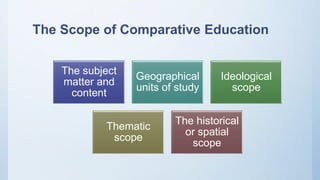
The subject
matter and
content
Geographical
units of study
Ideological
scope
Thematic
scope
The historical
or spatial
scope
The Scope of Comparative Education
The subject matter and content
• This covers the essential components of
educational systems such as structure, aims,
content or curriculum, administration,
financing, teacher education.
Geographical units of study
• These comprises intra-national,
international, regional, continental and global
or world systems studies and analysis.
The Scope of Comparative Education
Ideological scope
• This compares countries' educational systems on
the basis of different political, social and economic
ideologies. For example, democratic, communism,
socialist, capitalist, free market and mixed economies.
Thematic scope
• This scope focuses on educational themes, topical
issues or problems and compares them within one
or more geographical units. For example free
primary and secondary education, universal
primary education, education for all and universal
higher education.
The historical or spatial scope
• This deals with the study of the historical development of the
discipline from the earliest (pre-historic) phase known as the
period of Travelers' Tales to the modern phase known as the
period of social science perspectives.
The Scope of
Comparative
Education
PURPOSES OF COMPARATIVE EDUCATION
According to Harold J Noah and Max Eckstein (1993), Comparative Education has four purposes:
 To describe educational systems, processes, or outcomes.
 To assist in the development of educational institutions and practices.
 To highlight the relationships between education and society.
 To establish generalized statements about education those are valid in more than one country.
Some
Other
Purposes
Are:
• Description:
The most basic utility of comparative education is to describe
education systems.
• Understanding/Interpreting:
On the next level Comparative Education also satisfies the
need to understand: education systems.
• Evaluation:
Comparative education serves the purpose of evaluating education systems: the own
education system as well as universal evaluation of education systems.
• Education problems in world perspective:
Most countries of the world have identical problems in their educational perspective.
Therefore, it is possible for them to learn lessons from each other on how they resolved
a particular problem.
Introduction to comparative education

Introduction to comparative education

  • 1.
  • 2.
    • Nicholas Hans,(1958) - defines comparative education as a step-by-step study of different and often contrasting educational systems with a view of understanding their differences and similarities. Definition of Comparative Education
  • 3.
    The subject matter and content Geographical unitsof study Ideological scope Thematic scope The historical or spatial scope The Scope of Comparative Education
  • 4.
    The Scope ofComparative Education The subject matter and content • This covers the essential components of educational systems such as structure, aims, content or curriculum, administration, financing, teacher education. Geographical units of study • These comprises intra-national, international, regional, continental and global or world systems studies and analysis.
  • 5.
    The Scope ofComparative Education Ideological scope • This compares countries' educational systems on the basis of different political, social and economic ideologies. For example, democratic, communism, socialist, capitalist, free market and mixed economies. Thematic scope • This scope focuses on educational themes, topical issues or problems and compares them within one or more geographical units. For example free primary and secondary education, universal primary education, education for all and universal higher education.
  • 6.
    The historical orspatial scope • This deals with the study of the historical development of the discipline from the earliest (pre-historic) phase known as the period of Travelers' Tales to the modern phase known as the period of social science perspectives. The Scope of Comparative Education
  • 7.
    PURPOSES OF COMPARATIVEEDUCATION According to Harold J Noah and Max Eckstein (1993), Comparative Education has four purposes:  To describe educational systems, processes, or outcomes.  To assist in the development of educational institutions and practices.  To highlight the relationships between education and society.  To establish generalized statements about education those are valid in more than one country.
  • 8.
    Some Other Purposes Are: • Description: The mostbasic utility of comparative education is to describe education systems. • Understanding/Interpreting: On the next level Comparative Education also satisfies the need to understand: education systems.
  • 9.
    • Evaluation: Comparative educationserves the purpose of evaluating education systems: the own education system as well as universal evaluation of education systems. • Education problems in world perspective: Most countries of the world have identical problems in their educational perspective. Therefore, it is possible for them to learn lessons from each other on how they resolved a particular problem.