Pamela YeniPurwastri(19716251067)
Novi Dyah Arisanti (20716251028)
BILINGUAL AND
MULTILINGUAL EDUCATION
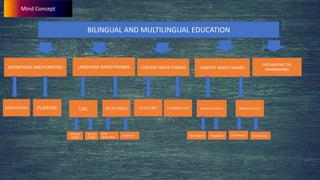
Mind Concept
BILINGUAL AND MULTILINGUAL EDUCATION
DEFINITIONS AND PURPOSES LANGUAGE-BASED FRAMES CONTENT BASED FRAMES CONTEXT BASED FRAMES
DEFINITION
INTEGRATING THE
FRAMEWORKS
PURPOSE USE OUTCOMES CULTURE CURRICULUM MACRO LEVELS MICRO LEVELS
STRONG
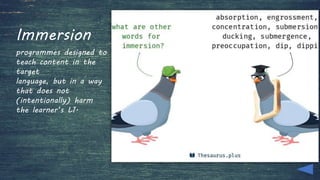
FORM
WEAK
FORM
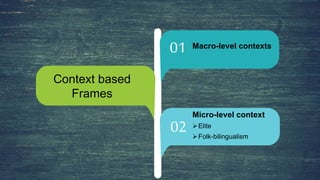
SUB-
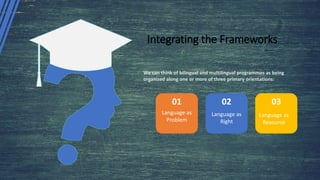
TRACTIVE
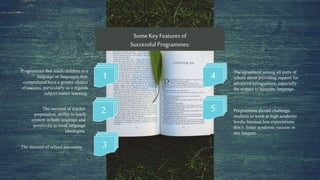
ADDITIVE Ideological Pragmatic Elite Routes Folk Routes
DEFINITION AND PURPOSES
of Bilingual and Multilingual
Education
DEFINITION
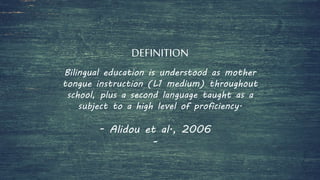
Bilingual education is understood as mother
tongue instruction (L1 medium) throughout
school, plus a second language taught as a
subject to a high level of proficiency.
- Alidou et al., 2006
-
PURPOSES
• to help learners develop knowledge about a
particular cultural group in addition to their own
• to promote assimilation and acculturation of
linguistically diverse learners into a mainstream or
dominant culture
FRAMEWORKS EDUCATION
in Bilingual and Multilingual
Education
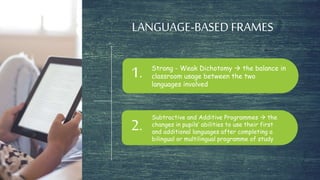
LANGUAGE-BASED FRAMES
Strong - Weak Dichotomy  the balance in
classroom usage between the two
languages involved
1.
Subtractive and Additive Programmes  the
changes in pupils’ abilities to use their first
and additional languages after completing a
bilingual or multilingual programme of study
2.
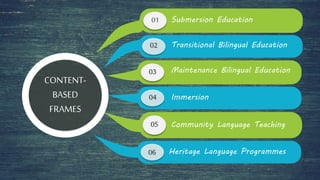
CONTENT-
BASED
FRAMES
01
02
03
04
Submersion Education
Transitional Bilingual Education
Maintenance Bilingual Education
Immersion
05
06
Community Language Teaching
Heritage Language Programmes
Submersion
Pupils are placed in
classes with students
who are
native/proficient
speakers of the
dominant language, and
their academic progress
is evaluated using
measures designed to
assess the performance
of native speakers and
for comparison with the
norms established for
them
Transitional
Bilingual
Education
using the first language
as a temporary medium
for
gaining proficiency in
the (dominant) second
Language.
Maintenance
Bilingual
Education
aiming to complement
and
strengthen, rather than
replace, the (minority)
first
language
Immersion
programmes designed to
teach content in the
target
language, but in a way
that does not
(intentionally) harm
the learner’s L1.
Community
Language
Teaching
An approach to heritage
language education
adopted in the UK,
Australia, the Netherlands
and other countries in
which the home languages
of ethnic minorities are
taught and used as
languages of instruction in
schools and community
centres
Heritage
Language
Programmes
promoting oral fluency
to foster
intergenerational
communication
(between children and
grandparents and other
elders), to developing
academic literacies as a
motor for advanced
biliteracy and university
study
01 Macro-level contexts
02
Micro-level context
Elite
Folk-bilingualism
Context based
Frames
We can think of bilingual and multilingual programmes as being
organized along one or more of three primary orientations:
Integrating the Frameworks
01 02 03
Language as
Problem
Language as
Right
Language as
Resource
SomeKey Features of
Successful Programmes:
41
2
3
5
Programmes that teach children in a
language or languages they
comprehend have a greater chance
of success, particularly as a regards
subject matter learning.
The succeed of teacher
preparation, ability to teach
content in both language and
sensitivity to local language
ideologies.
The succeed of school autonomy.
The agreement among all parts of
school about providing support for
advanced bilingualism, especially
the respect to minority language.
Programmes should challenge
students to work at high academic
levels, because low expectations
don’t foster academic success in
any languae.
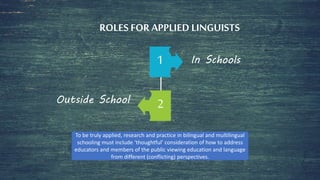
ROLES FOR APPLIED LINGUISTS
1 In Schools
2Outside School
To be truly applied, research and practice in bilingual and multilingual
schooling must include ‘thoughtful’ consideration of how to address
educators and members of the public viewing education and language
from different (conflicting) perspectives.
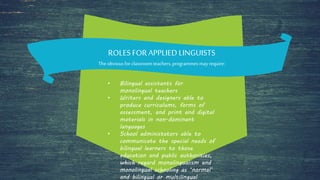
ROLESFORAPPLIED LINGUISTS
The obviousforclassroomteachers,programmesmayrequire:
• Bilingual assistants for
monolingual teachers
• Writers and designers able to
produce curriculums, forms of
assessment, and print and digital
materials in non-dominant
languages
• School administators able to
communicate the special needs of
bilingual learners to those
education and public authorities,
which regard monolingualism and
monolingual schooling as ‘normal’
and bilingual or multilingual
Thank You

Bilingual and Multilingual Education

  • 1.
    Pamela YeniPurwastri(19716251067) Novi DyahArisanti (20716251028) BILINGUAL AND MULTILINGUAL EDUCATION
  • 2.
    Mind Concept BILINGUAL ANDMULTILINGUAL EDUCATION DEFINITIONS AND PURPOSES LANGUAGE-BASED FRAMES CONTENT BASED FRAMES CONTEXT BASED FRAMES DEFINITION INTEGRATING THE FRAMEWORKS PURPOSE USE OUTCOMES CULTURE CURRICULUM MACRO LEVELS MICRO LEVELS STRONG FORM WEAK FORM SUB- TRACTIVE ADDITIVE Ideological Pragmatic Elite Routes Folk Routes
  • 3.
    DEFINITION AND PURPOSES ofBilingual and Multilingual Education
  • 4.
    DEFINITION Bilingual education isunderstood as mother tongue instruction (L1 medium) throughout school, plus a second language taught as a subject to a high level of proficiency. - Alidou et al., 2006 -
  • 5.
    PURPOSES • to helplearners develop knowledge about a particular cultural group in addition to their own • to promote assimilation and acculturation of linguistically diverse learners into a mainstream or dominant culture
  • 6.
    FRAMEWORKS EDUCATION in Bilingualand Multilingual Education
  • 7.
    LANGUAGE-BASED FRAMES Strong -Weak Dichotomy  the balance in classroom usage between the two languages involved 1. Subtractive and Additive Programmes  the changes in pupils’ abilities to use their first and additional languages after completing a bilingual or multilingual programme of study 2.
  • 8.
    CONTENT- BASED FRAMES 01 02 03 04 Submersion Education Transitional BilingualEducation Maintenance Bilingual Education Immersion 05 06 Community Language Teaching Heritage Language Programmes
  • 9.
    Submersion Pupils are placedin classes with students who are native/proficient speakers of the dominant language, and their academic progress is evaluated using measures designed to assess the performance of native speakers and for comparison with the norms established for them
  • 10.
    Transitional Bilingual Education using the firstlanguage as a temporary medium for gaining proficiency in the (dominant) second Language.
  • 11.
    Maintenance Bilingual Education aiming to complement and strengthen,rather than replace, the (minority) first language
  • 12.
    Immersion programmes designed to teachcontent in the target language, but in a way that does not (intentionally) harm the learner’s L1.
  • 13.
    Community Language Teaching An approach toheritage language education adopted in the UK, Australia, the Netherlands and other countries in which the home languages of ethnic minorities are taught and used as languages of instruction in schools and community centres
  • 14.
    Heritage Language Programmes promoting oral fluency tofoster intergenerational communication (between children and grandparents and other elders), to developing academic literacies as a motor for advanced biliteracy and university study
  • 15.
    01 Macro-level contexts 02 Micro-levelcontext Elite Folk-bilingualism Context based Frames
  • 16.
    We can thinkof bilingual and multilingual programmes as being organized along one or more of three primary orientations: Integrating the Frameworks 01 02 03 Language as Problem Language as Right Language as Resource
  • 17.
    SomeKey Features of SuccessfulProgrammes: 41 2 3 5 Programmes that teach children in a language or languages they comprehend have a greater chance of success, particularly as a regards subject matter learning. The succeed of teacher preparation, ability to teach content in both language and sensitivity to local language ideologies. The succeed of school autonomy. The agreement among all parts of school about providing support for advanced bilingualism, especially the respect to minority language. Programmes should challenge students to work at high academic levels, because low expectations don’t foster academic success in any languae.
  • 18.
    ROLES FOR APPLIEDLINGUISTS 1 In Schools 2Outside School To be truly applied, research and practice in bilingual and multilingual schooling must include ‘thoughtful’ consideration of how to address educators and members of the public viewing education and language from different (conflicting) perspectives.
  • 19.
    ROLESFORAPPLIED LINGUISTS The obviousforclassroomteachers,programmesmayrequire: •Bilingual assistants for monolingual teachers • Writers and designers able to produce curriculums, forms of assessment, and print and digital materials in non-dominant languages • School administators able to communicate the special needs of bilingual learners to those education and public authorities, which regard monolingualism and monolingual schooling as ‘normal’ and bilingual or multilingual
  • 20.