Facial Trauma
http://decode-medicine.blogspot.com/
                     by sun yaicheng
Look at the orbits carefully, 60 - 70% of all
facial fractures involve the orbit.
Exceptions: local nasal bone
fracture, zygomatic arch fracture, LeFort I
fracture.
Bilateral symmetry can be very helpful.
Carefully trace along the lines of Dolan
when examining the Waters view in a facial
series.
Radiographic Signs of Facial Fractures
 Direct Signs
   nonanatomic linear lucencies
   cortical defect or diastatic suture
   bone fragments overlapping causing a "double-
   density"
   asymmetry of face
 Indirect Signs
   soft tissue swelling
   periorbital or intracranial air
   fluid in a paranasal sinus
Emergency Management
and Resuscitation
 Airway
   Most urgent complicationl: Airway compromise
   Simple interventions first
   No mandible?

 Intubation
   Avoid nasotracheal intubation
   Aviod RSI
     Benzodiazepines
     Ketamine
     Etomidate
   Be Prepared and Be Creative
Emergency Management
and Resuscitation
 Airway Management Options
  Awake intubation
  Fiberoptic intubation
  Lateral or semi-prone position
  Percutaneous transtracheal jet ventilation
  Retrograde intubation
  Cricothyroidotomy
Emergency Management
and Resuscitation
 Hemorrhage Control
  Rarely develop shock from facial bleeding
  alone
  Direct Pressure
  LeFort Fractures
  Nasal hemorrhage may require A&P packing
Maxillofacial Trauma-History
 How is your vision?
 Is any part of your face numb?
 Are your teeth meeting normally?
Maxillofacial Trauma-Physical Exam

 Inspection                 Palpation
   Facial elongation          Tenderness
     High grade LeFort        (intraoral palpation)
     Fracture                 Step offs
   Asymmetry                  Facial stability
     Deformities and
     cranial nerve injury     Crepitus
                              Subcutaneous air
                              Cutaneous
                              anesthesia
Maxillofacial Trauma-Physical Exam

 Periorbital and Orbital Exam
   Perform early


  Professional Lid
     Retractor
Maxillofacial Trauma-Physical Exam

 Periorbital and Orbital Exam
   Look for exophthalmos or enophthalmos
   Pupil shape
   Hyphema
   Visual acuity
   Entrapment signs
   Raccoon sign


 Bimanual Palpation Test
Maxillofacial Trauma-Physical Exam

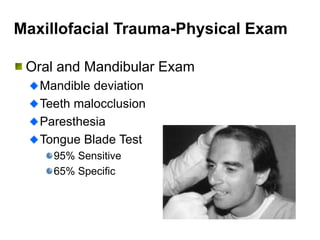
 Oral and Mandibular Exam
   Mandible deviation
   Teeth malocclusion
   Paresthesia
   Tongue Blade Test
     95% Sensitive
     65% Specific
Maxillofacial Trauma-Imaging

 PE detects up to 90% of fractures
 Plain Films: Waters
 CT
   Orbital fractures
   3D images available
Maxillofacial Trauma-Specific
Fractures
 Orbital Fractures
   Usually through floor or
   medial wall
   Enophthalmos
   Diplopia
   Infraorbital stepoff
   deformity
   Subcutaneous emphysema
   24 % of fractures are
                              “Blowout fracture” the arrows
   associated with ocular     point to the fracture fragments and
   injury                     periorbital tissue which have
                              herniated into the maxillary sinus
Teardrop
Herniation
Maxillofacial Trauma-Specific
Fractures
  Zygomatic Fractures
    Tripod fracture
      Most serious
      Lateral subconjunctival hemorrhage
      Need ORIF
Tripod Fracture
Maxillofacial Trauma-Specific
Fractures
 Maxillary Fractures
   High-energy injury
   Malocclusion
   Facial lengthening
   CSF rhinorrhea
   Periorbital ecchymosis
Lefort Classification
 Weakest areas of midfacial complex
 when assaulted from a frontal direction
 at different levels (Rene’ Lefort, 1901)
   Lefort I: above the level of teeth
   Lefort II: at level of nasal bones
   Lefort III: at orbital level
LeFort Fractures
LeFort I
 Transmaxillary fracture runs between the
 maxillary floor and the orbital floor. It may
 involve the medial and lateral walls of the
 maxillary sinuses and invariably involves the
 pterygoid processes of the sphenoid.
 The floating fragment will be the lower
 maxilla with the maxillary teeth
LeFort II
 Occurs along yet another weak zone in the
 face, and is sometimes called a pyramidal
 fracture because of its shape.
LeFort III
 craniofacial disassociation
 large unstable (floating) fragment is virtually
 the entire face!
Mandibular Fractures
 Second most common facial fracture
 Often multiple
 Mal-occlusion
 Intra-oral lacerations
 Sublingual ecchymosis
 Nerve injury
 Plain films
 Panorex
 CT
Clinical Findings
 Facial distortion
 Malocclusion of the teeth
 Abnormal mobility of portions of the mandible
 or teeth
TM Joint Dislocation
Nasal Bone Fracture
 Common pitfalls in viewing the nasal bone
 are the normal sutures lining the nasal
 bone
 CSF rhinorrhea
   Halo sign
25男性業務員騎機車過馬路時,不慎和對方來車相撞,
119送他到醫院時,發現他下巴中間有凹陷,臉部和口
腔都在流血,右側脖子腫脹,血壓80/50 mmHg、心跳
120/min、呼吸32/min,下列何種醫囑要先執行?
A.   臉部和口腔壓迫止血
B.   下巴固定
C.   輸林格氏液2000ml
D.   口咽氣管插管
E.   環甲軟骨切開術 (cricothyroidotomy)


                            96 急專
一位20歲男性騎車被貨車壓過,到院時有頭部外傷,顏面
骨骨折出血,胸部及腹部鈍傷,右大腿變形,BP:
80/40mmHg,HR:140/min,左側呼吸音減弱,上腹部有
輪胎壓痕,下列何者為處理之順序?
a.頭部電腦斷層
b.腹部超音波
c. 環甲膜切開術(Cricothyroidotomy)
d.左側胸管插入
e.大腿固定
 A. c,a,b,d,e
 B. c,d,b,e,a
 C. a,d,c,b,e
 D. c,d,a,b,e
                               95 急專
 E. c,d,b,a,e
一個戽斗男在ㄧ陣大笑後,嘴巴張大卡住無法閉合,
診斷為顳下頜關節脫臼(temporo-mandibular joint
dislocation),關於其處置何者為非?
A. 應對下頜骨照全口X光 (Panoramic view) 以排除骨
   折通常為兩側一起脫臼
B. 如果單側脫臼,下頜骨會偏向患側之對側
C. 復位時醫師以雙手伸入患者口中握住下頜骨兩側,
   其復位方向為向上向後(以病患為基準)
D. 有可能反覆發作


                          95 急專
70 歲婦人於打呵欠時,突然右側下巴轉角處(mandibular
angle)劇烈疼痛,嘴巴無法完全閉合。X 光確定並無骨折存
在,此時最合適的處置為:
A. 病人平躺面朝上,由正面按住病人兩側下巴轉角
   (mandibular angle)往頭的方向推
B. 病人坐著,由後面按住病人下巴轉角後方,施力令病人的
   頭部後仰(extension)
C. 病人坐著,將手指伸入病人嘴巴,按住患側臼齒或前臼齒
   處,往下及有點往後施力
D. 病人坐著,助手由後扶住病人頭部,面對病人將手指伸入
   病人下顎門牙內側往前方拉
E. 姿勢不拘,施力於正常一側臉部下巴轉角處,往患側推
   擠;若無效再試施力於患側臉部下巴轉角,往另一側推擠
                      98 急專
25 歲男性,因右眼被打了一拳而至急診就診,
身體檢查發現,右眼無法往上看,同時有複視,
懷疑眼眶爆裂性骨折(orbital blowout
fracture),你預期還有的身體檢查發現,不包
括下列何項?
A.   右側臉頰感覺異常
B.   眼球內陷
C.   眼眶周圍皮下氣腫
D.   結膜下出血
E.   腦脊髓液鼻漏

                  98 急專

Facial Trauma