Major Midface Trauma
Steven Edlund DDS
Lecturer Dept of Oral and
Maxillofacial Surgery
Goals
• learn the basics a maxillofacial trauma
exam
• understand how to identify common
fractures and their complications
• basics of treatment fractures
• laceration management and complications
Specific Objectives (test
material)
• understand the importance of always performing an exam in the same sequence
• know how to examine cranial nerves
• know what an aferrent pupilary defect is
• know how to identify a Lefort I,II, or III fracture, a zygoma and zygomatic arch fracture,
orbital floor fracture, frontal sinus fracture, and naso-orbital-ethmoidal (NOE) fracture
from a physical exam
• understand the role of radiology (particularly CT) in the evaluation and management of
midface trauma
• define Lefort I, II, and III fractures and understand how they differ from Lefort
osteotomies (may be helpful to look up the osteotomies from other lectures)
• know the areas of fracture in zygoma fractures
• know what NOE fractures are, and know what nasal fractures are and timing of
treatment
• understand the basics of managing facial fractures (when surgery is appropriate, surgical
approaches, goals of treatment)
• understand the importance of evaluation the facial nerve in pre-auricular lacerations
• know the order of treatment in laceration repair
Trauma Exam
• Know your ABC’s
– A- airway
– B- breathing
– C- circulation
– D- differential diagnosis
• Patient stability is first and foremost goal
Trauma Exam Continued
• Always proceed in an orderly fashion
– Form a pattern and always follow it
1. General overview
• Facial/cervical symmetry
2. Top down- lacerations, contusions, foreign
bodies, palpate for boney steps and mobility
• Scalp
• Forehead
• Orbits/eyes-entrapment, APD
• Nose-deviation, rhinorrhea
• Ears-Battles sign, otorhea
• Midface/ZMC
• Intraoral-dental occlusion
• Mandible
• Neck
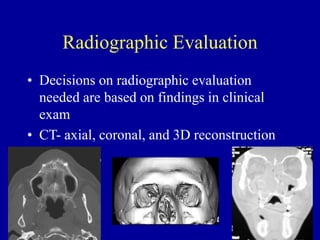
Radiographic Evaluation
• Decisions on radiographic evaluation
needed are based on findings in clinical
exam
• CT- axial, coronal, and 3D reconstruction
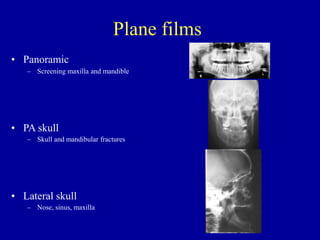
Plane films
• Panoramic
– Screening maxilla and mandible
• PA skull
– Skull and mandibular fractures
• Lateral skull
– Nose, sinus, maxilla
Plane films continued
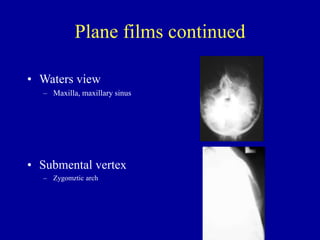
• Waters view
– Maxilla, maxillary sinus
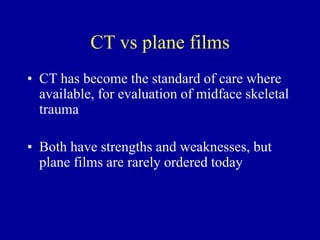
• Submental vertex
– Zygomztic arch
CT vs plane films
• CT has become the standard of care where
available, for evaluation of midface skeletal
trauma
• Both have strengths and weaknesses, but
plane films are rarely ordered today
Fractures
• Basic classification
– Greenstick- seen in children; more like a bend than a
clean break
– Simple- clean break along a single line with minimal
disruption of soft tissues; can be displaced or non-
displaced.
– Compound- broken bone that is displaced through the
integument
– Cominuted- multiple little pieces; looks like its
shatteren
Lefort Fractures
• Defined by Renee LeFort in early 1900’s
• Dropped skulls and viewed midface fracture
patterns
• Basic patterns were found based on the direction
of the blow to the face
• These fractures can occur in combination
• Can often be detected with bimanual palpation and
manipulation
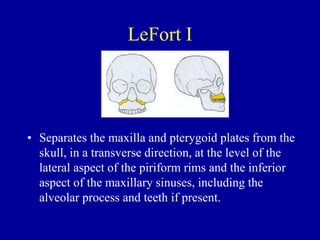
LeFort I
• Separates the maxilla and pterygoid plates from the
skull, in a transverse direction, at the level of the
lateral aspect of the piriform rims and the inferior
aspect of the maxillary sinuses, including the
alveolar process and teeth if present.
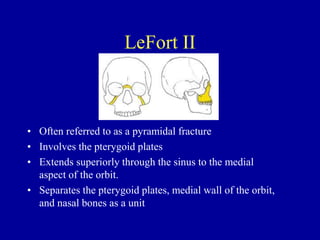
LeFort II
• Often referred to as a pyramidal fracture
• Involves the pterygoid plates
• Extends superiorly through the sinus to the medial
aspect of the orbit.
• Separates the pterygoid plates, medial wall of the orbit,
and nasal bones as a unit
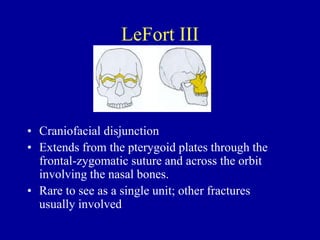
LeFort III
• Craniofacial disjunction
• Extends from the pterygoid plates through the
frontal-zygomatic suture and across the orbit
involving the nasal bones.
• Rare to see as a single unit; other fractures
usually involved
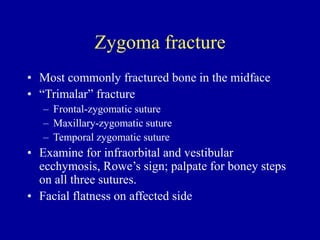
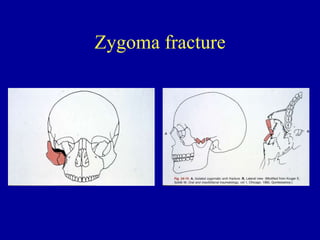
Zygoma fracture
• Most commonly fractured bone in the midface
• “Trimalar” fracture
– Frontal-zygomatic suture
– Maxillary-zygomatic suture
– Temporal zygomatic suture
• Examine for infraorbital and vestibular
ecchymosis, Rowe’s sign; palpate for boney steps
on all three sutures.
• Facial flatness on affected side
Zygoma fracture
Frontal bone fracture
• Contour change, ecchymosis, soft to
palpation, often associated with nasal and
orbital fractures.
• CT exam necessary to determine if the
anterior and/or posterior sinus walls are
involved.
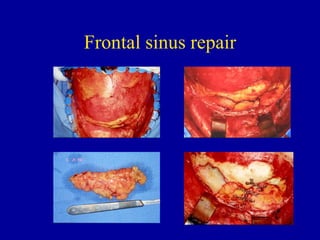
Frontal sinus repair
• Eliminate sinus mucosa lining- eliminates
mucocele, alows direct visualization of posterior
wall
• Plugging the ducts- eliminates communication to
the nasal cavity
• Fat graft- obliterates empty space
• Cranialization- done if posterior wall involved
Frontal sinus repair
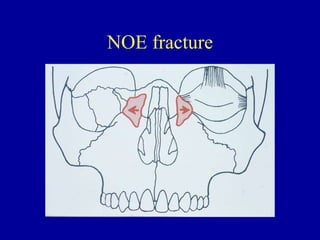
Nasal-orbital-ethmoid fracture
• Involves the nasal bone, orbital process of
the ethmoid, and the attacment of the
medial canthal ligament.
• Flatness of the nasal bridge, hypertelorism,
widened medial canthal distance
• Exam-
NOE fracture
Surgical approaches to the
midface
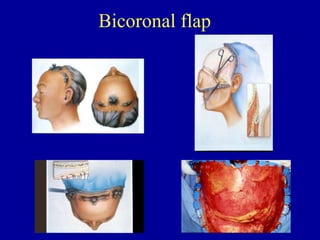
• Bicoronal flap- frontal sinus, zygoma, NOE
– Across the cranium in the hair bearing region, can
extend to the preauricular area for better access
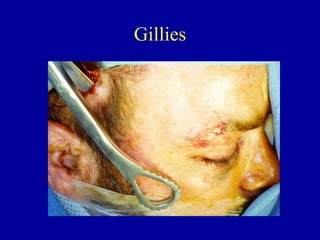
• Gillies- Zygoma, zygomatic arch
– Incision in temporal hair bearing region with dissection
under the superficial layer of deep temporal facia to the
zygoma/arch
• Keen- intraoral, buccal vestibule approach to
zygoma
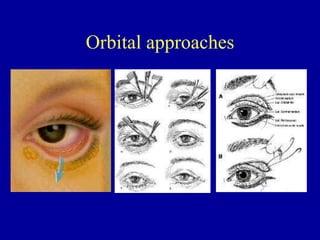
• Infraorbital, subcilliary,trans-conjunctival, upper
blephararoplasty, lateral brow- approaches to the
orbit
Bicoronal flap
Gillies
Orbital approaches
Goals in surgical repair
• Stabilize acute problems- ABC’s,
retrobulbar hematoma
• Prevent infection and long term
complications
• Restore function
• Restore esthetics
Restoring facial structure
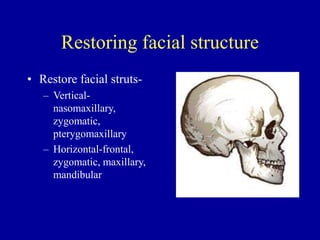
• Restore facial struts-
– Vertical-
nasomaxillary,
zygomatic,
pterygomaxillary
– Horizontal-frontal,
zygomatic, maxillary,
mandibular
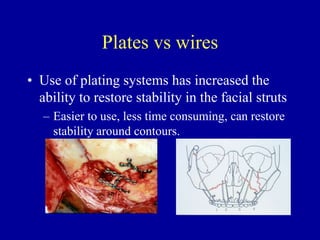
Plates vs wires
• Use of plating systems has increased the
ability to restore stability in the facial struts
– Easier to use, less time consuming, can restore
stability around contours.
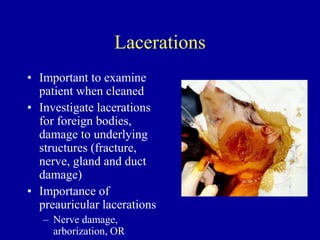
Lacerations
• Important to examine
patient when cleaned
• Investigate lacerations
for foreign bodies,
damage to underlying
structures (fracture,
nerve, gland and duct
damage)
• Importance of
preauricular lacerations
– Nerve damage,
arborization, OR
Basic principles of laceration
management
• Hemostasis
• Anesthesia
• Irrigation
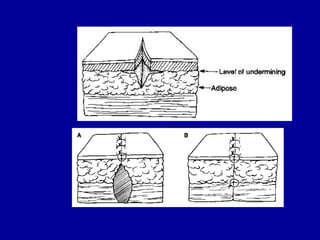
• Conserve viable tissue, remove necrotic tissue, undermine
• Layered closure
• Evert wound margins
• Support wound closure
• Antibiotics (topical and PO) and tetanus (booster within
last 5 years)
• Suture removal
• Home care instructions
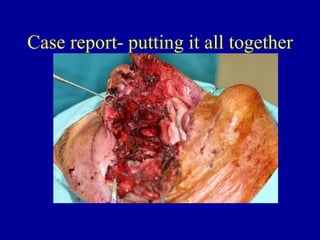
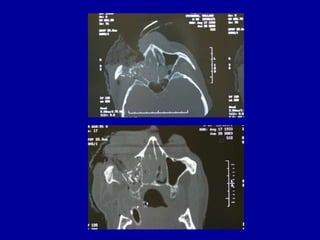
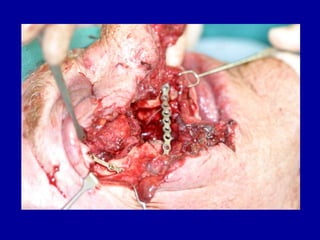
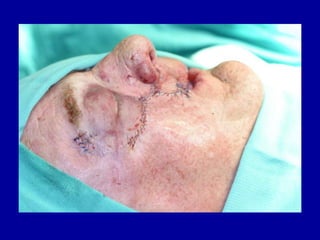
Case report- putting it all together
Questions?

Major Midface Trauma.ppt

  • 1.
    Major Midface Trauma StevenEdlund DDS Lecturer Dept of Oral and Maxillofacial Surgery
  • 2.
    Goals • learn thebasics a maxillofacial trauma exam • understand how to identify common fractures and their complications • basics of treatment fractures • laceration management and complications
  • 3.
    Specific Objectives (test material) •understand the importance of always performing an exam in the same sequence • know how to examine cranial nerves • know what an aferrent pupilary defect is • know how to identify a Lefort I,II, or III fracture, a zygoma and zygomatic arch fracture, orbital floor fracture, frontal sinus fracture, and naso-orbital-ethmoidal (NOE) fracture from a physical exam • understand the role of radiology (particularly CT) in the evaluation and management of midface trauma • define Lefort I, II, and III fractures and understand how they differ from Lefort osteotomies (may be helpful to look up the osteotomies from other lectures) • know the areas of fracture in zygoma fractures • know what NOE fractures are, and know what nasal fractures are and timing of treatment • understand the basics of managing facial fractures (when surgery is appropriate, surgical approaches, goals of treatment) • understand the importance of evaluation the facial nerve in pre-auricular lacerations • know the order of treatment in laceration repair
  • 4.
    Trauma Exam • Knowyour ABC’s – A- airway – B- breathing – C- circulation – D- differential diagnosis • Patient stability is first and foremost goal
  • 5.
    Trauma Exam Continued •Always proceed in an orderly fashion – Form a pattern and always follow it 1. General overview • Facial/cervical symmetry 2. Top down- lacerations, contusions, foreign bodies, palpate for boney steps and mobility • Scalp • Forehead • Orbits/eyes-entrapment, APD • Nose-deviation, rhinorrhea • Ears-Battles sign, otorhea • Midface/ZMC • Intraoral-dental occlusion • Mandible • Neck
  • 6.
    Radiographic Evaluation • Decisionson radiographic evaluation needed are based on findings in clinical exam • CT- axial, coronal, and 3D reconstruction
  • 7.
    Plane films • Panoramic –Screening maxilla and mandible • PA skull – Skull and mandibular fractures • Lateral skull – Nose, sinus, maxilla
  • 8.
    Plane films continued •Waters view – Maxilla, maxillary sinus • Submental vertex – Zygomztic arch
  • 9.
    CT vs planefilms • CT has become the standard of care where available, for evaluation of midface skeletal trauma • Both have strengths and weaknesses, but plane films are rarely ordered today
  • 10.
    Fractures • Basic classification –Greenstick- seen in children; more like a bend than a clean break – Simple- clean break along a single line with minimal disruption of soft tissues; can be displaced or non- displaced. – Compound- broken bone that is displaced through the integument – Cominuted- multiple little pieces; looks like its shatteren
  • 11.
    Lefort Fractures • Definedby Renee LeFort in early 1900’s • Dropped skulls and viewed midface fracture patterns • Basic patterns were found based on the direction of the blow to the face • These fractures can occur in combination • Can often be detected with bimanual palpation and manipulation
  • 12.
    LeFort I • Separatesthe maxilla and pterygoid plates from the skull, in a transverse direction, at the level of the lateral aspect of the piriform rims and the inferior aspect of the maxillary sinuses, including the alveolar process and teeth if present.
  • 13.
    LeFort II • Oftenreferred to as a pyramidal fracture • Involves the pterygoid plates • Extends superiorly through the sinus to the medial aspect of the orbit. • Separates the pterygoid plates, medial wall of the orbit, and nasal bones as a unit
  • 14.
    LeFort III • Craniofacialdisjunction • Extends from the pterygoid plates through the frontal-zygomatic suture and across the orbit involving the nasal bones. • Rare to see as a single unit; other fractures usually involved
  • 15.
    Zygoma fracture • Mostcommonly fractured bone in the midface • “Trimalar” fracture – Frontal-zygomatic suture – Maxillary-zygomatic suture – Temporal zygomatic suture • Examine for infraorbital and vestibular ecchymosis, Rowe’s sign; palpate for boney steps on all three sutures. • Facial flatness on affected side
  • 16.
  • 17.
    Frontal bone fracture •Contour change, ecchymosis, soft to palpation, often associated with nasal and orbital fractures. • CT exam necessary to determine if the anterior and/or posterior sinus walls are involved.
  • 18.
    Frontal sinus repair •Eliminate sinus mucosa lining- eliminates mucocele, alows direct visualization of posterior wall • Plugging the ducts- eliminates communication to the nasal cavity • Fat graft- obliterates empty space • Cranialization- done if posterior wall involved
  • 19.
  • 20.
    Nasal-orbital-ethmoid fracture • Involvesthe nasal bone, orbital process of the ethmoid, and the attacment of the medial canthal ligament. • Flatness of the nasal bridge, hypertelorism, widened medial canthal distance • Exam-
  • 21.
  • 22.
    Surgical approaches tothe midface • Bicoronal flap- frontal sinus, zygoma, NOE – Across the cranium in the hair bearing region, can extend to the preauricular area for better access • Gillies- Zygoma, zygomatic arch – Incision in temporal hair bearing region with dissection under the superficial layer of deep temporal facia to the zygoma/arch • Keen- intraoral, buccal vestibule approach to zygoma • Infraorbital, subcilliary,trans-conjunctival, upper blephararoplasty, lateral brow- approaches to the orbit
  • 23.
  • 24.
  • 25.
  • 26.
    Goals in surgicalrepair • Stabilize acute problems- ABC’s, retrobulbar hematoma • Prevent infection and long term complications • Restore function • Restore esthetics
  • 27.
    Restoring facial structure •Restore facial struts- – Vertical- nasomaxillary, zygomatic, pterygomaxillary – Horizontal-frontal, zygomatic, maxillary, mandibular
  • 28.
    Plates vs wires •Use of plating systems has increased the ability to restore stability in the facial struts – Easier to use, less time consuming, can restore stability around contours.
  • 29.
    Lacerations • Important toexamine patient when cleaned • Investigate lacerations for foreign bodies, damage to underlying structures (fracture, nerve, gland and duct damage) • Importance of preauricular lacerations – Nerve damage, arborization, OR
  • 30.
    Basic principles oflaceration management • Hemostasis • Anesthesia • Irrigation • Conserve viable tissue, remove necrotic tissue, undermine • Layered closure • Evert wound margins • Support wound closure • Antibiotics (topical and PO) and tetanus (booster within last 5 years) • Suture removal • Home care instructions
  • 32.
    Case report- puttingit all together
  • 36.