EIGENFACES FOR RECOGNITON

Paper: EigenFaces For Recognition, 1991

Authors: Matthew Turk and Alex Pentland

Presenter: Semih Korkmaz

1/24

EigenFaces For Recognition, 91

Presenter: Semih Korkmaz
EIGENFACES FOR RECOGNITON

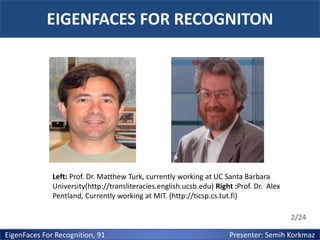
Left: Prof. Dr. Matthew Turk, currently working at UC Santa Barbara
University(http://transliteracies.english.ucsb.edu) Right :Prof. Dr. Alex
Pentland, Currently working at MIT. (http://ticsp.cs.tut.fi)
2/24

EigenFaces For Recognition, 91

Presenter: Semih Korkmaz
EIGENFACES FOR RECOGNITON
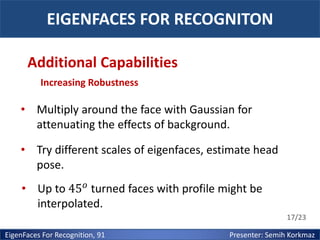
Contents

• Overview of the method
• Principal Component Analysis

• Recognition Process
• Acquiring Images
• Calculating EigenFaces
• Training the system

• Additional Capabilities

• Conclusion and Recent Work
EigenFaces For Recognition, 91

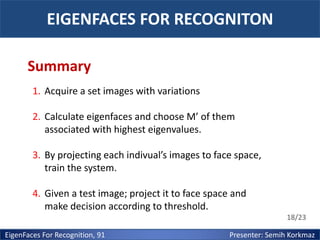
3/24

Presenter: Semih Korkmaz
EIGENFACES FOR RECOGNITON
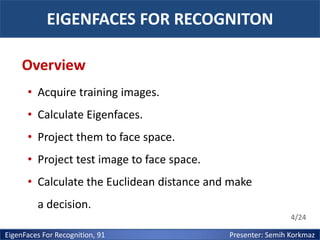
Overview
• Acquire training images.
• Calculate Eigenfaces.

• Project them to face space.
• Project test image to face space.

• Calculate the Euclidean distance and make
a decision.
4/24

EigenFaces For Recognition, 91

Presenter: Semih Korkmaz
EIGENFACES FOR RECOGNITON
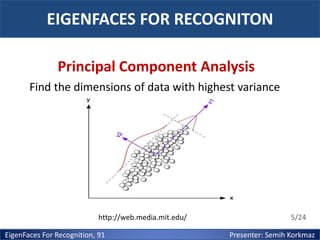
Principal Component Analysis
Find the dimensions of data with highest variance

http://web.media.mit.edu/

EigenFaces For Recognition, 91

5/24

Presenter: Semih Korkmaz
EIGENFACES FOR RECOGNITON
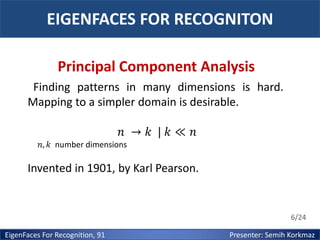
Principal Component Analysis
Finding patterns in many dimensions is hard.
Mapping to a simpler domain is desirable.
𝑛 → 𝑘 | 𝑘≪ 𝑛
𝑛, 𝑘 number dimensions

Invented in 1901, by Karl Pearson.

6/24

EigenFaces For Recognition, 91

Presenter: Semih Korkmaz
EIGENFACES FOR RECOGNITON
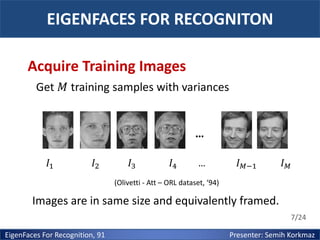
Acquire Training Images
Get 𝑀 training samples with variances

…
𝐼1

𝐼2

𝐼3

𝐼4

…

𝐼 𝑀−1

𝐼𝑀

(Olivetti - Att – ORL dataset, ‘94)

Images are in same size and equivalently framed.
7/24

EigenFaces For Recognition, 91

Presenter: Semih Korkmaz
EIGENFACES FOR RECOGNITON
Calculate EigenFaces
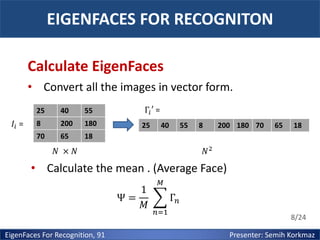
• Convert all the images in vector form.
25

55

8

200

180

70

𝐼𝑖 =

40
65

Γ𝑖 ′ =

18

25

40

55

8

200 180 70

65

18

𝑁2

𝑁 × 𝑁

• Calculate the mean . (Average Face)
1
Ψ=
𝑀
EigenFaces For Recognition, 91

𝑀

Γ𝑛
𝑛=1

8/24

Presenter: Semih Korkmaz
EIGENFACES FOR RECOGNITON
Calculate EigenFaces
• Normalize vectors.
Φ𝑖 = Γ 𝑖 − Ψ

• Form the covariance matrix
𝐴 = [Φ1 , Φ2 , . . , Φ 𝑚 ]
1
𝐶=
𝑀

𝑀
𝑇
Φ 𝑛 Φ 𝑛 = 𝐴𝐴 𝑇
𝑛=1

EigenFaces For Recognition, 91

9/24

Presenter: Semih Korkmaz
EIGENFACES FOR RECOGNITON
Calculate EigenFaces
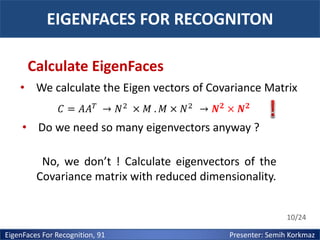
• We calculate the Eigen vectors of Covariance Matrix
𝐶 = 𝐴𝐴 𝑇 → 𝑁 2 × 𝑀 . 𝑀 × 𝑁 2 → 𝑵 𝟐 × 𝑵 𝟐

• Do we need so many eigenvectors anyway ?
No, we don’t ! Calculate eigenvectors of the
Covariance matrix with reduced dimensionality.
10/24

EigenFaces For Recognition, 91

Presenter: Semih Korkmaz
EIGENFACES FOR RECOGNITON
Calculate EigenFaces
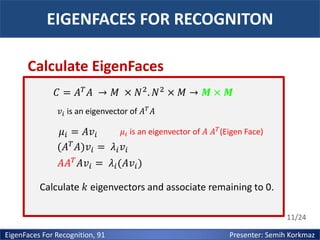
𝐶 = 𝐴 𝑇 𝐴 → 𝑀 × 𝑁2. 𝑁2 × 𝑀 → 𝑴 × 𝑴
𝑣 𝑖 is an eigenvector of 𝐴 𝑇 𝐴
𝜇 𝑖 is an eigenvector of 𝐴 𝐴 𝑇 (Eigen Face)
𝜇 𝑖 = 𝐴𝑣 𝑖
(𝐴 𝑇 𝐴)𝑣 𝑖 = 𝜆 𝑖 𝑣 𝑖

𝐴𝐴 𝑇 𝐴𝑣 𝑖 = 𝜆 𝑖 (𝐴𝑣 𝑖 )
Calculate 𝑘 eigenvectors and associate remaining to 0.
11/24

EigenFaces For Recognition, 91

Presenter: Semih Korkmaz
EIGENFACES FOR RECOGNITON
Training the system
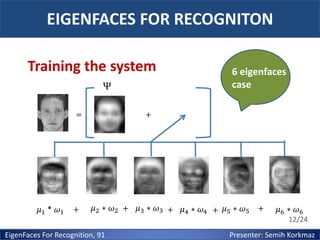
Ψ
=

𝜇1 * 𝜔1

+

6 eigenfaces
case

+

𝜇2 ∗ 𝜔2 +

𝜇3 ∗ 𝜔3 +

𝜇4 ∗ 𝜔4 + 𝜇5 ∗ 𝜔5 +

𝜇6 ∗ 𝜔6
12/24

EigenFaces For Recognition, 91

Presenter: Semih Korkmaz
EIGENFACES FOR RECOGNITON
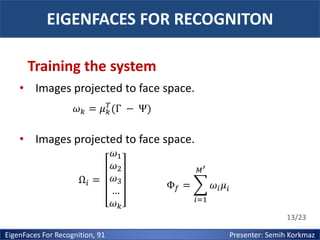
Training the system
• Images projected to face space.
𝜔 𝑘 = 𝜇 𝑘𝑇 (Γ − Ψ)

• Images projected to face space.
Ω𝑖 =

𝜔1
𝜔2
𝜔3
…
𝜔𝑘

𝑀′

Φ𝑓 =

𝜔𝑖 𝜇𝑖
𝑖=1

13/23

EigenFaces For Recognition, 91

Presenter: Semih Korkmaz
EIGENFACES FOR RECOGNITON
Training the system
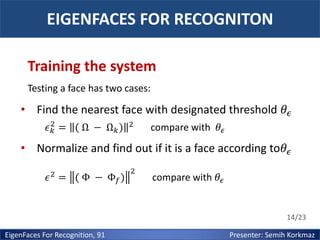
Testing a face has two cases:

• Find the nearest face with designated threshold 𝜃 𝜖
𝜖2 = ( Ω − Ω 𝑘)
𝑘

2

compare with 𝜃 𝜖

• Normalize and find out if it is a face according to𝜃 𝜖
2

𝜖 = ( Φ − Φ 𝑓)

2

compare with 𝜃 𝜖

14/23

EigenFaces For Recognition, 91

Presenter: Semih Korkmaz
EIGENFACES FOR RECOGNITON
Additional Capabilities
Detection and Tracking

• Check around every pixel for an image
• Try to classify faces using spatiotemporal filtering
for a video
• Both methods can be combined
15/23

EigenFaces For Recognition, 91

Presenter: Semih Korkmaz
EIGENFACES FOR RECOGNITON
Additional Capabilities
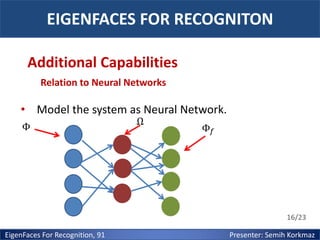
Relation to Neural Networks

• Model the system as Neural Network.
Φ

Ω

Φ𝑓

16/23

EigenFaces For Recognition, 91

Presenter: Semih Korkmaz
EIGENFACES FOR RECOGNITON
Additional Capabilities
Increasing Robustness

• Multiply around the face with Gaussian for
attenuating the effects of background.
• Try different scales of eigenfaces, estimate head
pose.

• Up to 45 𝜊 turned faces with profile might be
interpolated.
17/23

EigenFaces For Recognition, 91

Presenter: Semih Korkmaz
EIGENFACES FOR RECOGNITON
Summary
1. Acquire a set images with variations
2. Calculate eigenfaces and choose M’ of them
associated with highest eigenvalues.

3. By projecting each indivual’s images to face space,
train the system.
4. Given a test image; project it to face space and
make decision according to threshold.
18/23

EigenFaces For Recognition, 91

Presenter: Semih Korkmaz
EIGENFACES FOR RECOGNITON
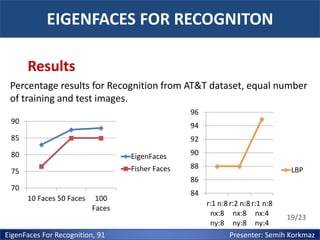
Results
Percentage results for Recognition from AT&T dataset, equal number
of training and test images.
96
90

94

85

92

80

EigenFaces

90

75

Fisher Faces

88

LBP

86
70
10 Faces 50 Faces

100
Faces

EigenFaces For Recognition, 91

84
r:1 n:8 r:2 n:8 r:1 n:8
nx:8 nx:8 nx:4
19/23
ny:8 ny:8 ny:4
Presenter: Semih Korkmaz
EIGENFACES FOR RECOGNITON
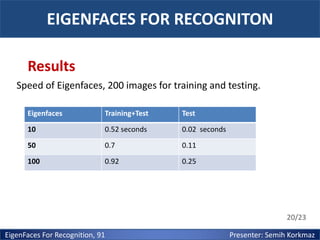
Results
Speed of Eigenfaces, 200 images for training and testing.
Eigenfaces

Training+Test

Test

10

0.52 seconds

0.02 seconds

50

0.7

0.11

100

0.92

0.25

20/23

EigenFaces For Recognition, 91

Presenter: Semih Korkmaz
EIGENFACES FOR RECOGNITON
Results

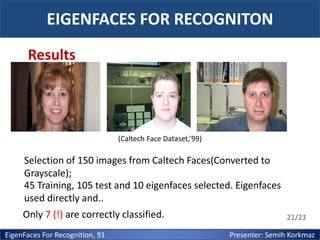
(Caltech Face Dataset,’99)

Selection of 150 images from Caltech Faces(Converted to
Grayscale);
45 Training, 105 test and 10 eigenfaces selected. Eigenfaces
used directly and..
Only 7 (!) are correctly classified.
EigenFaces For Recognition, 91

21/23

Presenter: Semih Korkmaz
EIGENFACES FOR RECOGNITON
References
[1]Matthew Turk and Alex Pentland. 1991. Eigenfaces for recognition. J.
Cognitive Neuroscience 3, 1 (January 1991), 71-86.
DOI=10.1162/jocn.1991.3.1.71 http://dx.doi.org/10.1162/jocn.1991.3.1.71
[2]L. Sirovich and M. Kirby, Low-dimensional Procedure for the
Characterization of Human Faces, Journal of the Optical Society of
America A, 4:519--524, 1987
[3]Belhumeur, P.N.; Hespanha, J.P.; Kriegman, D., "Eigenfaces vs.
Fisherfaces: recognition using class specific linear projection," Pattern
Analysis and Machine Intelligence, IEEE Transactions on , vol.19, no.7,
pp.711,720, Jul 1997 doi: 10.1109/34.598228
22/23

EigenFaces For Recognition, 91

Presenter: Semih Korkmaz
EIGENFACES FOR RECOGNITON
References
[4] Anil K. Jain and Stan Z. Li. 2005. Handbook of Face Recognition. SpringerVerlag New York, Inc., Secaucus, NJ, USA.

23/23

EigenFaces For Recognition, 91

Presenter: Semih Korkmaz
EIGENFACES FOR RECOGNITON

Thank you for listening
Questions ?

EigenFaces For Recognition, 91

Presenter: Semih Korkmaz

Eigenfaces

  • 1.
    EIGENFACES FOR RECOGNITON Paper:EigenFaces For Recognition, 1991 Authors: Matthew Turk and Alex Pentland Presenter: Semih Korkmaz 1/24 EigenFaces For Recognition, 91 Presenter: Semih Korkmaz
  • 2.
    EIGENFACES FOR RECOGNITON Left:Prof. Dr. Matthew Turk, currently working at UC Santa Barbara University(http://transliteracies.english.ucsb.edu) Right :Prof. Dr. Alex Pentland, Currently working at MIT. (http://ticsp.cs.tut.fi) 2/24 EigenFaces For Recognition, 91 Presenter: Semih Korkmaz
  • 3.
    EIGENFACES FOR RECOGNITON Contents •Overview of the method • Principal Component Analysis • Recognition Process • Acquiring Images • Calculating EigenFaces • Training the system • Additional Capabilities • Conclusion and Recent Work EigenFaces For Recognition, 91 3/24 Presenter: Semih Korkmaz
  • 4.
    EIGENFACES FOR RECOGNITON Overview •Acquire training images. • Calculate Eigenfaces. • Project them to face space. • Project test image to face space. • Calculate the Euclidean distance and make a decision. 4/24 EigenFaces For Recognition, 91 Presenter: Semih Korkmaz
  • 5.
    EIGENFACES FOR RECOGNITON PrincipalComponent Analysis Find the dimensions of data with highest variance http://web.media.mit.edu/ EigenFaces For Recognition, 91 5/24 Presenter: Semih Korkmaz
  • 6.
    EIGENFACES FOR RECOGNITON PrincipalComponent Analysis Finding patterns in many dimensions is hard. Mapping to a simpler domain is desirable. 𝑛 → 𝑘 | 𝑘≪ 𝑛 𝑛, 𝑘 number dimensions Invented in 1901, by Karl Pearson. 6/24 EigenFaces For Recognition, 91 Presenter: Semih Korkmaz
  • 7.
    EIGENFACES FOR RECOGNITON AcquireTraining Images Get 𝑀 training samples with variances … 𝐼1 𝐼2 𝐼3 𝐼4 … 𝐼 𝑀−1 𝐼𝑀 (Olivetti - Att – ORL dataset, ‘94) Images are in same size and equivalently framed. 7/24 EigenFaces For Recognition, 91 Presenter: Semih Korkmaz
  • 8.
    EIGENFACES FOR RECOGNITON CalculateEigenFaces • Convert all the images in vector form. 25 55 8 200 180 70 𝐼𝑖 = 40 65 Γ𝑖 ′ = 18 25 40 55 8 200 180 70 65 18 𝑁2 𝑁 × 𝑁 • Calculate the mean . (Average Face) 1 Ψ= 𝑀 EigenFaces For Recognition, 91 𝑀 Γ𝑛 𝑛=1 8/24 Presenter: Semih Korkmaz
  • 9.
    EIGENFACES FOR RECOGNITON CalculateEigenFaces • Normalize vectors. Φ𝑖 = Γ 𝑖 − Ψ • Form the covariance matrix 𝐴 = [Φ1 , Φ2 , . . , Φ 𝑚 ] 1 𝐶= 𝑀 𝑀 𝑇 Φ 𝑛 Φ 𝑛 = 𝐴𝐴 𝑇 𝑛=1 EigenFaces For Recognition, 91 9/24 Presenter: Semih Korkmaz
  • 10.
    EIGENFACES FOR RECOGNITON CalculateEigenFaces • We calculate the Eigen vectors of Covariance Matrix 𝐶 = 𝐴𝐴 𝑇 → 𝑁 2 × 𝑀 . 𝑀 × 𝑁 2 → 𝑵 𝟐 × 𝑵 𝟐 • Do we need so many eigenvectors anyway ? No, we don’t ! Calculate eigenvectors of the Covariance matrix with reduced dimensionality. 10/24 EigenFaces For Recognition, 91 Presenter: Semih Korkmaz
  • 11.
    EIGENFACES FOR RECOGNITON CalculateEigenFaces 𝐶 = 𝐴 𝑇 𝐴 → 𝑀 × 𝑁2. 𝑁2 × 𝑀 → 𝑴 × 𝑴 𝑣 𝑖 is an eigenvector of 𝐴 𝑇 𝐴 𝜇 𝑖 is an eigenvector of 𝐴 𝐴 𝑇 (Eigen Face) 𝜇 𝑖 = 𝐴𝑣 𝑖 (𝐴 𝑇 𝐴)𝑣 𝑖 = 𝜆 𝑖 𝑣 𝑖 𝐴𝐴 𝑇 𝐴𝑣 𝑖 = 𝜆 𝑖 (𝐴𝑣 𝑖 ) Calculate 𝑘 eigenvectors and associate remaining to 0. 11/24 EigenFaces For Recognition, 91 Presenter: Semih Korkmaz
  • 12.
    EIGENFACES FOR RECOGNITON Trainingthe system Ψ = 𝜇1 * 𝜔1 + 6 eigenfaces case + 𝜇2 ∗ 𝜔2 + 𝜇3 ∗ 𝜔3 + 𝜇4 ∗ 𝜔4 + 𝜇5 ∗ 𝜔5 + 𝜇6 ∗ 𝜔6 12/24 EigenFaces For Recognition, 91 Presenter: Semih Korkmaz
  • 13.
    EIGENFACES FOR RECOGNITON Trainingthe system • Images projected to face space. 𝜔 𝑘 = 𝜇 𝑘𝑇 (Γ − Ψ) • Images projected to face space. Ω𝑖 = 𝜔1 𝜔2 𝜔3 … 𝜔𝑘 𝑀′ Φ𝑓 = 𝜔𝑖 𝜇𝑖 𝑖=1 13/23 EigenFaces For Recognition, 91 Presenter: Semih Korkmaz
  • 14.
    EIGENFACES FOR RECOGNITON Trainingthe system Testing a face has two cases: • Find the nearest face with designated threshold 𝜃 𝜖 𝜖2 = ( Ω − Ω 𝑘) 𝑘 2 compare with 𝜃 𝜖 • Normalize and find out if it is a face according to𝜃 𝜖 2 𝜖 = ( Φ − Φ 𝑓) 2 compare with 𝜃 𝜖 14/23 EigenFaces For Recognition, 91 Presenter: Semih Korkmaz
  • 15.
    EIGENFACES FOR RECOGNITON AdditionalCapabilities Detection and Tracking • Check around every pixel for an image • Try to classify faces using spatiotemporal filtering for a video • Both methods can be combined 15/23 EigenFaces For Recognition, 91 Presenter: Semih Korkmaz
  • 16.
    EIGENFACES FOR RECOGNITON AdditionalCapabilities Relation to Neural Networks • Model the system as Neural Network. Φ Ω Φ𝑓 16/23 EigenFaces For Recognition, 91 Presenter: Semih Korkmaz
  • 17.
    EIGENFACES FOR RECOGNITON AdditionalCapabilities Increasing Robustness • Multiply around the face with Gaussian for attenuating the effects of background. • Try different scales of eigenfaces, estimate head pose. • Up to 45 𝜊 turned faces with profile might be interpolated. 17/23 EigenFaces For Recognition, 91 Presenter: Semih Korkmaz
  • 18.
    EIGENFACES FOR RECOGNITON Summary 1.Acquire a set images with variations 2. Calculate eigenfaces and choose M’ of them associated with highest eigenvalues. 3. By projecting each indivual’s images to face space, train the system. 4. Given a test image; project it to face space and make decision according to threshold. 18/23 EigenFaces For Recognition, 91 Presenter: Semih Korkmaz
  • 19.
    EIGENFACES FOR RECOGNITON Results Percentageresults for Recognition from AT&T dataset, equal number of training and test images. 96 90 94 85 92 80 EigenFaces 90 75 Fisher Faces 88 LBP 86 70 10 Faces 50 Faces 100 Faces EigenFaces For Recognition, 91 84 r:1 n:8 r:2 n:8 r:1 n:8 nx:8 nx:8 nx:4 19/23 ny:8 ny:8 ny:4 Presenter: Semih Korkmaz
  • 20.
    EIGENFACES FOR RECOGNITON Results Speedof Eigenfaces, 200 images for training and testing. Eigenfaces Training+Test Test 10 0.52 seconds 0.02 seconds 50 0.7 0.11 100 0.92 0.25 20/23 EigenFaces For Recognition, 91 Presenter: Semih Korkmaz
  • 21.
    EIGENFACES FOR RECOGNITON Results (CaltechFace Dataset,’99) Selection of 150 images from Caltech Faces(Converted to Grayscale); 45 Training, 105 test and 10 eigenfaces selected. Eigenfaces used directly and.. Only 7 (!) are correctly classified. EigenFaces For Recognition, 91 21/23 Presenter: Semih Korkmaz
  • 22.
    EIGENFACES FOR RECOGNITON References [1]MatthewTurk and Alex Pentland. 1991. Eigenfaces for recognition. J. Cognitive Neuroscience 3, 1 (January 1991), 71-86. DOI=10.1162/jocn.1991.3.1.71 http://dx.doi.org/10.1162/jocn.1991.3.1.71 [2]L. Sirovich and M. Kirby, Low-dimensional Procedure for the Characterization of Human Faces, Journal of the Optical Society of America A, 4:519--524, 1987 [3]Belhumeur, P.N.; Hespanha, J.P.; Kriegman, D., "Eigenfaces vs. Fisherfaces: recognition using class specific linear projection," Pattern Analysis and Machine Intelligence, IEEE Transactions on , vol.19, no.7, pp.711,720, Jul 1997 doi: 10.1109/34.598228 22/23 EigenFaces For Recognition, 91 Presenter: Semih Korkmaz
  • 23.
    EIGENFACES FOR RECOGNITON References [4]Anil K. Jain and Stan Z. Li. 2005. Handbook of Face Recognition. SpringerVerlag New York, Inc., Secaucus, NJ, USA. 23/23 EigenFaces For Recognition, 91 Presenter: Semih Korkmaz
  • 24.
    EIGENFACES FOR RECOGNITON Thankyou for listening Questions ? EigenFaces For Recognition, 91 Presenter: Semih Korkmaz